






Distribution Without Duplicate Vaults
The problem is familiar to anyone who has found a strategy on Ethereum while holding funds elsewhere. Access usually requires a bridge, destination-chain gas, another approval, and a separate deposit. Providers can deploy copies on more chains, but that splits liquidity and increases the number of configurations, governance actions, and operating processes they must maintain.
Chainlink's new adapters offer a different arrangement. Assets and instructions travel together to the home chain, where the adapter deposits into the existing vault. The strategy, accounting, and governance stay there. Cross-chain access changes how users reach the product rather than creating a separate strategy for each network.
Deposits and Shares Take Different Routes
After a successful deposit, users can receive their vault shares on the home chain or have them returned to the chain they started from. The second option requires the shares themselves to support cross-chain transfers. It could let a depositor hold a position alongside other assets on a preferred network, but using those shares as collateral still depends on another application's acceptance and liquidity.
The distinction limits the headline's scope. More than 80 supported chains does not mean every vault accepts every asset from every chain. Operators must enable the relevant routes and tokens. A simplified interface also does not make settlement instantaneous, and token approvals may still be required before sending a deposit.
Early Adopters Show Different Use Cases
Chainlink describes several applications in its launch announcement:
Lombard: Holders of BTC.b on Avalanche can reach its Ethereum-based Bitcoin Onchain Credit Strategy without manually bridging first.
Aave: Its sGHO expansion combines local GHO/sGHO swaps with adapter-based routing for larger transactions and liquidity rebalancing.
RockawayX: The curator is described as live with cross-chain access to its existing vault strategies.
Maple, Huma Finance, Veda, and other platforms are also named as adopters. That is not evidence that every listed integration is already live.
Vault Liquidity Spans Chains and Platforms

Chart 1 shows vault balances by the home chain. In the week ending October 4, Ethereum accounted for 42.0% and Base for 22.5% of $10.11B in tracked vault AUM. Source: Blockworks Intel.
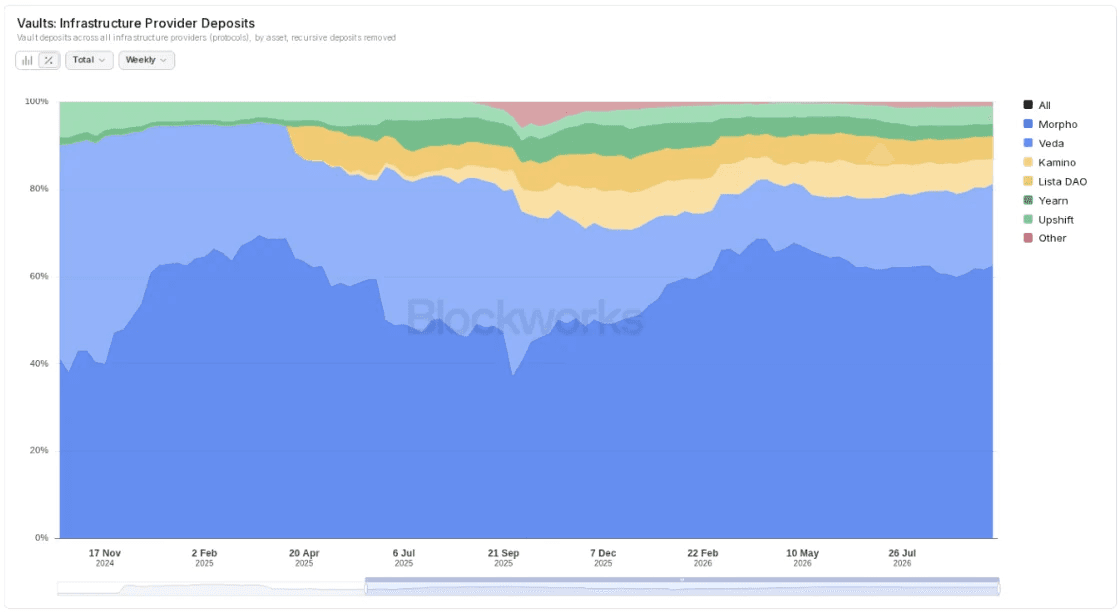
Chart 2 shows infrastructure providers' shares of tracked vault deposits. Morpho represented approximately 63% and Veda 19% in the same week. Source: Blockworks Intel, with recursive deposits removed.
The first chart illustrates why distribution cannot be reduced to one network. The second shows the platforms through which vault products already reach users, including Veda, an announced adapter adopter.