





Key Insights:
- Charles Hoskinson said the CLARITY Act could classify most new crypto tokens as securities by default under SEC oversight.
- The Senate talks halted as banks and crypto companies could not agree on stablecoin reward models by the March 1st deadline.
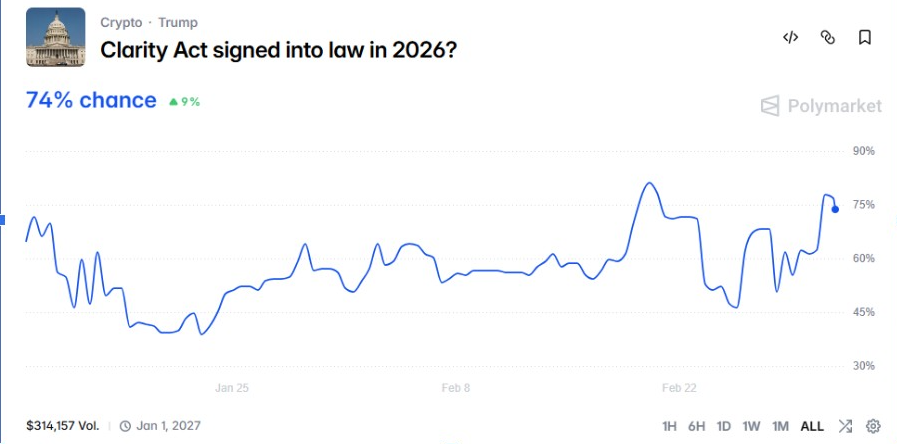
- Polymarket betting on CLARITY Act passage in 2026 changed sharply when Senate Banking Committee’s plans to mark up the bill were delayed.
As the Senate talks on the CLARITY Act with no outcome, Charles Hoskinson has further criticized the proposed bill. He warns that the bill could classify most new crypto tokens as securities by default. Senate discussions on the bill remain stalled as banks and crypto firms continue to disagree over stablecoin reward mechanisms.
Charles Hoskinson Criticizes CLARITY Act Bill
Charles Hoskinson stated during a recent livestream that the Clarity Act could classify most new digital tokens as securities by default. He said such a structure would expand the authority of the U.S. Securities and Exchange Commission over emerging blockchain projects. According to his remarks, this approach would subject new token issuers to securities registration requirements from inception.
Additionally, the Cardano founder added that established tokens such as XRP and ADA might avoid securities designation under the draft language. However, he maintained that newer projects could face automatic classification unless they meet narrow exemptions. So, he warns that this structure may create barriers for developers seeking to launch decentralized networks in the United States.

Likewise, Hoskinson stated that labeling assets as securities can limit liquidity pathways. He argued that restricted trading venues may reduce token distribution models. His comments were made as lawmakers continue reviewing the bill’s market structure provisions.
Senate Talks Stall Over Stablecoin Rewards
Senate discussions remain ongoing as banking groups and crypto firms disagree on stablecoin reward mechanisms. The White House had set a March 1 deadline for both sides to reach common ground. It has not yet decided on any formal compromise.
Rewards, staking programs, or membership benefits have been the subject of negotiations, whether or not stablecoin balances have yielded returns. Banking officials have been complaining that these kinds of models are like interest-bearing deposits. Cryptocurrency companies have also sought the flexibility to design incentive schemes within regulatory boundaries.
The Senate Banking Committee is considering a new markup window in mid-to-late March. Lawmakers are reviewing draft text tied to stablecoin oversight and decentralized finance provisions.
The Office of the Comptroller of the Currency has also proposed rulemaking tied to digital asset activities. Industry participants are monitoring how these regulatory proposals may align with legislative text. Meanwhile, Senate Agriculture Committee discussions on related crypto oversight have moved forward separately.
DeFi Provisions and Industry Response
Additionally, Charles Hoskinson has raised concerns about the absence of clear provisions for decentralized finance platforms. He referenced protocols such as Uniswap and said the current draft does not provide defined compliance pathways for similar systems. Hence, he also noted that prediction markets were not addressed in detail.
According to Hoskinson, the lack of direct statutory language may leave decentralized protocols subject to enforcement-based interpretation. He stated that new crypto projects would carry regulatory obligations from launch if securities classification applies by default.
Other industry leaders have taken a different position. Previously, the Cardano founder Charles Hoskinson criticized Brad Garlinghouse, CEO of Ripple Labs, for backing the Crypto-Asset Market Structure and Investor Protection Bill, commonly known as the CLARITY Act. He argued that the industry has capitulated to the Trump administration and urged the crypto community to reject the bill in its current form.
Polymarket Signals and Legislative Outlook
Odds related to the CLARITY Act’s passage in 2026 shifted sharply before stabilizing, on Polymarket. Analysts gave reports that stablecoin discussions were facing delays. Polymarket data on whether the Clarity Act, signed into law in 2026, is currently at 74% probability, up 9% from 65%.
The White House has facilitated meetings between banking institutions and crypto stakeholders in recent weeks. Officials have not released a revised deadline for agreement. Stakeholders involved in the talks have said discussions are ongoing despite the missed March target. Observers expect additional draft revisions before any floor vote is scheduled.
At the time of writing, Cardano (ADA) was trading at $0.2646, down 2.16% over the past 24 hours, while XRP was trading at $1.35.
The post Cardano’s Charles Hoskinson Blasts CLARITY Act as Senate Crypto Talks Face Delay appeared first on The Market Periodical.