





At the Argentina DevConnect in November 2025, Ethereum Foundation researcher Justin Drake demonstrated an alternative block validation process. His validation node used the zkLighthouse client and determined the validity of a block solely by relying on zero-knowledge proofs generated by external protocols such as Brevis's Pico zkVM. This strongly suggests the future scalability direction for Ethereum. It proves one key point: blockchains do not need to re-execute all computations; they can simply verify proofs generated externally.
What is Brevis: A verifiable computation layer used by protocols and Ethereum core
Brevis is not merely a specific application, but rather a verifiable computation layer. As an Infinite Compute Layer, it enables complex computations to be executed off-chain and then returns the results to the on-chain environment through zero-knowledge proofs, allowing smart contracts to verify them at extremely low cost. This is important because Ethereum's default security model fundamentally relies on recomputation across the entire network. After receiving a new block, each validating node typically has to re-execute the transactions in the block to confirm that the execution results are indeed correct. While this ensures correctness, it also means that computational power and resource consumption will continuously increase as the workload grows. Brevis is transforming this process by converting the heavy, repetitive computations that must be done by all nodes into a single computation and network-wide verification. It performs the computation off-chain and generates a proof, which only needs to be verified by the on-chain system and nodes, requiring just a very small proof.
Unlike many other zk applications that focus solely on privacy or scalability, Brevis is addressing structural issues in the Web3 industry. As on-chain computations become increasingly complex and frequent, is it necessary for every node to redundantly execute them to maintain trust? Brevis' approach is to move the computation off-chain, where it is executed by a zkVM and a proof is generated. On-chain smart contracts then only need to verify the proof, enabling them to trustfully utilize historical data, cross-chain states, or results of complex algorithms without introducing additional trust assumptions. In the process of achieving this goal, the ZK Data Coprocessor, Pico zkVM, and ProverNet form Brevis' three core technologies at present.
Breaking Boundaries with Smart Contracts: Superpowers Brought by the ZK Data Coprocessor
Brevis's initial technical breakthrough was the ZK Data Coprocessor. It enables smart contracts to query arbitrary on-chain historical data, perform off-chain computations, and generate zero-knowledge proofs, which provide the computation results as trusted inputs to the contracts. The ZK Data Coprocessor can query and compute on-chain historical trading volumes or user behaviors, and generate zero-knowledge proofs for contract verification. This allows contracts, which previously could only access the current block, to now utilize data across long time windows and cross-chain states.
After developing the Coprocessor prototype in 2023, Brevis continued to iterate and, by January 2025, launched version 2 and went live on the mainnet. The key improvements in v2—without getting bogged down by the specific names of the proof systems—can be abstractly summarized into three points: faster (completing the same tasks with fewer resources and in less time), more general (supporting a wider range of data types and computational needs), and more user-friendly (simplifying the process and encapsulating complexity).
Looking back at Brevis's technical roadmap before 2025, there is actually one main thread: first, to fully understand the performance limits of the proof system; then, to build an off-chain computation and on-chain verification system as a usable co-processor and continuously iterate on its engineering; and finally, to explore more systematic operational models.More importantly, it highlights the team's core strengths: they have expertise in both cryptography and large-scale system engineering. They don't rely on theoretical derivations alone; instead, they identified industry pain points from the project's early stages and are committed to achieving widespread adoption of the technology.
When Proof Capabilities Enter the System Layer: Pico zkVM and ProverNet
In 2025, Brevis completed the other two components of its "three-horse strategy." One is Pico zkVM, a more general-purpose and production-ready proof execution engine. The other is ProverNet, which opens up the proof generation capability as a service, enabling continuous and scalable supply of proofs, moving from the ability to prove to the ability to consistently and at scale provide proofs.
Pico zkVM can be understood as a general-purpose proving engine for Brevis. It advances zero-knowledge proofs from specialized circuits and manual adaptation toward a more software engineering-like approach—developers can write logic using familiar development methods, and the underlying system automatically converts it into verifiable proof results. More importantly, Pico was designed from the beginning with a focus on real-world throughput and cost efficiency. Under the same benchmark, Brevis' comparisons show that Pico has a clear performance advantage among mainstream zkVMs. Additionally, Pico can achieve even higher efficiency for specific types of computation through its pluggable components and co-processor architecture.
In June 2025, Brevis launched Pico-GPU, pushing real-time proof generation speed to a critical inflection point, not just for the protocol, but for the entire industry.Pico-GPU systematically moves the core process of proof generation onto GPU parallel computing. The official performance improvement reaches 10–20 times, representing a qualitative leap compared to previous solutions.
The Pico Prism, released in October, pushes this direction to a highly intuitive threshold. With a configuration of 64 consumer-grade GPUs, it achieves 99.6% of Ethereum 45M gas blocks being proven within 12 seconds, and 96.8% within 10 seconds, with an average proof time of approximately 6.9 seconds—nearly reaching the Ethereum Foundation's target.The real-time proof generation speed has for the first time almost perfectly matched Ethereum's block production speed, and compared to competing products, it uses fewer resources.
Such progress has also been directly acknowledged by the Ethereum core community. Vitalik directly mentioned in a tweet that Pico Prism's entry into the ZK-EVM proof race is an important step forward in proving speed and diversity. Justin Drake previously praised the real-time proof progress of Pico Prism as extraordinary in a clear tone in his tweets. It is worth noting that in May of this year, SP1 Hypercube required 160 RTX 4090 GPUs to prove approximately 94% of L1 blocks in 12 seconds. This dramatic lead in real-time proof speed has made Brevis's Pico Prism the most prominent solution in the spotlight.
After successfully developing a general-purpose zkVM and real-time proving technology, Brevis began addressing the issue of proof supply. In November 2025, Brevis announced the ProverNet vision, aiming to bring proof capabilities to a market model. In this model, any application can submit proof tasks, which are then matched with prover nodes through an auction mechanism. The mainnet Beta launched in December further materialized this vision into a usable product. The market continuously operates, allowing direct submission of proof requests. Provers can register and start bidding for tasks, eliminating the need for applications to build their own proof infrastructure.
With the "three-horse carriage" approach, Brevis transforms proof generation from a tool into infrastructure, offering both a scalable proof engine and an open proof supply network, enabling applications to access verifiable computation on demand. Its significance extends beyond Ethereum—this paradigm of off-chain computation and on-chain verification will spill over into the entire Web3 ecosystem, and even into other industries such as AI and gaming.
The protocol doesn't lie: what counts is how it works.
Brevis's technical value is ultimately reflected in real-world applications. It is not just a concept showcased in promotional materials, but a solution embedded in the daily operations of protocols—how data is retrieved, how metrics are calculated, how rewards are distributed, and how fees are adjusted. These tasks, which were previously either impossible or could only be accomplished through centralized scripts, are now beginning to follow a more protocol-driven path. In this process, Brevis has already generated over 280 million proofs for users, distributed more than $230 million in rewards, and securely driven a $2.5 billion increase in TVL.
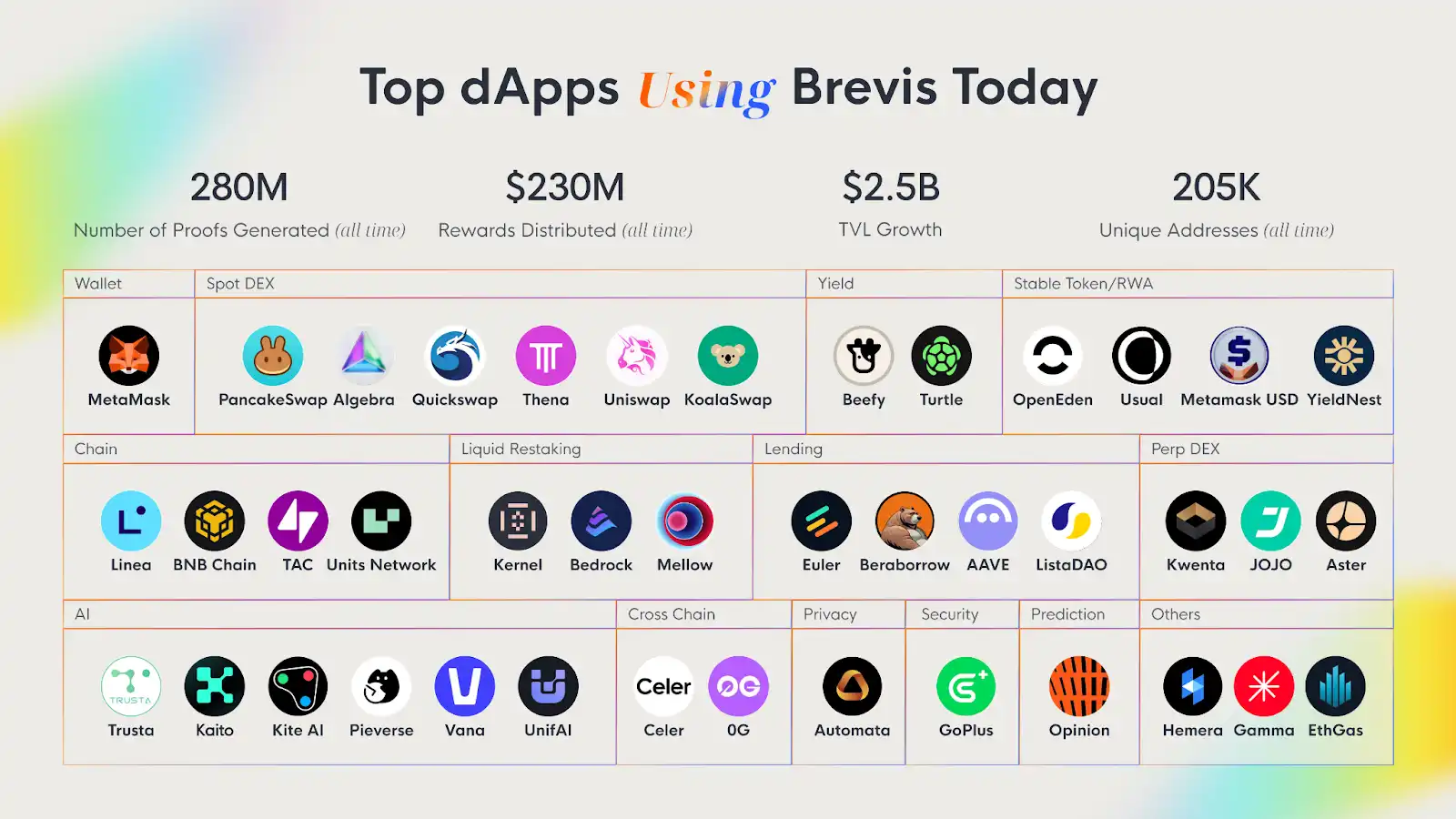
The most intuitive way to understand Brevis is to start with what users are most familiar with: trading. Brevis enables DEXs to have CEX-like functionalities while ensuring data privacy and authenticity, thereby improving the trading experience for DEX users. PancakeSwap Infinity uses hooks to make tiered trading fees possible, where historical behaviors such as token holdings and trading volumes can influence the fee rate for a specific transaction. However, these judgments rely on historical data aggregation. Storing this data on-chain is too expensive, while storing it off-chain introduces trust issues. What Brevis does is to calculate historical behaviors off-chain, and then use cryptographic proofs to bring the data back on-chain. This allows differentiated fee rates to be written into smart contracts, rather than being hardcoded in backend scripts like in CEXs.
If PancakeSwap represents a more CEX-like personalized experience, Usual demonstrates a more long-term growth mechanism, transforming one-time airdrops into a continuously operating CPI (Compound Participation Incentive). Rewards are tied to long-term behaviors such as holding assets and interacting with the protocol. Brevis makes these metrics verifiable inputs, enabling automated and auditable distribution, eliminating the need for the community to trust a centralized spreadsheet or centralized distributor. Through Incentra, reward issuance becomes a standardized capability. When a protocol wants to issue LP, lending, or holding rewards, the core process involves calculating metrics off-chain and settling rewards on-chain based on the proof. Euler's campaign on Arbitrum is a representative example—rewards are not manually calculated or distributed via multisignature, but instead are continuously allocated based on predefined rules and verifiable proofs.
When the scenario expands to the ecosystem level, Linea's Ignition Program illustrates the issue more clearly. The challenge is not merely distributing incentives, but rather how to do it effectively. Brevis enables large-scale incentive computations to be performed off-chain and brings the trustworthiness back on-chain for verification, transforming incentives from a centralized operational task into a reusable system capability. Similarly, Uniswap v4's Routing Rebate Program is also system-oriented. Whether a routing event occurs, how gas consumption is tracked, and how rebate amounts are calculated all form a data-computation-settlement chain. Here, Brevis handles the off-chain computation and proof generation, allowing the rebate system to be based on rules and verification, rather than relying on trust in a particular data provider.
By examining these cases collectively, Brevis's data acquisition, metric computation, and proof generation enable protocols to bring more logic—previously only feasible through centralized backends—back on-chain, without compromising decentralization. As a result, protocols across the entire crypto industry can accomplish more, and the design space is thus reopened.
Who is supporting long-termism technology?
The core team of Brevis is composed of researchers with backgrounds from top-tier universities and experienced system engineers working on the front lines. Their characteristics are very distinct: they are capable of long-term research and breakthroughs in proof systems and algorithmic levels, and they can also compress complex technologies into real production environments for repeated refinement until performance, stability, and cost all meet the standards for scalable deployment. More importantly, they are not just a technical team from a lab—they are also well-versed in how the crypto industry operates. They understand the real needs of protocol teams and the pacing of ecosystem collaboration, and they have long-term experience and connections in capital and community building. This enables them to translate engineering roadmaps into ongoing partnerships and developer momentum that lead to tangible results.
This is evident from the long-term support provided by both capital and the community for Brevis. In November 2024, Brevis successfully completed its seed round of financing, led by top-tier institutions such as Polychain and Yzi Labs, providing the necessary funding to continue advancing its zkVM, proof network, and product implementation. At the same time, Brevis's community experienced significant growth in 2025, with the Proving Grounds, role system, and task mechanisms attracting ongoing participation from developers and users. Combined with Vitalik's public endorsement and Ethereum Foundation's Justin Drake's attention to related progress in experiments and discussions, these factors together form external validation and trust capital for Brevis as it continues to expand as an infrastructure project.
From Ethereum to the Wider World
Ethereum's scalability has long been stuck in a structural dilemma: either all nodes redundantly perform computations to ensure security and trustlessness, but throughput and cost are constrained by the need for full network recomputation; or computations are outsourced to improve efficiency, but this requires placing additional trust in the external computing party. Brevis aims to offer a third path: performing complex computations off-chain and then using proofs to bring trustworthiness back on-chain for verification, thereby shifting the system from redundant computation to a division of labor based on result verification. Its value, therefore, lies not in any single product feature, but in establishing an entire end-to-end verifiable computation pipeline.
Brevis is not the only solution to Ethereum's scalability problem, but it demonstrates the significant value of a verifiable computation layer, decoupling computation from validation, ensuring security and decentralization while alleviating the pressure of on-chain execution. More importantly, the power of an infinite computation layer is not limited to Ethereum. For the entire crypto industry, it means that more on-chain applications can achieve complexity and user experiences close to Web2 without compromising security. When we look at the broader traditional world, the verifiable computation model of "compute first, verify later" also provides a new way of collaboration: when multiple parties need to share results but cannot share trust, proofs can become a new universal language. As open proof networks like ProverNet mature, what Brevis builds will not just be an enhancement for a single chain, but a trusted computation infrastructure that can be called across ecosystems and industries.
Click to learn about BlockBeats' job openings.
Welcome to join the official Lulin BlockBeats community:
Telegram Subscription Group:https://t.me/theblockbeats
Telegram discussion group:https://t.me/BlockBeats_App
Official Twitter account:https://twitter.com/BlockBeatsAsia