


Bittensor subnets are specialized digital-commodity markets inside the Bittensor network. Each subnet defines a task, rewards miners that produce the requested output, and relies on validators to score that work before the protocol distributes emissions. Targon SN4 provides confidential compute, Chutes SN64 deploys GPU applications, iota SN9 coordinates distributed model training, and Data Universe SN13 collects social data.
The subnet number alone reveals almost nothing about product quality. A useful review must connect the task to the scoring rule, the scoring rule to miner rewards, and the rewarded output to an external user. Alpha-token demand and emissions can support that market, but neither proves that the underlying service has paying customers.
The base Bittensor network provides shared coordination and token economics, while each subnet decides what participants should produce and how performance should be measured. That separation allows an inference network to reward latency and model quality without forcing a data-collection subnet to use the same benchmark. It is the reason Bittensor resembles a portfolio of specialized markets rather than one decentralized chatbot.
A subnet is not a separate blockchain and it is not simply a token listed beneath TAO. It is an operating environment built around a particular commodity, such as GPU compute, model responses, training progress, fresh data, forecasts, security testing, or agent trajectories. The Bittensor subnet directory shows how widely those tasks now vary, while AiCryptoCore’s decentralized AI project analysis places the model beside networks that coordinate compute, data, and inference in different ways.
| Component | Role inside the subnet | Evidence visible to a researcher |
|---|---|---|
| Subnet owner | Defines the task and incentive mechanism | Product description, scoring design, ownership and parameter changes |
| Miner | Produces the commodity or service | Returned output, available capacity, latency, freshness or benchmark result |
| Validator | Tests miners and submits weights | Validator count, scoring method, weight behavior and concentration |
| Metagraph | Records the subnet’s participants and relationships at a block | UIDs, hotkeys, stake, incentives, trust, dividends and weights |
| dTAO market | Prices the subnet’s alpha token against TAO | Pool depth, price, volume, stake and emission share |
Most of the useful work happens offchain. Bittensor records who participated, how validators scored miners and how rewards are distributed.
- Request: Validators send the task defined by the subnet owner, such as an inference request, hardware check or data-collection job.
- Output: Miners use their own models, hardware or datasets to return the requested result.
- Evaluation: Validators test that result using the subnet’s scoring rules and submit weights for the miners they evaluated.
- Consensus: Yuma Consensus combines validator weights while accounting for stake and agreement.
- Reward: The chain records miner incentives and validator dividends based on the resulting consensus.
The scoring test changes with the product. Targon checks hardware and execution attestations, while Data Universe samples records for authenticity and freshness. A high miner incentive therefore means the miner performed well under that subnet’s rule; it does not prove that an outside customer purchased the output.
| Participant | What they do | What determines the outcome | Main risk |
|---|---|---|---|
| Miner | Produces the subnet’s model output, compute, data or service | Quality score, uptime, operating cost, UID rank and subnet emissions | Registration and hardware costs can exceed rewards |
| Validator | Tests miners and submits weights | Scoring accuracy, validator trust, stake and agreement with consensus | Weak evaluation or low trust reduces influence and dividends |
| Subnet owner | Defines the task and incentive mechanism | Product usefulness, scoring design and ability to attract miners and validators | Poor rules reward the wrong behavior |
| Staker | Allocates TAO to a subnet and receives alpha exposure | Pool pricing, alpha demand, emissions and validator economics | Token returns can diverge from product demand |
The workload can be much heavier than a token dashboard suggests. In a dated Bittensor mining discussion, an operator described spending roughly seven hours a day during the first months and paying both GPU and registration costs.
The same operator reported going about three months without profit while learning the system. This single account is not a representative cost estimate, but it shows why prospective miners need a subnet-specific operating budget and performance test rather than an APY screenshot.
Miner profit, validator dividends and staker returns measure different activities. Combining them into one headline yield hides who performed work, who evaluated it and who only accepted token-market exposure.
Every active neuron has a UID and hotkey. The metagraph combines those identities with the subnet’s stake, weights, incentives, trust and dividends at a specific block.
The metagraph can show:
- Whether the subnet is full and how many UID slots are active.
- Which miners receive meaningful incentives.
- Which validators have the greatest weight and trust.
- Whether rewards and influence are concentrated among a small group.
The metagraph cannot show:
- Revenue paid by customers outside Bittensor.
- Whether an API request produced a useful result.
- Delivered compute, retained users or repeat integrations.
- Whether token demand comes from product use or market speculation.
Concentrated validator weights mean fewer actors influence miner rewards, while concentrated incentives mean a small group captures most emissions. A 2025 empirical analysis of Bittensor found substantial concentration in stake and rewards, so a large participant count does not establish decentralization.
A credible subnet review needs both layers: metagraph data for internal competition and customer evidence for external demand. That distinction also applies across the broader AI infrastructure crypto market.
The examples below are not a ranking. They were selected because each makes the miner-validator relationship visible through a different product: confidential compute, serverless inference, distributed model training and social-data collection. Names, netuids and market metrics were checked on August 24, 2026; subnet assignments and economics can change.
| Subnet | Product delivered | Miner contribution | Validator focus |
|---|---|---|---|
| Targon, SN4 | Confidential AI compute | Attested GPU capacity and execution | Hardware integrity and eligible capacity |
| Chutes, SN64 | Serverless GPU application deployment | GPU instances serving containerized workloads | Hardware validity, availability and service delivery |
| iota, SN9 | Distributed model pretraining | Coordinated training work across GPUs | Reproducible progress and valid contribution |
| Data Universe, SN13 | Fresh social-media datasets | Scraped and stored records | Authenticity, freshness, uniqueness and desirability |
Targon turns hardware attestation into a compute product
Targon focuses on confidential compute rather than generic GPU rental. According to its public subnet profile, miners operate eligible hardware and execution environments while validators verify attestation claims before that capacity can receive work and rewards. Its auction-based mechanism links emissions to available GPU capacity and target pricing, making the miner’s job more concrete than “provide AI compute.”
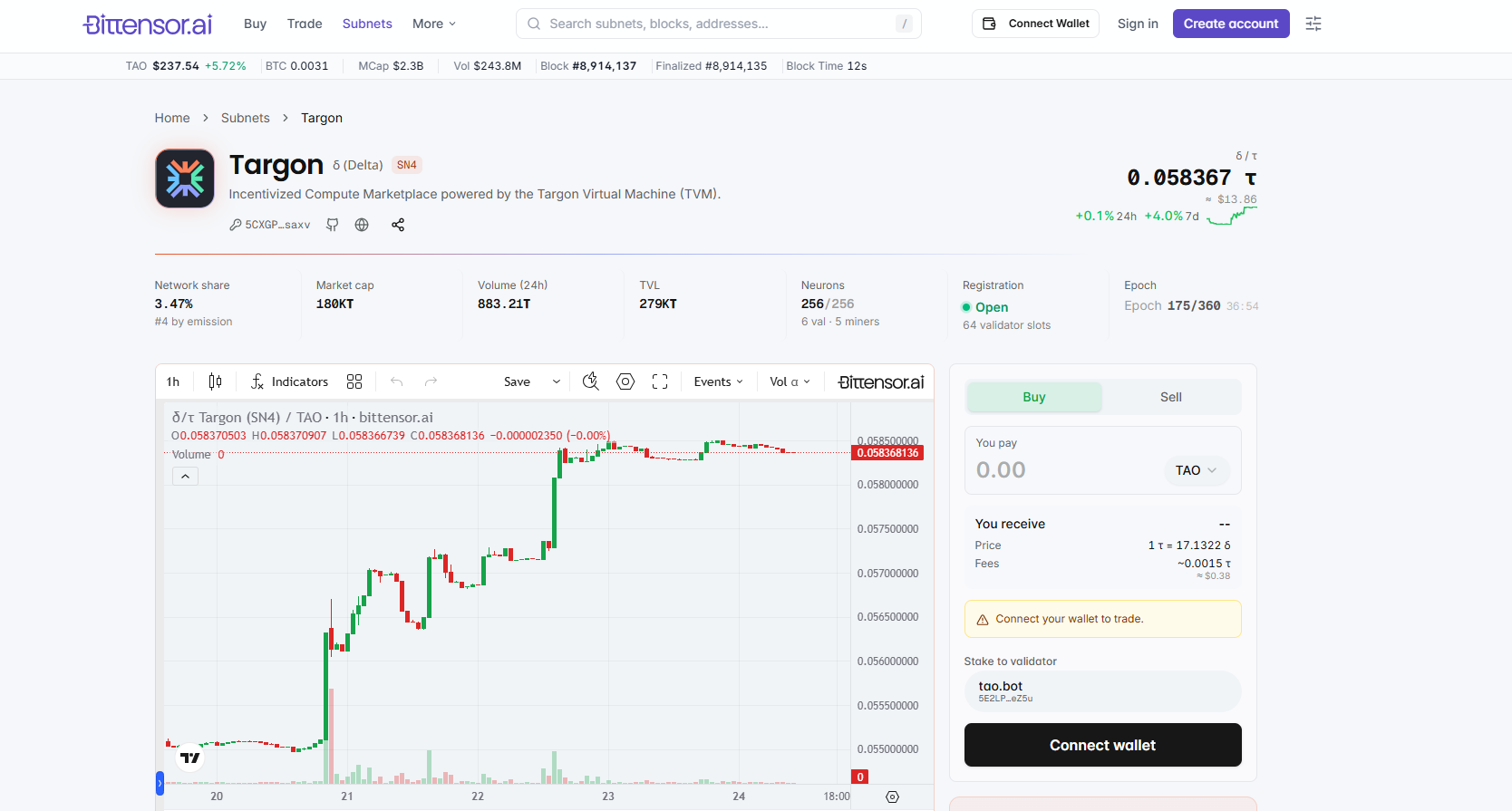
Targon’s public subnet profile documents attested hardware, auction parameters, and eligible capacity. It does not disclose independently verified workload volume, delivered customer cost, or retention. Those missing product measurements place Targon beside the decentralized GPU network comparison, where delivered workloads matter more than listed hardware.
Chutes packages miner GPUs as deployable applications
Chutes exposes a more application-facing proposition. Its SN64 profile describes containerized GPU applications that can scale across independently operated capacity, allowing developers to deploy inference workloads without managing a fixed cluster. Miners supply the hardware that runs those applications; the platform handles deployment, routing and usage-based operation.
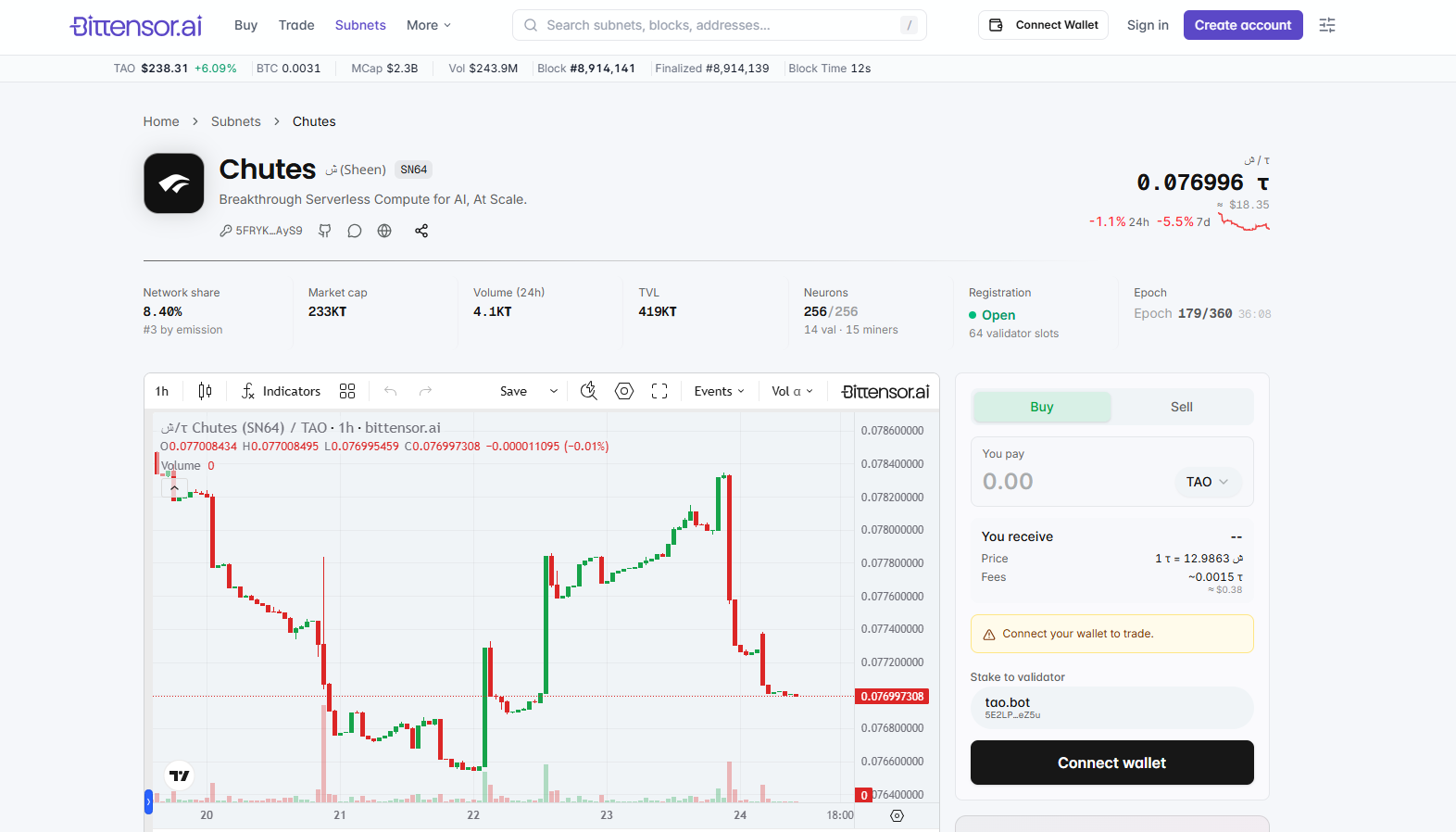
Chutes’ public profile documents its deployment model, GPU runtime billing, and automatic scaling. It does not provide an independently verified record of successful requests, cold-start performance, uptime, or delivered latency. Those are the same service measurements used in AiCryptoCore’s decentralized inference network guide, and alpha price does not replace them.
iota coordinates pretraining across unreliable GPUs
iota, identified as SN9 in its public subnet surface, focuses on pipeline-parallel model training across distributed GPU operators. That task differs sharply from serving one inference request. A useful result is sustained training progress that survives node variability and produces a reproducible model checkpoint, not merely a large inventory of registered hardware.
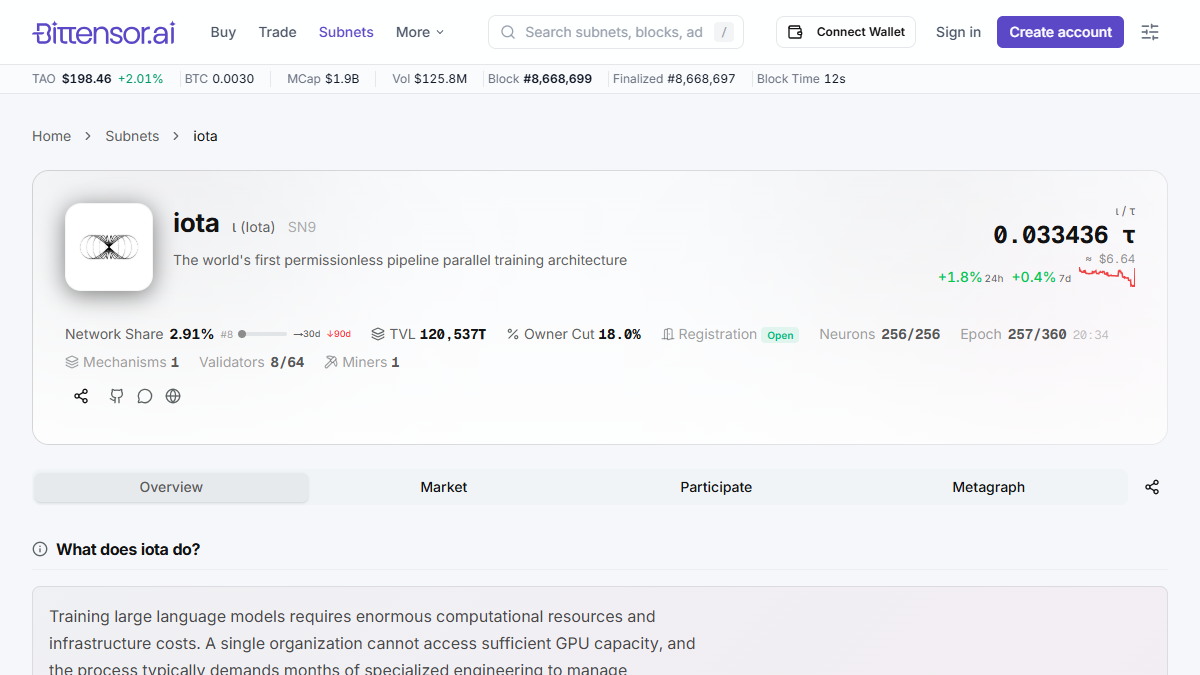
iota validators measure training contribution rather than hardware registration alone. The public subnet surface identifies the distributed training architecture, but it does not establish current checkpoint quality, fault-recovery performance, or final model capability. Completed training artifacts and reproducible evaluations establish whether the coordinated run produced a usable model.
Data Universe rewards fresh and verifiable records
Data Universe, SN13, shows that Bittensor miners do not always need GPUs. Its public subnet profile describes miners collecting social-media data while validators sample records and evaluate freshness, uniqueness, desirability and credibility. This gives the subnet a measurable commodity: records that satisfy declared quality rules.
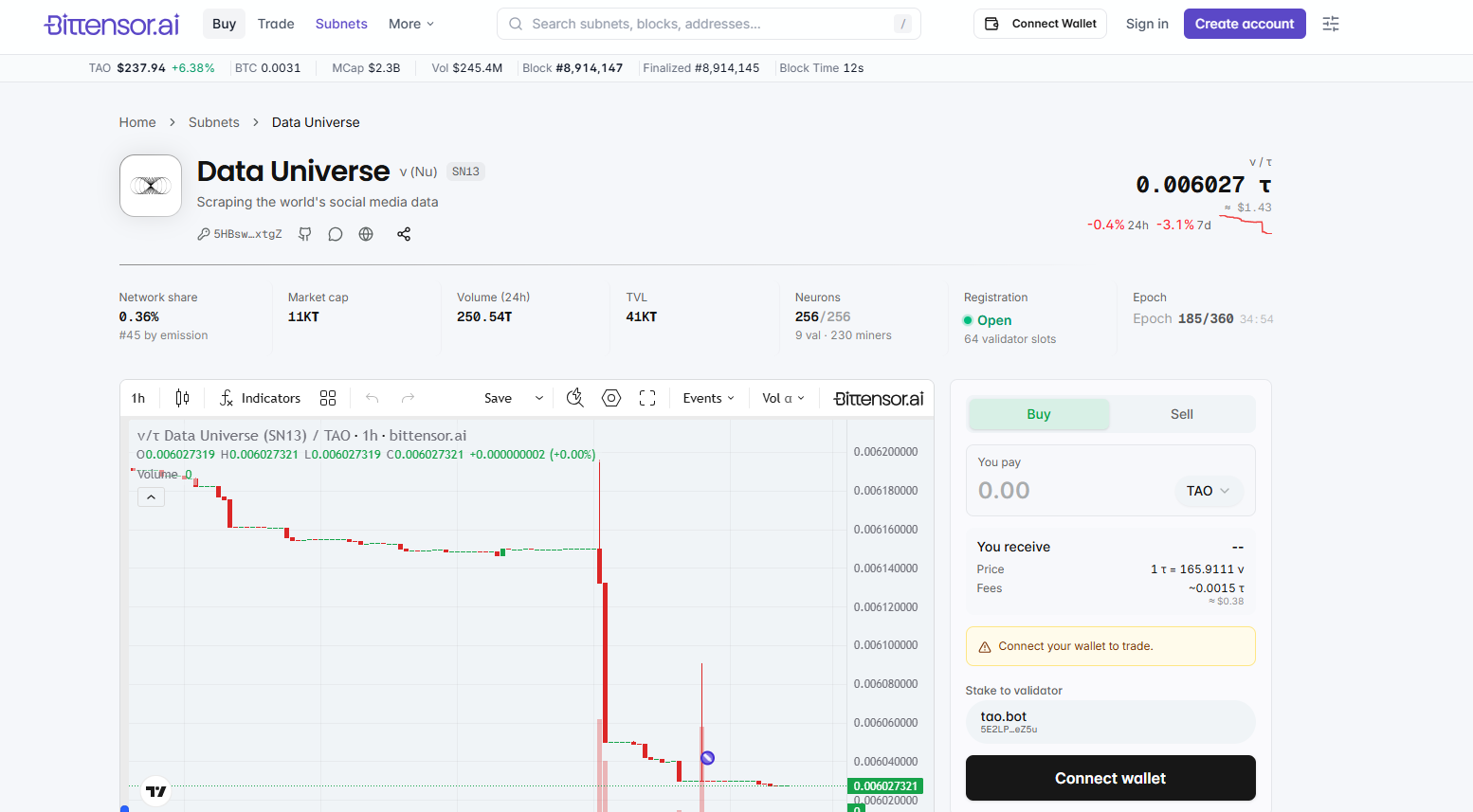
Data Universe validators establish whether submitted records satisfy the subnet’s authenticity, freshness, uniqueness, and desirability rules. The public subnet profile does not disclose independently verified customer retention, delivered dataset cost, or measured improvements to an external model. Protocol-valid data and buyer-valued data therefore remain separate evidence layers.
Dynamic TAO gives each subnet an alpha token and a pool pairing alpha with TAO. Staking TAO into a subnet returns alpha; exiting reverses the trade through the pool. The market price that emerges helps determine how emissions are directed across subnets, replacing a system that depended more heavily on a limited validator set. The dTAO whitepaper frames this as market-driven valuation of subnet commodities.
This makes Bittensor a market of markets and creates a reflexive link between alpha-token demand, stake allocation, and emissions. Alpha-price movement records activity in the subnet market; it does not establish customer demand for the underlying product. Pool depth and slippage determine the executable value of an alpha position rather than the displayed spot price alone.
The cleanest analysis separates three signals. Product demand records requests, customers and paid usage. Protocol performance records miner output, validator scoring and reliability. Market demand records alpha price, liquidity, stake and emissions. A subnet is strongest when all three improve together; one layer should not be used as a substitute for the other two.
A Bittensor subnet is useful when its incentive mechanism consistently turns miner competition into a digital commodity that someone wants. Targon, Chutes, iota and Data Universe demonstrate why no single “AI subnet” template is adequate: they ask participants to prove hardware, serve applications, advance training or supply verifiable data.
Emissions finance that competition and dTAO prices market interest, but the durable signal appears after the reward is earned. The output must survive an independent product test, and external users must have a reason to return. Reading Bittensor from task to score to product demand produces a much clearer picture than starting with the subnet leaderboard.
What is a Bittensor subnet?
A Bittensor subnet is a specialized market inside Bittensor where miners produce a defined digital commodity and validators score their performance. The task, evaluation method and incentive mechanism are specific to that subnet.
What is the difference between TAO and a subnet alpha token?
TAO is the shared network asset. An alpha token belongs to one subnet’s dTAO pool and reflects market activity around that subnet. The subnet’s moving alpha price contributes to its emission allocation; it does not establish product revenue or quality.
Do all Bittensor miners run AI models on GPUs?
No. Hardware requirements follow the subnet task. Targon, Chutes, and iota depend on GPU capacity for compute or training, while Data Universe rewards data collection and verification without requiring a GPU from its miners.
Is the subnet with the highest emissions the best one?
No. High emissions indicate strong protocol allocation and market support at a dated snapshot. A complete assessment also needs miner output quality, validator concentration, external usage, pool liquidity, operating cost and evidence that customers value the service.
Disclaimer:
The information provided on AiCryptoCore.com is for educational and informational purposes only and does not constitute financial, investment, or trading advice. Cryptocurrency investments involve risk and may result in financial loss. Always conduct your own research and consult with a qualified financial advisor before making any investment decisions.