



Bitcoin’s price is not the only part of the overall BTC ecosystem that has struggled in the past several months. One of the key components of the Bitcoin network, the mining difficulty adjustment, has just declined to a monthly low.
In the meantime, the hash rate has dropped by approximately 20% in less than a month, showing that miners have been shutting down machines.
Mining Difficulty Declines
Upon creating the world’s largest blockchain network, Satoshi Nakamoto incorporated an important self-adjusting mechanism that ensures the bitcoin mining speeds remain the same (~10 minutes), no matter how many miners are on board. It adjusts at every 2,016 blocks (roughly two weeks) and, if the number of miners increases, it goes up; vice versa. This process makes the new BTC issuance predictable.
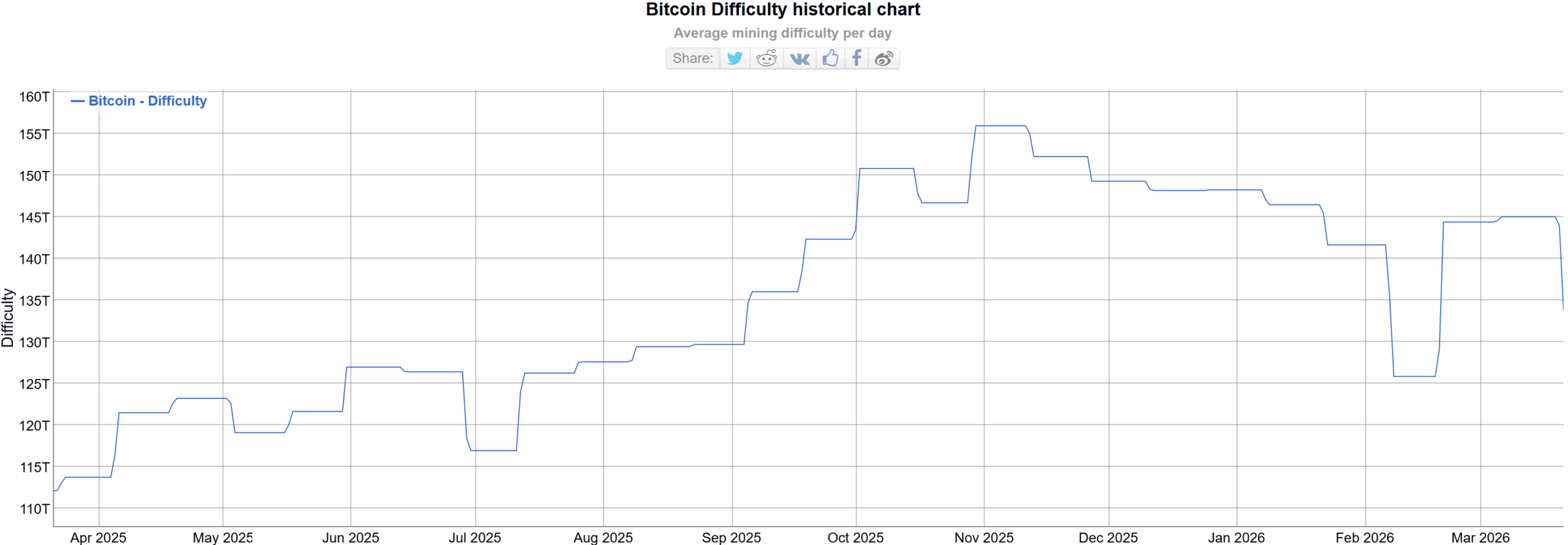
The last change took place in the early hours of the weekend and reduced the mining difficulty by 7.76%. This is the second-highest single decline in this metric in almost a year. What’s even more worrying is the fact that seven out of the last ten adjustments have been negative. And, two of the three positive ones were by less than 1%. The only significant increase was on February 19, when the metric jumped by 14.73%.
On-chain data now suggests that the next adjustment should take place on April 3, and current estimations show that the metric might increase slightly to almost 135T from 133.79T now. The difficulty peaked in late October 2025 at 155T, which means that the number now is over 13% lower.
Hash Rate Below 1 ZH/s
The hash rate is the other crucial metric showing the health of the Bitcoin network. It’s a calculated numerical value specifying an estimate of how many hashes are being generated by miners trying to solve the current block or any given one. It’s represented in hashes per second (H/s).
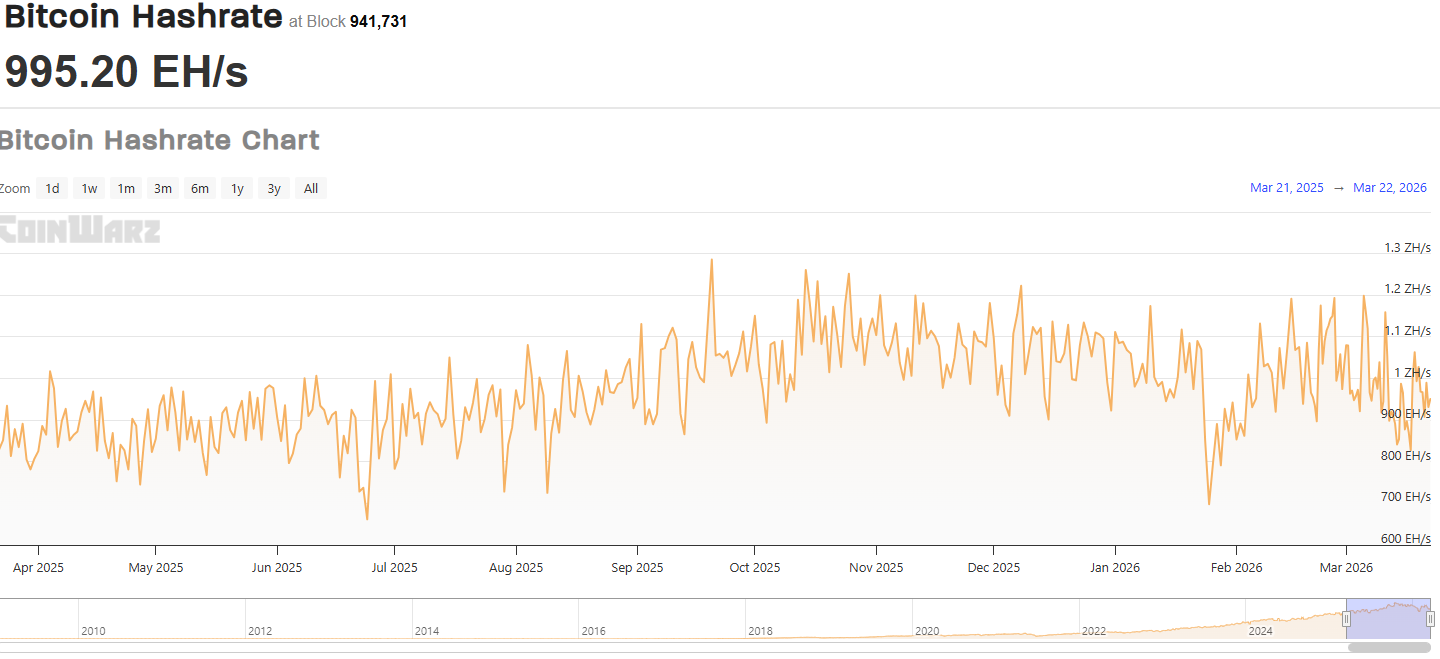
In simple terms, the higher the hash rate is, the more miners operate on the network, which makes it safer. Data from coinwarz shows that the metric peaked at over 1.28 ZH/s in late September last year, before it dropped within a range between 1.2 ZH/s and 900 EH/s. The severe storms in North America caused a brief disruption in late January to 700 EH/s, but quickly rebounded.
Nevertheless, it’s still just under 1 ZH/s, which places it at around 22% below its 2025 all-time high.
The post Bitcoin Records Second-Largest Difficulty Drop of 2026 as Hash Rate Remains Below 1 ZH/s appeared first on CryptoPotato.