





Article by Mahe, Foresight News
On March 23, Backpack, a prominent wallet and centralized exchange in the Solana ecosystem, will launch the BP token TGE. According to official information previously released by Backpack, the total supply is set at 1 billion tokens, with the contract address: BPxxfRCXkUVhig4HS1Lh7kZqV6SPJhzfEk4x6fVBjPCy. Currently, Backpack has launched its staking page; users can unstake at any time during the first 7 days, but after 7 days, a 7-day waiting period applies before unstaking. Users can view their BP token allocation after agreeing to the terms.
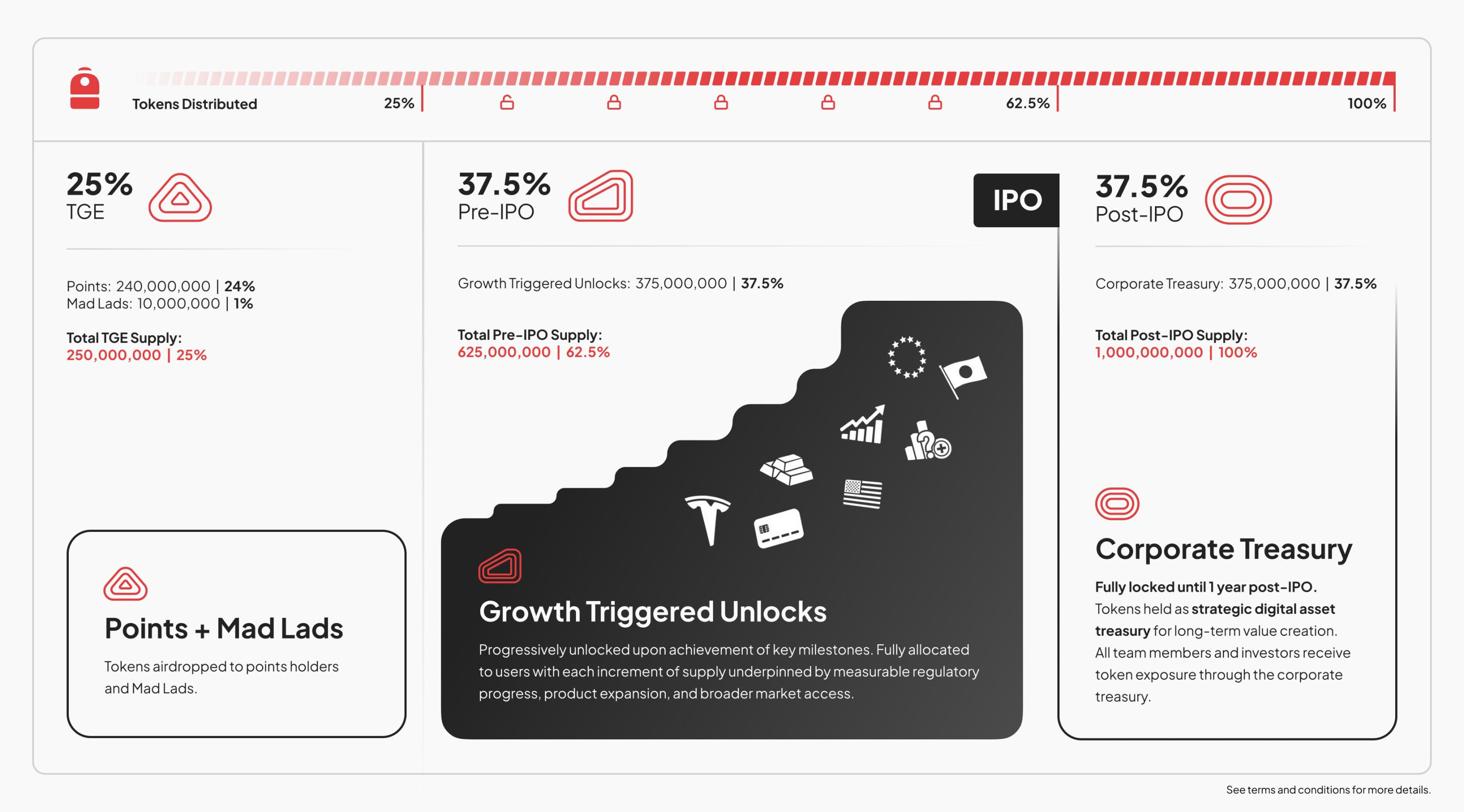
25% of the tokens will be unlocked at the TGE (24% for point holders; 1% for Mad Lads). 37.5% of the tokens will be unlocked prior to the IPO, with gradual releases tied to key milestones. All tokens will be allocated to users who achieve each supply increment milestone, based on measurable regulatory progress, product expansion, and broader market access.
37.5% will be unlocked after listing. As corporate treasury funds, all tokens are fully locked for one year following the IPO. The tokens are held as strategic digital assets to drive long-term value creation. All team members and investors gain token exposure through the corporate treasury.
During the TGE phase, 25%, or 250 million tokens, are immediately unlocked and exclusively allocated to community users, with no portion allocated to the team or investors in the initial circulation.
Backpack founder Armani Ferrante outlined the guiding principles behind the project’s tokenomics. The core objective is to prevent insiders from dumping tokens on retail investors; founders, executives, employees, and venture investors are prohibited from profiting from tokens until the project launches in the United States. Additionally, circulating tokens will be exclusively allocated to users as incentives for business growth, tied to key milestones such as entering new regions (e.g., the EU, Japan, the U.S.) or launching new products (e.g., predictions, stocks, debit cards).

Armani Ferrante emphasized that no founder, executive, team member, or venture investor received direct token allocations. The entire team’s allocation will remain in the company’s treasury and be locked for at least one year after listing. Team members hold equity in the company, while the company holds the majority of the token supply; team members can only benefit after the company goes public or upon an equity exit event.
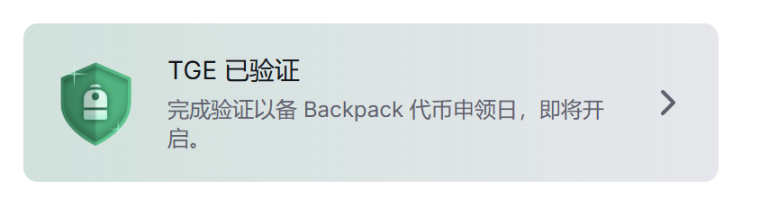
Users must log in to the Backpack website or mobile app to complete the TGE verification process; the system will automatically calculate and distribute Mad Lads NFT allocations based on the relative proportion of points at the snapshot. Mad Lads NFT holders only need to connect their corresponding wallet to automatically receive their allocation, with no additional steps required. After completion, users can view the “TGE Verified” badge under Points → Achievements.
Backpack’s points accumulation system includes multiple dimensions such as trading volume, asset holding duration, referrals, and depth of product usage. In addition, Backpack has introduced a staking-to-equity mechanism: users who stake BP for at least one year can convert their staked tokens into company equity at a fixed rate. A total of 20% of Backpack’s company shares will be allocated to qualified stakers, with staking duration, amount, and platform product usage serving as weighted factors to determine priority allocation rights in the IPO.
What is its value?
Before this airdrop, Backpack continuously upgraded its anti-sybil measures, requiring all accounts participating in the points program to complete KYC (identity verification). In early 2026, during the "Epilogue" phase, Backpack officially conducted an audit and, through data analysis, identified and reclaimed over 50 million so-called "fake points."
Backpack requires all eligible airdrop recipients to complete a secondary manual confirmation by the March 15, 2026 deadline. Many script accounts, after prolonged activity, may now be in an "offline" or "administrative vacuum" state. Requiring users to manually click and re-verify within a specific time window is the final measure to filter out automated accounts that engage only to claim and then disappear. One X user joked about their Metabape account: "Opened a 270,000-point account and saw: 1,000 coins."
Backpack’s “milestone unlock + equity conversion” model is an industry first. Additionally, Backpack has obtained licenses in the UAE, the UK, and multiple European countries, with a clear IPO pathway. Once the company achieves its business milestones, Pre-IPO unlocks will create a positive feedback loop. Of course, risks remain: failing to meet milestones may temporarily restrict liquidity—but this is precisely by design, ensuring token release is tied to actual value creation.
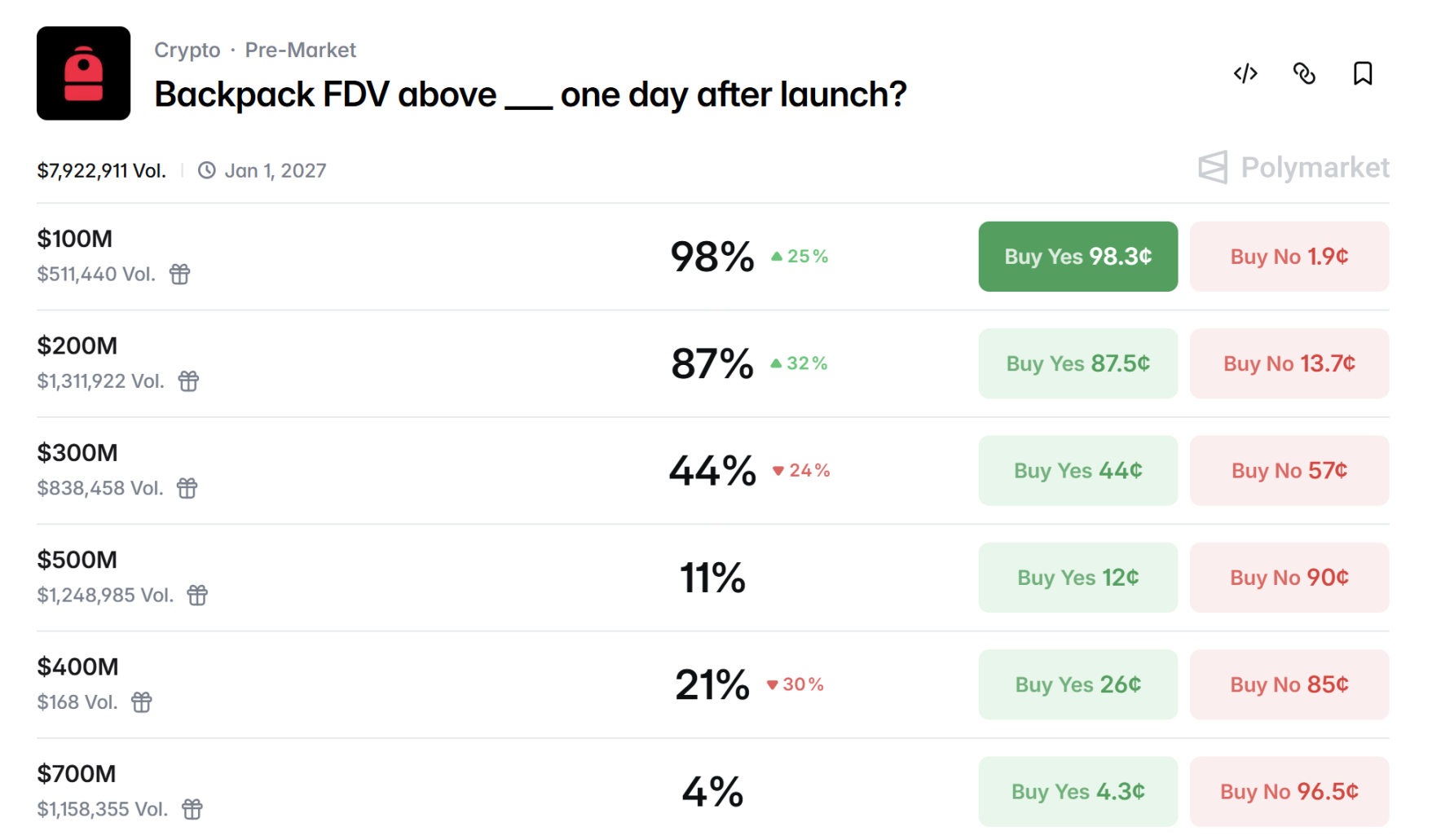
According to the latest data from Polymarket, the market assigns a 98% probability that its FDV will exceed $100 million on the day after launch, corresponding to a token price of $0.10; an 87% probability that FDV will exceed $200 million, corresponding to a token price of $0.20; a significant drop to 44% probability for FDV exceeding $300 million; and an 11% probability for FDV exceeding $500 million.
Currently, market participants on Polymarket predict its price range to be around $0.10 to $0.20.
Notably, the $100 million to $200 million FDV range corresponds to the publicly disclosed valuation of Backpack’s previous funding round.
In February 2024, Backpack completed a $17 million strategic Series A round at a $120 million valuation, led by Placeholder, with participation from Hashed, Robot Ventures, Amber Group, Wintermute, Jump Crypto, Delphi Digital, and others. In September 2022, Backpack previously raised $20 million, led by FTX Ventures and Jump Crypto.
In February 2026, according to Axios, sources familiar with the matter said that Backpack Exchange was negotiating a new funding round to raise $50 million at a $1 billion pre-money valuation. No final agreement has been reached yet.
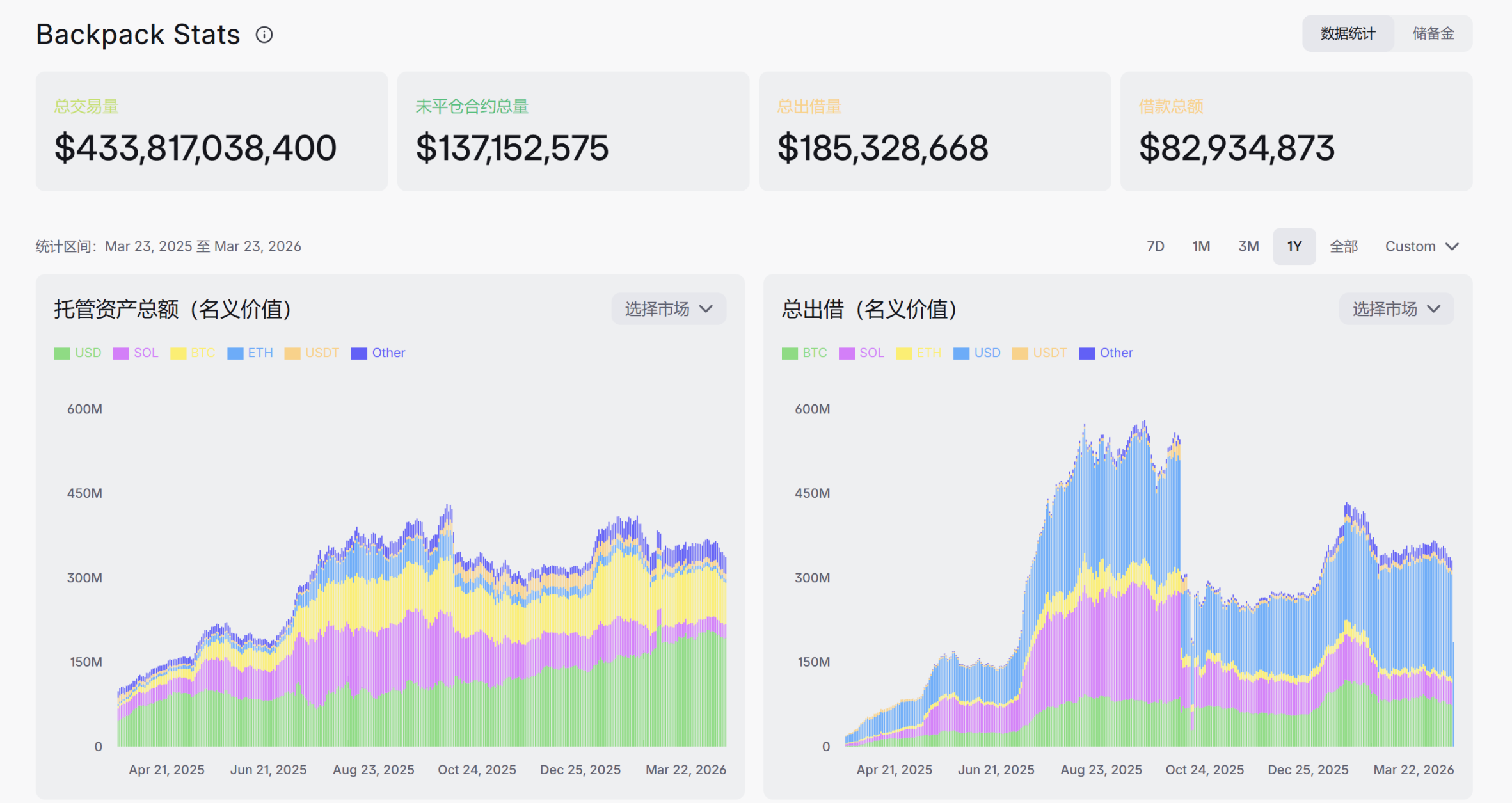
According to data from the official website, Backpack currently has open positions of $137 million, a total notional value of $350 million in custodied assets, a total notional lending value of $330 million, and total trading volume has reached $4.33 trillion due to anticipated airdrops.
Currently, the crypto market is in a deep bear phase, with Bitcoin consistently oscillating around $70,000, and some crypto projects, under immense pressure, have chosen to shut down and exit. Backpack had been repeatedly urged by the community to launch its token; however, due to hacks, system failures, and associated compensation obligations, the team ultimately decided to proceed with the TGE at the worst possible market conditions.
So, after Backpack’s TGE, will market buyers support it or completely abandon it? Today will tell.