



At the beginning of 2026, the world stands at an extremely divided crossroads.
On one side, inflation is easing, AI is accelerating its integration, and capital markets are showing signs of restlessness; on the other side, geopolitical tensions are rising, institutional uncertainties are increasing, and there is widespread skepticism about whether the "next round of growth is real." Against this backdrop, the globally influential tech business podcast "All-In Podcast" has released its annual ultimate predictions:
Headlined by Jason Calacanis, a renowned angel investor from Silicon Valley (early investor in Uber and Robinhood), the event features three prominent guests: Chamath, the "King of SPACs"; David Friedberg, known as the "Sultan of Science"; and David Sacks, who is externally referred to as the White House's first "AI and Cryptocurrency Czar."
These top minds, who control hundreds of billions of dollars and deeply understand the logic of power and capital, engaged in a heated debate on politics, technology, investment, and the geopolitical landscape.—from the wealth tax crisis in California to the expectation of a 6% GDP growth, from optimistic outlooks on Huawei and market forecasts to the astonishing hypothesis that SpaceX might be merged into Tesla, and more.
The Maitong MSX Institute has distilled the core ideas from their intellectual exchanges for the readers' enjoyment.
4 Experts' "11 Big Predictions"
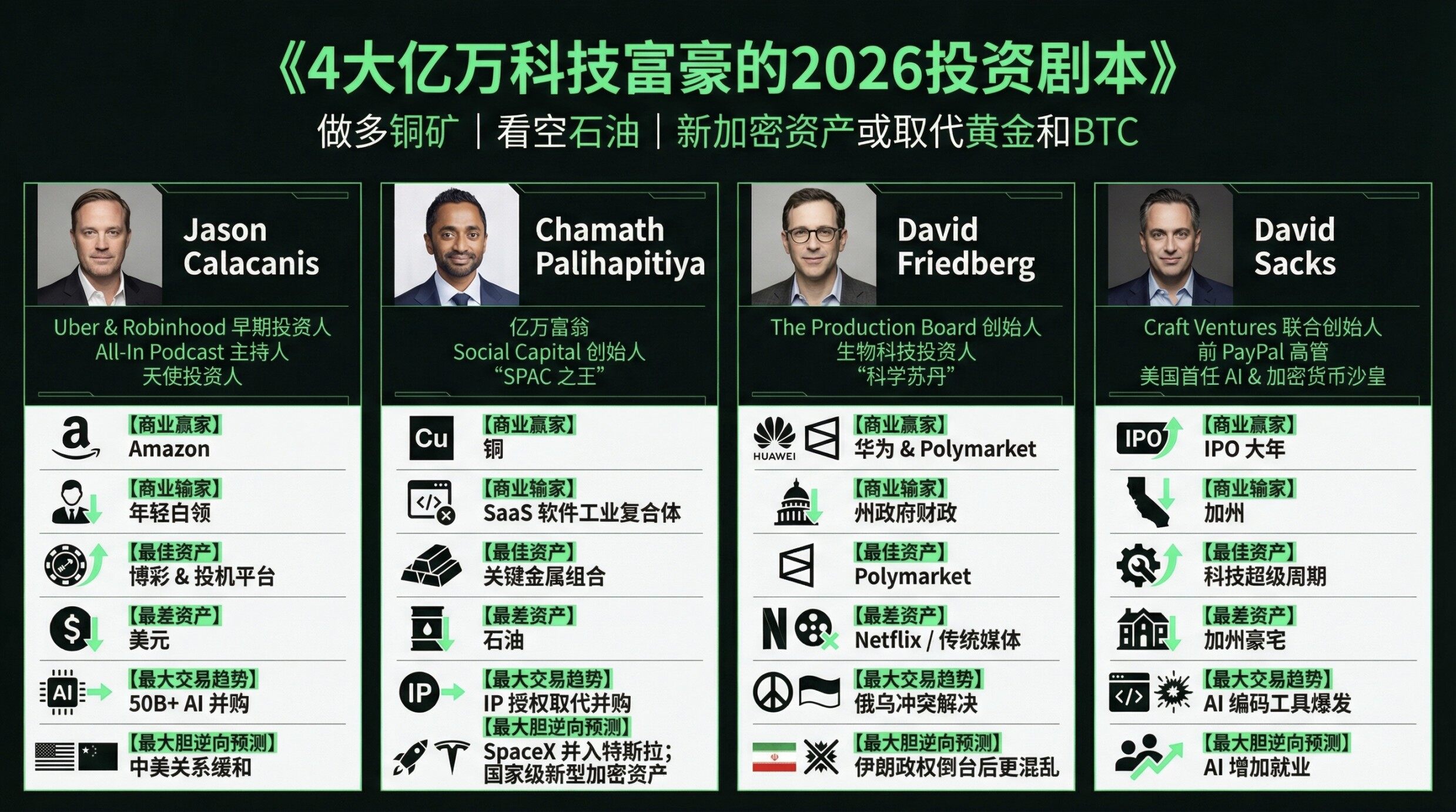
Source: Image generated and organized by AI
Regarding the California wealth tax and the risk of capital outflows, they respectively believe that:
- Chamath Palihapitiya: Has clearly chosen to leave the circles of California, with a combined net asset value reaching tens of billions of dollars.This poses a significant impact on California's long-term finances;
- David Friedberg: The proposal is unlikely to be implemented in reality, but it has already revealed structural pressures in local finances;
- David Sacks:The wealth tax is the direct reason I left California. Even if it doesn't pass by 2026, people expect some version of it to resurface by 2028.
Regarding the biggest business winners in 2026, they respectively believe that:
- Jason Calacanis: Bullish on Amazon, which will be the first to reach the "enterprise singularity," becoming...The first company where robots contribute more profit than humans,Its automated warehouse and logistics network have built a very high moat;
- Chamath Palihapitiya: Choose copper. Geopolitics and supply chain security will cause long-term supply and demand imbalances. At the current pace,The global copper supply will face a gap of about 70% by 2040;
- David Friedberg:Look up Huawei and Predict Market (PM),The former continues to achieve breakthroughs in its technical system, while the latter is evolving from a marginal product into a new type of infrastructure for information and price discovery, which may experience a breakout this year;
- David Sacks: 22026 will be a big year for IPOs, as the "Trump Prosperity" reignites the capital market's expansion cycle.Many companies will successfully go public, creating trillions of dollars in new market value; at the same time, I agree with Jason Calacanis's assessment of Amazon, but for different reasons (not elaborated).
Regarding the biggest business losers in 2026, they respectively believe that:
- Jason Calacanis: The group most affected are young white-collar workers in the U.S., as entry-level positions are being replaced by AI and automation first;
- Chamath Palihapitiya: The "maintenance and migration" revenue model for enterprise SaaS will be systematically compressed under the impact of AI;
- David Friedberg:State government finances, pension liabilities, and solvency issues will become sharply exposed;
- David Sacks: In California, the uncertainty regarding regulation and taxation will continue to drive out capital and businesses;
Regarding the most significant trading patterns in 2026, they respectively believe that:
- Jason Calacanis:An AI industry blockbuster merger and acquisition deal exceeding $500 billion will emerge;
- Chamath Palihapitiya: Traditional mergers and acquisitions will give way to large-scale IP licensing partnerships, a type of transaction that will become more common and mature by 2026;
- David Friedberg: Resolving conflicts at the geopolitical level will be the "biggest deal," and the Russia-Ukraine conflict may be resolved this year;
- David Sacks: Bullish on the breakout potential of coding assistants and tool usage.
For the boldest reverse predictions about 2026, they respectively believe that:
- Jason Calacanis:The China-U.S. relationship will experience a substantive easing,Both parties will establish a win-win working relationship;
- Chamath Palihapitiya: Two contrarian predictions, one is that SpaceX will not go public through an IPO, but may instead merge into Tesla.Second, central banks around the world will establish a new paradigm of sovereign digital currencies (different from BTC);
- David Friedberg: If the situation in Iran continues to escalate, it could further intensify instability in the Middle East;
- David Sacks: AI will become a job expander, not a job-creating machine, and we are likely to see job growth;
Regarding the assets that will perform best in 2026, they respectively believe that:
- Jason Calacanis: Bullish on speculative and platform-based assets,In this environment where the economy is about to take off, interest rates may be cut, and people have more disposable income, they will have more spare money to bet and speculate;
- Chamath Palihapitiya: Continue betting on a basket of key metals, including copper;
- David Friedberg: Predictive markets are replacing the functions of traditional media and markets, and have great potential;
- David Sacks: Choosing the Super Cycle of Tech Expansion;
Regarding the assets that will perform worst in 2026, they respectively believe:
- Jason Calacanis:The US dollar will remain under pressure;
- Chamath Palihapitiya: Judging that oil is entering a long-term downward trend, it might fall to $45 per barrel;
- David Friedberg:Bearing a bearish view on Netflix and traditional media stocks;
- David Sacks: Bearish on High-End Real Estate in California;
Regarding the most anticipated trends for 2026, they respectively believe that:
- Jason Calacanis:The IPO market is making a comeback, and among major companies like SpaceX, Anthropic, or OpenAI, at least two of them are expected to file for an IPO this year;
- Chamath Palihapitiya: Expecting the expansion of "Trumpism," unilateralism, economic resilience—it is a major trend, and its result will be significant GDP growth;
- David Friedberg: From the deepening situation in Iran, leading to a reshaping of the Middle East landscape;
- David Sacks: Auditing government spending at all levels requires normalizing a "decentralized DOGE (Department of Government Efficiency)" to enable the public to see where the money is being spent;
The biggest political winner in 2026:
- Jason Calacanis: Young left-wing political figure;
- Chamath Palihapitiya: A political force against waste and bureaucracy;
- David Friedberg: Democratic socialists (DSA) are taking over the Democratic Party, and this trend will be solidified by 2026;
- David Sacks:"Trump Prosperity"—predicting a 75 to 100 basis point rate cut in June;
The biggest political loser in 2026:
- Jason Calacanis: Democratic Moderate;
- Chamath Palihapitiya: Monroe Doctrine—because Trumpism has surpassed it;
- David Friedberg: The tech industry is becoming a common target for both left- and right-wing populists;
- David Sacks: Democratic Moderate;
Forecasts for the U.S. GDP growth rate in 2026:
- Chamath Palihapitiya:The lower limit is 5%, and the upper limit is 6.2%;
- David Friedberg:4.6%;
- David Sacks:5%;
Final Words
Today, China also announced the 2025 national economic operation results, showing a GDP scale of 140.19 trillion yuan, representing a 5.0% year-on-year growth, successfully achieving the target as expected.
If we broaden our perspective to the global coordinate system and take into account exchange rate factors over the next one to two years, we will find that...The gap between China's and the U.S.'s GDP (measured in U.S. dollars), which had once widened significantly in the past two years, now appears to be showing subtle signs of narrowing dramatically at this juncture.
This contrast is particularly thought-provoking: on one side is China seeking high-quality growth through structural adjustments; on the other is the United States, as described in the "All-In Podcast," attempting to forcefully escape a period of mediocre growth through a combination of "Trump prosperity + AI singularity."
It could be said that the only two major global economies are now simultaneously entering a new phase of competition centered on productivity and structural efficiency. It is precisely in this context that Chamath Palihapitiya's provocative remark on his show stands out: "Don't bet against the U.S. economy; it's ready for takeoff, and a 6% GDP growth isn't out of the question."Please enter a valid email address."
But the prerequisite is that in this year of accelerated reshuffling, you must stand on the side of productivity, not on the side that gets eliminated.
Perhaps this is the most important question in this cycle.
Let's encourage each other.