

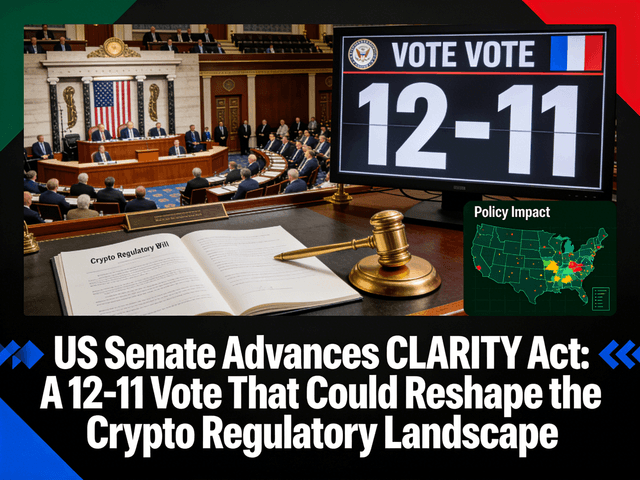
US Senate Advances CLARITY Act: A 12-11 Vote That Could Reshape the Crypto Regulatory Landscape
On January 29, 2026, the United States Senate Committee on Agriculture, Nutrition, and Forestry marked a historic milestone in the journey toward comprehensive digital asset oversight. In a razor-thin 12-11 party-line vote, the committee advanced the Digital Commodity Intermediaries Act, a core component of the broader Digital Asset Market CLARITY Act. Under the leadership of Chairman John Boozman (R-AR), this legislative move aims to provide the Commodity Futures Trading Commission (CFTC) with primary authority over spot markets for digital commodities like Bitcoin.
While the vote signifies a major victory for proponents of regulatory certainty, the narrow margin highlights a deeply divided Congress. The bill now heads to the Senate Banking Committee, where it faces intense scrutiny over stablecoin yields and consumer protection provisions. For investors, this progress represents a double-edged sword: the promise of institutional legitimacy balanced against the reality of strict new compliance burdens.
Key Takeaways
-
Party-Line Victory: The 12-11 vote was strictly split along partisan lines, with Republicans supporting the push for innovation and Democrats raising concerns over consumer safeguards.
-
CFTC Empowerment: The bill establishes the CFTC as the primary regulator for digital commodity spot markets, moving away from the SEC's "regulation-by-enforcement" model.
-
Structural Deadlines: Lawmakers are racing to merge this version with the Senate Banking Committee's draft, which is currently stalled over the treatment of stablecoin interest.
-
Institutional Bridge: By defining "mature blockchains," the act provides a legal pathway for assets to transition from securities to commodities, fostering long-term market stability.
-
Global Competitiveness: Proponents argue the act is essential to keeping crypto capital, jobs, and innovation within the United States rather than pushing them offshore.
A Unified Rulebook: Bridging the Gap Between the SEC and CFTC
For years, the U.S. crypto industry has been mired in a jurisdictional tug-of-war. The CLARITY Act seeks to end this friction by drawing a "bright line" between the Securities and Exchange Commission (SEC) and the CFTC. Under the new framework, digital assets are classified into three distinct categories: digital commodities, investment contract assets, and permitted payment stablecoins.
The CFTC would gain exclusive jurisdiction over digital commodities, including the power to supervise exchanges, brokers, and dealers. Conversely, the SEC would retain oversight of initial token issuances and "investment contract assets" that do not yet meet the criteria of a decentralized, mature blockchain. To stay updated on these high-stakes regulatory shifts, users can monitor KuCoin's real-time market insights to see how regulatory news impacts the volatility of major digital commodities.
The "Mature Blockchain" Threshold: A Path to Decentralization
One of the most innovative aspects of the CLARITY Act is the concept of a "mature blockchain". The bill acknowledges that a digital asset originally sold as a security may, through decentralization, evolve into a commodity. An issuer can certify to the SEC that their blockchain is mature—meaning it is not controlled by a central group—allowing the asset to move under the CFTC's more flexible commodity framework.
This "maturity certification" requires rigorous disclosures, including source code transparency, token economics, and risk factors. It provides a clear incentive for projects to decentralize their governance. For developers and investors, this creates a predictable lifecycle for crypto projects. Those looking to diversify into these emerging digital commodities can easily manage their portfolios via the KuCoin Lite version, which simplifies the acquisition of assets as they transition through these new regulatory phases.
Stablecoin Yields: The Final Hurdle in the Banking Committee
Despite the Agriculture Committee's success, the CLARITY Act's path to the Senate floor remains obstructed by the Senate Banking Committee. The primary sticking point is Section 404, which proposes a ban on stablecoin issuers or intermediaries paying yield or interest to holders.
Traditional banks argue that yield-bearing stablecoins act as "unregulated deposits," posing a systemic risk to the financial sector. Crypto advocates, however, see yield as a critical feature of decentralized finance. This stalemate has delayed the final markup of the bill, as lawmakers weigh the benefits of a "payment-only" stablecoin model against a more flexible financial tool. While the debate continues, the KuCoin trade platform remains a resilient environment for users to engage with stablecoin pairs under existing compliance standards.
Architectural Survival: Why Compliance Cuts Both Ways
While many in the industry view the 12-11 vote as a "bullish" signal, experts warn that clarity does not equal a "blessing". The CLARITY Act introduces significant operational requirements, including validator identification rules, customer fund segregation, and mandatory registration for spot market intermediaries.
Many existing crypto architectures were not built with these regulatory perimeters in mind. High-throughput chains may need to rewrite core code to implement compliance modules or settlement logic that satisfies the new federal standards. In this new phase, "speed doesn't equal survivability." Only the networks capable of adapting their execution environments to meet these "onshore" requirements will thrive in the coming decade.
Conclusion: A New Phase for U.S. Digital Asset Policy
The advancement of the CLARITY Act by the Senate Agriculture Committee signals that the conversation in Washington has shifted from whether to regulate to how to regulate. By positioning the CFTC at the center of spot market oversight and creating a path for asset decentralization, the U.S. is finally building the machinery to provide legal certainty.
The next few months will be critical as the Banking and Agriculture committees attempt to reconcile their differences. For market participants, this is a time for vigilance. Staying informed through a pro-level trading environment and following official legislative updates will be essential for navigating the transition from a "regulation-by-enforcement" era to a statutory, CFTC-led marketplace.
FAQs for CLARITY Act 12-11 Vote
What does the 12-11 vote in the Senate Agriculture Committee mean?
The vote means that the committee has approved its portion of the crypto market structure bill, allowing it to move forward toward a potential full Senate vote. However, the narrow margin indicates significant partisan disagreement on specific consumer protection rules.
How does the CLARITY Act change the roles of the SEC and CFTC?
The act grants the CFTC primary authority over "digital commodities" and spot markets. The SEC maintains jurisdiction over "investment contract assets" and primary token sales, but its role is narrowed once a blockchain is certified as "mature" or decentralized.
Why is the Senate Banking Committee delaying the bill?
The Banking Committee is currently deadlocked over stablecoin regulation, specifically whether issuers or service providers should be allowed to offer interest or yield to stablecoin holders.
What is a "mature blockchain" under the new legislation?
A mature blockchain is defined as a system that is not controlled by any single person or group under common control. Certification as "mature" allows a related digital asset to be regulated as a commodity rather than a security.
