

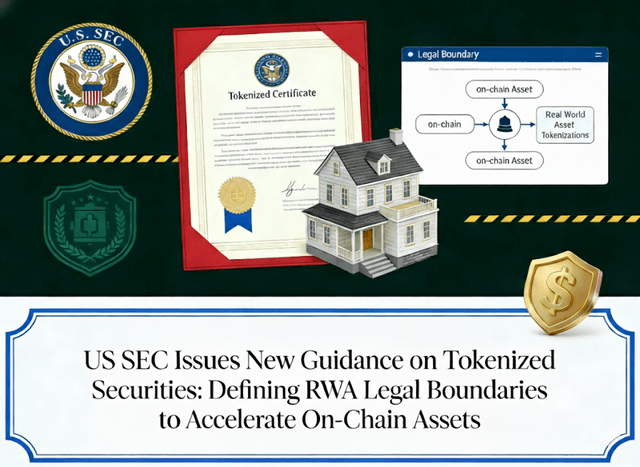
US SEC Issues New Guidance on Tokenized Securities: Defining RWA Legal Boundaries to Accelerate On-Chain Assets
The convergence of traditional finance (TradFi) and decentralized finance (DeFi) reached a historic milestone on January 28, 2026. The U.S. Securities and Exchange Commission (SEC) issued a comprehensive staff statement clarifying the regulatory landscape for tokenized securities. By reinforcing that the "format" of an asset—whether on a physical ledger or a blockchain—does not change its legal status, the SEC has provided the long-awaited roadmap for the multi-trillion dollar Real-World Asset (RWA) market.
Key Takeaways
-
Substance Over Form: The SEC confirmed that tokenized securities are subject to existing federal securities laws, including registration and disclosure requirements.
-
Two-Tier Framework: The guidance distinguishes between Issuer-Sponsored (direct) and Third-Party (indirect/synthetic) tokenization models.
-
Legal Continuity: Moving a security to a blockchain does not create a "regulatory vacuum"; the Securities Act of 1933 and the Exchange Act of 1934 remain the primary authorities.
-
Operational Clarity: The guidance allows for the same class of securities to exist simultaneously in tokenized and traditional formats.
-
Risk Mitigation: Investors are warned about the additional counterparty and bankruptcy risks associated with third-party custodial tokenization.
The SEC’s January 2026 Guidance: A Shift Toward Institutional RWA Adoption
For years, the "gray area" of RWA tokenization hindered institutional participation. The SEC's latest guidance, prepared by the Divisions of Corporation Finance, Investment Management, and Trading and Markets, removes much of this ambiguity. The core message is clear: a tokenized security is defined as any instrument already meeting the legal definition of a "security" that is represented as a crypto asset on a distributed ledger.
This clarification is a massive tailwind for the RWA sector. By defining the legal boundaries, the SEC is essentially inviting major financial institutions to move traditional products—like US Treasuries, private equity, and corporate bonds—onto blockchain rails with a clear understanding of the compliance hurdles.
Issuer-Sponsored vs. Third-Party Tokenization: Understanding the Taxonomy
The SEC’s taxonomy is perhaps the most critical part of the new guidance. It separates how assets are brought on-chain into two distinct categories, each with different legal implications.
-
Issuer-Sponsored Tokenization
In this model, the issuer of the security (or its authorized agent) uses blockchain technology as the official record of ownership.
-
Integrated Ledgers: The blockchain acts as the "master securityholder file." A transfer of the token on-chain constitutes a legal transfer of ownership.
-
Direct Rights: Investors hold direct legal claims against the issuer, identical to holding a traditional share or bond.
-
Third-Party Tokenization
This involves an unaffiliated entity "wrapping" an existing security into a token. The SEC identifies two sub-types:
-
Custodial Model: A third party holds the underlying security and issues tokens representing a "security entitlement." This introduces counterparty risk, as the token holder’s rights are tied to the third party's solvency.
-
Synthetic Model: These tokens represent "security-based swaps" or financial contracts that track the price of an underlying asset without providing ownership. The SEC noted that these often require registration as derivatives and may be restricted to "eligible contract participants."
For traders looking to explore these assets, understanding the difference between various token standards is essential to identifying which model a project follows.
Impact on Market Integrity and Investor Protection
The guidance emphasizes that the use of a crypto network does not exempt an offering from the Securities Act registration. Unless a project qualifies for an exemption (such as Regulation D for private placements), it must provide the same level of disclosure as a traditional IPO.
This focus on investor protection is designed to prevent "synthetic" products from bypassing the rigorous standards required for retail offerings. By enforcing these rules, the SEC aims to reduce the likelihood of another systemic failure caused by opaque, unbacked digital representations of traditional assets.
Accelerating the On-Chain Future: What This Means for Traders
The 2026 guidance acts as a catalyst for the "Innovation Exemption" sandbox, allowing qualified platforms to trade tokenized equities under controlled conditions. This move is expected to bridge the liquidity gap between 24/7 crypto markets and the T+1 or T+2 settlement cycles of traditional exchanges.
As the industry moves toward a more regulated framework, platforms like KuCoin continue to support the ecosystem by providing a secure environment for discovering high-quality RWA projects. You can start trading top RWA tokens to gain exposure to this growing sector as institutional infrastructure matures.
FAQs for US SEC Tokenized Securities Guidance
What is the definition of a tokenized security according to the SEC?
A tokenized security is a financial instrument that meets the legal definition of a "security" under federal law and is represented by a crypto asset, where ownership records are maintained wholly or partially on a blockchain.
Does tokenizing an asset change its legal status?
No. The SEC's 2026 guidance explicitly states that the "format" (on-chain vs. off-chain) does not alter the application of the Securities Act of 1933 or the Exchange Act of 1934.
What are the risks of "Third-Party" tokenized stocks?
The primary risks include counterparty risk and bankruptcy risk. If the third-party entity holding the underlying shares fails, the token holder may not have a direct legal claim to the assets, unlike issuer-sponsored tokens.
Can the same security exist in both tokenized and traditional formats?
Yes. The SEC guidance allows issuers to offer the same class of securities in multiple formats, provided they confer the same rights and privileges to all holders.
Do RWA projects need to register with the SEC?
Most RWA projects that offer economic interests or passive income to US investors will likely be deemed securities. They must either register the offering or operate under a valid exemption, such as those provided for "accredited investors."
As the boundaries between digital and traditional assets blur, staying informed is your best strategy. To begin your journey into the world of compliant on-chain assets, sign up for a KuCoin account today and explore our extensive library of educational resources to stay ahead of the regulatory curve.
