



AI Concerns Ease, U.S. Stocks Rebound, BTC Momentum Recovers
Summary
-
Macro Economy: Anthropic announced plans to proactively build industry partnerships, easing previous market concerns over a potential “AI shock.” The move supported a rebound in U.S. equities, with shares of partner companies broadly advancing. The U.S. Dollar Index remained resilient, rebounding after a brief consolidation and approaching a four-week high. In commodities, gold retreated after posting intraday highs for two consecutive sessions earlier this month, and is currently consolidating around $5,140.
-
Crypto Market: Continued liquidity tightness in the crypto market—driven by Federal Reserve tightening and weak capital inflows—has weighed on overall performance. After a sharp decline, BTC found support in the $62,800–$63,000 range, forming a short-term base before grinding higher. The latest breakout above $65,000 and the prior high-volume resistance zone has significantly improved short-term momentum. Altcoins have lagged overall, though market sentiment, while still in extreme fear territory, has shown signs of marginal stabilization.
-
Project Updates
-
Trending Tokens: PIPPIN, ESP, GPS, SKR, PAXG/XAUT, STEEM
-
PIPPIN: Extended gains for three consecutive days; social engagement rose over 27% yesterday, with the token up more than 13% on the day.
-
ESP: Surged over 110% following listings on two major Korean exchanges.
-
GPS: Jumped over 20% intraday on news of a Korean exchange listing.
-
SKR: Spiked more than 42% after spot trading launched on a Korean exchange.
-
PAXG/XAUT: Rising safe-haven demand and higher gold prices boosted interest in tokenized gold assets.
-
STEEM: Derivatives activity surged, with open interest spiking; the token rose over 30% at one point during the day.
-
Major Asset Changes
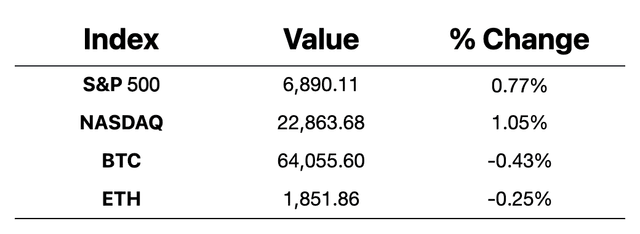
Crypto Fear & Greed Index: 11 (24 hours ago: 8) — Extreme Fear
Today’s Outlook
-
NVIDIA earnings release
-
Eurozone January CPI (final YoY and MoM readings)
-
Plasma (XPL) to unlock ~88.89 million tokens (~$10.79M)
-
Humanity (H) to unlock ~105 million tokens (~$14.12M)
Macro Developments
-
Trump’s new 10% global import tariff has officially taken effect for the next 150 days.
-
Trump signaled a preference for negotiations over war regarding U.S.–Iran tensions.
Policy & Regulation
-
The Federal Reserve is considering removing “reputational risk” from supervisory criteria, potentially easing debanking pressure on crypto firms.
-
The U.S. SEC granted exemptive relief to WisdomTree’s Treasury Money Market Digital Fund.
Industry Highlights
-
Hong Kong-based stablecoin payments firm RedotPay is reportedly considering a U.S. IPO, targeting a $1B valuation.
-
X updated its API policy to curb AI-driven comment spam.
-
Better and Framework Ventures announced a $500M stablecoin partnership to advance mortgage tokenization.
-
BlackRock and Citadel are accelerating their expansion into DeFi to gain access to DeFi infrastructure.
-
Trump’s “Peace Committee” is reportedly exploring a USD stablecoin pilot in Gaza.
-
Bitcoin BIP-110 proposal faces public opposition from several OG community members.
-
iShares filed for a staked Ethereum ETF, proposing a Nasdaq listing.
-
The Ethereum Foundation established a dedicated DeFi team to advance the DeFipunk protocol.
Deep Dive: Industry Highlights (Feb 25, 2026)
EF Treasury Staking: From "Sell-Offs" to Self-Sustenance
This marks a pivotal shift in the Ethereum Foundation’s (EF) financial strategy. Historically, the EF raised operational capital by selling ETH on the open market, which was often interpreted as a "sell signal," causing market volatility. By deploying 70,000 ETH into solo staking, the Foundation now generates an organic yield of approximately $3.6M annually (at a 2.8% APR). This move bolsters network security while establishing a "non-dilutive" non-profit funding model, setting a benchmark for treasury management across other Layer 1 ecosystems.
RedotPay’s U.S. IPO Ambition: The Quest for a Compliant Payments Unicorn
RedotPay’s pursuit of a $1B IPO at a rumored $4B valuation reflects the rapid integration of stablecoin payments into mainstream finance. Based in Hong Kong but targeting a New York listing with top-tier underwriters like Goldman Sachs, the firm is signaling its intent to globalize the "crypto debit card" as a regulated financial tool. A successful IPO would position RedotPay as a critical bridge between Web3 assets and traditional retail, challenging the status quo of the Visa/Mastercard duopoly with a digital-native infrastructure.
X’s API Policy Update: Musk’s Endgame for AI Spam
The recent API overhaul specifically targets the plague of "AI-driven auto-replies." By restricting programmatic POST permissions—limiting them primarily to mentions or quotes—X has effectively cut the lifeline for low-cost AI scripts. For the crypto industry, this means the era of "bot-bombing" popular threads with "memecoin" scams or phishing links is becoming prohibitively expensive. This is not just a technical fix; it is a strategic move to reclaim user attention and restore the platform's advertising integrity.
Better & Framework Partnership: A Milestone for Mortgage Tokenization
This $500M partnership represents a qualitative leap for RWA (Real World Assets). Unlike previous attempts that merely "on-chained" property titles, Better is leveraging the Sky (formerly MakerDAO) ecosystem to use stablecoins as a direct credit line for the source of mortgage lending. This "liquidity-first" approach is far more scalable. It signifies that DeFi liquidity is now flowing directly into the veins of the $12T U.S. housing market, positioning DeFi as a low-cost capital provider for traditional finance (TradFi).
BlackRock & Citadel in DeFi: Institutional Infrastructure Capture
The recent accumulation of UNI and ZRO tokens by BlackRock and Citadel Securities isn't about retail speculation; it’s about "Vendor Lock-in." For these giants, holding governance power ensures that the underlying infrastructure (like UniswapX or LayerZero) evolves in alignment with institutional compliance and execution requirements. We are entering the "Institutional DeFi" era, where top-tier liquidity is shifting from retail-driven pools to permissioned frameworks built by professional market makers.
Gaza Stablecoin Pilot: Stablecoins as Diplomatic Instruments
This "Peace Committee" initiative is a controversial yet visionary social experiment. In regions where traditional banking has collapsed, using USD stablecoins for humanitarian aid and daily commerce bypasses broken physical infrastructure and allows for real-time auditing. This move proves that stablecoins have transcended investment assets to become geopolitical tools. However, the ultimate challenge will be navigating the complex AML/KYC landscape in a high-conflict zone while maintaining the neutrality of the technology.
Bitcoin BIP-110 Controversy: The Battle for the Core Consensus
The public opposition from Bitcoin OGs against BIP-110 highlights the eternal tension between "innovation" and "ossification." As the proposal involves changes to the base protocol, purists fear that any added complexity threatens Bitcoin's status as a "pure" store of value. This debate reflects a deeper identity crisis: following the rise of Ordinals and Layer 2s, the community remains split on whether to sacrifice architectural minimalism for enhanced functionality.
iShares Staked Ethereum ETF: The Race for Native Yield
Following the success of spot ETH ETFs, BlackRock’s filing for a "Staked" version is the logical next step. Institutional investors are no longer satisfied with simple price exposure; they want the ~3% native staking yield. If approved, this transforms the ETH ETF into a "crypto-bond," making it significantly more attractive to long-term pension funds compared to non-yielding assets like Gold or Bitcoin ETFs, fundamentally altering Ethereum’s valuation model.
EF’s DeFi Team & DeFipunk: Reclaiming the Cypherpunk Soul
Led by industry veterans like Charles St. Louis, the "DeFipunk" team serves as a defensive mechanism against "over-institutionalization." By prioritizing permissionless, censorship-resistant, and privacy-first protocols, the team ensures that even as giants like BlackRock enter the space, Ethereum remains a fertile ground for decentralized innovation (such as ZK-privacy lending). It is a strategic effort to balance mainstream adoption with the preservation of its decentralized soul.
