


Multiple Uncertainties Weigh on Risk Assets as Crypto Sells Off on Heavy Weekend Volume
Summary
-
Macro Economy: Trump stated that the U.S. and Iran are in talks and that negotiations over Greenland are nearing an agreement, easing geopolitical risks temporarily. However, the U.S. Senate passed a roughly $1.2 trillion government spending bill, while a brief government shutdown still appears unavoidable. At the same time, Trump nominated Kevin Warsh as Federal Reserve Chair, and December PPI data came in hotter than expected, further reinforcing hawkish expectations. These overlapping uncertainties pressured risk appetite, sending all three major U.S. equity indices lower. Precious metals were also hit by the “Warsh shock,” with gold falling below $4,700/oz.
-
Crypto Market: Amid Middle East geopolitical volatility, U.S. government shutdown uncertainty, and increasingly cautious internal crypto sentiment, the crypto market saw a sharp, high-volume sell-off. Total market liquidations on Saturday hit the highest single-day level since the “10/11 crash,” with Bitcoin plunging intraday to $75.7k. Altcoins declined in tandem on surging volume, and market sentiment quickly deteriorated into extreme fear.
-
Project Updates:
-
Hot tokens: ZK, VIRTUAL, JUP
-
ZK: zkSync released its 2026 roadmap, including Prividium integrating enterprise systems and workflows, and Airbender expanding application scenarios.
-
VIRTUAL: Virtuals Protocol announced that OpenClaw will soon integrate ACP, with the initial version supporting “buyer mode” and x402 micropayment settlement.
-
JUP: Jupiter launched “Jupiter Global,” integrated Polymarket, and announced that the GUM private beta is coming soon, with APIs supporting login, swaps, general deposits, cross-chain spot trading, and perpetuals.
-
LUNC: An FTX creditor representative stated that the next round of distributions is expected on March 31.
-
Major Asset Changes
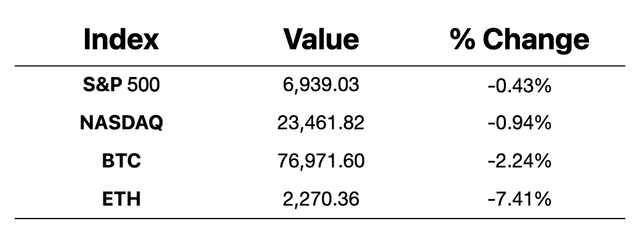
Crypto Fear & Greed Index: 14 (unchanged from 24 hours ago), Extreme Fear
Today’s Outlook
-
The White House will convene banks and crypto firms to seek legislative compromise
-
Uniswap to launch auction functionality on its web app
-
Record date for Trump Media & Technology Group’s digital token plan
-
Aster begins Phase 6 airdrop, allocating 0.8% of total supply
-
Ethena (ENA) unlock of ~40.63 million tokens (~$5.7m)
Macro Economy
-
U.S. President Trump: Kevin Warsh to serve as Fed Chair; Warsh reportedly implicated in the Epstein case
-
U.S. Senate passed a $1.2 trillion government spending bill, but a brief shutdown remains unavoidable; House Speaker Johnson said he is “confident” the government will resume operations by Tuesday
-
U.S. December PPI m/m at 0.5% (vs. 0.2% expected); PPI y/y at 3.0% (vs. 2.7% expected)
-
Fed’s Bostic: No need for rate cuts at present
-
Trump said the U.S. and Iran are negotiating; an adviser to Iran’s Supreme Leader said a “negotiation framework” is taking shape; Trump also said Greenland talks are close to an agreement
Policy Direction
-
U.S. Treasury sanctioned crypto exchanges Zedcex and Zedxion over Iran-related transactions
-
A Tennessee state lawmaker proposed legislation to establish a “Tennessee Strategic Bitcoin Reserve”
-
A U.S. judge ruled that a shareholder lawsuit alleging insider trading by Coinbase directors may proceed
-
Hong Kong’s Financial Services and the Treasury Bureau plans to submit four virtual asset service provider regulatory bills within the year
-
SEC Chair: The time is ripe to allow cryptocurrencies into 401(k) retirement accounts
Industry Highlights
-
The WLS 2026 Mobius Forum, hosted by WLA and co-hosted by KuCoin, opened in Dubai
-
Network-wide liquidations on January 31 reached $2.5615 billion, the highest single-day total since the “10/11 crash”
-
Michael Saylor again released Bitcoin Tracker updates, potentially signaling another purchase disclosure next week
-
Close associates of the Abu Dhabi royal family reportedly invested $500 million to acquire a 49% stake in the Trump family’s WLFI company
-
Bitcoin hashrate fell to its lowest level since October 2021
-
Tether reported net profit exceeding $10 billion in 2025, with gold reserves reaching $17.4 billion
-
Cross-chain bridge CrossCurve was reportedly exploited via “fabricated information,” resulting in losses of about $3 million
Deep Dive: Industry Highlights (Feb 02, 2026)
-
WLS 2026 Mobius Forum Opens in Dubai
Hosted by the World Laureates Association (WLA) and co-hosted by KuCoin, this prestigious event marks a pivotal shift where fundamental science and blockchain technology move from "technical silos" toward "collaborative governance." The forum focuses on AI, disruptive technologies, and new materials, aiming to translate scientific consensus into global governance frameworks. KuCoin’s deep involvement suggests that crypto infrastructure is seeking a more socially responsible identity—positioning itself not just as a financial tool, but as a "digital foundation" for global research collaboration and transparent governance.
-
Network-wide Liquidations Hit $2.5615 Billion on Jan 31
This staggering figure marks the highest single-day liquidation total since the infamous “10/11 crash.” Notably, long liquidations accounted for over 90% (approx. $2.4 billion) of the total. This reflects an extreme downward volatility spike at the end of January, where massive deleveraging flushed out high-leverage positions. Such deep liquidity squeezes often signal that market sentiment has entered an "extreme fear" zone, potentially clearing the path for price discovery at fundamental support levels.
-
Michael Saylor Releases Bitcoin Tracker Updates
Saylor’s "More Orange" updates are historically the precursor to MicroStrategy disclosing new Bitcoin acquisitions. Following past patterns, these updates are usually followed by an SEC 8-K filing within 24 hours. Amidst current market volatility, Saylor’s persistent buying (with total holdings exceeding 670,000 BTC) serves as more than just a corporate treasury strategy—it acts as a market anchor, attempting to counteract retail panic and attract institutional observers on the sidelines.
-
Abu Dhabi Royal Associates Invest $500M in WLFI (Reports & Clarifications)
Reports of associates close to the Abu Dhabi royal family acquiring a 49% stake in the Trump family’s World Liberty Financial (WLFI) have sent shockwaves through the industry. While some suggested this move was a "geopolitical bridge" to secure access to U.S. AI chips, industry figures like Nano Labs CEO Jack Kong have dismissed these claims as misinformation. This highlights how, in the complex political climate of 2026, crypto projects are frequently used as vessels for geopolitical rumors and policy speculation.
-
Bitcoin Hashrate Drops to Lowest Level Since Oct 2021
A significant decline in network computing power typically indicates that miners are entering a severe "capitulation phase." Due to recent price fluctuations hitting break-even points, many mining firms using older hardware have likely powered down. While a falling hashrate can trigger short-term concerns regarding network security, historically, this has often been a market bottoming signal, as only the most efficient miners survive the "winter."
-
Tether Reports 2025 Net Profit Exceeding $10 Billion
Tether’s financial disclosure rivals the profitability of top-tier global banks. This $10 billion profit is primarily driven by interest income from its holdings of over $120 billion in U.S. Treasuries. Notably, its gold reserves reaching $17.4 billion reflect a strategic move to diversify into hard assets to hedge against potential fiat currency credit risks. This further solidifies USDT’s role as the primary liquidity bedrock of the digital economy.
-
Cross-chain Bridge CrossCurve Exploited via “Fabricated Information”
The loss of approximately $3 million on CrossCurve reveals persistent vulnerabilities in cross-chain verification logic. Attackers exploited "fabricated information" to deceive the protocol’s verification mechanism, enabling unauthorized withdrawals. This serves as a stark reminder for interoperability protocols: as cross-chain asset volume grows, systems relying solely on code logic without multi-signature backups or dynamic risk controls remain prime targets for hackers.
