
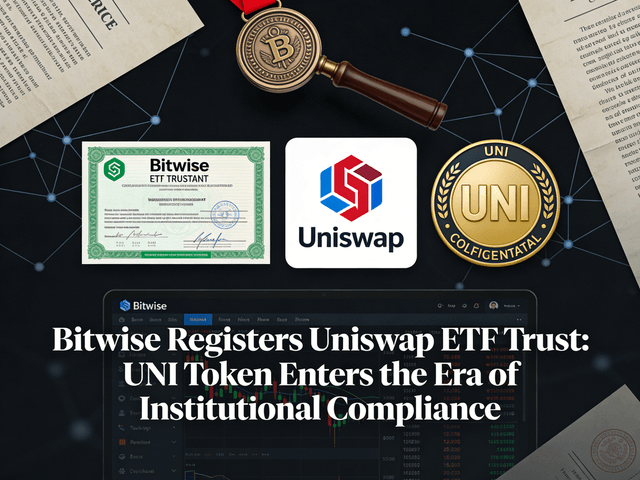
Bitwise Registers Uniswap ETF Trust: UNI Token Enters the Era of Institutional Compliance
In a move that signals a structural shift for decentralized finance (DeFi), the prominent crypto asset manager Bitwise has officially registered a statutory trust for a Uniswap ETF in Delaware. Filed on January 27, 2026, under file number 10486859, this registration represents the first formal step toward bringing the world’s largest decentralized exchange (DEX) into the regulated wrapper of a U.S. exchange-traded fund.
The timing of this "front-running" registration is significant. As the broader market navigates a hawkish pause from the Federal Reserve, institutional appetite is shifting from pure speculative assets to protocols with proven cash flows and regulatory "cleanliness." Following the SEC’s resolution of its investigation into Uniswap Labs in early 2025, the legal path for the UNI token has cleared, allowing Bitwise to lead the charge in the institutionalization of DeFi.
Key Takeaways
-
Strategic Filing: Bitwise has established the "Bitwise Uniswap ETF" trust in Delaware, a customary precursor to an official SEC S-1 filing.
-
Regulatory Clarity: The move follows the 2025 conclusion of the SEC's probe into Uniswap Labs, signaling a shift from enforcement to structural integration.
-
Institutional Bridge: An ETF would allow institutional investors to gain exposure to UNI through traditional brokerage accounts without managing wallets or private keys.
-
DeFi Maturity: This registration marks the transition of UNI from a "governance-only" token to a regulated financial instrument.
-
Market Reaction: While UNI prices saw a modest 4% uptick following the news, the long-term impact lies in the potential for massive capital inflows from 401(k)s and pension funds.
The Road to a Regulated Uniswap ETF
The registration of a statutory trust in Delaware is often the "smoke before the fire" in the world of crypto ETFs. For Bitwise, this is a calculated play to secure optionality. While a Delaware filing does not guarantee a launch, it establishes the legal entity required to hold the underlying UNI tokens and issue shares.
What makes the Bitwise Uniswap ETF unique is the underlying asset's nature. Unlike Bitcoin, which is often viewed as "digital gold," Uniswap is a functional piece of financial infrastructure. In 2026, Uniswap remains the dominant liquidity layer for the entire on-chain economy. By productizing this through an ETF, Bitwise is effectively offering investors a "tax" on DeFi's growth.
Institutional players who previously stayed on the sidelines due to custody concerns can now look toward regulated crypto funds as a viable entry point. The shift suggests that Wall Street is no longer content with just Bitcoin; they want exposure to the protocols that are actually disrupting traditional exchange models.
SEC Policy Shift: From Enforcement to Infrastructure
The "institutionalization" of UNI wouldn't be possible without a significant change in the regulatory climate. In 2024 and 2025, the SEC's stance on DeFi was characterized by aggressive probes. However, by January 2026, the agency has moved toward a more nuanced taxonomy of tokenized securities.
The closure of the Uniswap Labs investigation in February 2025 was a watershed moment. It provided the "regulatory green light" that asset managers like Bitwise needed to begin the ETF application process. In the current landscape, the SEC appears more focused on ensuring that third-party custodians—such as the Bank of New York Mellon, which Bitwise often uses—can safely handle the complexities of smart-contract-based assets.
For investors, this means the risk profile of holding UNI is changing. It is moving away from the "will they be sued?" category into the "how much revenue are they generating?" category. Traders can monitor this transition by tracking UNI trading volume on major venues, which provides the real-time liquidity data that the SEC scrutinizes during the ETF approval process.
UNI Tokenomics 2.0: Value Accrual and Governance
A key driver for institutional interest in a Uniswap ETF is the evolution of UNI’s tokenomics. In late 2025, Uniswap successfully implemented the "Fee Switch," transitioning UNI from a pure governance token to one that directly benefits from protocol usage.
The Impact of the Fee Switch
-
Supply Burn: A portion of protocol fees is now used to burn UNI tokens, creating a deflationary pressure that institutions find attractive.
-
Unichain Synergies: The launch of Uniswap’s own Layer-2, Unichain, has further concentrated liquidity and reduced operational costs, making the protocol's revenue more predictable.
-
Institutional Fundamentals: For a Bitwise ETF to be successful, the underlying asset must have a clear valuation model. With annualized protocol fees now reaching significant milestones, UNI is being valued more like a high-growth fintech stock than a volatile altcoin.
To understand the scale of this opportunity, many users are using KuCoin’s DeFi analysis tools to compare Uniswap's on-chain performance against traditional exchange volumes. The "Institutionalization" of UNI via an ETF would likely accelerate this "flippening" of liquidity from CEXs to DEXs.
Custody and Pricing: The Challenges Ahead
Despite the excitement, Bitwise faces several hurdles before the ETF can list on the NYSE Arca. The SEC remains cautious about two primary factors: Custody and Pricing.
Unlike Bitcoin, UNI is a smart-contract-based asset. Storing it isn't just about holding a private key; it involves managing governance rights and potential airdrops from the Uniswap ecosystem. Bitwise will need to prove that its custodial arrangements are robust enough to handle these technical nuances.
Furthermore, the SEC requires a "reliable pricing mechanism." Because UNI trades across dozens of decentralized and centralized pools, establishing a single "Net Asset Value" (NAV) for an ETF is complex. Bitwise will likely rely on a composite price index that aggregates data from high-liquidity venues. For those looking to get ahead of the institutional curve, you can buy UNI today and participate in the ecosystem before the ETF-driven demand potentially reshapes the market.
Conclusion: A Turning Point for the DeFi Sector
Bitwise’s registration of the Uniswap ETF Trust is more than just a headline; it is a signal that the "Wild West" era of DeFi is being integrated into the global financial system. If approved, the ETF would grant millions of investors regulated access to the primary engine of decentralized trading.
As we move through 2026, the distinction between "Traditional Finance" and "Decentralized Finance" continues to blur. With UNI leading the way, we are likely to see a wave of similar filings for other DeFi "Blue Chips."
Ready to position yourself for the future of decentralized exchange? Trade UNI on KuCoin and stay informed on the latest institutional developments.
FAQs for Bitwise Uniswap ETF Registration
Does the Delaware registration mean the Uniswap ETF is approved?
No. Registration of a statutory trust in Delaware is a preliminary legal step. Bitwise must still file an S-1 registration statement with the SEC and wait for the agency to review and approve the filing before the ETF can begin trading.
Why did Bitwise choose Uniswap for its next ETF?
Uniswap is the industry leader in decentralized trading, with the highest TVL and volume in the DEX sector. Following the resolution of its SEC investigation, it is considered one of the most "regulatory-ready" DeFi assets for an institutional product.
How will a Uniswap ETF affect the price of UNI?
While not guaranteed, an ETF typically provides a significant catalyst for price appreciation by opening the doors to trillions of dollars in institutional capital that cannot currently buy tokens directly on exchanges.
Will the ETF include UNI governance voting rights?
Typically, spot crypto ETFs do not pass through governance voting rights to the shareholders. The fund manager (Bitwise) would likely hold the voting power, though they may choose to abstain or follow a specific governance policy outlined in the fund's prospectus.
Where can I buy UNI while waiting for the ETF?
You can easily purchase UNI tokens on KuCoin. This allows you to hold the actual asset and participate in governance or liquidity provision, which is not possible through an ETF.
