

XRP vs Ripple: What's the Difference & Can XRP Break $2 in 2026?
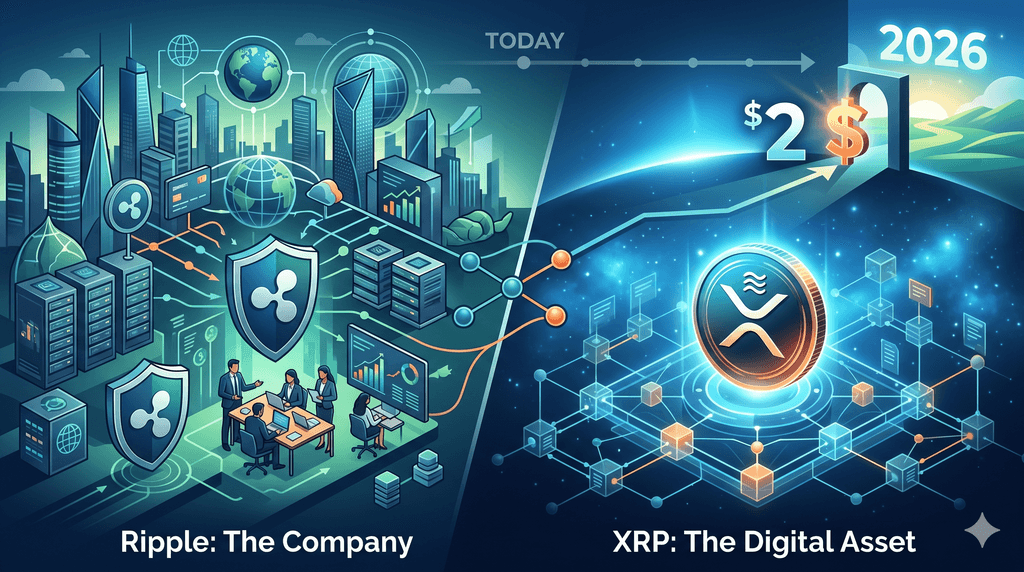
Ask ten people in the crypto community what "Ripple" is, and most will say it's a cryptocurrency. They are not entirely wrong — but not entirely right either. The confusion between XRP and Ripple has persisted since the 2017 bull run, and it continues to shape how investors misread the asset, misjudge its risk profile, and misunderstand its price catalysts.
This matters acutely right now. XRP is trading at $1.44 as of April 17, 2026, with a 24-hour trading volume of $3.94 billion and a market cap of approximately $88.9 billion. That places it more than 60% below its 2025 peak. Meanwhile, Ripple the company has arguably never been in stronger institutional shape. The gap between Ripple's corporate momentum and XRP's depressed price is the central tension every XRP investor needs to understand right now.
Key Takeaways
-
XRP and Ripple are not the same. XRP is an independent digital asset; Ripple Labs is a private fintech company that uses — but does not own — the XRP Ledger.
-
The SEC lawsuit is resolved. The case concluded in August 2025. Ripple paid a $50 million settlement, and the court-imposed injunction was dissolved.
-
XRP is trading around $1.44 today, down roughly 61% from its July 2025 peak of $3.65.
-
The CLARITY Act — targeted for a Senate Banking Committee markup in late April 2026 — is the single most important near-term price catalyst.
-
Ripple is expanding aggressively: RLUSD has crossed $1 billion in circulation, and Rakuten just integrated XRP for 44 million users in Japan.
-
Standard Chartered's Geoffrey Kendrick forecasts XRP at $2.80 by year-end 2026, implying over 100% upside from current levels, though bears see $1.15 as the floor if macro conditions deteriorate.
XRP vs Ripple: The Distinction That Actually Matters
The terms get used interchangeably in headlines, but they describe fundamentally different things — and conflating them leads to serious analytical errors.
Ripple Labs is a private San Francisco-based fintech company founded in 2012. It builds enterprise payment infrastructure, most notably Ripple Payments (formerly ODL), the RLUSD stablecoin, and institutional custody solutions. It has hundreds of employees, has raised hundreds of millions in venture capital, and acquired prime brokerage firm Hidden Road for $1.25 billion in 2025.
XRP is a digital asset running on the XRP Ledger — an open-source, decentralised blockchain that operates independently of Ripple. The XRPL was co-created in 2011 by David Schwartz, Jed McCaleb, and Arthur Britto. It has its own validator network, its own Federated Byzantine Agreement consensus mechanism, and a developer community that extends far beyond Ripple's own products.
The relationship is best understood through analogy: Ripple is to XRP roughly what Google is to the internet. The company is a major participant and helped define the infrastructure, but it does not own or control the protocol. Ripple holds approximately 37–40 billion XRP in escrow and releases a portion monthly — but it cannot freeze accounts, change consensus rules, or alter the token supply the way a central bank can.
Why does this distinction matter for traders? Because Ripple's corporate success does not automatically translate into XRP price appreciation. A new enterprise deal benefits Ripple equity holders; it only moves XRP if it creates actual on-chain token demand. Understanding this separation is the prerequisite for reading any XRP price prediction with accuracy.
The Legal Chapter That Changed Everything for XRP
Before assessing where XRP goes from here, you need to understand the five-year legal battle that defined both Ripple's corporate identity and XRP's regulatory standing.
In December 2020, the SEC sued Ripple, claiming it raised $1.3 billion through unregistered securities sales of XRP. The lawsuit triggered mass US exchange delistings and years of paralysing uncertainty. The fight concluded in August 2025 with both sides dropping appeals. Ripple agreed to a $125 million civil penalty — far less than the $2 billion originally sought by regulators.
The ruling itself set important precedent. Institutional sales directly to hedge funds were classified as securities offerings because purchasers had reasonable expectations of profit based on Ripple's promotional efforts. Programmatic sales on secondary markets did not meet the Howey Test criteria, as buyers lacked direct contractual relationships with Ripple.
The practical consequence was major: XRP regained its status on US exchanges, ETF products became viable, and on March 17, 2026, the SEC and CFTC jointly issued new guidance formally classifying XRP as a digital commodity, ending the legal overhang it had faced since 2020.
The ghost of the SEC lawsuit is now largely exorcised. What drove XRP to $3.65 at its 2025 peak was the celebration of that outcome. What has brought it back to the $1.40s is an entirely different set of forces — macro headwinds, ETF underperformance, and geopolitical risk — and understanding those is the only way to assess whether $2 is realistic this year.
Ripple's Corporate Momentum: What the Company Is Building
While XRP's price has declined in 2026, Ripple as a company has been accumulating strategic partnerships at a pace that would impress any fintech observer.
The RLUSD stablecoin has been Ripple's most commercially significant launch of the past eighteen months. Launched in late 2024, RLUSD grew to over $1.3 billion in circulation by early 2026. It is NYDFS-regulated with 1:1 USD backing through cash and cash equivalents, and has been adopted across DeFi platforms, Ripple's cross-border payment corridors, and institutional settlement pipelines.
The Mastercard partnership represents the most high-profile validation RLUSD has received to date. Since November 2025, Ripple and Mastercard have been running a live pilot that settles real credit card transactions on the XRP Ledger using RLUSD — involving Ripple, Mastercard, WebBank, and Gemini, and marking one of the first times a regulated US bank has settled traditional card payments using a regulated stablecoin on a public blockchain. In March 2026, Mastercard's Crypto Partner Program added Ripple as a participant, giving it direct access to infrastructure processing more than $9 trillion in annual payments across 200+ countries.
The Japan story adds another layer. Rakuten integrated XRP into its payments app in April 2026, allowing 44 million users to spend it across more than 5 million merchants and earn it through a loyalty system with over $23 billion in points in circulation. Ripple called this one of XRP's most significant adoption milestones in Asia. There is also movement in South Korea, where Ripple partnered with Kyobo Life Insurance to enable tokenised government bond settlement, potentially shrinking settlement cycles from two days to near real-time.
The aggregate picture is of a company that has converted years of legal adversity into an institutional playbook. Whether XRP the token benefits proportionally depends on whether these use cases generate measurable on-chain token demand — which remains the crux of the bull vs. bear debate.
Can XRP Break $2 in 2026? What the Data Actually Shows
This is the question every XRP investor is trying to answer. The honest response is: possible, but it requires multiple catalysts to align — and right now, not all of them look certain.
XRP's 2026 price range is projected at $1.20–$2.60. The 200-day moving average at $1.8823 is the key bull/bear dividing line — a sustained hold above it targets $2.20, while a break below $1.20 risks a slide toward $1.00. On the technical side, the setup is challenging. XRP is sitting below both the 50-day EMA at $1.38 and the 200-day EMA at $1.88. Roughly 60% of XRP's circulating supply is held at an average cost basis around $1.44, meaning every push toward that zone runs into a wall of sellers looking to break even.
Spot XRP ETFs have so far failed to move the needle. XRP has declined 42% in 2026 despite the availability of those products, with combined AUM sitting at around $1 billion — just 1.2% of XRP's market cap. By comparison, spot Bitcoin ETFs represent approximately 6.4% of Bitcoin's market cap, highlighting a meaningful institutional conviction gap.
The legislative catalyst, however, is real and imminent. The CLARITY Act Senate Banking Committee markup is targeted for the second half of April 2026. The bill now has backing from Coinbase, the Treasury Secretary, the SEC Chair, and the former White House crypto czar — the first time in 2026 that no major player is blocking it. If the CLARITY Act gains traction, a rally to $1.50 or beyond is very plausible. If it stalls, a drift toward $1.15 is just as realistic.
Geopolitics is the wildcard nobody can fully price in. Oil prices above $100 per barrel driven by Middle East tensions have consistently acted as a headwind for crypto risk appetite throughout 2026, amplifying XRP's losses. A de-escalation could release pent-up demand across the market and benefit XRP disproportionately given how far it has already fallen.
The longer-term picture is more constructive. Analysts forecast XRP could reach $2.10 at its peak in October 2026, with a possible floor near $1.99 in November — suggesting $2 is achievable, but as a second-half story, not an immediate one. Standard Chartered's revised forecast of $2.80 by year-end still implies more than 100% upside if conditions improve.
How to Position for XRP's Next Move on KuCoin
Understanding XRP's fundamentals is only half the work. The other half is having the right tools to act on that knowledge efficiently — especially for an asset like XRP that can move 10–15% in hours around legislative updates, macro shifts, or partnership announcements.
This is where platform choice genuinely matters. KuCoin has become one of the most XRP-oriented exchanges in the market, offering spot trading pairs across USDT, BTC, and fiat gateways alongside futures contracts for leveraged positioning in either direction. For a token currently consolidating between clear support at $1.28 and resistance at $1.45, the ability to deploy both long and short strategies from the same dashboard — and to execute quickly when the CLARITY Act vote date or an FOMC decision drops — is directly relevant to performance.
KuCoin's grid trading bot ecosystem is particularly suited to XRP's current range-bound behaviour. A grid strategy set between the established floor and resistance can systematically capture small percentage gains from repeated bounces while the larger directional move develops. When it does break — and given the legislative calendar, the window is weeks away, not months — having positioned orders and alert infrastructure in place matters.
Beyond execution, KuCoin's research resources and real-time market data help traders stay current on XRP-specific developments, from Ripple's institutional deal flow to US Senate activity. In a market where the difference between $1.15 and $2.80 hinges on a handful of definable events concentrated in the next sixty days, staying informed and positioned with minimal friction is itself a meaningful strategic advantage.
Conclusion
XRP and Ripple are related but distinct: one is a public digital asset whose fate is determined by market dynamics, regulatory outcomes, and on-chain adoption; the other is a private company whose success, while relevant context, does not map directly to token price. Keeping that distinction clear is the foundation of any rational XRP analysis.
In April 2026, the situation is one of compressed potential. Ripple the company is arguably in its strongest institutional position ever — the SEC case is resolved, RLUSD is scaling, Mastercard and Rakuten integrations are live. XRP the token, by contrast, has endured six consecutive months of decline from a $3.65 peak and now trades in the low $1.40s, below key moving averages, with macro headwinds from geopolitical tension adding pressure.
Breaking $2 this year is plausible but requires a specific sequence: CLARITY Act passage, macro de-escalation, and measurable on-chain XRP demand growth. If those conditions align in the second half of the year, the path to $2 — and Standard Chartered's $2.80 target — is there. If they do not, a test of $1.15 or below remains the bear case. The next sixty days will be decisive.
FAQs
Q1: Is XRP the same as Ripple?
No. XRP is a digital asset on the open-source XRP Ledger. Ripple Labs is a private company that uses the XRPL for its payment products and holds a large XRP reserve — but it does not own the token or control the protocol.
Q2: Did Ripple win its lawsuit against the SEC?
The outcome was mixed but broadly favourable. Courts ruled XRP sold on public exchanges is not a security. The case formally ended in August 2025 with Ripple paying a $50 million settlement. In March 2026, the SEC and CFTC jointly classified XRP as a digital commodity.
Q3: What is XRP's price today, April 17, 2026?
XRP is trading at approximately $1.44, up roughly 4% in the past 24 hours, with a market cap near $88.9 billion and a 24-hour trading volume of $3.94 billion.
Q4: What is the CLARITY Act and why does it matter for XRP?
The CLARITY Act is US federal legislation that would permanently define XRP and other cryptocurrencies as digital commodities, removing remaining regulatory ambiguity. A Senate Banking Committee markup is targeted for late April 2026. Passage could be a significant price catalyst; failure could send XRP back toward $1.15.
Q5: Can XRP realistically hit $2 in 2026?
Possibly, but it is a second-half story contingent on legislative progress and macro improvement. Standard Chartered forecasts $2.80 by year-end. Technical models point to an October–November window for a $2+ retest. The bear case is $1.15 if the CLARITY Act stalls and geopolitical tensions persist.
Q6: What is RLUSD?
RLUSD is Ripple's USD-backed stablecoin, launched in December 2024 under a New York DFS Trust Charter. It maintains a 1:1 peg to the dollar and is currently used in Ripple's Mastercard settlement pilot and cross-border payment corridors. Unlike XRP, it is not volatile — it is designed as a compliant enterprise settlement instrument.