

What is TradFi? Understanding the Core Differences Between Traditional Finance and DeFi
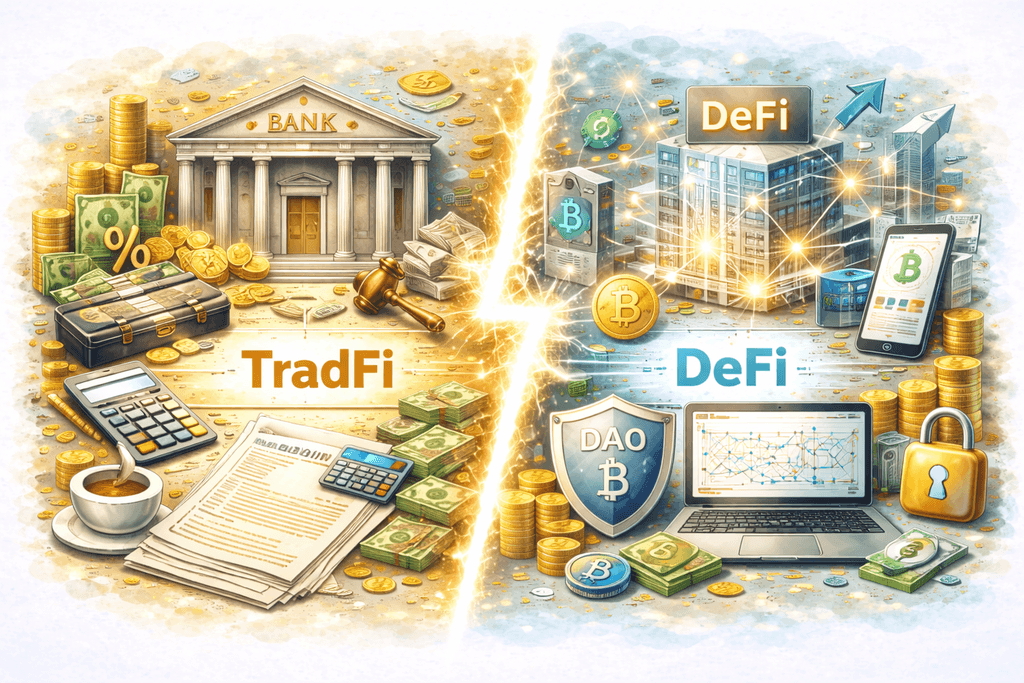
The global financial landscape is currently undergoing a structural transformation as decentralized technologies challenge long-standing economic models. For many years, the world relied exclusively on centralized institutions to facilitate commerce, lending, and wealth management. Understanding the evolution of these systems is essential for anyone navigating the modern digital asset space, as it provides the necessary context to identify the risks associated with crypto bubbles and market shifts.
The following analysis explores the definition of traditional finance and its operational mechanics compared to emerging decentralized protocols. By examining the fundamental differences in a DeFi comparison, market participants can better understand the strengths and weaknesses of both financial systems.
Key Takeaways
-
Traditional finance (TradFi) relies on centralized intermediaries like banks and clearinghouses to authorize and settle transactions.
-
DeFi utilizes blockchain technology and smart contracts to execute financial services without the need for a central authority.
-
Access to TradFi is often restricted by geographical location, credit history, and stringent Know Your Customer (KYC) requirements.
-
Regulation in TradFi is managed by government bodies to ensure consumer protection, while DeFi relies on code-based transparency.
-
Settling transactions in TradFi can take several days, whereas DeFi settlements are usually finalized within minutes on the blockchain.
-
Identifying the points of convergence between these systems is crucial for understanding how to avoid the fallout of crypto bubbles.
The Essence of TradFi
Traditional finance, or TradFi, refers to the mainstream financial system that has governed global economic activity for centuries. It is built on a foundation of centralized authority, where licensed institutions act as the gatekeepers of capital. In this system, trust is placed in the hands of third parties—such as commercial banks, investment firms, and central banks, to maintain accurate ledgers and ensure the integrity of the monetary supply.
The primary characteristic of TradFi is its "permissioned" nature. To participate in the system, individuals and businesses must meet specific criteria established by these intermediaries. This often includes providing proof of identity, maintaining a minimum balance, or passing credit checks. For those trading or accessing the token's markets for the first time, the contrast between this closed system and the open-access nature of blockchain technology is often the first major point of realization.
Furthermore, TradFi is heavily reliant on "legacy infrastructure." This includes physical bank branches, aging mainframe computers, and complex interbank communication networks like SWIFT. While this infrastructure has provided stability and security for decades, it is often criticized for being slow, expensive, and inaccessible to the "unbanked" population in developing regions. Despite these criticisms, TradFi remains the bedrock of global trade, providing the liquidity and legal framework necessary for large-scale economic operations.
Key Components of TradFi
To understand the scope of the current DeFi vs TradFi debate, one must first identify the structural pillars that support the legacy system.
-
Commercial Banks: These institutions serve as the primary interface for retail customers, providing deposit accounts, personal loans, and payment processing services.
-
Investment Banks: These entities facilitate capital raising for corporations and governments through the issuance of stocks and bonds, while also managing complex mergers and acquisitions.
-
Central Banks: Organizations like the Federal Reserve or the European Central Bank manage a nation's currency, control interest rates, and act as the "lender of last resort" during financial crises.
-
Stock Exchanges: Centralized marketplaces where shares of public companies are bought and sold under the supervision of regulatory bodies.
-
Clearinghouses: Intermediaries that sit between buyers and sellers to ensure that transactions are completed successfully, reducing the risk of counterparty default.
The interoperability of these components is what allows a consumer in one country to purchase goods from another using a credit card. However, each layer of this system adds a level of cost and time. Every intermediary takes a fee for their service, and the "settlement lag"—the time it takes for money to actually move from one account to another can range from 24 hours to several days. When looking at market data and trading pairs on a modern digital exchange, the inefficiencies of these traditional silos become increasingly apparent.
The Role of Regulation in TradFi
Regulation is perhaps the most significant differentiator when discussing what TradFi is. In the traditional world, financial activity is governed by a dense web of local and international laws designed to prevent fraud, money laundering, and systemic collapse.
Consumer Protection and Deposit Insurance
In most developed nations, TradFi participants benefit from government-backed insurance. For example, if a bank fails, a specific amount of the depositor's funds is guaranteed by the state. This safety net is a primary reason why many individuals remain hesitant to move entirely away from traditional finance. It provides a psychological and financial buffer that is often missing during the collapse of speculative crypto bubbles.
AML and KYC Compliance
Financial institutions are legally required to verify the identity of their clients through Anti-Money Laundering (AML) and Know Your Customer (KYC) protocols. While these regulations are often seen as a barrier to privacy and speed, they are intended to stop the flow of illicit funds and ensure that the financial system is not used to facilitate criminal activity. In the TradFi system, the responsibility of compliance rests on the institution, which faces heavy fines for failure to adhere to these rules.
Market Oversight
Regulators such as the SEC or FCA monitor the activities of exchanges and investment firms to ensure that markets are fair and transparent. They enforce rules against insider trading, market manipulation, and the sale of unregistered securities. For more detailed information on how these regulatory frameworks are evolving to include digital assets, many professionals refer to further reading and research resources.
TradFi vs. DeFi
The core of the current technological shift lies in the DeFi comparison. While both systems aim to provide the same basic financial services—lending, borrowing, and trading—they do so using entirely different philosophies and tools.
-
Centralization vs. Decentralization: TradFi is centralized, meaning a company or government controls the system. DeFi is decentralized, meaning it is governed by code (smart contracts) distributed across a global network of computers.
-
Custody of Assets: In TradFi, the bank holds your money. In DeFi, you hold your own assets in a non-custodial wallet, giving you total control but also total responsibility for security.
-
Transparency: TradFi ledgers are private and can only be audited by authorized officials. DeFi ledgers (blockchains) are public and can be audited by anyone with an internet connection.
-
Accessibility: TradFi requires documentation and approval. DeFi is "permissionless," meaning anyone with a smartphone and an internet connection can access it regardless of their location or status.
-
Operating Hours: TradFi operates on a 9-to-5 schedule, Monday through Friday, and is closed on holidays. DeFi operates 24/7/365, with no downtime.
One of the major risks in the DeFi space is the lack of a "lender of last resort." If a protocol fails or a smart contract is exploited, there is no government agency to step in and reimburse the users. This lack of a safety net is why DeFi markets are often more volatile and susceptible to the rapid inflation and deflation of crypto bubbles. However, proponents argue that the transparency of the blockchain allows for a more "natural" market where risk is priced in more accurately than in the opaque world of Traditional finance.
The Future of TradFi
The relationship between these two Financial systems is increasingly moving away from competition and toward integration. This hybrid model, often referred to as "Institutional DeFi," involves TradFi entities adopting blockchain technology to improve their internal efficiencies while maintaining their regulatory oversight.
We are seeing the rise of tokenized real-world assets (RWAs), where stocks, real estate, and bonds are represented as digital tokens on a blockchain. This allows for the fractional ownership of high-value assets and 24/7 trading, bringing the benefits of DeFi to the assets of TradFi. Institutions are also experimenting with Central Bank Digital Currencies (CBDCs), which aim to modernize national fiat currencies using the speed of distributed ledger technology.
As this integration continues, it is vital to stay updated on platform updates and announcements to see how regulated exchanges are bridging the gap. The goal for many is to create a system that combines the consumer protections and stability of Traditional finance with the efficiency, transparency, and global reach of decentralized protocols. This evolution will likely define the next decade of the global economy, making the DeFi vs TradFi distinction more about the underlying technology than the service provided.
Conclusion
In summary, while Traditional finance remains the dominant global force due to its regulatory stability and institutional trust, it is being forced to adapt to the technological advantages of decentralized systems. The primary difference in any DeFi vs TradFi analysis is the shift from human-managed intermediaries to code-managed protocols. While TradFi offers a safety net through insurance and regulation, it lacks the accessibility and 24/7 efficiency of its counterpart. Understanding the nuances of these Financial systems is the best way for participants to protect their wealth and avoid the risks associated with crypto bubbles as the world transitions into a more integrated, digital-first financial era.
Create your free KuCoin account today to access over 700+ global crypto assets and the latest gems. Sign Up Now!
FAQs
What is the biggest risk in traditional finance?
The biggest risks in TradFi are often systemic, such as bank runs, inflation caused by central bank policy, or the failure of a major intermediary. Because the system is centralized, the failure of one "too big to fail" institution can have a cascading effect on the entire global economy.
Is DeFi safer than TradFi?
Safety is subjective in this context. TradFi is safer in terms of legal protection and insurance, but DeFi is safer in terms of transparency and individual control. However, DeFi carries significant technical risks, such as smart contract bugs and the lack of recourse in the event of a hack.
Can TradFi and DeFi coexist?
Yes, and they are already beginning to do so. Many TradFi institutions are using blockchain to settle trades more quickly, and many DeFi users are using stablecoins—which are often backed by TradFi assets like US Dollars, to hedge against the volatility of crypto bubbles.
Why do I need a bank if I have a crypto wallet?
Currently, a bank is still necessary for most people to pay taxes, receive salaries from traditional employers, and access the legal protections offered by the state. While it is possible to be "bankless," the lack of integration between crypto and the real-world legal system makes it difficult for the average person.
How does inflation affect TradFi differently than DeFi?
In TradFi, inflation is managed by central banks through interest rates and money printing. In DeFi, the monetary policy is typically "hard-coded" into the protocol. For example, Bitcoin has a fixed supply, which proponents argue makes it a better hedge against the inflationary tendencies of traditional finance.
Further reading
Disclaimer: The information on this page may have been obtained from third parties and does not necessarily reflect the views or opinions of KuCoin. This content is provided for general informational purposes only, without any representation or warranty of any kind, nor shall it be construed as financial or investment advice. KuCoin shall not be liable for any errors or omissions, or for any outcomes resulting from the use of this information. Investments in digital assets can be risky. Please carefully evaluate the risks of a product and your risk tolerance based on your own financial circumstances. For more information, please refer to our Terms of Use and Risk Disclosure.