

What is Katana (KAT)? The Ultimate Guide to the DeFi Flywheel Layer 2
2026/03/24 17:33:02
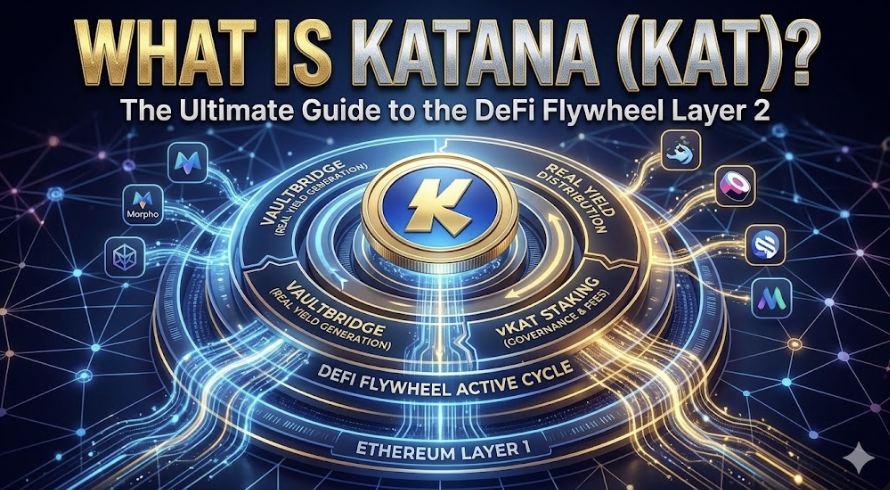
If you are researching the latest market movers, you might be asking: what is Katana (KAT)? Far from being just another token, Katana is a highly efficient DeFi-native Layer 2 network incubated by industry giants Polygon Labs and GSR. Following its highly anticipated fair launch and recent listing on KuCoin, it has quickly captured the attention of both retail and institutional investors.
In this comprehensive guide, we will explore how Katana's innovative VaultBridge works, explain its unique tokenomics, and show you exactly how to trade it securely today.
Key Takeaways
-
Katana is a specialized blockchain network designed to aggregate deep liquidity and maximize capital efficiency across the decentralized finance ecosystem.
-
The network utilizes an innovative VaultBridge to generate sustainable yield from underlying Layer 1 assets and distribute it directly to active participants.
-
By staking the base KAT token, users receive vKAT, which unlocks governance voting rights and a share of the protocol's trading fees.
-
Incubated by Polygon Labs and GSR, Katana launched with strictly zero venture capital allocation to protect retail investors from sudden insider sell-offs.
-
The KAT token is now officially listed on KuCoin, providing global traders with a highly liquid and secure spot market.
What is Katana (KAT)? More Than Just a Blockchain
To truly understand what Katana is, you have to rethink the traditional purpose of a blockchain. Most networks (like Ethereum or Solana) are general-purpose platforms hosting everything from NFT games to social media apps. Katana, however, is a DeFi-specific Layer 2 network. It is an integrated financial hub built from the ground up to do one thing perfectly: maximize capital efficiency.
By operating as an aggregation layer, Katana brings core DeFi primitives, such as spot trading (powered by integrations like Sushi) and lending markets (via Morpho)—under a single, unified roof. This structural design offers several massive advantages to the crypto market:
Eliminating Fragmentation: In standard DeFi, liquidity is split across dozens of competing decentralized exchanges and lending pools, which thins out the market and worsens prices for traders. Katana centralizes this liquidity into a core set of applications, ensuring deep markets and minimal slippage.
Chain-Owned Liquidity: Katana pioneers a model where the network itself helps secure and own its liquidity. This protects the ecosystem from the mercenary capital problem, where yield-farmers drain a network of its funds the moment incentives dry up during a bear market.
Institutional-Grade Experience: By solving the liquidity problem and reducing bridging friction, Katana creates an environment that is highly attractive not just to retail traders looking for the best swap rates, but to institutional players who require deep, stable markets to execute large-volume trades.
In short, Katana is not just a ledger recording transactions, it is an active, yield-generating financial engine designed to make decentralized trading faster, cheaper, and vastly more rewarding for its participants.
How the Katana DeFi Flywheel and VaultBridge Work
To grasp why Katana is generating so much institutional and retail interest, you must understand the underlying mechanics that power its economy: the DeFi Flywheel and the VaultBridge.
In traditional Layer 2 networks, when users bridge their assets from the Ethereum mainnet to the L2, those underlying assets usually sit idle in a smart contract. They provide security, but they do not generate any inherent value. Katana fundamentally changes this dynamic through capital efficiency. Here is a breakdown of the two core engines driving the Katana ecosystem:
The VaultBridge
The VaultBridge is Katana’s proprietary cross-chain innovation. Instead of letting bridged assets sit dormant, the VaultBridge actively deploys these underlying Layer 1 assets into safe, whitelisted, yield-generating strategies.
The profits generated from these L1 strategies are then bridged back to the Katana Layer 2 and distributed to ecosystem participants. This means that simply by participating in the Katana network, the ecosystem is constantly being injected with Real Yield, a sustainable source of income that does not rely on inflationary token printing.
The DeFi Flywheel Effect
The yield generated by the VaultBridge is the ignition switch for Katana’s DeFi flywheel, a self-sustaining cycle designed to perpetually grow the network's liquidity and volume. Here is how the flywheel operates in sequence:
Step 1: Yield Attracts Capital: The promise of sustainable, real yield from the VaultBridge attracts liquidity providers (LPs) and institutional capital to the Katana network.
Step 2: Capital Deepens Liquidity: As more capital flows into Katana's integrated applications (like its native spot DEX and lending markets), the liquidity pools become massive.
Step 3: Liquidity Drives Volume: Deep liquidity means traders experience near-zero slippage and highly efficient pricing. This superior trading environment naturally attracts high-frequency traders, retail users, and institutional volume.
Step 4: Volume Generates Fees: Massive trading volume generates significant protocol fees. These fees, combined with the VaultBridge yield, are then routed back to the network and its token holders, making the ecosystem even more attractive to new capital.
By aligning the incentives of liquidity providers, traders, and token holders, Katana’s flywheel ensures that liquidity remains "sticky." Instead of capital fleeing the network during a bear market, the integrated yield mechanics keep funds locked inside the ecosystem, providing a stable foundation for long-term growth.
Understanding KAT and vKAT Tokenomics
A DeFi protocol is only as strong as its tokenomics. To ensure that the Katana network remains stable and that its participants are focused on long-term growth rather than short-term dumping, the ecosystem employs a sophisticated dual-token model: KAT and vKAT.
This structure is designed to separate the liquid, tradable asset from the value-accruing, governance asset, thereby rewarding the most loyal ecosystem participants.
The KAT Token (The Base Asset)
KAT is the native, liquid utility token of the Katana Layer 2 network. This is the asset that recently underwent its Token Generation Event (TGE) and is actively traded on major centralized exchanges like KuCoin. It serves as the baseline entry point into the Katana ecosystem. While holding liquid KAT allows you to trade freely and capture price movements, the true power of the ecosystem is unlocked when you stake it.
The vKAT Token (The Value-Accrual Engine)
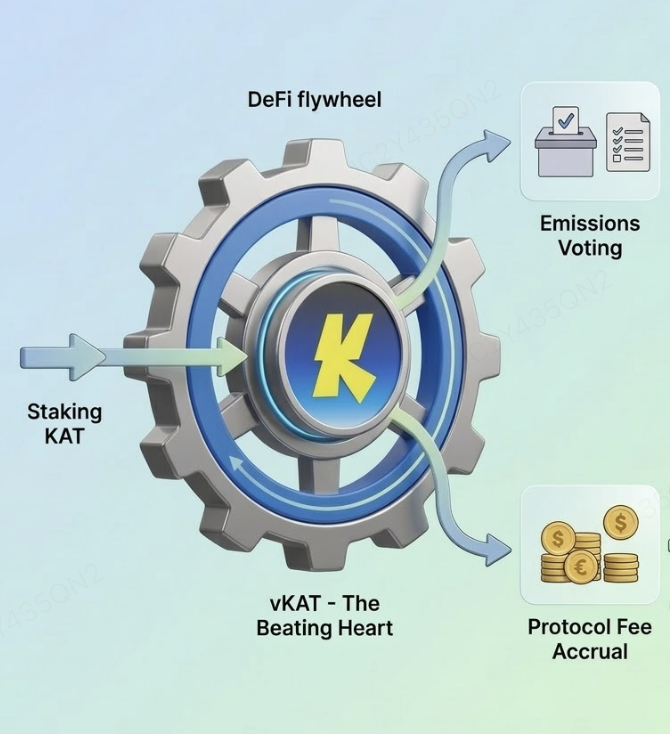
When users stake their liquid KAT into the protocol, they receive vKAT (Voter KAT) in return. vKAT is the beating heart of the DeFi flywheel. It aligns the incentives of users with the success of the network by offering several powerful utilities:
-
Emissions Voting: vKAT holders possess governance power. They can vote on which liquidity pools or decentralized applications (dApps) within the Katana ecosystem receive the highest yield emissions. In practice, this means protocols will actively compete with vKAT holders to secure their votes and attract liquidity.
-
Protocol Fee Accrual: By holding vKAT, you are essentially holding a stake in the network's revenue. vKAT holders earn a share of the fees generated across the entire Layer 2 ecosystem, including trading fees from the native DEX, borrowing fees from the lending markets, and the "Real Yield" brought in by VaultBridge.
The 45-Day Cooldown and Exit Penalty
To protect the network from mercenary capital (whales who deposit funds just to farm yields and then suddenly dump their tokens), Katana has implemented a strict unstaking mechanism.
If a user wants to convert their vKAT back into liquid KAT, they must initiate a 45-day cooldown period. After these 45 days, they receive their KAT at a 1:1 ratio. However, if a user wishes to bypass the cooldown and exit their position immediately, they are subject to an early exit fee. This penalty is not just a deterrent, the captured fees are typically redistributed to the remaining vKAT holders or burned, mathematically rewarding the users who stay loyal to the ecosystem.
By forcing capital to commit long-term or pay a premium to leave, Katana's tokenomics creates a highly resilient liquidity environment that protects everyday investors from sudden, massive sell-offs.
Polygon Labs, GSR, and No-VC Backing: The Market Advantage
In the cryptocurrency market, revolutionary technology is only half of the equation. How a token is distributed to the public is equally critical to its long-term success. Many promising DeFi projects fail because their tokenomics are heavily skewed toward early insiders, leading to massive sell-offs. Katana has taken a radically different approach, combining institutional-grade backing with a retail-first launch strategy.
If you are evaluating the Katana (KAT) token as an investment, its origin story and distribution model offer a massive competitive edge.
Incubated by Industry Titans
Katana was not built in isolation. It was incubated by Polygon Labs, one of the leading forces in Ethereum scaling solutions, and GSR, a global leader in crypto market making and liquidity provision. This dual backing ensures that Katana benefits from cutting-edge Layer 2 infrastructure while simultaneously having the institutional liquidity required to support deep, stable markets from day one.
The "No-VC" Fair Launch
The most compelling narrative behind Katana’s Token Generation Event (TGE) is its strict "No-Venture Capital" policy. In a typical crypto launch, VCs purchase tokens at fractions of a penny during private seed rounds, only to dump them on retail investors once the token lists on major exchanges. Katana completely bypassed this model. By launching without private VC allocations, KAT avoids the dreaded "insider unlock" periods that artificially suppress token prices.
Retail and Community Alignment
Because there are no massive VC wallets waiting to cash out, the circulating supply of KAT is held by the actual users, traders, and public investors who support the ecosystem. This creates a much healthier price discovery mechanism on exchanges like KuCoin and aligns perfectly with the true, decentralized ethos of Web3.
By merging the technical firepower of Polygon and GSR with a highly equitable, VC-free token distribution, Katana has engineered a market environment that heavily favors its community and minimizes institutional sell pressure.
Why Katana is a Game-Changer for Capital Efficiency
For years, the Decentralized Finance (DeFi) sector has struggled with a persistent and expensive problem: billions of dollars often sit idle in smart contracts, or worse, become heavily fragmented across dozens of competing protocols on the same blockchain. Katana fundamentally rewrites this script.
By operating as a fully integrated DeFi Layer 2, Katana does not just host financial applications; it actively optimizes the money flowing through them. Here is why this architecture is a massive leap forward for the entire cryptocurrency ecosystem:
Maximized Asset Utility: In traditional models, bridged assets do nothing but secure the network. Through Katana's VaultBridge, assets deposited into the L2 are never truly idle. They are constantly working on the base layer to generate real, sustainable yield, which is then injected directly back into the Katana economy.
The End of Liquidity Fragmentation: Instead of forcing a decentralized exchange (DEX), a lending protocol, and a yield aggregator to fight over the same user funds, Katana aligns them. By centralizing liquidity into a core set of native applications, the network ensures that traders experience minimal slippage and optimal pricing, while lenders enjoy high, stable utilization rates.
Sustainable, "Sticky" Liquidity: The older DeFi model relied heavily on printing inflationary tokens to attract "mercenary" liquidity providers. The moment those token rewards dried up, the capital vanished, leaving the network barren. Katana’s reliance on Real Yield, combined with the 45-day vKAT cooldown mechanism, creates sustainable, chain-owned liquidity that protects the ecosystem even during bear markets.
Bridging Retail and Institutions: Retail investors love Katana for its fair launch and high yields, but institutions love it for its capital efficiency. Deep, unfragmented liquidity pools are a strict requirement for institutional players who need to execute massive trades without crashing the market. Katana provides the exact infrastructure required to bring heavy institutional volume on-chain.
Ultimately, Katana bridges the gap between the decentralized ethos of Web3 and the strict efficiency requirements of traditional finance. It is an infrastructural upgrade that makes your capital work harder, smarter, and safer.
How to Buy Katana (KAT) on KuCoin
Because Katana launched with a highly anticipated "No-VC" model, retail demand for the token has been significant from day one. Fortunately, securing your position in the DeFi flywheel is straightforward, as Katana is officially listed on major tier-one platforms. KuCoin offers deep liquidity and a seamless trading experience for the newly launched asset.
If you are ready to participate in the ecosystem, here is a step-by-step guide on how to securely add KAT to your portfolio:
Step 1: Create and Secure Your KuCoin Account If you do not already have one, your first step is to register an account. You can begin the process by visiting the official page to buy Katana (KAT) on KuCoin. Before depositing any funds, ensure that you have completed the standard KYC (Know Your Customer) verification and enabled Two-Factor Authentication (2FA) for maximum account security.
Step 2: Fund Your Wallet To trade for KAT, you will need funds in your KuCoin account. You can easily purchase a stablecoin like USDT directly through KuCoin’s fiat gateways (using a credit card, debit card, or bank transfer), or you can deposit existing cryptocurrency from an external Web3 wallet into your KuCoin funding account.
Step 3: Navigate to the Spot Market Once your account is funded, transfer your assets from your Funding Account to your Trading Account. Navigate to the KuCoin spot trading terminal and search for the official KAT/USDT trading pair. Because Katana is a high-demand new listing, the spot market provides the most efficient way to enter your position with minimal slippage.
Step 4: Execute Your Trade In the trading terminal, choose the order type that fits your strategy:
-
Market Order: Select this if you want to buy KAT immediately at the current best available market price.
-
Limit Order: Select this if you want to specify the exact price at which you are willing to buy. Your order will only be executed when the market reaches your target price.
Step 5: Decide on Storage and Staking Once the transaction is complete, your KAT tokens will appear in your wallet. While you can keep them on KuCoin for active swing trading, remember the core thesis of the Katana ecosystem: the real value lies in the DeFi flywheel. If you are a long-term believer in the project, you may choose to withdraw your KAT to a secure on-chain wallet and stake it into the protocol to receive vKAT, allowing you to earn real yield and participate in network governance.
Conclusion
Katana (KAT) is a transformative DeFi-native Layer 2 network designed to solve capital inefficiency. By leveraging the VaultBridge for real yield and the vKAT staking mechanism to power its DeFi flywheel, Katana creates a sustainable, chain-owned liquidity ecosystem. Backed by industry leaders like Polygon Labs and launched with a highly equitable "No-VC" model, it offers a rare, retail-friendly opportunity. For investors looking to participate in the next generation of decentralized finance, acquiring KAT on KuCoin provides direct exposure to this highly efficient, yield-generating powerhouse.
FAQs
Is Katana (KAT) a meme coin?
No. While there are legacy tokens and meme coins that share the "Katana" name or use the crossed swords (⚔️) emoji, the newly listed KAT token is a highly technical, DeFi-native Layer 2 network incubated by Polygon Labs and GSR. It focuses on capital efficiency, yield generation, and liquidity aggregation.
What is the difference between KAT and vKAT?
KAT is the liquid, base utility token that is actively traded on cryptocurrency exchanges. vKAT (Voter KAT) is the staked version of the token. By staking KAT to receive vKAT, users earn a share of the protocol's trading fees, capture real yield from the VaultBridge, and gain voting rights to direct network emissions.
What blockchain network is Katana built on?
Katana operates as its own DeFi-specific Layer 2 network. It leverages cutting-edge scaling architecture to provide an integrated, high-throughput environment for spot trading, lending, and yield generation without the high gas fees of the Ethereum mainnet.
Why is Katana's "No-VC" launch important?
A No Venture Capital launch means that early institutional investors were not given the opportunity to buy massive amounts of the token at heavily discounted pre-sale prices. This prevents the severe insider dumping that often crushes retail investors when early unlocks occur, resulting in a much fairer and healthier market dynamic.
Where is the safest place to buy Katana (KAT)?
Following its Token Generation Event, KAT secured listings on top-tier global exchanges. The most efficient way to acquire the asset is to register an account, complete verification, and buy Katana (KAT) directly through KuCoin's highly liquid spot market using the KAT/USDT trading pair.