

Exploring the Reasons for the Collapse of the Cryptocurrency “4-Year Cycle”
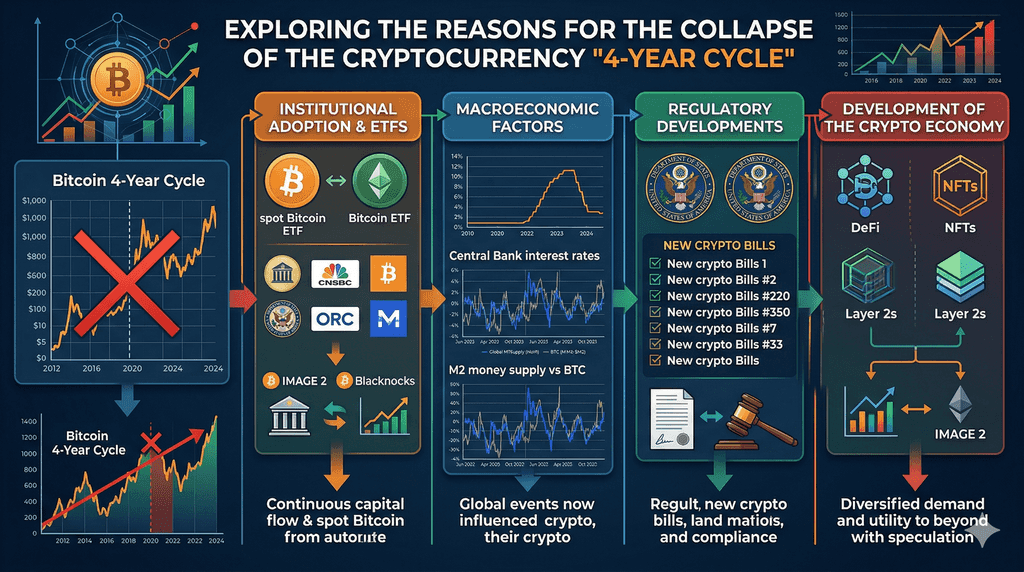
For over a decade, Bitcoin’s four-year cycle, anchored around halving events, served as a reliable framework for predicting bull and bear markets. However, recent market behavior suggests that this cycle is no longer functioning as expected. Structural shifts, including institutional capital inflows, macroeconomic dominance, and diminishing supply shocks, are transforming Bitcoin from a speculative asset into a complex macro-driven instrument, fundamentally altering its historical rhythm.
The Original Logic Behind the 4-Year Cycle
The four-year cycle in cryptocurrency was built on a simple but powerful idea: scarcity drives price. Every four years, Bitcoin undergoes a halving event, reducing the block reward for miners by 50%. Historically, this created a supply shock, tightening the availability of new coins entering the market and triggering strong bull runs. The pattern was consistent. After the 2012, 2016, and 2020 halvings, Bitcoin experienced explosive rallies followed by deep corrections of up to 80%.
This rhythm became a roadmap for traders. The timeline was almost predictable, roughly 12 to 18 months of bullish expansion followed by a sharp downturn and a prolonged bear phase. What made the cycle powerful was not just supply mechanics, but psychology. Traders began front-running halvings, reinforcing the pattern itself. It became a self-fulfilling structure where belief and behavior aligned. But that predictability may have been its weakness.
Research from the National Bureau of Economic Research highlighted how constrained supply combined with rising demand could produce outsized price movements in speculative assets. Over time, the cycle became more than just a theory, it turned into a trading strategy. Participants began positioning ahead of halvings, expecting predictable upside. This behavior reinforced the cycle itself, making it appear even more reliable. However, markets tend to adapt quickly when patterns become obvious. Once a large number of participants begin trading the same thesis, the edge disappears. What initially worked as a structural inefficiency slowly turned into a crowded trade, setting the stage for its eventual breakdown.
The 2024–2025 Cycle That Didn’t Behave Normally
The most recent cycle has raised serious doubts about whether the old pattern still holds. After the April 2024 halving, expectations were clear: a strong rally into 2025 followed by a euphoric peak. Instead, the market delivered something very different. Bitcoin reached new highs earlier than expected and then moved sideways rather than entering a classic “blow-off top” phase. More notably, 2025 broke a critical rule. Historically, the year after a halving has always been strongly positive. Yet in 2025, Bitcoin posted a decline of around 6% from its yearly open, marking the first time the pattern failed.
This deviation is not a minor anomaly, it challenges the core assumption that halvings dictate price cycles. Instead of a clean expansion and collapse, the market has shown slower, uneven growth and extended consolidation. This suggests that the forces driving Bitcoin’s price are no longer tied primarily to its issuance schedule, but to something broader and more complex.
Institutional Capital Has Changed Everything
One of the most significant shifts in recent years is the arrival of institutional capital. The launch of spot Bitcoin ETFs in early 2024 opened the floodgates for pension funds, asset managers, and corporate treasuries to gain exposure. Unlike retail traders, institutions behave differently. They are less reactive to short-term volatility and more focused on long-term allocation. This creates a stabilizing effect on the market. Instead of rapid boom-and-bust cycles, capital flows become more gradual and persistent.
This shift has fundamentally altered market structure. Large players can absorb selling pressure that would have previously triggered crashes. As a result, volatility has decreased, and price movements have become more controlled. The consequence is profound: the emotional, retail-driven cycles that once defined crypto are being replaced by slower, more deliberate trends. This dampens the dramatic peaks and troughs that characterized the four-year cycle.
The Halving No Longer Creates a Strong Supply Shock
The halving remains a core feature of Bitcoin, but its impact is diminishing. In earlier cycles, reducing block rewards significantly constrained new supply, forcing prices higher to balance demand. Today, that effect is much weaker.
By 2024, over 90% of Bitcoin’s total supply had already been mined. The latest halving reduced annual inflation from roughly 1.7% to 0.85%, a relatively small change in absolute terms. At the same time, the market has grown dramatically. Institutional buyers can acquire more Bitcoin in a single day than miners produce in weeks, effectively neutralizing the supply shock. This means the halving is no longer the dominant force it once was. While it still carries symbolic importance, its ability to drive massive price rallies has weakened. The cycle, once anchored in scarcity, is losing its foundation.
Bitcoin Is Now a Macro Asset
Another major reason for the breakdown of the four-year cycle is Bitcoin’s transformation into a macro asset. In its early years, Bitcoin operated largely in isolation. Today, it moves in response to global economic conditions. During the 2022 interest rate hikes, Bitcoin fell alongside equities. As liquidity improved between 2023 and 2025, it rallied again.
This correlation reflects a deeper shift. Bitcoin is increasingly influenced by factors such as central bank policy, inflation expectations, and global liquidity. Analysts now argue that the market is watching interest rates more closely than halving schedules. In this environment, price cycles are no longer tied to a fixed four-year rhythm. Instead, they follow broader economic waves, which are less predictable and more complex.
Market Size Has Reduced Volatility
Bitcoin is no longer a small, speculative asset. With a market capitalization exceeding $1 trillion at times, it requires significantly more capital to move prices. In earlier cycles, relatively small inflows could trigger massive rallies. Today, the scale of the market dampens volatility. Large price swings still occur, but they are less frequent and less extreme.
This change has disrupted the cycle’s timing. Instead of sharp peaks followed by rapid crashes, the market now experiences longer periods of consolidation. The “explosive” nature of previous cycles is fading, replaced by slower, more sustained movements.
The Missing Mania Phase
One of the clearest signs that the cycle is changing is the absence of a true mania phase. Previous bull markets were marked by extreme speculation, rapid price increases, and widespread public excitement. In the current cycle, that frenzy has not materialized. Despite reaching new highs, Bitcoin has largely moved sideways, without the dramatic surge that defined past peaks.
This suggests a more mature market. Speculative excess still exists, but it is less dominant. Without the emotional extremes of mania, the traditional boom-and-bust pattern becomes less pronounced.
Liquidity Cycles Are Replacing Halving Cycles
Increasingly, analysts are linking Bitcoin’s behavior to global liquidity cycles rather than its internal mechanics. When liquidity expands, risk assets, including Bitcoin, tend to rise. When liquidity contracts, they fall. Research shows that Bitcoin peaks often align with peaks in global money supply growth, rather than halving events.
This shift reframes how the market operates. Instead of a predictable four-year rhythm, Bitcoin now moves in sync with broader financial conditions. This makes cycles longer, less defined, and harder to predict.
Early Price Discovery Has Changed Timing
Another major deviation is that Bitcoin reached new all-time highs before the 2024 halving, something that had never happened before. This suggests that markets are becoming more forward-looking. Participants are pricing in expected events earlier, reducing the impact of the halving itself.
As a result, the cycle is no longer anchored to a specific timeline. Price discovery happens continuously, rather than in predictable phases.
Leverage and Liquidations Still Matter, But Differently
While the market has matured, leverage still plays a role. Large liquidation events continue to influence price movements, but their impact is more localized.
For example, a $19 billion liquidation event in 2025 triggered a sharp sell-off, highlighting the ongoing influence of derivatives markets. However, these events no longer define entire cycles. Instead, they create short-term volatility within a broader, more stable trend.
The Cycle May Be Stretching, Not Disappearing
Some analysts argue that the four-year cycle is not dead but growing. Instead of disappearing, it may be stretching into longer timeframes, potentially extending into five or more years. This would reflect the growing complexity of the market. As new participants and factors emerge, cycles become less rigid and more fluid.
A New Market Structure Is Emerging
The cryptocurrency market is entering a new phase of maturity, moving beyond the extreme swings driven by retail speculation and predictable hype cycles. In its early years, crypto’s rhythm was largely dictated by emotional trading and scarcity-driven halving events, which created sharp booms and dramatic busts. Today, however, price behavior is influenced by a wider set of factors, including macroeconomic trends, liquidity flows, and the growing scale of the market itself.
Long-term holders and broader market dynamics now play a more stabilizing role. Large accumulations of Bitcoin reduce the coins available for speculative trading, slowing rapid price swings and extending periods of consolidation. The result is a market that is calmer, more deliberate, and less prone to sudden, extreme surges or crashes.
This evolution has fundamentally altered how price cycles behave. The once-reliable four-year rhythm, anchored around halving events, no longer dictates market movements with precision. Instead, cycles are becoming longer, more fluid, and harder to predict, reflecting the interplay between supply, demand, and global financial conditions.
In this emerging structure, volatility is moderated, and growth tends to unfold more gradually. While this stability can benefit long-term participants, it also challenges traders who relied on the old patterns. The cryptocurrency market is now a complex, interconnected system where the simple rules of the past have given way to nuanced trends, requiring a more sophisticated approach to understanding its behavior and anticipating its cycles.
From Halving Cycles to Macro Cycles: Why Bitcoin’s Predictable Rhythm Is Breaking Down
For most of its history, Bitcoin moved to an internal clock. The halving cycle dictated supply, and supply dictated price behavior. This created a rhythm that traders could anticipate: accumulation before the halving, expansion after it, and eventual correction. But that framework depended on Bitcoin operating in relative isolation. Today, that condition no longer exists. Bitcoin is increasingly integrated into the global financial system, and as a result, its price is being shaped less by its own mechanics and more by external forces such as interest rates, liquidity conditions, and institutional capital flows.
The shift became more visible following the approval of spot Bitcoin ETFs and the entry of firms like BlackRock and Fidelity. These players do not trade based on halving narratives; they allocate capital based on macroeconomic signals, portfolio diversification strategies, and long-term risk management frameworks. When capital of this scale enters the market, it changes behavior. Instead of sharp, sentiment-driven rallies, price movements become more gradual and tied to broader cycles in global liquidity. In this environment, Bitcoin reacts more like a macro asset, similar to equities or commodities, rather than a purely speculative instrument driven by internal supply shocks.
This transformation explains why the traditional four-year cycle is losing its predictive power. The halving still reduces new supply, but its impact is diluted in a market where daily trading volumes and institutional inflows far exceed miner issuance. At the same time, macro forces, such as central bank tightening or easing, can override any supply-driven narrative. The result is a market that no longer adheres to a fixed timeline but instead moves in sync with global economic conditions. Bitcoin’s rhythm is not disappearing; it is evolving into something more complex, where understanding macro trends matters as much as understanding blockchain mechanics.
Conclusion
The collapse of the four-year cycle is not a failure, it is a sign of evolution. Bitcoin has outgrown the conditions that once defined it. What worked in a small, speculative market no longer applies to a trillion-dollar asset integrated into global finance.
The halving still matters, but it is no longer the main driver. Instead, Bitcoin is shaped by liquidity, institutions, and macroeconomic forces. The result is a market that is more stable, but also more complex. For traders and investors, this means one thing: the old playbook is no longer enough.
FAQs
1. Is the Bitcoin 4-year cycle completely dead?
Not necessarily. Many analysts believe it is evolving rather than disappearing, with longer and less predictable timelines.
2. What replaced the 4-year cycle?
Macro factors like liquidity, interest rates, and institutional flows are now more influential.
3. Do halvings still matter?
Yes, but their impact is smaller compared to earlier cycles.
4. Why is Bitcoin less volatile now?
Institutional participation and larger market size have stabilized price movements.
5. What should investors focus on now?
Global liquidity, macro trends, and market structure are increasingly important indicators.
Disclaimer
This content is for informational purposes only and does not constitute investment advice. Cryptocurrency investments carry risk. Please do your own research (DYOR).