

Uniswap v4 Hooks and the Mechanism Coin Boom: Why This New Crypto Trend Exploded
2026/05/14 17:57:02
Overview
-
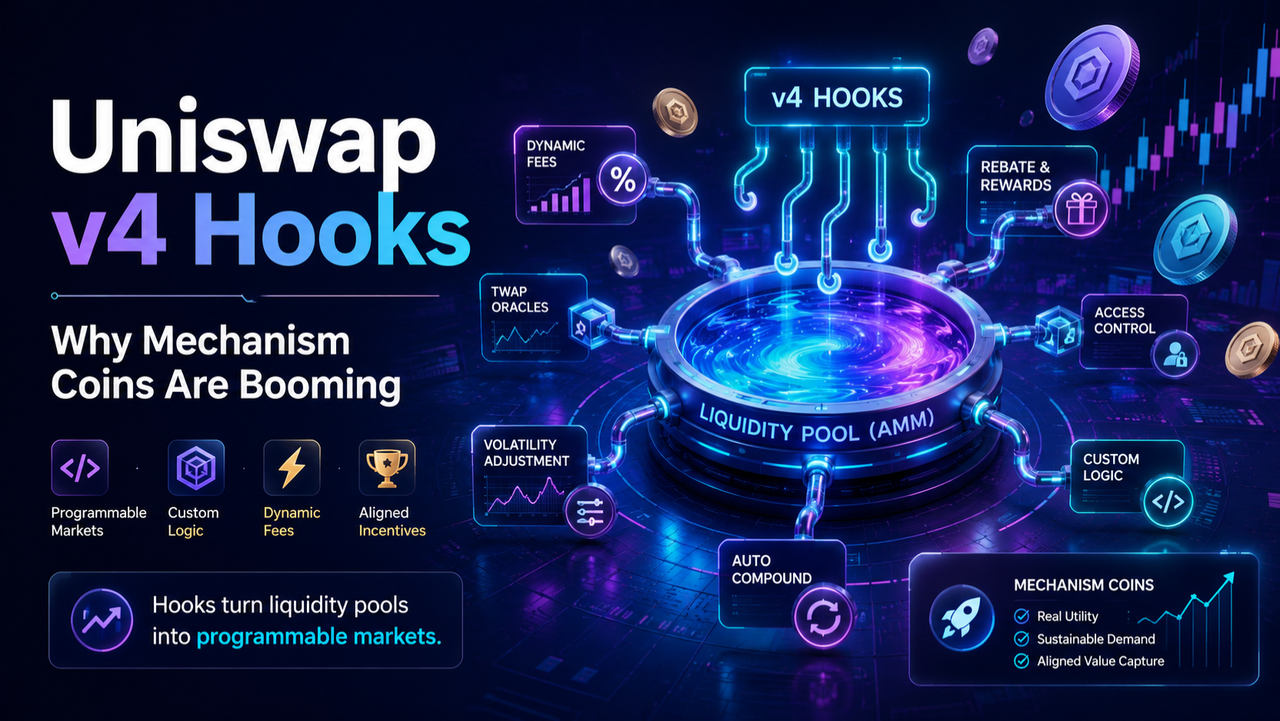
Uniswap v4 hooks allow developers to add custom rules to liquidity pools.
-
These hooks turn liquidity pools from simple trading venues into programmable markets.
-
Mechanism coins are tokens built around on-chain systems such as burns, buybacks, rewards, dynamic fees, or liquidity incentives.
-
The trend became popular because traders wanted something beyond ordinary memecoins.
-
Mechanism coins combine memecoin-style excitement with DeFi-style tokenomics.
-
Uniswap v4 hooks make it easier for builders to create custom token mechanisms without launching a full DeFi protocol.
-
The new hook economy gives projects more ways to design incentives, attract liquidity, and build stronger token narratives.
-
However, not every mechanism creates real value, so traders should watch for risks like smart contract bugs, hidden fees, liquidity traps, and unsustainable rewards.
Introduction
Uniswap v4 hooks have created a new wave of interest in mechanism coins. By allowing developers to add custom logic to liquidity pools, hooks make it possible for tokens to have built-in on-chain systems like burns, rewards, dynamic fees, and liquidity incentives. This gives traders something beyond hype: a token that feels powered by an economic mechanism.
What Are Uniswap v4 Hooks?
Uniswap is one of the most important decentralized exchanges in crypto. It made token swapping easier by allowing users to trade directly through liquidity pools instead of using traditional order books.
Each major version of Uniswap has added something new. Uniswap v2 made decentralized swaps simple and widely used. Uniswap v3 introduced concentrated liquidity, which helped liquidity providers use their capital more efficiently.
Uniswap v4 goes a step further with hooks.
A hook is a smart contract that can be attached to a Uniswap v4 liquidity pool. It lets developers add custom rules that run before or after actions like swaps, adding liquidity, removing liquidity, or launching a pool.
Hooks allow liquidity pools to behave differently based on their purpose.
For example, one pool could use dynamic fees. Another could reward long-term liquidity providers. Another could send part of each trade to a project treasury. A new token launch could even use hooks to reduce bot activity.
This is why Uniswap v4 hooks are so important. They turn liquidity pools from simple trading venues into programmable financial systems.
Uniswap v4 Hooks: How Programmable Liquidity Created Mechanism Coins
Uniswap v4 hooks changed liquidity pools from passive trading venues into programmable markets. Before hooks, pools mainly handled swaps and paid fees to liquidity providers. With hooks, developers can add custom rules that run when users swap, add liquidity, or interact with a pool.
This makes it possible to build tokens around visible on-chain actions. A hook can support dynamic fees, token burns, LP rewards, automated buybacks, treasury funding, anti-bot rules, or community rewards.
That is where mechanism coins come in. A mechanism coin is a token built around a programmed economic rule. Unlike a memecoin, which mostly sells attention and community hype, a mechanism coin sells a system.
The key question becomes: what happens when people trade this token?
If every trade powers burns, rewards, liquidity growth, or another useful process, the token feels more active and structured. This is why Uniswap v4 hooks made mechanism coins easier to build and easier to market.
The Rise of Mechanism Coins From Meme Narratives to On-Chain Economic Machines
Mechanism coins became popular because they gave traders something new after the memecoin boom. People still wanted tokens that were exciting, simple to understand, and full of upside potential, but they also wanted a stronger reason to believe in them.
Instead of depending only on jokes, mascots, influencers, or viral posts, mechanism coins offer a built-in on-chain system. They still have the fast, attention-driven energy of memecoins, but they add something extra: a programmed rule that makes the token feel more active and useful.
That is what makes them different.
A regular memecoin usually says, “Buy this because the community is strong.”
A mechanism coin says, “Buy this because every trade, fee, or liquidity action helps power the system behind the token.”
This kind of story works well in crypto because traders like simple ideas that also feel smart. Mechanism coins give them both: the excitement of speculation and the feeling that there is real economic logic behind the token.
Why Traders Moved Beyond Pure Meme Narratives
Memecoins proved that crypto markets do not always need traditional fundamentals to create demand. A simple meme, fast liquidity, strong community participation, and viral branding can create huge market attention.
But after thousands of similar meme launches, the market began to feel overcrowded. Many traders still wanted high-risk, high-upside opportunities, but they wanted a new reason to believe.
Mechanism coins filled that gap.
They gave traders something that looked more structured than a pure meme. Burns, buybacks, fee sharing, LP rewards, anti-bot systems, and dynamic fees all created the feeling that the token had a machine working behind it.
That machine may be genuinely useful, or it may simply be good marketing. But either way, it gives the token a stronger story than a meme alone.
This is why mechanism coins became so appealing. They made speculation feel more intelligent.
How On-Chain Mechanisms Create a Stronger Token Story
The strength of mechanism coins comes from visibility. When a token has an on-chain rule, users can understand the token through action rather than promises.
For example, a project can say that trading volume supports liquidity growth. Another can design fees that fund a treasury. Another can create a burn mechanism that reduces supply when volume increases. Another can reward liquidity providers or long-term participants based on pool activity.
These mechanisms make tokenomics feel active.
Traditional tokenomics often exists in a whitepaper. Mechanism coins bring tokenomics into the market itself.
This creates a simple and powerful story:
More trading creates more fees.
More fees trigger burns, rewards, or liquidity growth.
More visible activity attracts more attention.
More attention brings more trading.
That feedback loop is extremely attractive in crypto. It gives traders a reason to believe price action is connected to usage, not just hype.
From Community Tokens to Economic Machines
The biggest change is that mechanism coins turn tokens into systems.
A normal community token depends mostly on belief, identity, and social momentum. A mechanism coin adds programmed behavior that can be measured, tracked, and marketed.
Every swap can become an event. Every fee can become fuel. Every liquidity action can become part of the story.
The token is no longer only a symbol for a community. It becomes the front end of a market mechanism.
That is why Uniswap v4 hooks made this narrative especially powerful. Hooks allow custom logic to live directly around liquidity pools, which means the mechanism can sit close to the place where trading actually happens.
For traders, this makes the token easier to understand. For builders, it creates a new way to design market behavior. For communities, it creates a stronger story to promote.
Mechanism coins became popular because they combine the viral appeal of memecoins with the appearance of DeFi-style utility. They are fast, speculative, and narrative-driven, but they also offer a visible system that claims to create value from activity.
Why the Trend Exploded: Speculation, Tokenomics, and the New Hook Economy
The rise of mechanism coins did not happen overnight. It was the result of several trends coming together at the same time: memecoin fatigue, the demand for stronger token stories, the launch of Uniswap v4 hooks, and the crypto market’s constant search for the next big narrative.
Uniswap v4 hooks arrived at the perfect moment. Traders were already used to fast-moving meme markets, but many wanted something that felt more advanced than another mascot token. At the same time, builders wanted easier ways to create custom incentives without building an entire DeFi protocol from scratch.
Hooks solved both problems.
They gave builders a way to turn liquidity pools into programmable token engines. Instead of a pool simply handling swaps, it could now support custom rules, dynamic fees, rewards, burns, treasury funding, anti-bot systems, and other on-chain mechanisms.
That is why the trend spread so quickly. Mechanism coins combine the viral energy of memecoins with the economic language of DeFi tokenomics, programmable liquidity, and on-chain automation.
Speculation Needed a New Story
Crypto markets are driven by narratives. When one trend becomes too crowded, traders start looking for the next one.
Memecoins became popular because they were simple, social, and easy to trade. But after thousands of similar launches, the market needed a fresh angle. Traders still wanted high-risk, high-reward opportunities, but they also wanted a stronger reason to believe in them.
Mechanism coins gave them that reason.
They kept the familiar memecoin formula: fast launches, strong communities, viral marketing, and speculative upside. But they added something new: a built-in economic system.
Instead of saying, “This coin could go up because people like the meme,” a mechanism coin can say, “This coin has a system where trading volume can trigger burns, reward liquidity providers, fund the treasury, or strengthen the ecosystem.”
That makes the speculation feel more logical. Even when the mechanism is simple, it gives traders a story that sounds more convincing than hype alone.
Tokenomics Became More Active
Traditional tokenomics often feels static. A project may publish its token supply, vesting schedule, staking rewards, and treasury allocation. These details are important, but they do not always create an active experience for traders.
Mechanism coins changed that by making tokenomics feel alive.
With Uniswap v4 hooks and programmable liquidity pools, a token’s economics can respond to market activity. Every swap, fee, or liquidity change can become part of the system. Trading volume can support burns. Fees can reward LPs or holders. Pool activity can help fund development. Dynamic rules can adjust costs based on volatility, demand, or user behavior.
This makes the token story easier to follow in real time.
Traders can watch volume increase and feel like the mechanism is getting stronger. They can see fees build up and imagine buybacks, rewards, or deeper liquidity. They can connect market activity with the token’s economic design.
That visibility is powerful in crypto. Traders do not only follow fundamentals. They follow charts, dashboards, narratives, and feedback loops. Mechanism coins give them more things to watch, discuss, and believe in.
The Hook Economy Created a Builder Gold Rush
Uniswap v4 hooks also created a major opportunity for developers.
Before hooks, building custom DeFi mechanics often required launching a full protocol, creating a separate AMM, or designing complex smart contract systems. With hooks, builders can add custom behavior directly to a Uniswap v4 liquidity pool.
This lowers the barrier to experimentation.
A team can test new fee models, launch rules, LP incentives, anti-bot systems, creator rewards, liquidity strategies, or reward loops around a pool. Each hook can become the foundation for a new token, product, or community.
This is what people mean by the hook economy.
In the hook economy, value is not only created by the token itself. It is also created by the mechanism attached to the token’s market. A strong hook can become a competitive advantage. A pool with better incentives can attract more liquidity. A token with a clearer mechanism can attract more attention. A community with a stronger economic loop can market itself more effectively.
That is why mechanism coins exploded as a crypto trend. They gave traders a new speculative category, gave builders a new design surface, and gave projects a better way to explain why their token matters.
Uniswap v4 hooks turned liquidity pools into programmable markets, and mechanism coins turned that technical upgrade into a powerful market narrative.
Key Types of Mechanism Coins Emerging Around Uniswap v4 Hooks
The mechanism coin trend is still new, but some clear categories are already starting to appear. These categories show why traders, builders, and DeFi communities are paying close attention to Uniswap v4 hooks.
Hooks make it easier to design tokens with built-in rules. Instead of simply launching a token and hoping people trade it, projects can create mechanisms that react to market activity. These mechanisms may burn supply, grow liquidity, adjust fees, reduce bot activity, or share rewards with the community.
-
Burn Mechanism Coins
Burn mechanism coins use trading activity to reduce token supply. The idea is simple: when people trade the token, part of the fee or token amount is burned.
This creates an easy story for traders to understand:
More trading means more burning. More burning means lower supply.
That scarcity narrative is powerful because many crypto traders already understand the idea of supply reduction. If demand stays strong while supply decreases, the token can appear more attractive.
However, burns are not automatically valuable. A burn mechanism only matters if people actually want the token. Reducing supply does not create long-term value by itself. If there is no real demand, burning tokens may only become a marketing trick.
-
Liquidity Growth Coins
Liquidity growth coins focus on making the token’s market stronger over time. In this model, part of the trading fees may be used to deepen liquidity, reward liquidity providers, or support more stable trading conditions.
This is important because many new tokens suffer from weak liquidity. When liquidity is low, prices can move too sharply, slippage becomes high, and large buyers or sellers can easily affect the market.
A well-designed liquidity growth mechanism can help solve this problem. It can make trading smoother, improve confidence, and create a healthier market structure.
Still, the design needs to be clear. If users do not understand where the fees go or how liquidity is being improved, the mechanism may lose trust.
-
Dynamic Fee Coins
Dynamic fee coins use changing market conditions to adjust trading fees. For example, fees may increase during high volatility and decrease when the market is calmer.
This type of mechanism can be useful because not every token needs the same fee structure. A stable asset, a volatile memecoin, and a new experimental token all behave differently. A fixed fee model may not always be the best fit.
With Uniswap v4 hooks, dynamic fees can help make pools more adaptive. They may protect liquidity providers during risky periods, reduce harmful trading behavior, and improve market efficiency.
This is one of the more serious use cases for mechanism coins because it is not just about creating hype. It can directly improve how the market works.
-
Anti-Bot and Fair Launch Coins
Anti-bot and fair launch coins are designed to reduce problems during new token launches. Many launches are affected by bots, snipers, and automated traders that buy early and sell quickly, often hurting regular users.
Hook-based mechanisms can help reduce this by adding custom launch rules. These may include timing restrictions, wallet limits, changing fees, or other protections during the early trading period.
This type of mechanism is attractive because it promises a fairer launch environment. Retail traders like the idea that they are not entering a market already dominated by bots.
However, fair launch mechanisms must be handled carefully. If the rules are too strict, unclear, or controlled by insiders, they can create new unfair advantages. A fair launch system should protect users, not trap them.
-
Reward and Redistribution Coins
Reward and redistribution coins send part of the trading fees back to holders, liquidity providers, creators, or community treasuries. This creates a direct connection between market activity and community rewards.
The idea is simple: if the token gets more trading activity, the system has more value to distribute.
This narrative is powerful because users feel more connected to the token’s success. Instead of only watching the price, they can see how activity supports rewards, treasury growth, or liquidity incentives.
But this model also has risks. Reward systems can become unsustainable if they depend only on constant trading volume. When volume drops, rewards may shrink quickly, and the story can lose strength.
A strong reward mechanism should support long-term participation, not just short-term excitement.
The Risks Behind the Mechanism Coin Trend
The biggest risk is that “mechanism” becomes just another marketing word. A token can have a Uniswap v4 hook and still fail to create real value. Custom logic does not automatically make a project useful, fair, or sustainable.
-
Smart contract bugs: Custom hook code may contain vulnerabilities, especially if it is unaudited or poorly tested.
-
Hidden fee extraction: Some projects may quietly route fees to insiders, private wallets, or the team instead of benefiting users.
-
Liquidity traps: Custom pool rules may make it harder or more expensive for traders to exit their positions.
-
Unsustainable rewards: Reward systems can look attractive at first but may collapse when trading volume slows down.
-
False flywheels: Some mechanisms only work during hype. Once attention fades, the economic loop may stop producing value.
-
Governance abuse: If the team can change fees, rules, or parameters too easily, users may face unfair changes.
-
Bot exploitation: Complex mechanisms can create new opportunities for bots, arbitrage traders, or advanced market participants.
Explore the Uniswap v4 hook economy with KuCoin and learn how programmable liquidity is shaping the next wave of DeFi. For deeper reading, check KuCoin’s guides on how Uniswap v4 hooks actually work and how Uniswap v4 hooks create a new strategy layer.
Conclusion
Mechanism coins became popular because they combine memecoin-style excitement with DeFi-style tokenomics. Uniswap v4 hooks made this possible by turning liquidity pools into programmable markets. Still, not every mechanism creates real value, so traders should focus on transparency, security, and whether the system actually improves the token’s market.
FAQs
What are Uniswap v4 hooks?
Uniswap v4 hooks are smart contracts that add custom rules to liquidity pools.
What are mechanism coins?
Mechanism coins are tokens built around on-chain systems like burns, rewards, buybacks, or dynamic fees.
Why did mechanism coins become popular?
They became popular because traders wanted tokens that felt more useful and structured than ordinary memecoins.
How do hooks help mechanism coins?
Hooks allow token mechanisms to run directly inside liquidity pools when users trade or add liquidity.
Are mechanism coins different from memecoins?
Yes. Memecoins mainly rely on hype, while mechanism coins add programmed economic rules.
Are mechanism coins risky?
Yes. Risks include smart contract bugs, hidden fees, liquidity traps, and unsustainable rewards.
Can mechanism coins create real value?
Yes, but only if the mechanism improves liquidity, incentives, or market behavior instead of just creating hype.
Disclaimer
The information provided on this page may originate from third-party sources and does not necessarily represent the views or opinions of KuCoin. This content is intended solely for general informational purposes and should not be considered financial, investment, or professional advice. KuCoin does not guarantee the accuracy, completeness, or reliability of the information, and is not responsible for any errors, omissions, or outcomes resulting from its use. Investing in digital assets carries inherent risks. Please carefully evaluate your risk tolerance and financial situation before making any investment decisions. For further details, please consult KuCoin’s Terms of Use and Risk Disclosure.