

Inside Paradigm’s $1.2 Billion Bet: The Convergence of Crypto and AI Agents
2026/07/12 13:00:00
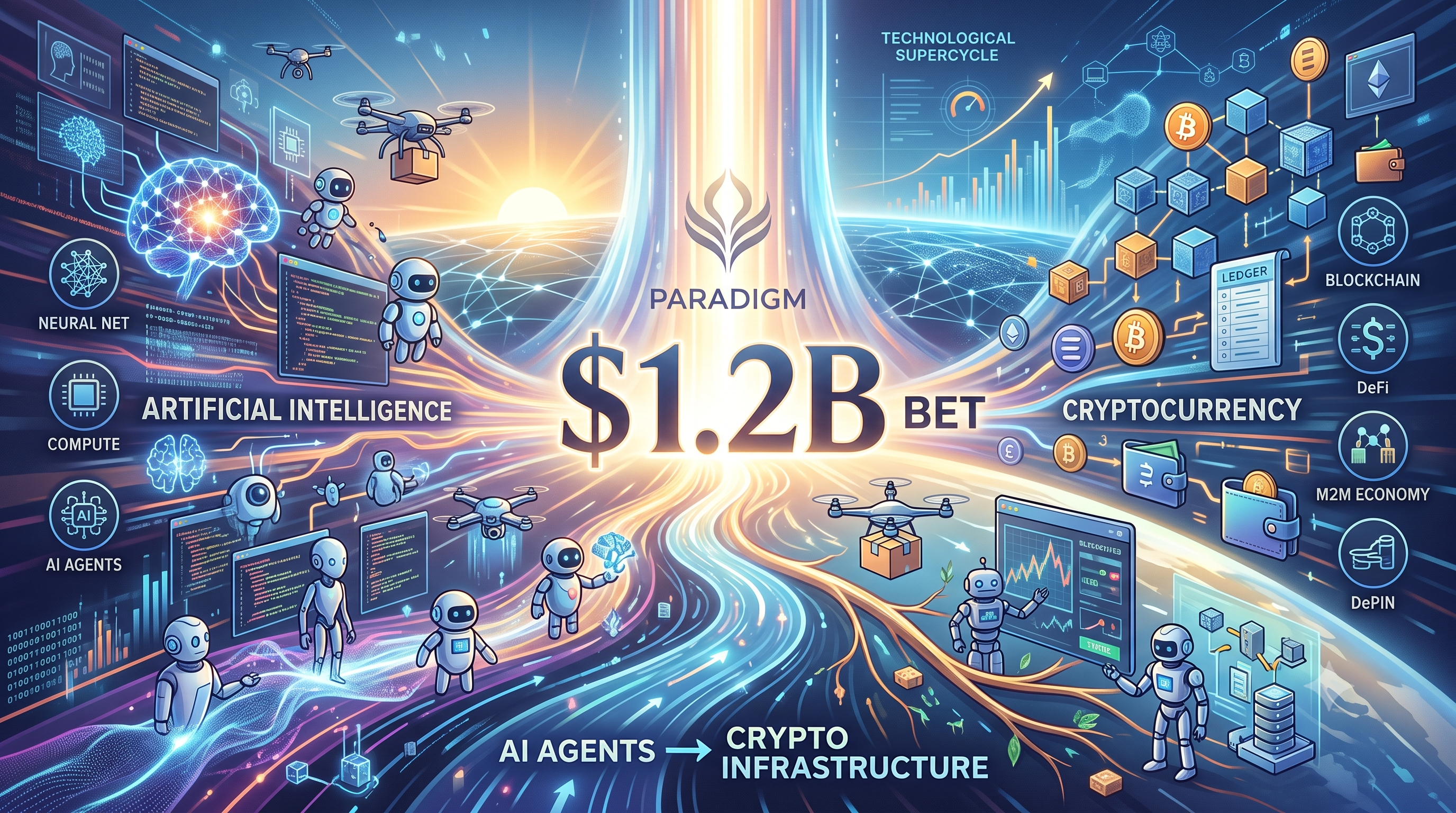
Imagine, for a moment, the next massive cryptocurrency whale making waves on-chain. This entity is executing complex arbitrage strategies, trading millions of dollars in microseconds, and paying for decentralized server space—all without ever sleeping. The plot twist? This whale is not a human being. It is an autonomous Artificial Intelligence agent navigating the blockchain.
In July 2026, Paradigm—one of the most influential venture capital firms in the Web3 space—made a seismic announcement that validated this very future. The firm successfully closed its fourth fund, raising a staggering $1.2 billion. But this wasn't just another massive capital injection into decentralized finance (DeFi) or layer-1 blockchains. Paradigm officially declared a strategic pivot: they are broadening their investment mandate beyond pure digital assets to aggressively pursue the intersection of crypto, artificial intelligence, robotics, and frontier technologies.
This is not merely a rebranding exercise for a single VC firm. Paradigm’s $1.2B fund of 2026 marks a watershed moment for the entire Web3 industry. It signals a fundamental shift in how smart money views the future of technology: not in silos, but as a deeply integrated ecosystem where crypto serves as the native financial infrastructure for a world dominated by AI agents and machine learning.
Here is a deep dive into why Paradigm is making this historic bet, the undeniable convergence of crypto and AI integration, and what it means for your portfolio in the next technological supercycle.
The $1.2 Billion Plot Twist: What Did Paradigm Just Do?
To understand the magnitude of this shift, we have to look at the historical context of Paradigm. Founded in 2018 by Matt Huang and Fred Ehrsam, Paradigm built its formidable reputation by being stubbornly "crypto-native." They were the visionary early backers of titans like Coinbase, Uniswap, and MakerDAO. They funded the infrastructure that built the modern Web3 ecosystem.
When murmurs began circulating in early 2026 that Paradigm was seeking $1.5 billion for a new fund, the industry expected more of the same. Ultimately closing at $1.2 billion, the sheer size of the fund is a massive vote of confidence in a post-bear-market world. However, the mandate accompanying this capital is what truly shocked the ecosystem.
The Strategy Shift
Paradigm is no longer strictly a digital asset fund. They are officially deploying capital into artificial intelligence, decentralized AI compute, and physical frontier tech (including robotics and space). They recognize that isolating Web3 from the explosion of AI innovation is a losing strategy. By adopting a "Crypto + AI" dual-track approach, they are positioning themselves at the bleeding edge of where the digital economy is actually heading.
The Team Dynamics
Interestingly, Paradigm has chosen not to spin up a completely separate, siloed team of AI experts. Instead, they are relying on their existing core technical investment team to bridge the gap. This speaks volumes about their underlying thesis: the architecture of decentralized networks and the architecture of advanced AI are becoming so intertwined that understanding one soon requires understanding the other. The crypto developers of today are the AI agent architects of tomorrow.
The Perfect Match: Why AI and Crypto Are Merging
The immediate reaction from some crypto purists was skepticism. Is this just VC FOMO? A desperate attempt to catch the AI hype train? The reality is far more foundational. Artificial intelligence and cryptocurrency are not competing narratives; they are the ultimate complementary technologies. They solve each other's biggest existential crises.
Right now, the AI industry is facing massive bottlenecks. Compute power is increasingly monopolized by a handful of mega-corporations (Big Tech). The data used to train these models is plagued by copyright disputes and a lack of verifiable ownership. Furthermore, as generative AI floods the internet with deepfakes, proving what is real and what is synthetic has never been more difficult.
Web3 inherently provides the decentralized infrastructure to solve these exact problems. Blockchain technology offers permissionless access, cryptographic verification, and decentralized resource allocation.
Synergy Matrix: How Web3 Solves AI Bottlenecks
| AI Industry Bottlenecks | Web3 / Crypto Solutions |
| Compute Monopolies (Big Tech hoarding GPUs) | Decentralized Compute Networks (DePIN, Akash, Render) pooling idle global hardware. |
| Black-box Data Models (Unclear origins of training data) | Blockchain Verification tracking data provenance and enabling tokenized ownership/royalties. |
| Financial Exclusion (AI agents cannot open bank accounts) | Crypto Wallets & Smart Contracts allowing permissionless, instant micro-transactions. |
| Deepfakes & Misinformation (Inability to trust digital media) | Cryptographic Signatures & ZK-Proofs verifying human authenticity and data integrity. |
When you look at this matrix, Paradigm's pivot isn't a distraction—it is a logical evolution. Machine learning crypto projects are building the essential trust and settlement layers that AI desperately needs to scale safely.
Meet the New Whales: Why AI Agents Need Blockchain
The most compelling narrative driving the crypto and AI integration is the rise of AI Agents. Unlike traditional AI chatbots (like the early versions of ChatGPT) that simply return text based on a prompt, AI agents are autonomous. They are designed to pursue goals, make decisions, interact with other software, and execute complex workflows without human intervention.
But here is the critical flaw in the current system: autonomous AI agents cannot participate in the traditional economy.
If an AI agent needs to rent an AWS server, scrape a paid database, or hire another AI to process a specialized task, how does it pay? It cannot walk into a Chase branch and open a checking account. Traditional financial rails like Visa, Mastercard, or Stripe require KYC (Know Your Customer), social security numbers, and human identities.
The Machine-to-Machine (M2M) Economy
This is where blockchain becomes indispensable. Crypto is the native money of the internet. An AI agent can spin up a self-custodial wallet in milliseconds, holding Ethereum, stablecoins, or specific utility tokens. It can interact with smart contracts to execute trades, pay for decentralized server bandwidth, or compensate human data labelers.
Furthermore, AI agents operate at blistering speeds. Traditional banking takes days to settle; blockchains like Solana or Ethereum Layer-2s settle in seconds, allowing for micro-transactions worth fractions of a cent.
Real-World Use Cases on the Horizon:
-
DeFi Arbitrage: AI agents autonomously scanning decentralized exchanges (DEXs) to execute complex, multi-hop arbitrage trades, paying their own gas fees.
-
Automated Resource Procurement: An AI agent running low on processing power automatically dips into its crypto wallet to buy more GPU time from a Decentralized Physical Infrastructure Network (DePIN).
-
Content Monetization: AI curators scouring the web for niche research, packaging it, and selling it via micro-payments mediated by smart contracts.
Following the Smart Money: Inside Paradigm’s New Portfolio
If you want to find the true Alpha, you have to follow where the smart money is actually deploying its capital. Even before the official $1.2B announcement, Paradigm had quietly begun expanding its portfolio far beyond pure digital assets, planting flags in frontier tech and AI.
💡 Beyond Traditional Web3
Look at their recent investments:
-
Zipline: A massive autonomous drone delivery and logistics company.
-
True Anomaly: A space defense and orbital technology startup.
-
SendCutSend: A rapid manufacturing platform.
-
Nous Research: A highly respected AI research organization focused on developing autonomous AI agents (like the Hermes Agent).
At first glance, drones, space defense, and AI labs have nothing to do with blockchain. But look closer.
The Missing Link
What do autonomous drones, AI agents, and orbital tech have in common? They are all non-human, highly automated entities that require secure, verifiable, and decentralized networks to communicate and transact.
Paradigm is simultaneously funding the physical/AI layer (Nous Research, Zipline) and the crypto infrastructure layer (tools like Foundry, Reth, and EVMbench—a smart contract security benchmark co-developed with OpenAI). The endgame is clear: Paradigm is funding both the AI agents of the future and the decentralized financial rails those agents will use to interact with the world.
Is "Pure Crypto" Dead? Unpacking the VC Exodus
With Paradigm—the poster child of crypto venture capital—broadening its horizons, a wave of anxiety has washed over the crypto-native community. Is pure crypto dead? Are VCs abandoning Web3 for the shiny new toy of AI?
The Macro Shift
The reality is that Paradigm is not alone. Other top-tier funds like Framework Ventures and Haun Ventures have also expanded their mandates to include AI. The days of throwing $50 million at a poorly coded fork of a DeFi protocol just because it has a new token ticker are over. The speculative frenzy of the past has been washed out.
Reassuring the Market
This pivot does not signal the death of crypto; it signals its maturation. Web3 is transitioning from an isolated casino of speculative tokens into a critical backend infrastructure layer for the world's most advanced technologies.
"Pure crypto" isn't dying—it is being integrated. Cryptography, decentralized consensus, and tokenized incentives are proving to be the missing puzzle pieces for AI scalability. If anything, this macro shift validates the core thesis of blockchain technology: that the internet needs a permissionless, trustless settlement layer.
The Bottom Line: How to Survive the Crypto-AI Supercycle
Paradigm’s $1.2 billion fund of 2026 is a massive bet on a decentralized, intelligent future. It is a loud, billion-dollar alarm bell signaling that the next wave of technological wealth will not be created in isolated silos, but at the violent, rapid intersection of Web3 and Artificial Intelligence.
For investors, developers, and crypto natives, the playbook is clear. To survive and thrive in this impending Crypto-AI supercycle, you must look beyond traditional DeFi and meme coins. Focus your research on Decentralized Physical Infrastructure Networks (DePIN), permissionless compute markets, Zero-Knowledge Proof (ZKP) verification systems, and protocols building the wallet and payment infrastructure explicitly designed for autonomous AI agents. The future belongs to the machines, but the machines will run on crypto.
Frequently Asked Questions (FAQs)
Will AI agents actually have to pay gas fees on Ethereum?
Yes, but they are highly unlikely to operate on the congested Ethereum Layer-1 where fees can be prohibitively expensive. AI agents require high-frequency, low-latency execution. They will predominantly utilize highly scalable Layer-2 rollups (such as Base, Arbitrum, or Optimism) or dedicated, high-performance Layer-1 networks (like Solana or Monad), allowing them to execute thousands of micro-transactions with gas fees measured in fractions of a cent.
Does Paradigm’s pivot mean they are abandoning DeFi and NFTs?
Absolutely not. Decentralized Finance (DeFi) is the exact sandbox where AI agents will first achieve true economic autonomy. DeFi protocols are permissionless, meaning an AI can trade, borrow, and lend without human intervention. Paradigm is still deeply committed to funding core crypto infrastructure; they are simply realizing that the primary users of these DeFi protocols in the future will likely be AI scripts, not human retail traders.
What is the difference between an AI crypto coin and AI agent infrastructure?
It is vital to separate the hype from the utility. An "AI crypto coin" is often just a traditional token or meme coin that has slapped the word "AI" onto its marketing materials to capitalize on retail FOMO, with zero underlying machine learning technology. Conversely, "AI agent infrastructure" refers to legitimate foundational protocols—such as decentralized compute networks, cryptographic data verification systems, and machine-readable smart contracts—that actually allow complex AI models to operate, own assets, and execute tasks on the blockchain.
Disclaimer: This content is for informational purposes only and does not constitute investment advice. Cryptocurrency investments carry risk. Please do your own research (DYOR).