

Is Crypto Crashing? 2026 Market Analysis, Key Triggers, and What’s Next?
2026/03/26 16:00:03
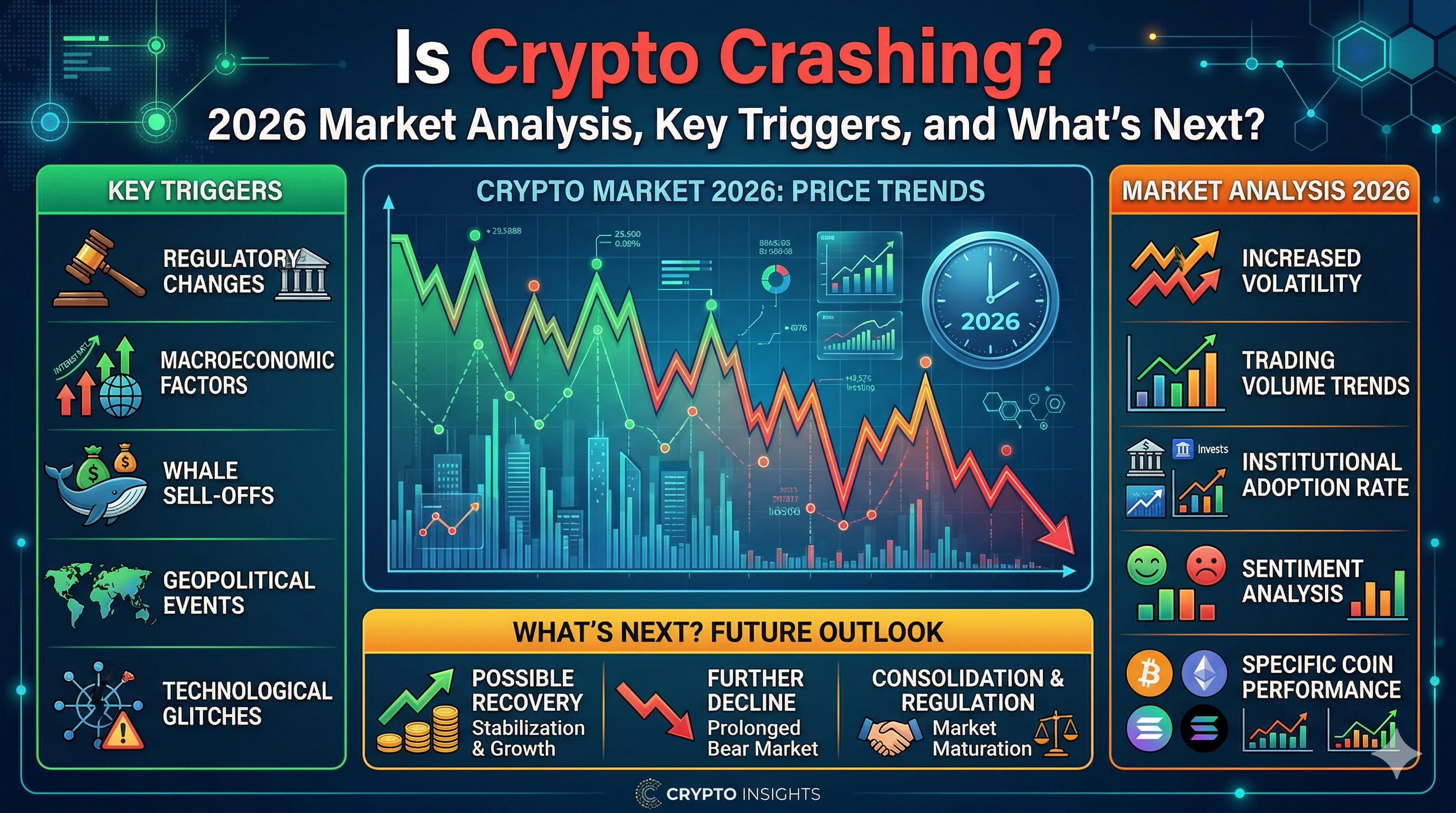
The central question dominating every trading desk from New York to Singapore remains: Is crypto crashing? Or are we simply witnessing the most significant "shakeout" in the history of the asset class? As of late March 2026, the total cryptocurrency market capitalization has retreated significantly from its $4.1 trillion peak, currently oscillating around $2.27 trillion. With Bitcoin experiencing a year-to-date decline of nearly 20% and the "Altcoin Fear Index" hitting levels not seen since the 2022 collapse, the psychological weight on investors is immense.
This exhaustive 2026 market analysis explores the structural, macroeconomic, and technical reasons behind the current downturn and provides a roadmap for what comes next.
Key Takeaways
-
The Price Correction: Bitcoin has retraced from its 2025 peak of $126,000 to a support zone between $68,000 and $72,000.
-
The "Liquidity Vacuum": The Federal Reserve’s decision to hold interest rates at 3.5%–3.75% longer than expected has sucked speculative liquidity out of risk assets.
-
ETF Maturity: The initial "hype phase" of Spot ETFs has transitioned into a "maintenance phase," where outflows are now a regular part of the market cycle.
-
Regulatory Reckoning: The U.S. Clarity Act of 2026 is currently in the Senate, creating a "wait-and-see" approach among large-scale institutional allocators.
-
The Broken Cycle Theory: 2026 is the first time in history where Bitcoin did not follow the traditional 4-year post-halving trajectory, peaking earlier and correcting deeper.
-
DeFi vs. CeFi: Decentralized Finance (DeFi) protocols have shown remarkable resilience compared to centralized exchanges, which are facing increased scrutiny over "Proof of Solvency" 2.0.
Current Market Status: Why Is Crypto Down Today?
To understand if crypto is "crashing," we must first define the anatomy of the current decline. Unlike the 2022 "contagion" caused by the collapse of FTX and Terra Luna, the 2026 downturn is a systemic re-pricing driven by the exhaustion of buyers and a shift in the global cost of capital.
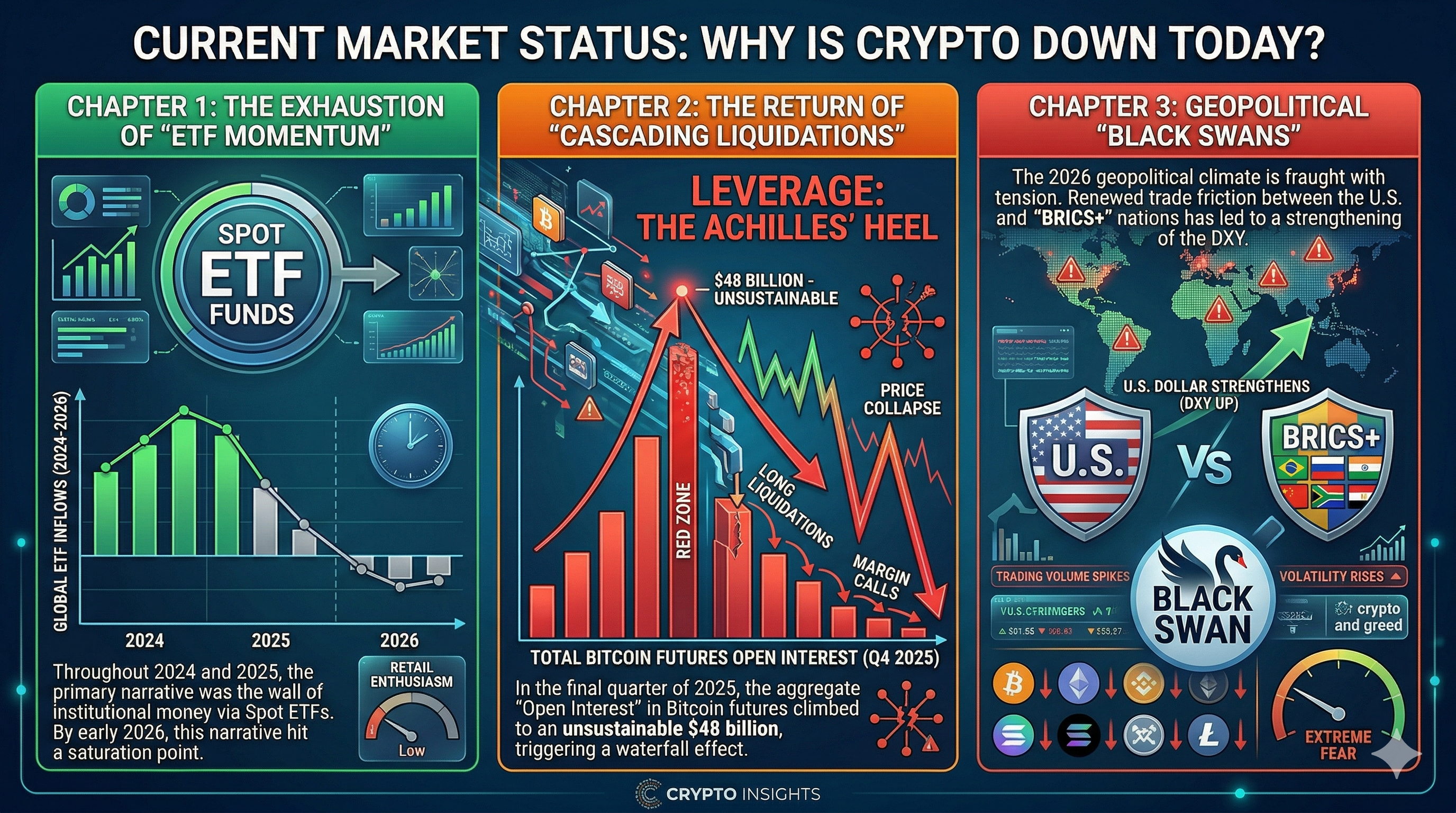
The Exhaustion of the "ETF Momentum"
Throughout 2024 and 2025, the primary narrative was the wall of institutional money entering via Spot ETFs. By early 2026, this narrative hit a saturation point. Most "early adopter" institutions that wanted exposure had already achieved their target allocations (typically 1–3% of AUM). Without a new catalyst—such as sovereign wealth fund nation-state adoption—the "buy pressure" simply leveled off, leaving the market vulnerable to profit-taking.
The Return of "Cascading Liquidations"
Leverage remains the Achilles' heel of the crypto market. In the final quarter of 2025, the aggregate "Open Interest" (OI) in Bitcoin futures climbed to an unsustainable $48 billion. When Bitcoin failed to break the $130,000 resistance level in January 2026, a series of "long squeezes" began.
-
Phase 1: Small liquidations at $115,000.
-
Phase 2: Forced selling collateralized loans at $100,000.
-
Phase 3: The "Psychological Break" at $80,000.
-
Each of these phases triggered automated sell orders, creating a "waterfall" effect that many retail investors perceive as a crash.
Geopolitical "Black Swans"
The 2026 geopolitical climate is fraught with tension. Renewed trade friction between the U.S. and the "BRICS+" nations has led to a strengthening of the DXY (US Dollar Index). Historically, Bitcoin has an inverse correlation with DXY. As the dollar nears a 5-year high in March 2026, Bitcoin's attractiveness as a "global liquidity hedge" has been temporarily overshadowed by the dollar’s role as the ultimate safe haven.
The Role of Institutional Outflows and Spot ETFs
The narrative of 2026 is inextricably linked to the "Institutionalization of Crypto." While this was hailed as the savior of the industry, it has introduced a new type of volatility: the "Wall Street Whale" volatility.
The ETF Rebalancing Trap
Major financial institutions now treat Bitcoin as a "Tech Risk" asset.() When the Nasdaq 100 faces a correction, as seen in the recent "software-mageddon", where AI stocks plummeted—institutional portfolios automatically rebalance. This involves selling Bitcoin ETFs to maintain fixed asset percentages. This "Passive Rebalancing" means crypto can now "crash" simply because software stocks are underperforming.
Institutional Resilience vs. Retail Panic
Despite the price drop, institutional data reveals a divergence. While retail investors (wallets < 0.01 BTC) have been "buying the dip" aggressively—often a contrarian bearish signal—whales have remained flat.() However, BlackRock’s IBIT saw a massive $648 million inflow on a single day in mid-March, suggesting that "Smart Money" is building a massive position at the $70,000 level.
Stabilization Signs: The "Buy the Dip" Floor
Despite the outflows, the data shows a clear "support floor." Whenever Bitcoin dips below $65,000, we see a massive spike in "inflow volume" for BlackRock’s IBIT and Fidelity’s FBTC. This suggests that while institutions are willing to sell at the top, they are equally committed to accumulating at these lower valuations.
| Date (2026) | Net ETF Flow (BTC) | Avg. BTC Price | Institutional Sentiment |
| Jan 15 | -$890M | $112,000 | Heavy Profit Taking |
| Feb 10 | -$1.2B | $95,000 | Risk-Off Sentiment |
| Mar 05 | +$410M | $71,000 | Strategic Re-entry |
| Mar 20 | +$620M | $69,500 | Accumulation Phase |
Macroeconomic Pressures: Inflation and the Fed in 2026
The "Is crypto crashing?" The question cannot be answered in a vacuum. The crypto market is now a subset of the global financial system, meaning it is at the mercy of the Federal Open Market Committee (FOMC).
The "Higher for Longer" Nightmare
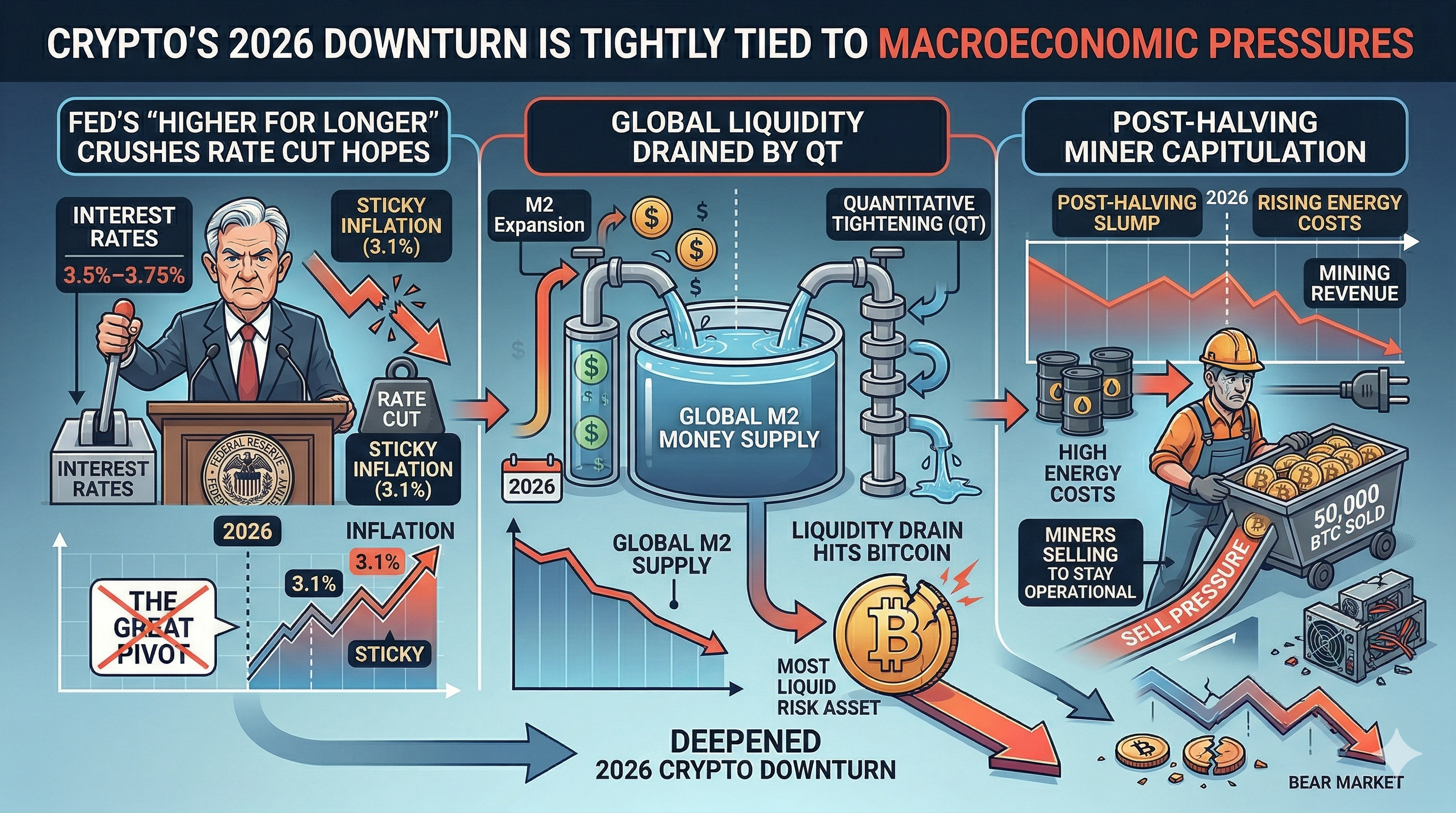
In 2025, the market priced at "The Great Pivot"—the expectation that interest rates would drop to 2% by 2026. However, due to persistent supply chain disruptions and a "deglobalization" trend, inflation has remained "sticky" at 3.1%.
-
The Result: The Fed has kept the Fed Funds Rate at 3.5%–3.75%.
-
The Impact on Crypto: When investors can get a "risk-free" 3.75% return on Treasury Bills, the "opportunity cost" of holding a volatile asset like Bitcoin increases. This has led to a migration of capital from "speculative tech" (including crypto) into fixed income.
M2 Money Supply Contraction
For the first time in decades, the global M2 money supply has seen periods of actual contraction. Bitcoin thrives on "Excess Liquidity." When the world’s central banks stop printing money and start "Quantitative Tightening" (QT), the tide goes out, and Bitcoin—as the most liquid "risk" asset—is often the first to be sold to cover losses elsewhere.
The Energy Crisis and Mining Economics
2026 has seen a resurgence in energy costs. For Bitcoin miners, the "hash price" (the revenue earned per unit of hashing power) has plummeted. With 2024 still fresh in memory and electricity prices up 15% globally, many miners have been forced to sell their BTC treasuries to stay operational. This "miner capitulation" added roughly 50,000 BTC of sell pressure to the market in Q1 2026 alone.
Technical Analysis: Is the 4-Year Cycle Broken?
Since the genesis block in 2009, Bitcoin has followed a predictable pattern: a parabolic run-up following the halving, a "blow-off top," and a year-long bear market. However, the 2026 data suggests the cycle has mutated.
The "Left-Translated" Peak
In technical terms, a "left-translated" cycle is one where the peak occurs much earlier than historical averages.
2012 Cycle: Peak at ~12 months post-halving.
2016 Cycle: Peak at ~17 months post-halving.
2020 Cycle: Peak at ~18 months post-halving.
2024/25 Cycle: Peak at ~14 months post-halving (October 2025).
Because the peak happened earlier, the "crash" or correction phase of 2026 started earlier. This has led to the "Cycle is Broken" narrative, but in reality, it may just be the "Cycle is Accelerating" due to the speed of institutional capital.
Support and Resistance Levels for 2026
Using the Fibonacci Retracement tool from the 2022 low to the 2025 high:
The 0.382 Level: $88,000 (Broken in February).
The 0.50 Level: $72,500 (Current "Battleground" zone).
The 0.618 "Golden Pocket": $58,000 (The ultimate "Must Hold" level).
If Bitcoin could hold the $68,000 - $72,000 range throughout Q2 2026, it would confirm a "healthy correction" rather than a full-scale market crash. A break below $58,000, however, would signal a "Crypto Winter" 2.0.
The Exponential Moving Average (EMA) Ribbon
On the weekly timeframe, Bitcoin is currently testing the 50-week EMA. Historically, during bull markets, this ribbon acts as a trampoline. In 2026, we are currently "riding the ribbon." A decisive close below the 50-week EMA would be the technical confirmation that the 2025 bull run is officially over.
Altcoins vs. Bitcoin: Where is the Damage Most Severe?
If Bitcoin is experiencing a "correction," the altcoin market is experiencing a "purge." The "Is crypto crashing?" Sentiment is largely driven by catastrophic losses in the mid-cap and small-cap sectors.
The Death of "Vaporware"
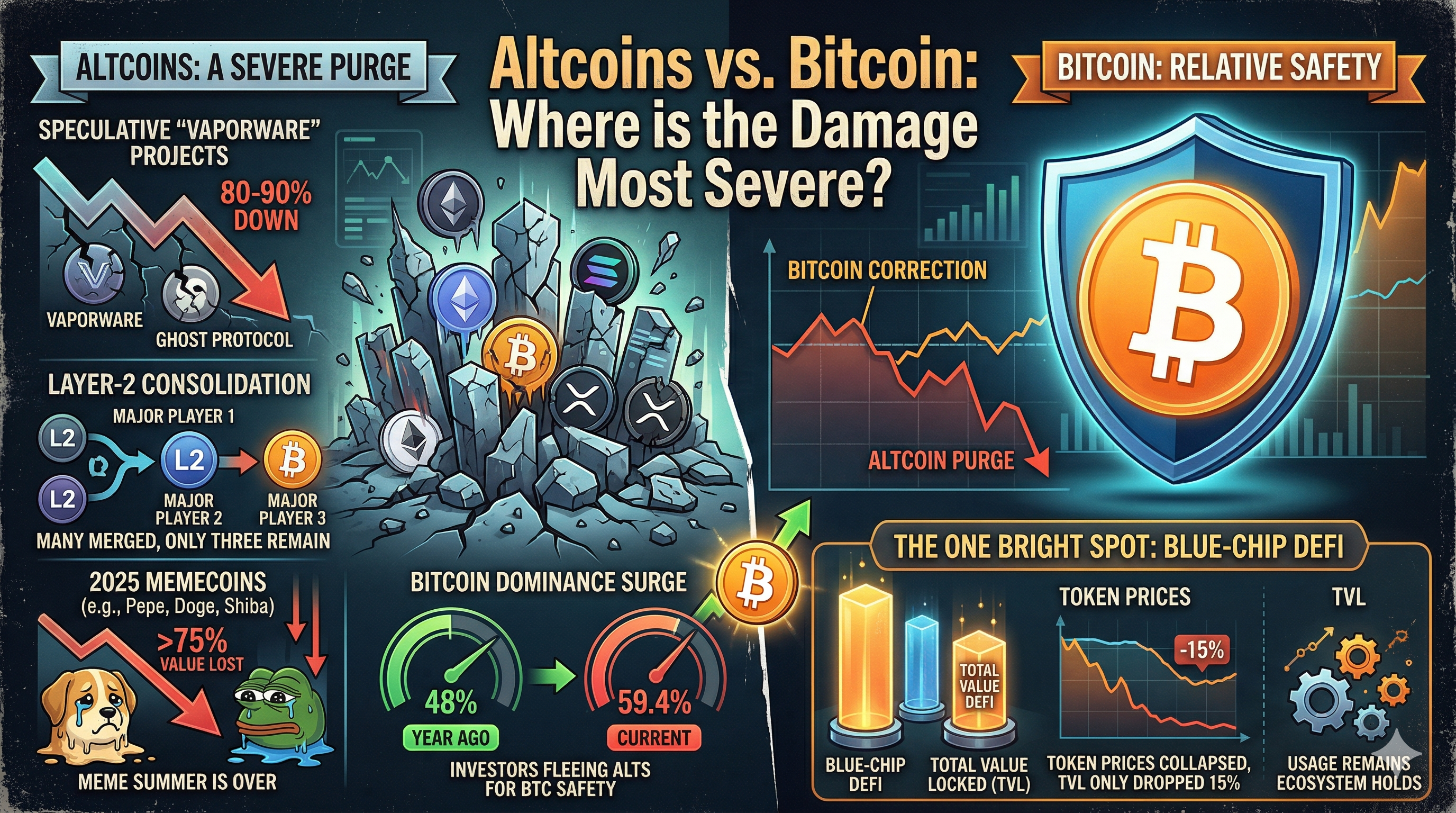
2026 is becoming the year of "Fundamental Realism." During the 2025 boom, thousands of projects launched with nothing but a whitepaper and an AI-generated roadmap. As liquidity dries up, these projects are seeing their tokens drop 80-90%.
Layer-2 Fatigue: With over 50 "major" Ethereum Layer-2 solutions, the market has realized that we don't need this much block space. Capital is consolidating into the top three: Arbitrum, Optimism, and Base.
The Memecoin Burnout: The 2025 "Meme Summer" saw coins like PEPE and WIF reach multi-billion dollar valuations. In 2026, these assets have lost over 75% of their value as retail investors pivot back to "utility" or exit the market entirely.
Bitcoin Dominance: The 60% Target
Bitcoin Dominance (BTC.D) is a measure of how much of the total market cap is held in Bitcoin.
March 2025: 48% (Altcoins thriving).
March 2026: 59.4% (Investors hiding in BTC).
When BTC.D rises during a price drop, it is a classic "bear market" signal. It shows that even crypto-native investors are selling their "Alts" to hold "The King."
The "Survival of the Fittest" in DeFi
While prices are down, the Total Value Locked (TVL) in blue-chip DeFi protocols like Aave, Uniswap, and MakerDAO has only dropped by 15%. This is a massive divergence from 2022. It proves that while the price of the tokens is crashing, the usage of the protocols is not. This "Utility Floor" is what will likely prevent a total collapse of the ecosystem.
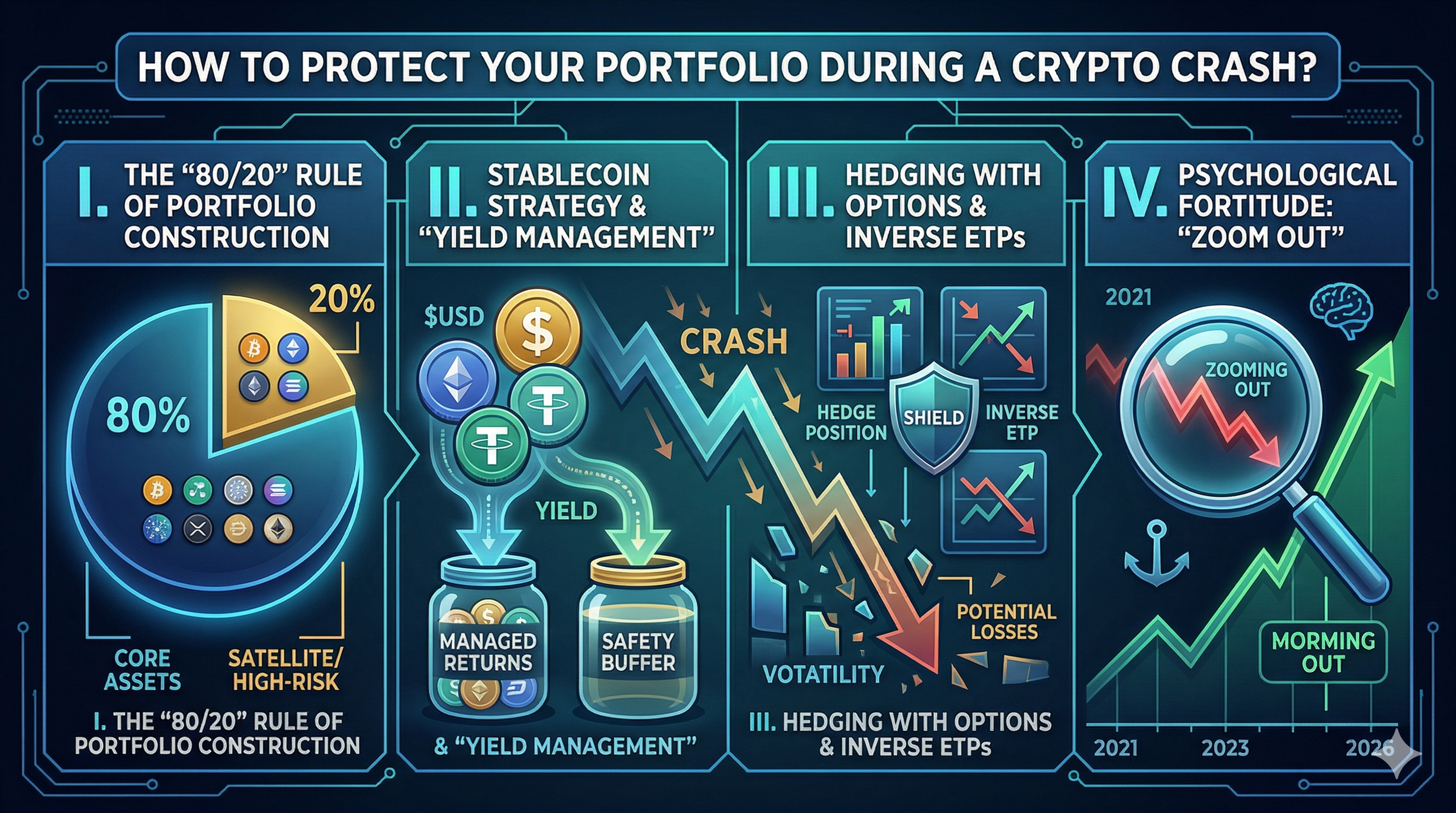
How to Protect Your Portfolio During a Crypto Crash?
In a market defined by "Extreme Fear," your greatest enemy is not the chart—it is your own emotions. Protecting your portfolio in 2026 requires a disciplined, professional approach.
I. The "80/20" Rule of Portfolio Construction
The "Wild West" days of holding a 100% altcoin portfolio are over. Modern portfolio theory for digital assets now favors a more disciplined structure: 80% in core blue chips (BTC and ETH) to anchor your portfolio with the assets most likely to receive institutional “buy the dip” support; 15% in high-utility mid-caps (such as SOL, LINK, UNI) for growth with stronger fundamentals; and just 5% in high-risk moonshots or memecoins for speculative upside. By rebalancing to this framework, you ensure that even during a crash, your core holdings remain resilient while limiting exposure to the assets that bleed the most.
II. Stablecoin Strategy and "Yield Management"
The U.S. The Clarity Act has made holding stable coins on exchanges more complex. However, on-chain stablecoins like USDC and DAI remain the best "dry powder."
The Strategy: Keep 20-30% of your portfolio in stablecoins. This allows you to "buy blood" when the market hits extreme oversold levels without having to deposit fresh fiat from a bank (which can take days).
III. Hedging with Options and Inverse ETPs
2026 has seen the rise of "Inverse Bitcoin ETFs" (like BITI). For investors with large spot holdings who don't want to sell for tax reasons, buying a "Put Option" or an "Inverse ETF" can provide a hedge. If the price of Bitcoin crashes, the gain on the "short" position offsets the loss on the "long" position.
IV. Psychological Fortitude: "Zoom Out"
When uncertainty strikes, zooming out to the logarithmic chart offers invaluable perspective. In 2016, Bitcoin traded at $600; by 2020, it had climbed to $9,000; and in 2026, it now hovers around $70,000—a price that would have been an “impossible dream” just four years earlier. Recognizing that the current “crash” is unfolding at levels once considered unimaginable helps separate panicked sellers from generational accumulators who understand the long arc of Bitcoin’s trajectory.
The Future Outlook: What Happens After the "Crash"?
History shows that the most sustainable bull markets are born out of the ashes of a "wipeout." The 2026 correction is doing exactly what it needs to do: clearing out the "tourists," bankrupting the over-leveraged "zombie" companies, and forcing a migration toward quality.
The Q4 2026 Recovery Narrative
Most analysts, including the research team at Standard Chartered, predict that the "bottom" will be in by Q3 2026. The triggers for a recovery include:
The Fed "Pivot": Once the Fed finally cuts rates (expected late 2026), the floodgates for "cheap money" will reopen.
The Clarity Act Passing: Once the rules of the game are signed into law, trillions in "sideline" institutional capital will have the legal green light to enter the spot market.
Real-World Asset (RWA) Tokenization: By late 2026, the tokenization of BlackRock’s "BUIDL" fund and other private equity vehicles will move from "experiment" to "mainstream," creating a massive new source of demand for the Ethereum and Solana networks.
Conclusion
Is crypto crashing? If your definition of a crash is a volatile, painful, and deep correction that tests the resolve of every investor, then yes. But if your definition of a crash is "the end of the industry," then the answer is a resounding no.
The 2026 market is simply maturing. It is shedding the skin of a purely speculative retail playground and growing into the suit of a global financial asset class. The "crash" is the price of admission for institutional adoption. It is the process of transferring wealth from the "impatient" to the "patient."
As we move through the remainder of 2026, the winners will not be those who predicted the exact bottom, but those who built a resilient portfolio, understood the macroeconomic "why," and stayed focused on the fundamental shift toward a decentralized financial future.
FAQs
1. Why is Bitcoin dropping if the halving already happened?
The "Halving" reduces the supply of new Bitcoin, but the price is determined by supply AND demand. In 2026, the reduction in supply was outweighed by a temporary drop in demand caused by high interest rates and institutional profit-taking after the 2025 surge.
2. Is the 2026 crash similar to 2022?
No. The 2022 crash was a "structural failure" caused by the bankruptcy of major players (FTX, Celsius, Luna). The 2026 downturn is a "macroeconomic correction" driven by interest rates and a standard post-bull market deleveraging. The underlying infrastructure in 2026 is much healthier.
3. What is the "Golden Pocket" everyone is talking about?
In technical analysis, the "Golden Pocket" is the area between the 0.618 and 0.65 Fibonacci retracement levels. For Bitcoin in 2026, this costs around $58,000 - $61,000. Many traders believe this is the ultimate "buy zone" where the market will find long-term support.
4. Are altcoins dead in 2026?
"Zombie" altcoins with no utility or revenue are likely dead. However, "Utility Altcoins" (like SOL, LINK, and various RWA projects) are simply on sale. The market is moving away from "buying anything with a logo" to "buying things that generate protocol fees."
5. How low can Bitcoin go in 2026?
While "bottom-calling" is difficult, most institutional models suggest a "floor" at the $52,000 - $55,000 range, which represents the average cost basis for many of the large Spot ETF providers. A drop below this would be highly unlikely without a global economic depression.
6. Will Ethereum ever flip Bitcoin?
"The Flippening" remains a popular topic, but in 2026, Bitcoin Dominance has actually increased. While Ethereum is the "World Computer," Bitcoin has solidified its role as "World Collateral." For now, Bitcoin remains the undisputed leader of the market.