

Decoding the Future: What Does IBIT Options OI Say About the Long-Term BTC Price Thesis?
2026/05/13 11:27:44
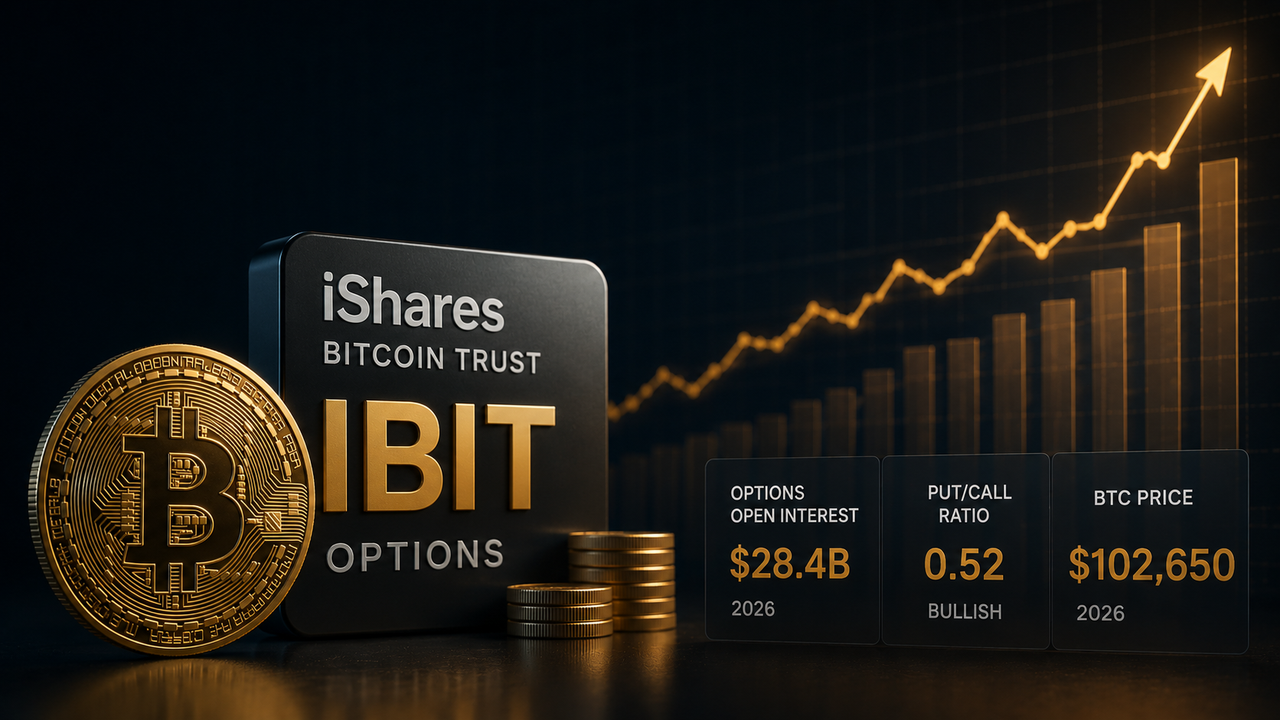
The approval and subsequent launch of iShares Bitcoin Trust (IBIT) options have marked a watershed moment in the integration of digital assets into the global financial architecture. For the first time, institutional investors possess a regulated, high-liquidity vehicle to express complex views on the future of the market, moving beyond simple spot accumulation to sophisticated derivative strategies.
In this deep dive, we explore how IBIT Options OI serves as a leading indicator for the BTC Price, providing an unprecedented window into the long-term conviction of the world's largest asset managers.
Key Takeaways:
The data emerging from BlackRock’s derivative ecosystem offers several critical insights for the macro investor:
-
Institutional Domination: The rapid growth of Open Interest (OI) in IBIT options confirms that Bitcoin has transitioned from a retail-driven speculative asset to an institutional-grade portfolio component.
-
Structural Bullishness: Current Put-Call ratios suggest that major players are positioning for a multi-year upward trajectory, rather than short-term price discovery.
-
Volatility Compression: The presence of a regulated options market allows for gamma hedging and income-generation strategies (like covered calls), which historically lead to a more stable price environment.
-
Regulatory Confidence: The migration of capital from offshore, unregulated exchanges to IBIT signifies a "flight to safety" and a long-term bet on the US regulatory framework.
Defining the Indicator: What is IBIT Options OI and Why Does it Matter?
To navigate the 2026 crypto landscape, one must look past simple daily volume and focus on Open Interest (OI). While volume measures the intensity of trading within a 24-hour window, Open Interest represents the total number of outstanding contracts that have not been settled or closed. It is the definitive metric of "skin in the game."
The Mechanics of Open Interest: Measuring Capital Commitment
Open Interest serves as the pulse of market commitment. In the context of IBIT, every contract held open represents a strategic decision by an investor to maintain exposure to the BTC Price over a specific duration. When IBIT Options OI rises alongside a trending price, it confirms that the trend is supported by new capital rather than just short-term covering. Conversely, if OI falls during a rally, it suggests the move is driven by short-squeezes and may lack long-term sustainability.
IBIT vs. The Field: Why BlackRock’s Data is the New Gold Standard
For years, Deribit was the undisputed leader in Bitcoin derivatives. However, the launch of IBIT options has shifted the "center of gravity" to Wall Street. Because IBIT is backed by a physically-settled spot ETF and operates within the infrastructure of the OCC (Options Clearing Corporation), its OI data reflects the actions of pension funds, insurance companies, and sovereign wealth funds—entities that were previously prohibited from trading on offshore platforms. This makes IBIT Options OI the most reliable gauge for "smart money" sentiment.
The Regulatory Premium: How US-Based Options Differ from Offshore Derivatives
Offshore platforms often feature high leverage (up to 100x) and cross-margining that can lead to cascading liquidations. IBIT options, governed by SEC and CFTC oversight, require robust collateralization. This "Regulatory Premium" means that the OI seen in IBIT is inherently more "sticky" and less prone to the "flash crashes" associated with unregulated leverage. For the long-term BTC Price thesis, this provides a much more stable foundation for growth.
The Strategic Correlation: How IBIT Options OI Drives BTC Price Action
The relationship between IBIT Options OI and the BTC Price is not just reflective; it is causal. The way market makers manage their risk around these options creates tangible buying and selling pressure in the spot market.
Sentiment Mapping: Decoding the 0.52 Put-Call Ratio for 2026
In the current 2026 market cycle, the Put-Call Open Interest ratio for IBIT has hovered around 0.52. This is a significantly bullish reading. A ratio below 0.70 typically indicates that investors are buying nearly twice as many call options (upside bets) as put options (downside protection). This imbalance suggests that the institutional consensus is heavily skewed toward a higher BTC Price over the coming quarters, as major players are more concerned with "missing out" on the rally than protecting against a total collapse.
Strike Price Concentration: Identifying the Next "Magnets" for BTC Price
By analyzing the specific strike prices where IBIT Options OI is highest, traders can identify "price magnets." For instance, a massive concentration of OI at the $100,000 strike price indicates that a significant number of market participants have a vested interest in that price level. As the expiration date approaches, the BTC Price often gravitates toward these high-OI clusters due to the hedging activities of the institutions that sold those contracts.
Gamma Exposure (GEX): How Market Maker Hedging Reduces Retail Volatility
Market makers who sell IBIT options must remain delta-neutral. If they sell a call option, they must buy a certain amount of Bitcoin (or IBIT shares) to hedge their risk. As IBIT Options OI grows, the aggregate "Gamma Exposure" increases. In a "Positive Gamma" environment, market makers sell into strength and buy into weakness to maintain their hedge. This mechanical trading effectively dampens the erratic volatility of the BTC Price, making the asset more predictable for traditional financial advisors.
The "Max Pain" Theory: Predicting BTC Price Behavior Near Expiration Dates
The "Max Pain" price point is the strike price where the highest number of options (both puts and calls) would expire worthless. Historically, in high-OI environments like IBIT, the BTC Price tends to gravitate toward this Max Pain level as the monthly expiration Friday approaches. This is not necessarily a "manipulation," but rather the result of thousands of participants adjusting their hedges simultaneously, creating a gravitational pull toward the point of least payout for option buyers.
The Multi-Year Horizon: Analyzing Long-Tenor Contracts and LEAPS
One of the most profound impacts of IBIT Options OI is the extension of the investment horizon. Unlike the 24-hour "perps" (perpetual swaps) used by retail speculators, IBIT offers LEAPS (Long-Term Equity Anticipation Securities) that extend years into the future.
Betting on 2028: The Significance of 900-Day Expiration Cycles
We are currently seeing a surge in OI for IBIT contracts expiring in late 2027 and 2028. These 900-day expiration cycles allow institutions to express a view that transcends the typical 4-year halving cycle. When a hedge fund opens a million-dollar position in 2028 calls, they are signaling that the BTC Price is no longer a "trade," but a permanent fixture of the global macro-economic landscape. This shift in time preference is perhaps the most bullish development for Bitcoin since its inception.
Bitcoin as a Structural Asset: Moving Beyond the 4-Year Halving Narrative
Historically, the BTC Price was dictated by the supply-side shock of the halving. However, the depth of the IBIT Options OI suggests that demand-side derivatives are now the primary driver. With the ability to hedge and leverage over multiple years, institutional investors can smooth out the halving volatility. This transition treats Bitcoin as a structural asset—similar to gold or oil—where price discovery is driven by global liquidity and credit cycles rather than just the mining schedule.
Institutional Hedging: Using IBIT Options to Protect Global Portfolios
For a global 60/40 portfolio, IBIT options provide a unique "tail-risk" hedge. Large institutions are using the OI in IBIT puts to protect against a "black swan" event in the traditional banking sector. Ironically, this use of puts actually stabilizes the BTC Price, as it allows massive pools of capital to remain invested in Bitcoin through periods of uncertainty, knowing they have a regulated exit or hedge in place.
Liquidity and Stability: The Impact of Regulated Financial Plumbing
The "plumbing" of the financial system—the clearing, settlement, and margining of trades—is often overlooked, but it is where the real stability of the BTC Price is forged.
Dampening the Flash Crash: How IBIT OI Prevents Cascading Liquidations
In offshore markets, a 5% drop in the BTC Price can trigger a "liquidation engine," where automated sell orders cascade, leading to a 20% crash in minutes. Because IBIT Options OI is held by entities with significant collateral and sophisticated risk management, these contracts are rarely "liquidated" in the same violent manner. This regulated liquidity provides a "bid" under the market, preventing the vertical drop-offs that used to characterize Bitcoin's price action.
The Inflow Feedback Loop: How Options Volume Spurs Spot ETF Demand
There is a direct "feedback loop" between derivative volume and spot demand. When IBIT Options OI surges, market makers are forced to buy more IBIT shares to hedge their positions. This creates a consistent inflow into the spot ETF, which in turn requires BlackRock to purchase more physical Bitcoin. This synergy between the options market and the spot market is a powerful engine for a sustained increase in the BTC Price.
Bridging the Gap: How IBIT Options Connect Wall Street to Satoshi’s Vision
While purists might argue that derivatives are far removed from Satoshi Nakamoto’s vision of a peer-to-peer electronic cash system, the reality is that IBIT Options OI provides the bridge. By creating a regulated, familiar environment for capital to enter, these options have turned Bitcoin into a global reserve asset. The "institutionalization" of Bitcoin through IBIT is the final step in its journey from a cypherpunk experiment to a multi-trillion-dollar asset class.
Macro Risks and Externalities: What Could Challenge the Bullish OI Thesis?
While the current IBIT Options OI data is overwhelmingly positive, no investment is without risk. Several macro factors could disrupt the current bullish trajectory of the BTC Price.
Interest Rate Sensitivity: The Fed’s Shadow Over BTC Price Projections
Bitcoin remains a "long-duration" asset, meaning its price is highly sensitive to the cost of capital. If the Federal Reserve were to pivot back to a "higher-for-longer" interest rate stance in late 2026, the cost of carrying large options positions in IBIT would increase. This could lead to a contraction in IBIT Options OI as institutions move capital back into "risk-free" Treasury yields, putting downward pressure on the BTC Price.
Regulatory "Black Swans": Potential Shifts in SEC Oversight Post-2026
While IBIT options are currently thriving under the current regulatory regime, a shift in political or administrative leadership could change the rules of the game. If new regulations were introduced to limit the amount of leverage used in crypto ETFs, or if "position limits" were strictly enforced, the IBIT Options OI could shrink overnight. Such a loss of liquidity would immediately increase the volatility of the BTC Price.
The Liquidity Trap: Can IBIT Options OI Withstand a Global Credit Crunch?
In a true global credit crunch, all correlations tend to go to 1.0, and investors sell what they can, not what they want. If a systemic crisis were to hit the US banking sector, even the most bullish IBIT Options OI could not prevent a temporary liquidation of Bitcoin as a source of emergency liquidity. However, the presence of long-dated OI suggests that many investors would see such an event as a buying opportunity, potentially leading to a "V-shaped" recovery for the BTC Price.
Conclusion:
The explosive growth of IBIT Options OI is the strongest evidence to date that Bitcoin has achieved "escape velocity" from its speculative roots. By providing a regulated, transparent, and multi-year framework for price discovery, IBIT options have reduced the catastrophic risk of the asset while increasing its appeal to the world’s most conservative capital. While macro risks like interest rate shifts and regulatory changes remain, the structural bullishness evidenced by the 0.52 Put-Call ratio and the rise of LEAPS suggests that the long-term BTC Price thesis is more robust than ever. As the financial plumbing of Wall Street continues to integrate with the digital scarcity of Satoshi’s network, we expect the BTC Price to transition into a period of more stable, institutionalized growth, ultimately cementing Bitcoin's status as the premier collateral of the digital age.
FAQ:
Does high IBIT options OI always lead to a BTC price pump?
Not necessarily. High IBIT Options OI simply means high participation. If the OI is dominated by put options, it could signal a bearish move. However, when high OI is coupled with a low Put-Call ratio, it is generally a precursor to sustained upward movement in the BTC Price.
How can retail investors track IBIT OI changes in real-time?
Retail investors can monitor IBIT Options OI through major financial data platforms like Bloomberg, Reuters, or specialized crypto analytics sites like OptionCharts. Tracking the daily change in OI alongside BTC Price action is a vital skill for modern crypto traders.
What is the difference between IBIT volume and IBIT Open Interest?
Volume measures the total number of contracts traded during a single day, regardless of whether those positions were closed by the end of the day. IBIT Options OI measures only the active, outstanding contracts. OI is a better indicator of long-term sentiment and capital commitment.
How does IBIT options OI affect Bitcoin's correlation with the S&P 500?
As more institutional capital enters Bitcoin through IBIT, its correlation with the S&P 500 often increases in the short term, as both are influenced by global liquidity. However, over the long term, the unique supply dynamics of the BTC Price often lead to a decoupling from traditional equities.