

Could decentralized AI (DeAI) or blockchain-based governance models offer an alternative to centralized AI control?
Introduction
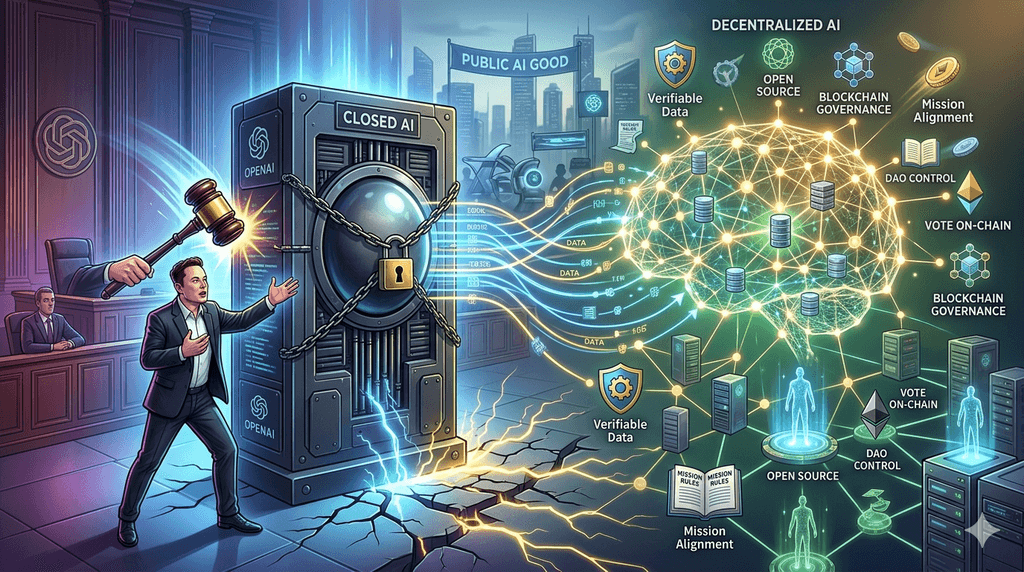
Could a $150 billion legal battle be the catalyst that finally breaks the monopoly of centralized artificial intelligence? As the trial between Elon Musk and OpenAI commenced in an Oakland federal court on April 27, 2026, it became clear that the industry is facing a crisis of trust that only decentralized technology can solve.
Decentralized AI (DeAI) and blockchain-based governance models offer a definitive alternative to centralized control by stripping power from opaque corporate boards and redistributing it across transparent, incentive-aligned networks. By using distributed ledgers to govern model training, data provenance, and safety protocols, DeAI ensures that AI development remains a "public good" rather than a "wealth machine" for a select few.
The Musk vs. OpenAI Trial: A Turning Point for AI Governance
The $150 billion lawsuit filed by Elon Musk against OpenAI, Sam Altman, and Microsoft represents a fundamental challenge to the "closed-source" for-profit model that currently dominates the industry. According to April 2026 reports from Reuters, Musk’s legal team has focused the case on breach of charitable trust and unjust enrichment, arguing that OpenAI abandoned its original mission to benefit humanity in favor of maximizing commercial value for its largest investor, Microsoft. Musk’s central claim is that AI development is too dangerous to be controlled by a single, profit-driven entity, suggesting that the current centralized structure creates systemic risks that could "destroy everything" if not properly regulated or decentralized.
Evidence presented during the jury selection in late April 2026 highlighted internal power struggles and conflicting visions of AI safety. Documents revealed in court showed that OpenAI’s leadership discussed a transition to a for-profit model as early as 2017, contradicting public statements about their commitment to non-profit research. This lack of transparency is the primary driver behind the sudden surge in interest in decentralized alternatives. While centralized entities can pivot their missions behind closed doors, blockchain-based protocols encode their mission into immutable smart contracts, making such "mission drift" technically impossible without a public, democratic vote.
Market sentiment surrounding the trial is currently divided, but the focus on AI safety is a significant tailwind for the blockchain sector. Based on April 2026 analysis from Silicon Valley legal observers, a victory for Musk could force OpenAI to restructure, potentially setting a precedent for "sovereign AI" models that are not tethered to corporate profits. Conversely, an OpenAI victory might legitimize the current for-profit trajectory, further widening the gap between corporate AI and the public interest—a gap that DeAI protocols are now racing to fill.
Decentralized AI (DeAI): Architecture for Transparent Control
Decentralized AI (DeAI) replaces central servers and corporate overseers with a global network of independent nodes that collaborate to train and run models. Unlike the centralized models used by OpenAI or Google, where data and compute are gated, DeAI protocols like Bittensor (TAO) and the Artificial Superintelligence Alliance (ASI) distribute these resources across a permissionless infrastructure. According to March 2026 data from the EAK Digital Future of Web3 Guide, Bittensor’s "Proof-of-Intelligence" mechanism now rewards contributors based on the verifiable quality of their model outputs, creating a meritocratic marketplace that no single CEO can manipulate.
The technical stack of DeAI is built on three core pillars: distributed compute, verifiable data, and open-source models. Projects like Render Network (RENDER) and Akash Network (AKT) provide the "hardware layer" by allowing anyone to rent out idle GPU power for AI training. Based on Nvidia’s March 2026 GTC projections, the demand for AI chips has surpassed $1 trillion, a supply crunch that centralized providers like AWS struggle to manage. Decentralized GPU marketplaces solve this by aggregating global resources, ensuring that AI development remains accessible to independent developers rather than being restricted to the world's five wealthiest corporations.
Data provenance is the second pillar, ensuring that the information used to train AI is ethical and transparent. In centralized systems, the "black box" nature of training data often leads to copyright disputes and bias. Blockchain-based solutions like Grass use decentralized web-crawling networks to create auditable data pipelines. According to recent 2026 performance metrics, these networks are now powering significant AI pipelines at scale, providing a "paper trail" for every piece of information an AI consumes, which is a critical requirement for the safety standards Musk is advocating for in court.
Blockchain-Based Governance: Replacing Boards with Code
Blockchain-based governance models offer a structural solution to the "mission drift" seen in centralized AI companies by replacing human boards with Decentralized Autonomous Organizations (DAOs). In a DAO, major decisions—such as whether to release a powerful new model or how to distribute profits—are made by token holders through on-chain voting. This prevents a "Sam Altman-style" centralized takeover, as the rules of the organization are enforced by code. According to a March 2026 report from Supertrends, these hybrid governance structures are becoming a "baseline expectation" for enterprise AI, as they provide a level of auditability that traditional corporate structures cannot match.
On-chain governance also enables "Sovereign AI," where a community or nation-state can own and control its own intelligence models. During the Musk vs. OpenAI trial, it was revealed that OpenAI's nonprofit arm retains only a 26% stake in its for-profit subsidiary as of 2026. In contrast, DeAI protocols ensure that the community retains 100% control over the protocol’s evolution. If a community decides that a specific AI behavior is unsafe, they can vote to "slash" the rewards of nodes providing that output or update the model’s weights across the entire network simultaneously.
The integration of "Ethics Boards" into smart contracts is another emerging trend in 2026. Instead of an ethics board that can be fired or ignored by a CEO, DeAI projects are beginning to implement "Governor" contracts. These contracts can automatically pause model access if certain safety thresholds are breached. Based on McKinsey’s 2026 AI Trust Maturity Survey, nearly 72% of organizations now cite "agentic AI controls" as their top security concern. Blockchain-based governance provides these controls natively, offering a "kill switch" that is managed by a consensus of stakeholders rather than a single individual.
Comparing Centralized AI vs. Decentralized AI Governance (2026)
| Feature | Centralized AI (e.g., OpenAI) | Decentralized AI (e.g., Bittensor/ASI) |
| Control Structure | Board of Directors / CEO | On-chain DAO / Token Holders |
| Mission Alignment | Profit-driven (Public Benefit Corp) | Code-enforced (Smart Contracts) |
| Transparency | Closed-source / "Black Box" | Open-source / Verifiable Provenance |
| Compute Access | Gated by API / Corporate Cloud | Permissionless GPU Marketplace |
| Safety Oversight | Internal Ethics Teams | Distributed Consensus / Slashing |
Economic Incentives: Aligning Safety with Rewards
The primary flaw in centralized AI governance is the misalignment of incentives, where the rush to be first to market often overrides safety concerns. In the Musk vs. OpenAI lawsuit, Musk claims the company became a "wealth machine" for its founders, which inevitably led to cutting corners on AI alignment. DeAI protocols flip this incentive structure by using native tokens to reward "good" behavior. For example, the Artificial Superintelligence Alliance (ASI) merged FET, AGIX, and OCEAN in 2024 to create a unified tokenomic system that rewards developers for creating safe, interoperable agents.
In a decentralized ecosystem, profit is a byproduct of utility and safety, not an end in itself. According to Zerocap's March 2026 market wrap, the "Covenant-72B" model—the largest LLM training run ever completed on a decentralized network—was made possible because participants were incentivized to provide high-quality compute and data. If a participant had attempted to "poison" the data or provide unsafe outputs, they would have lost their staked tokens. This "economic alignment" creates a self-regulating system where the most useful and safest models naturally rise to the top of the leaderboard.
Furthermore, DeAI enables a "circular economy" for AI. Instead of all revenue flowing to a single corporation, the value generated by AI agents is distributed among the data providers, compute nodes, and model developers. Based on 2026 projections for the Sky protocol (formerly MakerDAO), AI agents are increasingly using on-chain payment rails to settle transactions autonomously. This allows AI to operate as an independent economic actor that is bound by the rules of the blockchain, preventing any single entity from monopolizing the wealth generated by artificial intelligence.
Technical Challenges: The Barriers to Full Decentralization
Despite the governance benefits, decentralized AI faces significant technical hurdles, primarily regarding latency and communication overhead. Training a massive LLM requires high-speed interconnects (like InfiniBand) between thousands of GPUs, which is difficult to replicate across a distributed global network. Centralized data centers have a distinct advantage in raw training speed. However, according to April 2026 performance reports, the Bittensor network has partially solved this through "Subnet" architecture, allowing specialized tasks to be handled by optimized clusters of nodes.
The "Inference Gap" is another challenge being addressed in 2026. While training is difficult to decentralize, running the AI (inference) is much easier. Protocols like the Internet Computer (ICP) are now running AI models natively on-chain, eliminating the need for centralized cloud providers like AWS. This ensures that the AI’s decisions cannot be tampered with between the model and the user. While centralized AI is currently faster for training "frontier" models, decentralized networks are becoming the preferred choice for privacy-sensitive and censorship-resistant applications.
Security risks also exist in DeAI, particularly "Sybil attacks" where one actor tries to control multiple nodes to influence the network. To combat this, 2026-era protocols utilize advanced cryptographic proofs and "Proof-of-Staking" models. Based on recent audits of the Oasis Network (ROSE), privacy-preserving computation now allows AI to train on sensitive data without the data ever being exposed to the nodes themselves. This solves a major "trust" hurdle, as companies can contribute proprietary data to a decentralized pool without fear of it being stolen by a competitor.
The Investor’s Perspective: Is DeAI the "Safe" Bet?
The outcome of the Musk v. OpenAI case will likely determine the short-term trajectory of AI token valuations. If the court rules that OpenAI must return to a non-profit structure or share its technology more broadly, it will be a massive validation of the open-source and decentralized ethos. According to Zerocap’s April 2026 insights, AI tokens like TAO, RENDER, and ASI have seen a 60% increase in "open interest" since the trial began, as investors hedge against the risks of centralized AI regulation.
A "bullish" view on DeAI suggests that as governments introduce more AI regulations—such as the 2026 updates to the EU AI Act—centralized companies will struggle with the massive compliance costs. Decentralized protocols, which are globally distributed and transparent by design, may find it easier to adapt to these "Brussels Effect" regulations. However, a "bearish" view holds that the sheer capital advantage of Microsoft and OpenAI (with its potential $1 trillion IPO valuation) will allow them to steamroll decentralized competitors regardless of the legal outcome.
Ultimately, the market is beginning to price in "governance" as a feature. Just as Bitcoin offered an alternative to centralized central banks, DeAI offers a "censorship-resistant" brain for the internet. For the crypto community, the Musk lawsuit isn't just about money; it’s about ensuring that the most powerful technology in human history is not controlled by a small, unaccountable group of executives in San Francisco.
Should You Trade Decentralized AI (DeAI) Tokens on KuCoin?
The convergence of AI and blockchain is no longer a speculative narrative; it is a structural shift in how global intelligence is governed. With the Musk vs. OpenAI trial bringing issues of AI safety and corporate greed to the forefront of global media, the demand for decentralized alternatives has never been higher. As a leading global exchange, KuCoin provides a robust platform to trade the primary assets driving this revolution, including:
Trading DeAI tokens on KuCoin allows you to participate in the growth of decentralized compute and governance. According to market data from April 2026, the DeAI sector has outpaced the broader crypto market in terms of volume and institutional interest. Whether you are bullish on the "Sovereign AI" movement or simply looking to hedge against the volatility of the tech sector, KuCoin’s deep liquidity.
New users can now register at KuCoin and Get Up to 11,000 USDT in New User Rewards.
Conclusion
Decentralized AI and blockchain governance represent the most credible solution to the trust deficit currently plaguing the tech industry. The ongoing legal dispute between Elon Musk and OpenAI has exposed the fragility of centralized "non-profit" missions, proving that even the most altruistic goals can be subverted by the pressure of commercial interests and the influence of massive capital. By distributing power among a global network of stakeholders, DeAI ensures that no single individual or corporation can unilaterally decide the fate of artificial intelligence.
While centralized models currently maintain an edge in raw computational speed, the gap is closing. Technologies such as Bittensor’s subnets and the Oasis Network’s privacy-preserving computation are proving that decentralized networks can handle complex AI workloads while maintaining transparency and safety. The shift toward blockchain-based governance models is not just a technical evolution; it is a necessary safeguard for humanity. As we move further into 2026, the choice between a "closed-box" corporate AI and a "transparent-ledger" decentralized AI will define the future of our digital world. For those looking to support a future where AI serves the public good, the infrastructure for that vision is already being built on the blockchain.
FAQs
Does decentralized AI really solve the safety concerns raised by Elon Musk?
Yes, DeAI addresses Musk’s concerns by making safety protocols and model weights transparent and auditable on a public ledger. Unlike centralized companies where safety decisions are made in private boardrooms, DeAI uses on-chain governance (DAOs) to ensure that any change to a model’s "guardrails" must be approved by a consensus of the community, preventing a single entity from prioritizing profit over safety.
Is training a large AI model on a blockchain slower than using a centralized server?
Currently, training is slower due to "latency," which is the delay in communication between nodes spread across the world. Centralized data centers use high-speed wires to connect GPUs, whereas DeAI relies on the internet. However, DeAI projects are overcoming this by decentralizing the "inference" (using the AI) and using specialized clusters for training, which is becoming increasingly efficient as of 2026.
What happens to my DeAI tokens if OpenAI wins the Musk lawsuit?
If OpenAI wins and the for-profit model is legitimized, it might cause short-term negative sentiment for DeAI tokens as the "narrative risk" of centralization decreases. However, the long-term value of DeAI tokens is tied to the demand for decentralized compute and censorship-resistant AI, which remains high regardless of a single court ruling in the United States.
How can I verify that a decentralized AI model hasn't been "poisoned" with bad data?
DeAI protocols use "Proof-of-Intelligence" and cryptographic proofs to verify data provenance. Every piece of data used in the training pipeline is recorded on the blockchain, creating an immutable paper trail. If a node attempts to submit malicious or biased data, the network’s consensus mechanism will identify the anomaly and "slash" (take away) the node's staked tokens.
Can governments shut down decentralized AI networks?
Because DeAI networks are distributed across thousands of nodes in multiple countries, they are "censorship-resistant" and extremely difficult for any single government to shut down. Unlike OpenAI, which has a central office and server, a DeAI protocol like Bittensor lives on the computers of its global participants, making it as resilient as the Bitcoin network itself.