

USDT vs. USDC: Which Stablecoin Dominates Crypto Payments in 2026?
Introduction
Stablecoins are becoming an important part of digital payments, but high on-chain activity does not necessarily translate into real-world commerce. Although USDT and USDC dominate the stablecoin market, their usage patterns differ significantly across blockchain networks, trading platforms, and merchant payment systems.
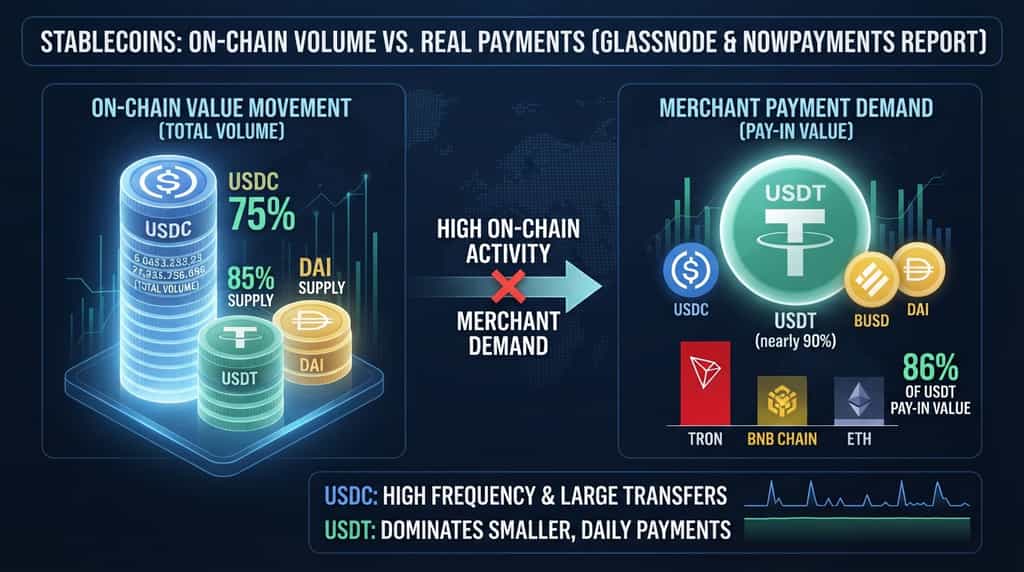
A recent report by Glassnode, developed with merchant pay-in data from NOWPayments, examines how the two largest dollar-pegged stablecoins move across different networks and how businesses actually receive payments. Its findings reveal a notable gap between on-chain transaction activity and merchant demand: USDC accounts for a large share of on-chain value movement, while USDT dominates stablecoin payment volume in the merchant dataset.
For businesses considering stablecoin payments, the distinction matters. Choosing the right blockchain network can affect customer reach, transaction costs, payment reliability, and operational requirements.
Quick Answer: Which Stablecoins and Networks Are Most Used for Payments?
USDT dominates merchant stablecoin pay-ins in the NOWPayments dataset, accounting for nearly 90% of stablecoin payment value. USDT on Tron and BNB Chain is particularly important, while USDC on Base generates substantial on-chain activity but contributes only a small share of merchant payments.
Key findings from the Glassnode and NOWPayments report include:
-
USDT dominates merchant payments: It represents nearly 90% of stablecoin pay-in value in the NOWPayments dataset.
-
USDC moves more value on-chain: USDC transfers approximately three times as much value as USDT across the networks covered.
-
Three USDT networks lead merchant payments: USDT on Tron, BNB Chain, and Ethereum account for 86% of stablecoin pay-in value.
-
On-chain activity can be misleading: USDC on Base accounts for 45% of on-chain USDT and USDC value but only 0.6% of merchant pay-in value.
-
Payment activity peaks in the evening: The largest payment networks see their highest pay-in activity between 19:00 and 21:00 UTC.
Why Are Stablecoin Payments Growing in Importance?
Stablecoins combine blockchain-based transfers with relatively stable reference values, making them useful for moving dollar-denominated funds across digital platforms. Unlike volatile cryptocurrencies, major dollar-pegged stablecoins are designed to maintain a value close to $1.
USDT and USDC account for approximately 85% of the total stablecoin supply, according to the report. Together, stablecoins hold more than $300 billion in supply and have become a major source of on-chain value transfer.
Over the 30 days preceding October 5, 2026, stablecoins moved more than $200 billion in value per day on-chain, exceeding the combined daily value movement of Bitcoin and Ethereum.
However, this comparison requires an important qualification. The methodology used for Bitcoin and Ethereum excludes transfers in which holders move assets between their own wallets, while the stablecoin figures include every transfer. Even when all Bitcoin and Ethereum transfers are counted, stablecoins still move approximately 2.5 times as much value.
This activity reflects the growing role of stablecoins in trading, treasury management, exchange transfers, and payments. Yet these use cases should not be treated as interchangeable. A blockchain transfer may represent a customer purchase, an exchange settlement, an internal wallet movement, or automated trading activity.
For merchants, the relevant metric is not simply how much value moves on a network, but how much of that activity represents actual customer payments.
USDT vs. USDC: How Do Their On-Chain Usage Patterns Differ?
Although both assets track the US dollar, USDT and USDC show different transaction patterns across the networks covered by the report.
USDC Moves More Frequently and Handles Larger Transfers
Between September 2025 and September 2026, USDC moved approximately three times as much value as USDT across the networks included in the analysis.
The difference becomes more striking when transaction frequency is considered. On average, an individual USDT moved approximately once every three days, while an individual USDC moved two or three times per day.
Base played a major role in this pattern. On that network, each USDC moved approximately once an hour on average. Even excluding Base, USDC still changed hands several times more frequently than USDT.
However, higher transfer frequency does not necessarily mean greater payment adoption. Much of the activity may come from trading platforms, exchanges, funds, and automated applications.
USDT Has a Stronger Presence in Smaller Transfers
The report also identifies differences in transfer size.
USDT moves a larger proportion of its value through transfers below $10,000, a range more closely associated with many everyday payments. USDC, in comparison, moves a much larger share of its value through high-value transfers.
This distinction helps explain why USDC can dominate on-chain value movement while USDT remains the leading stablecoin in merchant payment activity.
For businesses, the practical implication is that stablecoin selection should reflect customer payment behavior rather than overall blockchain transaction volume.
Which Blockchain Networks Are Most Popular for Stablecoin Payments?
One of the report's most important findings is the gap between the networks carrying the most on-chain value and those generating the most merchant pay-ins.
USDT on Tron and BNB Chain Leads Merchant Payments
USDT accounts for nearly 90% of stablecoin pay-in value in the NOWPayments dataset.
Three networks—Tron, BNB Chain, and Ethereum—together account for 86% of stablecoin pay-in value through USDT.
USDT on Tron and BNB Chain alone generates approximately three-quarters of merchant pay-in value, despite representing only 14% of the combined on-chain USDT and USDC value measured in the report.
This suggests that merchant payment demand is concentrated on networks that may not dominate aggregate on-chain value movement.
USDC on Base Shows the Opposite Pattern
USDC on Base represents 45% of on-chain USDT and USDC value across the networks covered. Yet it contributes only 0.6% of stablecoin pay-in value in the NOWPayments dataset.
The difference suggests that much of Base's USDC activity may be associated with transfers between trading platforms, exchanges, and funds rather than direct merchant payments.
The findings highlight an important distinction: a network can be highly active without being a major payment channel for businesses.
For merchants, selecting payment networks based only on transaction volume could therefore lead to an inefficient allocation of technical and operational resources.
How Does Stablecoin Payment Demand Differ Across Industries?
Stablecoin adoption also varies by merchant business model. The report identifies meaningful differences among trading platforms, e-commerce businesses, SaaS providers, iGaming merchants, and token-sale businesses.
Among merchants with known industry classifications:
-
Trading platforms: Account for close to half of the pay-in value for both USDT and USDC.
-
E-commerce: Represents approximately one-sixth of the pay-in value for each stablecoin.
-
SaaS: Contributes around one-fifth of USDC pay-in value, compared with roughly one-tenth for USDT.
-
iGaming: Accounts for 15% of USDT pay-in value but only 1.3% of USDC pay-in value.
-
Token sales: Represent approximately 9% of USDC pay-in value, with almost no comparable contribution from USDT.
These differences indicate that stablecoin preferences are influenced by the type of business accepting payments.
For example, SaaS providers and token-sale platforms show a stronger relative preference for USDC in the dataset, while iGaming merchants rely more heavily on USDT.
Businesses should therefore evaluate payment preferences within their own customer segments rather than assume that the overall market distribution applies equally to every industry.
Conclusion
The Glassnode and NOWPayments report shows that stablecoin adoption cannot be measured through on-chain transaction volume alone. USDT and USDC serve different purposes across blockchain networks, and the networks carrying the most value are not necessarily those receiving the most merchant payments.
USDC moves substantially more value and changes hands more frequently, particularly on Base. USDT, however, dominates merchant pay-ins, with Tron, BNB Chain, and Ethereum accounting for most payment value in the NOWPayments dataset.
For businesses, the distinction has direct operational implications. Payment network selection should be based on customer behavior, industry-specific demand, transaction costs, and payment timing rather than headline on-chain activity. Monitoring active addresses, transfer sizes, and pay-in patterns can provide a more useful picture of real payment adoption.
As stablecoins become more integrated into digital commerce, the ability to distinguish financial transfers from actual customer payments will become increasingly important for merchants building reliable blockchain-based payment infrastructure.
FAQs
-
What is the most widely used stablecoin for merchant payments?
In the Glassnode and NOWPayments report, USDT accounts for nearly 90% of stablecoin pay-in value. Its strong presence on Tron, BNB Chain, and Ethereum makes it the dominant stablecoin in the merchant dataset.
-
Is USDT or USDC better for stablecoin payments?
Neither stablecoin is universally better. The report shows that USDT dominates merchant pay-ins, while USDC moves more value on-chain and has a particularly strong presence on Base. Businesses should evaluate customer preferences, supported networks, transaction costs, and operational requirements before choosing.
-
Why does USDC have more on-chain activity than USDT?
USDC moves approximately three times as much value as USDT across the networks covered by the report. Its high activity on Base and other networks is partly associated with large transfers and frequent movements involving trading platforms, exchanges, and funds. This does not necessarily indicate greater merchant payment demand.
-
Which blockchain networks are most important for USDT payments?
USDT on Tron, BNB Chain, and Ethereum accounts for 86% of stablecoin pay-in value in the NOWPayments dataset. Tron and BNB Chain together contribute approximately three-quarters of total stablecoin pay-in value.
-
When do stablecoin payments usually peak?
The largest stablecoin payment pairs in the report see their highest pay-in activity between 19:00 and 21:00 UTC. Approximately one-third of pay-ins arrive between 17:00 and 23:00 UTC, several hours after the peak in on-chain activity.
Disclaimer: This general market information may come from third-party, commercial, or sponsored sources and is provided for informational and educational purposes only. It does not constitute financial or investment advice, an offer, a solicitation, or a guarantee. We assume no responsibility for the accuracy, completeness, or reliability of this information or for any losses arising from its use.
Investing and trading involve risks. Past performance does not guarantee future results. Users should conduct their own research, exercise sound judgment, and take full responsibility for their decisions. For more information, please refer to KuCoin's Terms of Use and Risk Disclosure.