

What Role Do Bitcoin ETFs, Stablecoins, and DeFi Liquidity Pools Play in Offsetting Capital Outflows?
2026/04/29 12:15:01
Introduction
In the first quarter of 2026, the cryptocurrency market witnessed a remarkable shift in capital dynamics. U.S. spot Bitcoin ETFs absorbed approximately $1.32 billion in net inflows during March alone—their first positive monthly performance since October 2025. This figure becomes even more significant when examining the broader capital flow picture: according to JPMorgan analysts, the crypto market recorded nearly $130 billion in historical capital inflows during 2025, representing approximately one-third growth year-over-year.
These instruments have emerged as critical mechanisms for absorbing selling pressure and maintaining market stability during periods of heightened volatility. Understanding how Bitcoin ETFs, stablecoins, and decentralized finance (DeFi) liquidity pools function as capital flow shock absorbers requires examining their distinct yet complementary roles in the modern crypto financial ecosystem.
The Evolution of Capital Flow Dynamics in Cryptocurrency Markets
The cryptocurrency market has undergone a fundamental transformation in how capital flows through its ecosystem. Traditional cryptocurrency markets operated with relatively straightforward dynamics: capital entered through centralized exchanges during bull markets and exited during downturns, creating pronounced boom-bust cycles. However, the maturation of institutional-grade infrastructure—particularly through regulated ETFs, stablecoin rails, and DeFi protocols—has introduced more sophisticated mechanisms for managing capital rotation and cushioning market shocks. The interconnected nature of these three instruments creates what market observers describe as a "liquidity flywheel," where capital circulates through different channels rather than simply entering or exiting the market wholesale. This structural shift has profound implications for how market participants should understand price discovery, volatility management, and investment strategy development in 2026.
The fundamental question that emerges from this market evolution concerns how each instrument contributes to offsetting capital outflows. Rather than treating these as isolated products, the most accurate analytical framework recognizes that Bitcoin ETFs, stablecoins, and DeFi liquidity pools operate as complementary components within a unified capital management system. When institutional or retail investors seek to reduce crypto exposure, their capital does not necessarily leave the ecosystem entirely—instead, it often rotates through these different instruments, creating multiple layers of liquidity support that can absorb selling pressure and stabilize markets during turbulent periods.
Bitcoin ETFs: Institutional Capital's Shock Absorber
Absorbing Supply and Dampening Volatility
Bitcoin ETFs have fundamentally altered the relationship between cryptocurrency supply and capital flows. The approval of spot Bitcoin ETFs in the United States in January 2024 created a new channel through which traditional financial system capital could enter the crypto ecosystem. Crucially, this channel has proven particularly effective at absorbing selling pressure during market downturns. When examining the data from late 2025, during the October market crash that saw over $19 billion in crypto leverage liquidated in a single day, Bitcoin ETFs demonstrated a remarkable capacity to continue absorbing supply even as prices declined sharply. The ETF structure provides institutional investors with a familiar, regulated vehicle for entering or exiting positions, which means that selling pressure from the broader crypto market often gets absorbed by ETF managers who can arbitrage price discrepancies between the fund and underlying Bitcoin holdings.
The supply-absorption dynamic deserves particular attention when analyzing ETF impacts on capital outflows. Bitcoin production through mining adds approximately 450-900 new bitcoins to circulation daily, depending on the period relative to halving events. However, weekly net inflows into U.S. spot Bitcoin ETFs have repeatedly exceeded these new supply figures. During October 2025, despite significant market volatility, weekly ETF inflows regularly matched or exceeded weekly mining production, effectively removing this supply from the immediate market. This dynamic creates a structural floor beneath prices during periods of selling, as ETF demand effectively represents committed capital that remains in the ecosystem even when individual investor sentiment turns negative.
The Concentration of Institutional Flows
Analysis of Bitcoin ETF flows reveals important insights about the distribution of institutional participation. According to data from Matrixport and other research platforms, the total net inflow into Bitcoin ETFs reached $35.5 billion, with BlackRock's IBIT commanding approximately $39.6 billion and Fidelity's FBTC holding roughly $11.4 billion. This concentration suggests that current ETF buying comes primarily from specific institutional client groups rather than representing broad retail adoption. If widespread retail participation were driving flows, inflows would distribute more evenly across ETF providers. This concentration has both advantages and implications for understanding capital outflow dynamics: large institutional investors tend to maintain positions for longer periods, with ETF holdings showing turnover rates below 0.5% and average holding periods exceeding 210 days. Such patient capital provides substantial stability during market corrections.
The institutional nature of ETF flows also creates a different quality of capital compared to direct cryptocurrency holdings. Traditional crypto investors might sell positions quickly during volatility, whereas institutional ETF allocations typically follow longer-term strategic allocation frameworks. When markets decline, institutional investors using ETFs may actually increase allocations as prices become more attractive, effectively providing countercyclical buying support. This behavior pattern has made Bitcoin ETFs particularly effective at offsetting retail-driven selling pressure, as institutional ETF demand creates a consistent bid that can absorb panic selling from individual investors.
Stablecoins: The Escape Hatch That Keeps Capital Within the Ecosystem
Stablecoins as Capital Preservation Vehicles
Stablecoins represent perhaps the most critical innovation for keeping capital within the cryptocurrency ecosystem during periods of market stress. Rather than converting crypto profits to traditional fiat currencies and exiting the ecosystem entirely, traders and investors increasingly use stablecoins as temporary parking vehicles during volatility. The largest stablecoins by market capitalization—USDT (Tether) and USDC (Circle)—now collectively maintain market capitalizations exceeding $180 billion, representing capital that remains in crypto-native form while avoiding the volatility of Bitcoin, Ethereum, or other digital assets. This phenomenon has fundamentally changed the calculus of capital outflows: when investors exit volatile crypto positions, a substantial portion of that capital now rotates into stablecoins rather than leaving the ecosystem entirely.
The mechanism works through several interconnected channels. During market corrections, traders selling Bitcoin or other volatile assets typically convert proceeds to stablecoins to preserve value while deciding on next steps. This conversion does not represent capital leaving the cryptocurrency ecosystem—it merely represents a rotation from volatile assets to stable ones. The stablecoin liquidity that results from this rotation provides critical support for trading activity: decentralized exchanges, centralized platforms, and DeFi protocols all require stablecoin liquidity to function efficiently. When markets recover and confidence returns, stablecoin holders can quickly re-enter volatile positions, effectively providing the demand that absorbs price recovery. This rotation dynamic means that stablecoins function as shock absorbers, capturing capital that might otherwise exit the ecosystem and making it immediately available for reinvestment when opportunities emerge.
The Expanding Role of Stablecoins in Global Finance
The stablecoin ecosystem continues expanding beyond simple trading applications into broader financial infrastructure. Circle's 2026 launch of the Arc blockchain introduces StableFX, an institutional-grade foreign exchange engine allowing 24/7 stablecoin trading across currency pairs. The Partner Stablecoins initiative supports regional stablecoin issuers including Avenia (Brazilian Real), Busan Digital Asset Custody Services (Korean Won), and Coins.ph (Philippine Peso). These developments indicate that stablecoins are evolving from trading instruments into global payment infrastructure, creating additional channels through which capital can remain within the broader crypto ecosystem while serving real-world financial needs.
Regulatory developments in the United States further validate stablecoins' structural importance. The GENIUS Act and related legislation aim to establish comprehensive frameworks governing stablecoin issuance, reserves, redemption rights, and custody arrangements. These regulatory frameworks, while adding compliance requirements, also provide legitimacy that encourages further institutional adoption of stablecoins as treasury management tools. Companies like Stripe and Klarna have expressed interest in stablecoin infrastructure for cross-border payments, demonstrating that stablecoin adoption extends beyond cryptocurrency traders into mainstream financial applications. This broadening use case reinforces stablecoins' role as capital retention mechanisms: as stablecoins become embedded in more financial applications, the capital they hold becomes increasingly integrated into the crypto financial ecosystem rather than representing a departure from it.
DeFi Liquidity Pools: Decentralized Market Depth
How Liquidity Pools Create Price Stability
Decentralized finance liquidity pools represent the third critical component in offsetting capital outflows. These pools, maintained by liquidity providers who deposit asset pairs into automated market maker protocols like Uniswap, Curve, and others, create continuous trading capacity even during periods when centralized exchanges experience liquidity stress. The mechanics differ fundamentally from traditional order book markets: liquidity pools provide constant availability for trades at prices determined by mathematical formulas rather than matching buy and sell orders. This structural difference means that liquidity pools cannot experience the same type of bid-ask spread widening or liquidity evaporation that affects traditional markets during volatility. The stability provided by these pools helps absorb trading demand that might otherwise create excessive price impact.
The data from 2025 demonstrates both the value and limitations of DeFi liquidity pools as capital flow shock absorbers. During the first half of 2025, DeFi total value locked (TVL) surged from $182.3 billion to $277.6 billion, reaching historic highs. This growth reflected substantial capital commitment to liquidity provision, which subsequently provided trading capacity when markets declined in the fourth quarter. Following the October 2025 market crash that saw TVL decline to approximately $189 billion, liquidity pools still maintained sufficient depth to facilitate continued trading activity. While the decline demonstrated that DeFi is not immune to market stress, the relative resilience compared to highly leveraged positions showed that committed liquidity provider capital provided meaningful support.
Concentration Dynamics and Market Structure
Analysis of DeFi market structure reveals important patterns regarding how liquidity contributes to offsetting capital outflows. The top 10 decentralized exchanges now capture approximately 80% of trading activity, with Uniswap and PancakeSwap alone representing roughly 40% of volume. This concentration suggests that liquidity provision has become increasingly professionalized, with significant capital committed to major protocols providing consistent market depth. Solana-native decentralized exchanges have emerged as particularly important contributors, with five of the top 10 DEXs now operating on Solana, reflecting that blockchain scalability and transaction costs significantly influence where liquidity providers commit capital.
Hyperliquid's rise in the perpetual futures market demonstrates how specialized DeFi protocols can capture specific market niches. By March 2025, Hyperliquid commanded over 60% of perpetual futures trading volume, representing billions in daily trading activity. This concentration of trading activity within specialized protocols provides substantial liquidity in those specific markets while demonstrating that DeFi can effectively serve professional trading needs. The implication for capital outflow offsetting is that specialized protocols create concentrated liquidity pools that can absorb significant trading volume without excessive price impact, effectively keeping capital active within the DeFi ecosystem rather than rotating to traditional markets.
The Interconnected Flywheel: How These Instruments Work Together
Capital Rotation Dynamics
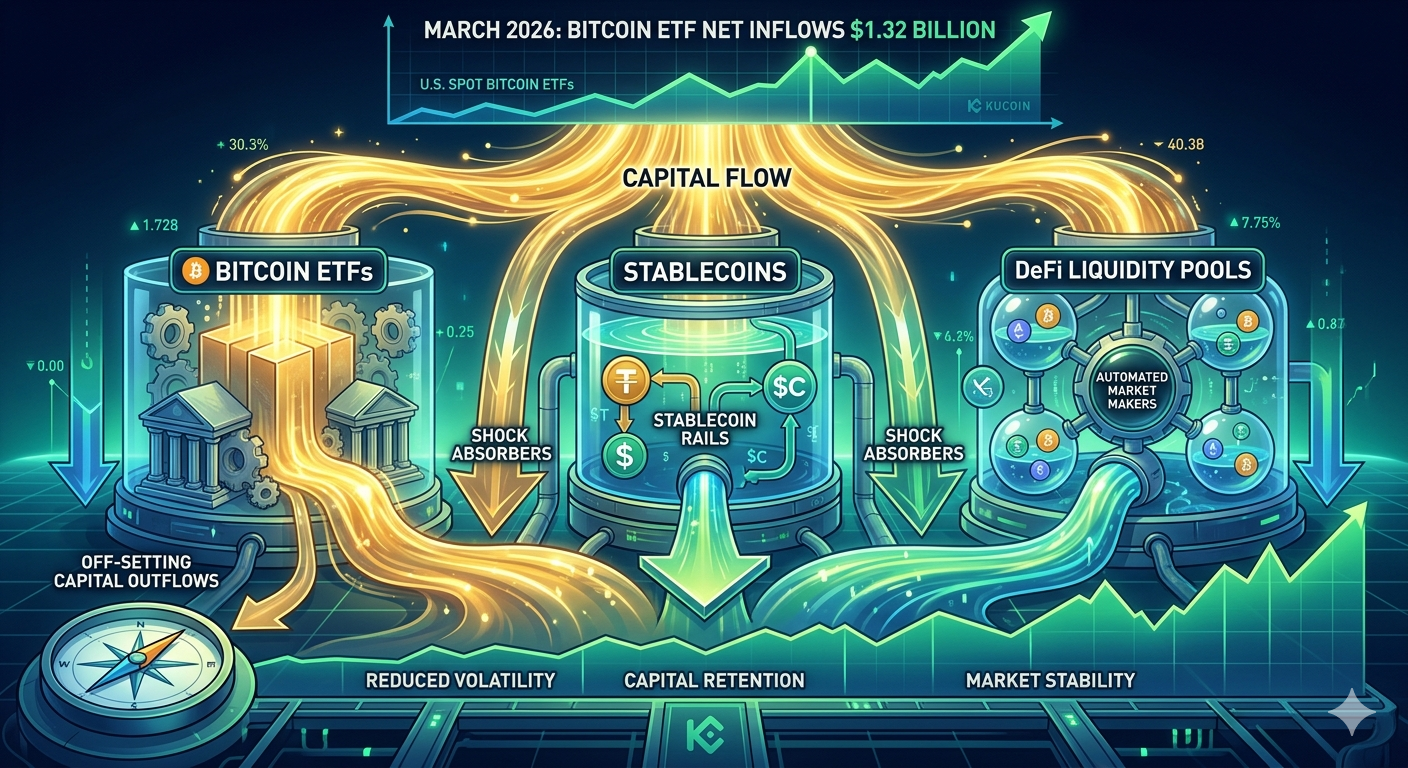
The true power of Bitcoin ETFs, stablecoins, and DeFi liquidity pools in offsetting capital outflows emerges when examining how they function as an interconnected system. Rather than competing for capital, these instruments create a flywheel where capital rotates through different forms while remaining within the broader cryptocurrency ecosystem. An institutional investor might reduce Bitcoin exposure during volatility by selling ETF shares, converting proceeds to stablecoins, then providing that liquidity to DeFi protocols to earn yield while waiting for reinvestment opportunities. This rotation keeps capital in crypto-native form throughout the process, providing stability to the overall market structure.
The flywheel mechanism becomes particularly evident during market stress periods. When Bitcoin prices decline, ETF arbitrage mechanisms create buying pressure at lower levels. Investors who sell during declines often rotate into stablecoins rather than exiting entirely, maintaining purchasing power for future entries. DeFi liquidity pools provide the trading infrastructure that facilitates both the stablecoin rotation and the eventual re-entry into volatile assets. Each step in this cycle keeps capital within the ecosystem, reducing the magnitude of true capital outflows that would otherwise amplify price declines. The cumulative effect is a market structure significantly more resilient to capital flight than existed in earlier cryptocurrency market history.
Comparative Analysis of Capital Retention Mechanisms
Understanding the distinct contributions of each instrument requires analyzing how they differ in capital retention characteristics. Bitcoin ETFs primarily capture institutional capital and provide the most direct connection between traditional finance and cryptocurrency markets. Their regulated structure encourages longer holding periods and creates structural demand that persists even during volatility. Stablecoins function as the universal medium of exchange within the crypto ecosystem, enabling rapid capital rotation without exiting to traditional finance. DeFi liquidity pools provide the infrastructure for decentralized trading and increasingly sophisticated financial products, creating utility for capital that maintains engagement with the ecosystem.
The following table summarizes key characteristics of each capital retention mechanism:
|
Instrument
|
Primary Function
|
Capital Retention Mechanism
|
Key Advantage
|
|
Bitcoin ETFs
|
Institutional gateway
|
Structural demand absorbs selling
|
Regulated, familiar structure
|
|
Stablecoins
|
Exchange medium
|
Capital rotation without exit
|
Immediate availability for re-entry
|
|
DeFi Liquidity Pools
|
Trading infrastructure
|
Continuous market making
|
Decentralized, censorship-resistant
|
These instruments do not operate in isolation—rather, they create a comprehensive capital retention system. The effectiveness of any single mechanism depends on the functioning of the others. Stablecoins require DeFi infrastructure to provide utility; ETF arbitrage requires stablecoin liquidity for efficient operation; DeFi protocols benefit from stablecoin liquidity provision. This interdependence means that the overall ecosystem's capital retention capacity depends on maintaining all three components at sufficient scale and quality.
Should You Trade Bitcoin, Stablecoins, and DeFi Assets on KuCoin?
KuCoin offers comprehensive access to all three capital retention instruments discussed in this article, making it an effective platform for implementing rotation strategies during various market conditions. For Bitcoin exposure through ETFs is not available in all jurisdictions, the exchange provides direct Bitcoin trading with deep order book liquidity that complements ETF-based strategies. Stablecoin trading pairs on KuCoin enable efficient capital rotation between volatile assets and stable value holders like USDT and USDC. The platform's DeFi offerings, including staking, lending, and liquidity provision tools, allow users to earn yield on idle stablecoins while maintaining ecosystem exposure.
For traders seeking to leverage the capital flow dynamics described in this article, KuCoin's spot trading, futures contracts, and DeFi earning products provide the infrastructure to implement sophisticated rotation strategies. The exchange's multi-chain support enables access to various DeFi protocols across different blockchain networks, potentially capturing yield opportunities across the liquidity pool landscape. Whether the goal is capital preservation during volatility, yield generation during market uncertainty, or strategic re-entry during corrections, the platform offers the tools necessary to navigate the interconnected capital flow ecosystem.
New users can now register at KuCoin and Get Up to 11,000 USDT in New User Rewards.

Conclusion
Bitcoin ETFs, stablecoins, and DeFi liquidity pools have collectively transformed the cryptocurrency market's resilience to capital outflows. These instruments do not merely represent alternative investment vehicles—they constitute a comprehensive capital retention infrastructure that keeps funds within the ecosystem during volatility. Bitcoin ETFs absorbed approximately $1.32 billion in net inflows during March 2026, demonstrating continued institutional commitment that provides structural support. Stablecoins with over $180 billion in market capitalization serve as the critical rotation medium that prevents capital from exiting to traditional finance. DeFi liquidity pools, despite experiencing significant drawdowns during the October 2025 crash, maintained sufficient depth to facilitate continued trading activity and preserve capital commitment to the ecosystem.
The interconnected nature of these instruments creates a flywheel effect where capital rotates through different forms rather than exiting entirely. This structural change represents one of the most significant developments in cryptocurrency market infrastructure, providing explanations for why recent market corrections, while severe in percentage terms, have been shorter-lived than historical patterns would suggest. For market participants, understanding these capital retention mechanisms provides crucial insight into market dynamics and investment strategy. The instruments that offset capital outflows are no longer simply market participants—they are foundational infrastructure supporting the modern cryptocurrency financial system.
FAQs
How do Bitcoin ETFs help reduce cryptocurrency market volatility?
Bitcoin ETFs reduce volatility by providing institutional investors with a regulated, familiar vehicle for buying and selling Bitcoin exposure. This institutional capital tends to have longer holding periods and follows strategic allocation frameworks rather than panic selling, creating consistent buying support during market declines. When ETF inflows exceed new mining supply, as happened repeatedly during 2025, the structural demand absorbs selling pressure that would otherwise amplify price declines.
What percentage of stablecoin capital actually leaves the cryptocurrency ecosystem?
The exact percentage varies by market conditions, but research suggests that the vast majority of stablecoin capital remains within the cryptocurrency ecosystem. Unlike in earlier market cycles when traders might convert crypto profits to fiat currencies, modern market participants increasingly use stablecoins as temporary parking vehicles. The expansion of DeFi yield opportunities and trading pairs has made stablecoins increasingly useful within the ecosystem, reducing incentives for fiat conversion.
Can DeFi liquidity pools prevent losses during major market crashes?
DeFi liquidity pools cannot prevent losses on volatile asset positions, but they do provide important capital retention infrastructure. During the October 2025 crash that saw over $19 billion in leverage liquidated, liquidity pools maintained sufficient depth to facilitate continued trading activity. While TVL declined significantly during the crash, the preserved liquidity infrastructure enabled faster market recovery by maintaining immediate availability for trading and re-entry.
Why did institutional Bitcoin ETF flows concentrate among BlackRock and Fidelity?
BlackRock and Fidelity command the majority of Bitcoin ETF flows due to their established institutional relationships, existing custody infrastructure, and brand recognition among traditional finance participants. When pension funds, sovereign wealth funds, and other institutional allocators decide to add Bitcoin exposure, they typically work with their existing asset manager relationships, which heavily favor these two providers. This concentration creates higher-quality institutional capital with longer holding periods.
How do capital retention mechanisms affect long-term cryptocurrency adoption?
The improved capital retention infrastructure supports long-term adoption by demonstrating market maturity to institutional investors. When large capital allocators can enter and exit positions through familiar instruments like ETFs without concerns about liquidity or custody, they are more likely to make initial allocations. The stablecoin and DeFi infrastructure that keeps capital within the ecosystem during volatility also means that recovered markets have immediate liquidity available for reinvestment, creating a more attractive investment environment compared to markets where capital fully exits during corrections.