

Top Crypto Trends to Watch in 2026- AI, RWA, and Beyond
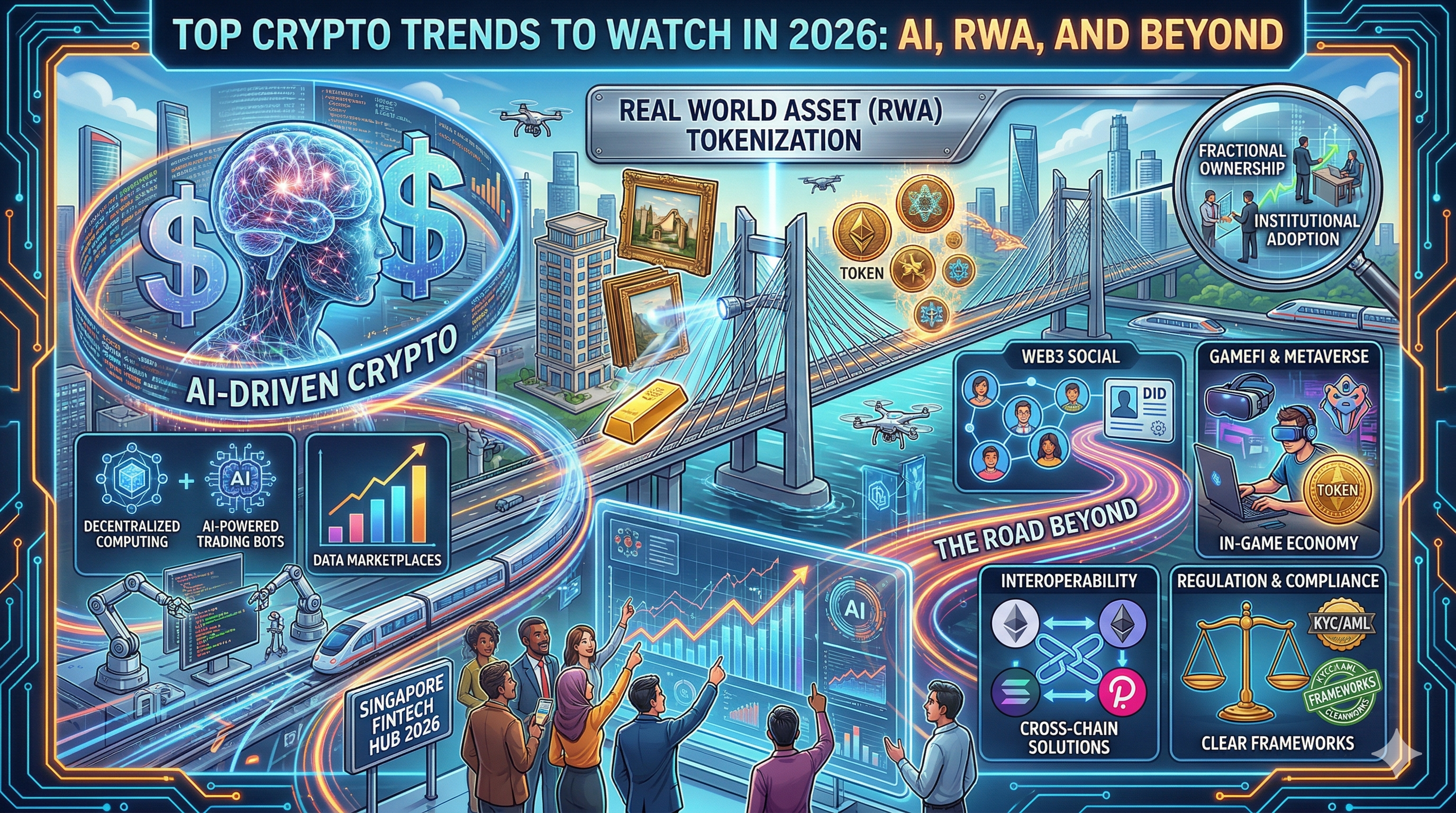
For years, we heard the same story: “Big banks are coming to crypto.” Investors and enthusiasts envisioned Wall Street rushing in, launching Bitcoin ETFs, and suddenly legitimizing the retail-driven, hype-fueled market of 2020–2024. And yes, they did come, but not in the way anyone predicted. It wasn’t about flashy ETFs or meme-fueled pumps. The real revolution happened quietly, almost imperceptibly, when institutions realized they could tokenize real-world assets, government bonds, gold, corporate debt, and move them on-chain with unprecedented speed, efficiency, and transparency. Suddenly, blockchain wasn’t just a tool for speculation; it became the infrastructure for modern finance.
Fast forward to March 2026. The crypto market as we knew it in 2024 is dead. The chaotic, high-volatility playground of dog coins, social-media-driven pumps, and random token launches has been replaced by a sophisticated, institutional-grade financial machine. In this new ecosystem, the line between a digital asset and real-world value has all but disappeared. A U.S. Treasury isn’t just a piece of paper anymore, it’s a token, tradable 24/7, programmable, and instantly settled across borders. Gold isn’t confined to vaults; it exists as tokenized contracts on the blockchain, allowing instant transfers anywhere in the world. The technology has matured, and with it, the capital has followed. This is no longer about hype, it’s about utility, liquidity, and systemic efficiency.
If you’re still hunting for the next 100x dog coin or chasing tokens because of a Twitter rumor, you’re reading the wrong map. The real opportunity in 2026 isn’t in the noise of speculative retail assets, it’s in the plumbing of the new financial system. It’s in the autonomous agents that trade relentlessly while markets sleep, in algorithms optimizing liquidity across decentralized exchanges, and in the tokenized government securities that function as the internet’s native reserve currency. This infrastructure underpins trillions of dollars of real value and is quietly reshaping how capital flows around the globe.
Two pillars define this new era. First is The Tokenization of Everything, which transforms physical and financial assets into programmable digital instruments. Second is The Rise of the Global Brain, the network of AI-driven agents, protocols, and smart contracts that collectively manage, route, and optimize this value without human friction. Together, they form the backbone of the 2026 financial space: a self-organizing, always-on, globally integrated system. For anyone serious about the future of finance, understanding these two forces is essential. They are not just trends, they are the architecture of the next generation of wealth creation.
The Flippening No One Saw Coming: Circle, BlackRock, and the Battle for the Dollar
The headlines this week are dominated by a single number: $2.4 billion. That is the current assets under management (AUM) of Circle’s USYC fund. For the first time, it has officially surpassed BlackRock’s BUIDL, which is currently holding steady at $2 billion. To the uninitiated, this might look like a minor corporate scuffle, a footnote in financial news. But to the institutional desk, it represents a tectonic shift in the very architecture of money. This is not just a story about AUM; it’s a story about how traditional financial powerhouses are being outmaneuvered in a domain they assumed they would dominate.
For the last two years, the industry watched BlackRock with bated breath, assuming the world’s largest asset manager would naturally own the on-chain Treasury market. Analysts, media outlets, and retail investors all predicted a slow but inevitable BlackRock monopoly. The expectation was that a Bloomberg terminal and a centuries-old reputation would be enough to control the flow of tokenized government debt. But Circle played a different game entirely. While BlackRock built a high-walled garden, accessible mostly to institutions with legacy infrastructure, Circle embraced composability, the idea that financial instruments could be modular, interoperable, and usable across the ecosystem.
USYC succeeded because it became the ultimate “lego piece” of the 2026 bull market. Unlike a traditional stablecoin or yield token, it functions simultaneously as a store of value, collateral, and an engine for leverage. Traders across crypto exchanges and networks like BNB Chain are no longer content to let “dry powder” sit idle in zero-interest stablecoins. Instead, they deploy USYC as collateral for perpetual futures and other strategies, allowing them to earn yield while maintaining active market exposure. These yields are typically benchmarked against short-term U.S. Treasury rates, which in recent market conditions have hovered in the mid-single-digit range. This dual utility, earning yield while unlocking trading power, has helped accelerate the growth of the tokenized real-world asset (RWA) sector. According to data from RWA.xyz, the RWA market has expanded to tens of billions of dollars in on-chain value, excluding traditional stablecoins, with tokenized U.S. Treasuries emerging as one of the fastest-growing segments.
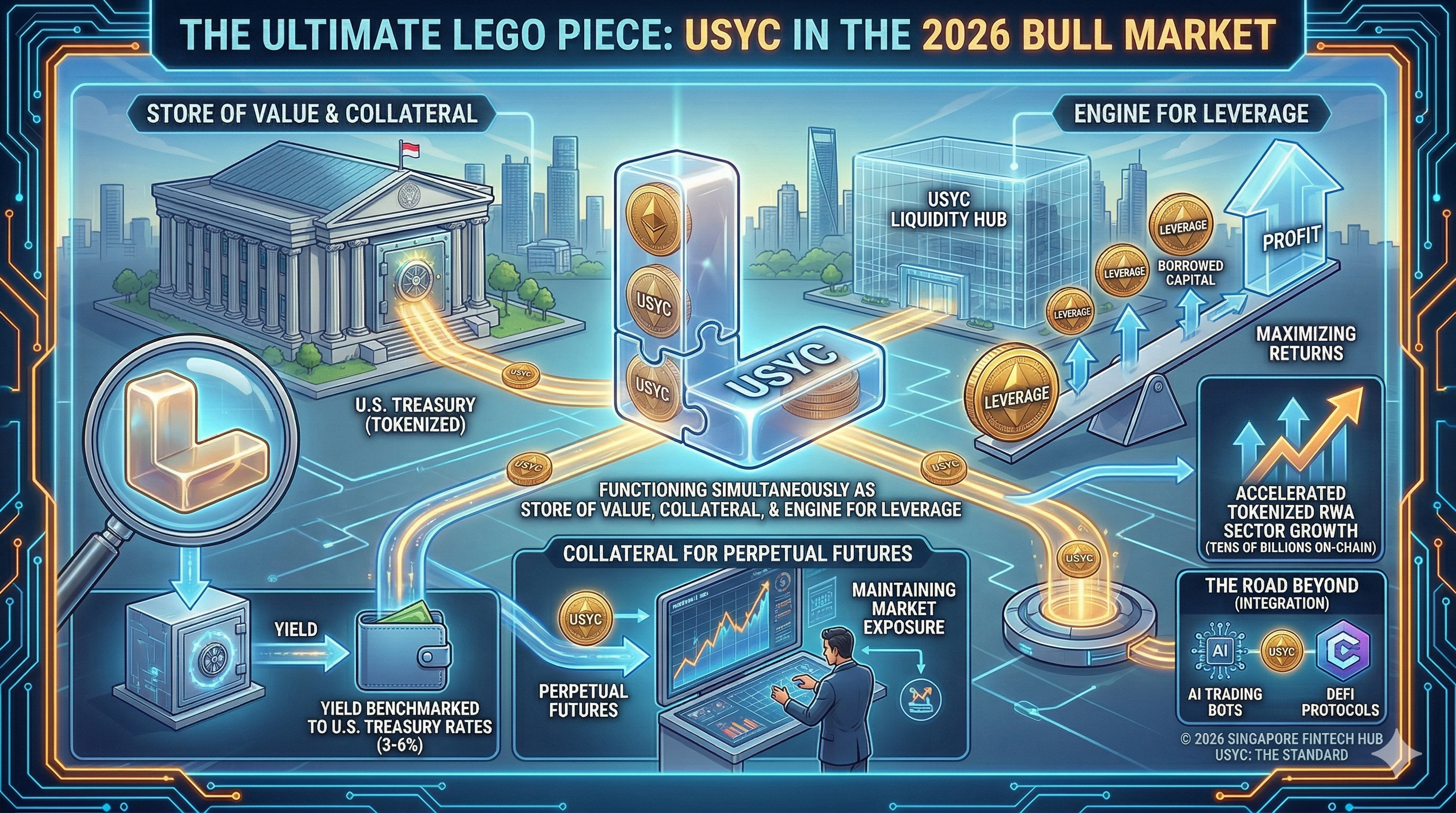
We’ve moved past the era where tokenization was a mere “pilot program.” Tokenized U.S. Treasuries, now totaling $11.92 billion, have become the bedrock of the internet’s M0 money supply. These digital Treasuries are no longer confined to the offices of hedge funds or the proprietary desks of banks; they are accessible to anyone with a wallet and a connection. This shift is more than operational, it is philosophical. It represents the democratization of the risk-free rate, granting anyone in Jakarta, or Buenos Aires access to the same yield opportunities that were once exclusive to Manhattan hedge funds.
The implications are profound. The gatekeepers didn’t just lose the keys, they lost the entire door. In 2026, financial plumbing is no longer centralized; it is global, open, and composable. Circle’s USYC isn’t just winning a numbers game; it’s reshaping how capital flows, how liquidity is accessed, and how financial power is distributed. BlackRock’s BUIDL remains formidable, but the landscape has fundamentally changed. The question is no longer whether traditional finance can compete on-chain, it’s whether it can adapt fast enough to thrive in a world where modular, tokenized assets define the rules of engagement.
The flippening isn’t about hype or short-term market movements. It’s about the architecture of money itself. Circle’s rise signals a future where yield, liquidity, and access are democratized at scale, challenging centuries-old hierarchies and rewriting the rules of global finance.
The Global Brain: Bittensor and the Death of "Black Box" AI
While the financial world was busy tokenizing the dollar, the technology world was busy decentralizing the mind. The conversation around Artificial Intelligence in 2026 has shifted away from the centralized monopolies of Silicon Valley. We’ve seen what happens when three companies control the "world’s weights", we get bias, censorship, and massive points of failure. The antidote has been Bittensor (TAO).
Bittensor is no longer the "niche" protocol it was in 2024. It has grown into a 128-subnet powerhouse. Think of it as a competitive meritocracy for machine intelligence. Whether it’s financial forecasting, image recognition, or protein folding, these subnets operate on a brutal, beautiful incentive loop: provide the best output, or get pruned.
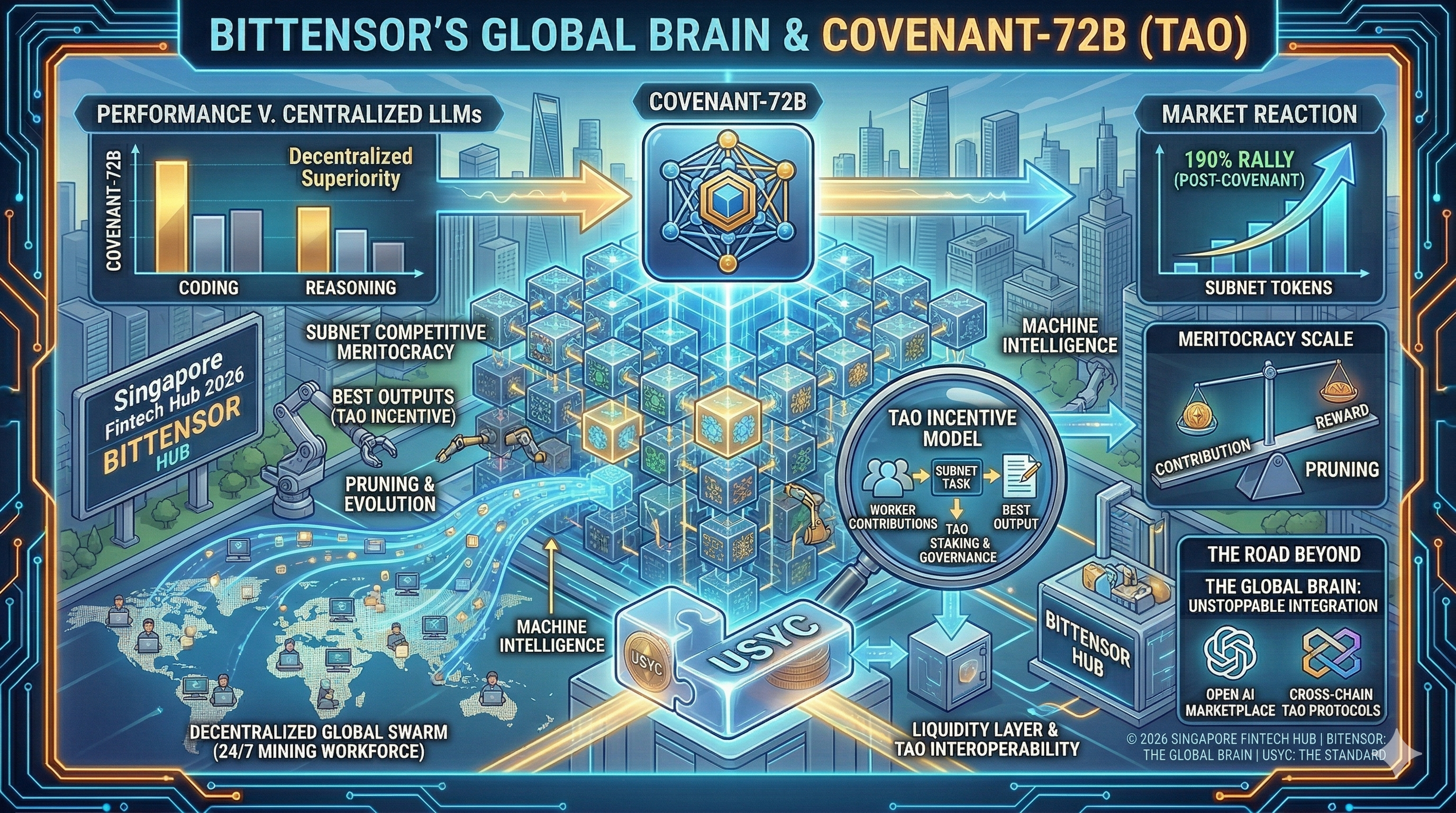
The "Sputnik moment" for decentralized AI occurred earlier this year with the release of Covenant-72B on Subnet 3. This wasn't a model trained by a corporation; it was a model "mined" by a distributed swarm of global contributors. When Covenant-72B started outperforming centralized LLMs in coding and logical reasoning, the market reacted with a 190% rally in the associated Templar subnet tokens.
It proved the thesis: decentralized networks don't just "match" centralized ones; they iterate faster because they have a global, 24/7 workforce incentivized by the TAO token. We aren't just building chatbots anymore; we are building a "Global Brain" that anyone can plug into, but no one can switch off.
The Synthesis: The Rise of the Self-Driving Treasury
The most profound development of 2026 is the point where these two narratives collide: tokenized real-world assets and AI-driven financial systems. We call it Autonomous Finance. For the last decade, the biggest friction point in crypto has always been the human element. Humans are slow. They sleep. They panic. They let emotions, fatigue, and cognitive biases dictate capital allocation. In the early 2020s, traders had to watch charts, react to news cycles, and make split-second decisions, all while the markets moved at speeds faster than any human could reliably process. Even with algorithmic trading, humans were still in the loop, often limiting efficiency and introducing unpredictable risk.
In 2026, the paradigm has shifted dramatically. The human has been moved to an oversight position, while autonomous AI agents handle execution. This isn’t some theoretical innovation, it is the backbone of the new financial landscape. Autonomous Finance allows capital to flow seamlessly, 24/7, without emotional volatility or fatigue-induced errors. These AI agents can respond to microsecond-level market movements, manage liquidity across multiple exchanges, and optimize collateral deployment across tokenized real-world assets, all while maintaining compliance with legal and regulatory frameworks. Humans now monitor strategy, set high-level parameters, and ensure governance, but the heavy lifting is performed by intelligent systems that never sleep and never panic.
At the center of this revolution is the Artificial Superintelligence Alliance (ASI), which has emerged as the de facto operating system for this convergence. ASI has become the universal layer through which tokenized assets and autonomous agents interact. With the launch of ASI, we’ve seen the birth of what the industry now calls Safe Yield Agents (SYAs). These aren’t simple bots executing pre-programmed strategies, they are fully autonomous entities with their own on-chain identity, reputation, and, critically, the legal agency to manage capital. Each SYA can hold assets, enter into contracts, and interact with other agents or humans in a decentralized legal framework.
The implications of Safe Yield Agents are staggering. Imagine a global marketplace where trillions of dollars in tokenized Treasuries, corporate debt, and commodities are managed not by humans staring at screens, but by autonomous agents that continuously optimize yield, risk, and collateral efficiency. They can deploy capital simultaneously across multiple chains, dynamically adjusting strategies based on real-time risk metrics, interest rate movements, and liquidity conditions. The result is a system that operates at institutional-grade precision but with the accessibility and transparency of decentralized finance.
Moreover, these agents have introduced a new era of composable financial intelligence. Just as tokenized assets can be stacked and used as collateral across multiple protocols, Safe Yield Agents can interoperate, forming networks of autonomous capital managers. One agent can automatically lend to another, hedge exposure via derivatives, and even negotiate terms with human stakeholders, all autonomously. These networks are self-organizing, learning from outcomes, and growing strategies without direct human intervention. In essence, we are witnessing the emergence of a Global Brain for Finance, where intelligence and capital are fused into a single, continuously optimizing system.
From a governance perspective, humans are still critical. Oversight is essential to ensure ethical behavior, regulatory compliance, and systemic stability. But the role of the human has transformed from executor to supervisor, strategist, and auditor. Decisions about monetary policy, protocol upgrades, and macro-level capital allocation are still human-led, but the day-to-day operation of trillions of dollars of capital is now autonomously managed, optimized, and deployed at a scale impossible for any human institution.
Autonomous Finance is not just an evolution of decentralized finance, it is a complete redefinition of capital markets. Tokenized assets give the system real-world value, while AI-driven agents ensure that value moves efficiently, continuously, and optimally. The marriage of these two forces, autonomous agents and tokenized real-world assets, is the single most transformative development of 2026, and it signals a future where humans and machines operate in symbiosis, creating a financial ecosystem that is smarter, faster, and more resilient than anything that came before.
A typical morning in 2026 looks like this:
An AI agent, tasked with managing a corporate treasury, queries a Bittensor subnet for a 30-day forecast on Federal Reserve sentiment. It cross-references this with real-time liquidity depth on Circle’s USYC and BlackRock’s BUIDL. It notices a 0.15% yield spread opening up on a secondary market pool. Within milliseconds, the agent executes a cross-chain swap, logs the transaction for the auditors, and updates the "Proof of Reserve" dashboard.
The agent doesn't need a broker. It doesn't need a signature. It just needs logic. This loop, where RWAs provide the "low-volatility fuel" and AI provides the "navigation", is why the 2026 cycle feels more durable than anything we’ve seen before. It’s not built on hype; it’s built on productivity.
The Infrastructure Play: DePIN is the New Utility
Underpinning this entire movement and trend is the physical backbone: DePIN (Decentralized Physical Infrastructure Networks). To think, an AI agent needs to be computed. To see the real world, an RWA needs data. This is where projects like Render, Akash, and Helium have become the utilities of the digital age. In 2026, GPU cycles are the new oil.
AI agents are now the primary customers of these networks. They use the yield they earn from tokenized Treasuries to buy more GPU power from platforms like Render to improve their own models. It is a closed-loop economy that operates entirely on-chain. This isn't just speculative crypto; this is the infrastructure of the 21st century. When you look at the $42 billion market cap of the DePIN sector, you aren't looking at a bubble, you’re looking at the valuation of the world’s most efficient utility company.
The Sovereign Regulatory Shift: The GENIUS Act
We cannot ignore the role of the GENIUS Act (Global Electronic Network Integration and Uniform Standards). Passed in late 2025, this legislation was the green light the institutional world had been waiting for. For years, adoption of tokenized real-world assets (RWAs) was blocked by unclear laws. Banks, asset managers, and hedge funds were hesitant to move capital on-chain because the legal framework simply did not exist. Two years of regulatory uncertainty and lawsuits had left the market fragmented and cautious. The GENIUS Act changed all that. It did what litigation, advocacy, and piecemeal frameworks could not: it provided a clear, internationally recognized legal bridge between digital tokens and physical assets.
The GENIUS Act essentially codified the idea that a tokenized representation of an asset, be it a Treasury, a corporate bond, a commodity, or even real estate, carries the same legal weight as the underlying physical or financial instrument. Suddenly, a U.S. Treasury note on-chain is legally equivalent to a Treasury note held in a vault. Tokenized gold can be used as collateral in court, just as physical bullion could. This clarity removed the last major obstacle for institutions: legal enforceability. For compliance officers and risk managers, this was the signal that blockchain-based instruments were no longer experimental, they were legitimate, auditable, and enforceable under law.
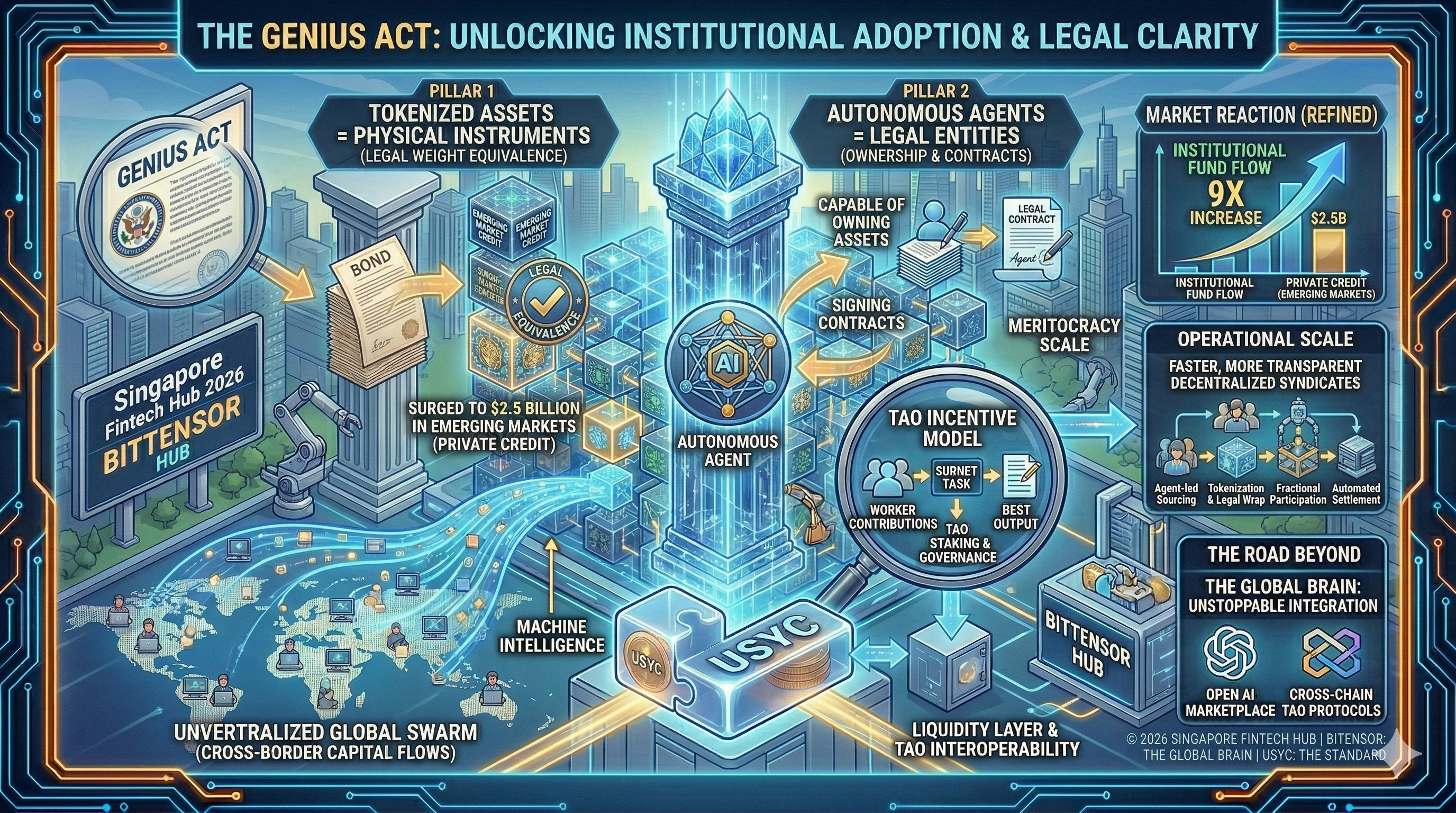
Perhaps even more revolutionary was the GENIUS Act’s recognition of legal personhood for autonomous agents. Before this, AI-driven agents, Safe Yield Agents, trading bots, and capital managers, operated in a gray zone. They could execute trades, manage collateral, and optimize liquidity, but they could not formally hold assets or sign contracts. GENIUS changed that, giving these agents the ability to legally own property, enter binding contracts, and interact with human counterparties. This legal empowerment transformed the AI infrastructure of finance from a set of tools into independent economic actors. They now function as co-managers of capital rather than mere execution engines, bridging the gap between digital efficiency and legal legitimacy.
The impact of this legislation is already visible across global markets. Tokenized private credit, loans to real companies in Brazil, Kenya, Vietnam, and beyond, has surged to $2.5 billion. Small and medium enterprises in emerging markets can now access capital through on-chain lending protocols, with AI agents evaluating risk, setting terms, and managing repayments automatically. The on-chain world is no longer a parallel or experimental environment; it is becoming the primary ledger of record for the real world, where contracts, payments, and asset transfers are transparent, instantaneous, and enforceable.
Equally significant is the act’s effect on cross-border finance. Prior to GENIUS, legal and regulatory uncertainty made international capital flows cumbersome. Different jurisdictions interpreted tokenized ownership inconsistently, creating friction and limiting participation. Now, global institutions can confidently deploy capital across borders, knowing that the digital representation of an asset carries universal legal validity. This has enabled a surge in decentralized global syndicates, where multiple institutions and autonomous agents collectively fund projects in emerging economies, often faster, cheaper, and with far greater transparency than traditional finance could manage.
The New Risks: Hallucinations and Oracle Lags
Of course, a journalist’s job isn't just to report the growth, but to point out the cracks. 2026 has introduced "Black Swan" risks we couldn't have imagined in 2024.
The most prominent is Agentic Hallucination. In January, a faulty oracle feed led a swarm of autonomous agents to believe a minor bank glitch was a systemic collapse. Within minutes, billions were rotated out of stable RWA pools, causing a "flash de-peg" that took hours to stabilize. While the market recovered, it was a sobering reminder that when you give machines the keys to the vault, you better make sure their "eyes" (the oracles) are clean.
There is also the Centralization Paradox. As Circle and BlackRock dominate the RWA space, we have to ask: is a tokenized Treasury actually decentralized if a single corporate entity can freeze the smart contract? The tension between permissionless tech and permissioned assets is the great debate of 2026.
For the investor looking at a platform like KuCoin today, the strategy has moved from picking winners to allocating to infrastructure.
A 2026 Blueprint portfolio generally follows a Core-and-Satellite model:
-
The Core (70%): Yield-bearing RWAs (like ONDO or USYC) and "Global Reserve" assets (BTC/ETH). This is your ballast.
-
The Intelligence Satellite (20%): High-tier DeAI tokens like TAO and FET. These are your growth engines.
-
The Utility Satellite (10%): DePIN tokens that provide the compute and data for the agents.
The 2026 cycle is characterized by Active Passive Income. You don't just hold; you deploy. You use your tokenized Treasuries to earn yield, you use that yield to fund your AI agents, and you use those agents to hunt for alpha across the 128 subnets of the global brain.
March 2026: The Scorecard
|
Thing |
Value |
Trend |
|
Real Assets on Chain |
$27.35 Billion |
Up |
|
U.S. Bonds on Chain |
$11.92 Billion |
Steady |
|
AI Subnets (Bittensor) |
128 |
Fast Growth |
|
Computer Power Market |
$42 Billion |
High Demand |
Conclusion
We are no longer in the early days. The infrastructure is built, the regulations are (mostly) clear, and the capital has arrived.
2026 is the year we stopped talking about the "potential" of blockchain and started living in the reality of Autonomous Value. The flippening of Circle over BlackRock is just the beginning. As AI agents continue to mature and more of the world’s $300 trillion in assets move on-chain, the distinction between crypto and finance will eventually disappear entirely.
The casino is closed. The autonomous factory is open. And it never sleeps.