

Top Public Companies Holding Bitcoin in 2026 and Their Acquisition Costs
Introduction
Bitcoin is no longer just an asset for retail speculators. It has become a board-level treasury decision. As of April 8, 2026, at least 154 publicly traded companies collectively hold about 5.351% of Bitcoin’s fixed 21 million supply, valued at approximately $80.55 billion.
Private companies account for an additional 2.054%, worth around $30.91 billion, while the top 34 mining companies hold roughly 0.536%, valued at about $8.07 billion. These figures highlight how deeply Bitcoin has been integrated into corporate balance sheets across both public and private markets.
The real story, however, is not just who holds Bitcoin. It is what it costs them to hold it. For traditional tech and finance companies, the key metric is the average purchase price, also known as the cost basis per coin. For mining companies, there is an added layer that reflects the full cost of production, including ASIC hardware efficiency, electricity pricing, and chip-level economics.
This article identifies the top public companies holding Bitcoin in 2026 and breaks down their acquisition cost per coin. For mining firms, it also examines the underlying hardware and energy costs behind each BTC on their balance sheets.
By the end, readers will have a clear, data-backed view of which firms are sitting on unrealized gains, which are under pressure, and how differences in mining economics could shape long-term sustainability.
Bitcoin as a Corporate Reserve Asset in 2026
Bitcoin has moved from a speculative asset to a strategic reserve on corporate balance sheets. By 2026, companies across industries are holding BTC for different reasons, from treasury diversification to long-term capital preservation.
Why Companies Hold Bitcoin on Their Balance Sheets
A corporate Bitcoin treasury strategy, the practice of holding BTC as a primary or supplementary reserve asset, gained traction after Michael Saylor led MicroStrategy to adopt Bitcoin in August 2020. What began as a hedge against currency depreciation has, by 2026, evolved into a broader corporate trend across multiple industries and regions.
The motivations vary, but the core reasons for holding Bitcoin on the balance sheet remain consistent across most adopters:
Inflation Hedge and Currency Debasement Protection
Bitcoin’s fixed supply of 21 million BTC makes it resistant to inflationary pressures that affect fiat currencies. For companies holding large cash reserves, Bitcoin offers an alternative store of value that is not subject to monetary expansion. This is particularly relevant for firms operating in environments where long-term currency depreciation is a concern.
Liquidity and Global Accessibility
Bitcoin can be transferred and settled across borders without reliance on traditional banking systems. This makes it more flexible than assets such as real estate or commodities, which often require intermediaries, regulatory approvals, or extended settlement periods. For multinational companies, this liquidity supports faster capital mobility and reserve allocation.
Institutional Demand for Bitcoin Exposure
As institutional interest in Bitcoin has grown, many investors seek exposure through publicly traded companies that hold BTC on their balance sheets. This creates indirect demand for equities tied to Bitcoin reserves, allowing companies to benefit from capital inflows while giving investors a regulated entry point into Bitcoin exposure.
Treasury Diversification
Traditional corporate treasuries are typically concentrated in fiat cash, short-term bonds, or money market instruments. Allocating a portion of reserves to Bitcoin introduces a non-correlated asset class, which can help diversify balance sheets and reduce reliance on conventional financial instruments.
Long-Term Capital Appreciation Strategy
Some companies treat Bitcoin as a long-term strategic asset rather than a short-term hedge. By accumulating and holding BTC over extended periods, these firms position themselves to benefit from potential appreciation, aligning part of their treasury strategy with long-duration asset growth rather than immediate liquidity needs.
The Top 10 Public Companies Holding Bitcoin in 2026
The table below presents the top 10 publicly traded companies by Bitcoin holdings as of April 2026. It is compiled from Q1 filings, official company disclosures, and aggregated data from Bitbo’s Bitcoin treasury tracker. For mining companies, the cost basis reflects the all-in electrical cost of producing Bitcoin rather than an open-market purchase price. This distinction is important and is explained in detail in Section 3.
|
Company |
Ticker |
BTC Holding |
Value (April, 2026) |
Type |
|
Strategy (MicroStrategy) |
MSTR |
766,970 |
$54.99 B |
Business Intelligence |
|
Marathon Digital Holdings Inc |
MARA |
38,689 |
$2.77 B |
Bitcoin Mining Company |
|
Twenty One Capital (XXI) |
XXI |
43,514 |
$3.1 B |
Bitcoin Treasury Company |
|
Metaplanet Inc. |
MPJPY |
40,177 |
$2.88 B |
Bitcoin Treasury Company |
|
Bullish |
BLSH |
24,300 |
$1.74 B |
Digital Asset Platform |
|
Riot Platforms, Inc. |
RIOT |
15,680 |
$1.12 B |
Bitcoin Mining Company |
|
Coinbase Global, Inc. |
COIN |
15,389 |
$1.10 B |
Crypto Exchange |
|
Hut 8 Corp |
HUT |
13,696 |
$981.69 M |
Bitcoin Mining Company |
|
CleanSpark Inc |
CLSK |
13,363 |
$958.1 M |
Bitcoin Mining Company |
|
Galaxy Digital Holdings |
GLXY |
6,894 |
$494 M |
Crypto Financial Services |
Source: BitcoinTreasuries.net
Strategy Inc. (MSTR) Bitcoin Holdings, Cost Basis, and Treasury Strategy in 2026
Strategy Inc., rebranded from MicroStrategy in February 2025, holds approximately 766,970 BTC as of early April 2026, making it by a wide margin the largest corporate Bitcoin holder in the world. The company has spent roughly $58 billion to accumulate its Bitcoin holdings, at an average cost of about $75,648 per BTC. As of April 2026, these holdings are valued at approximately $54.99 billion.
With Bitcoin trading near $68,000 to $70,000 in early April, Strategy’s treasury is carrying an estimated paper loss of roughly 5%–6%, a figure that plays a central role in equity valuation and market sentiment around the stock.
What differentiates Strategy from other corporate holders is its financing model. The company has accumulated Bitcoin primarily through capital markets activity rather than operating cash flow. Its approach relies on preferred stock issuances, zero-coupon convertible notes, and at-the-market equity offerings to raise capital, which is then deployed into Bitcoin purchases. This structure allows Strategy to continuously expand its Bitcoin holdings while maintaining flexibility in how it sources capital.
Strategy also evaluates its performance using a proprietary metric known as BTC Yield, which measures the percentage increase in Bitcoin per diluted share over time. This KPI reflects the company’s focus on increasing Bitcoin exposure on a per-share basis rather than simply growing total holdings. Management considers the strategy effective as long as Bitcoin accumulation per share outpaces the effects of equity dilution from its capital raising activities.
Marathon Digital Holdings Inc. (MARA) Bitcoin Mining Operations, Holdings, and Production Strategy in 2026
Marathon Digital Holdings Inc., listed on NASDAQ under the ticker MARA, holds approximately 38,689 BTC as of April, 2026. Unlike treasury-focused companies that acquire Bitcoin through capital markets, Marathon accumulates its holdings primarily through its mining operations. The company generates Bitcoin as a block reward by contributing computational power to the Bitcoin network, making its accumulation process dependent on operational performance rather than direct purchases.
Marathon’s business model is built around large-scale Bitcoin mining infrastructure. The company operates with an installed hash rate of approximately 30.6 EH/s, which allows it to compete for block rewards at an industrial scale. As one of the largest publicly traded miners, Marathon’s Bitcoin holdings reflect a combination of mined production and its internal policy on how much BTC to retain versus sell.
Unlike corporate treasury companies, Marathon’s cost basis is not determined by market purchase prices. Instead, it is driven by its all-in production cost per Bitcoin. This includes electricity costs, mining hardware efficiency, infrastructure expenses, and general operational overhead. These inputs collectively influence profitability and determine whether mined Bitcoin is held on the balance sheet or sold to cover expenses and support ongoing operations.
Overall, Marathon represents a mining-driven category of corporate Bitcoin holders. Its Bitcoin exposure is both a result of production activity and a balance sheet strategy, placing it at the intersection of energy usage, mining economics, and long-term digital asset accumulation in 2026.
Twenty One Capital (XXI) Bitcoin Treasury Strategy and Institutional Position in 2026
Twenty One Capital, listed under the ticker XXI, holds approximately 43,514 BTC, placing it among the largest publicly traded corporate Bitcoin holders in 2026. Backed by Cantor Fitzgerald, SoftBank, and Tether, the company was structured from inception as a Bitcoin treasury vehicle.
Its first disclosed purchase occurred on May 9, 2025, when it acquired 4,812 BTC for approximately $458.7 million at an average price of $95,319.83 per BTC, as reported in a Form 8-K filing with the U.S. Securities and Exchange Commission.
While the company has continued accumulating Bitcoin since then, its full average cost basis across the entire position remains undisclosed. Based on its initial purchase and the timing of subsequent accumulation during the 2025 bull cycle, its blended average cost is widely estimated to fall within the $90,000 to $100,000 range per BTC. At current market prices, its holdings are valued at roughly $3.1B, making its market value to net asset value ratio a key metric for analysts assessing its valuation.
Led by Jack Mallers and based in Austin, Twenty One Capital operates as a Bitcoin-native financial services firm. In addition to accumulating Bitcoin, it develops products such as credit and brokerage services, creating a hybrid model that combines treasury accumulation with operating activity and positions the company within the evolving institutional Bitcoin landscape.
Metaplanet Inc. Bitcoin Holdings and Accumulation Strategy in 2026
Metaplanet Inc., a Tokyo-listed investment firm and hotel operator, has emerged as one of the most aggressive corporate Bitcoin accumulators in 2025 and 2026. The company began building its Bitcoin position in April 2024 with fewer than 100 BTC and has since scaled rapidly to approximately 40,177 BTC as of April 2026. This places it among the top public Bitcoin holders globally and the leading non-U.S. company in the corporate Bitcoin treasury landscape.
This rapid accumulation has come at a high cost. Metaplanet’s average purchase price is approximately $104,107 per BTC, with its holdings currently valued at around $2.87 billion. At prevailing market prices, this implies a significant unrealized loss on its balance sheet.
However, the company maintains a long-term perspective, positioning Bitcoin as a strategic reserve asset in response to macroeconomic pressures, including sustained depreciation of the Japanese yen.
Metaplanet’s strategy is defined by scale and forward targets. Through its “555 Million Plan,” the company aims to reach 100,000 BTC by the end of 2026 and 210,000 BTC by the end of 2027.
Achieving this would require a substantial acceleration in capital deployment and continued access to funding. As a result, Metaplanet stands out not only for the size of its current holdings but also for the pace and ambition of its Bitcoin accumulation strategy within the global corporate treasury landscape.
Bullish Bitcoin Holdings and Accumulation Strategy in 2026
Bullish is an institutionally focused digital asset exchange that provides trading, liquidity, and market infrastructure services within a regulated framework. Founded in 2020, the platform integrates elements of decentralized finance with traditional financial controls, positioning itself as a compliance-first exchange designed for institutional participation.
As of April 2026, Bullish holds approximately 24,300 BTC, valued at around $1.74 billion. The company began accumulating Bitcoin in August 2025, aligning its balance sheet with the digital asset markets it facilitates.
Unlike mining companies or pure treasury firms, Bullish holds Bitcoin as part of its exchange and liquidity infrastructure. Its accumulation strategy reflects both balance sheet exposure and operational utility, where Bitcoin supports trading activity, liquidity provisioning, and institutional demand. This positions Bullish as an exchange-driven Bitcoin holder, combining market infrastructure with direct BTC ownership in 2026.
Riot Platforms Inc. (RIOT) Bitcoin Mining Operations, Holdings, and Infrastructure Strategy in 2026
Riot Platforms is one of the leading publicly traded Bitcoin mining firms, operating a vertically integrated model that spans mining operations, engineering, and large-scale data center development.
As of April 2026, the company holds approximately 15,680 Bitcoin, valued at around $1.12 billion, reflecting its continued position as a significant institutional holder within the mining sector.
Riot generates its Bitcoin primarily through mining rather than open-market purchases. Its operations are anchored by large-scale facilities, including the Whinstone site in Texas, one of the largest Bitcoin mining centers in North America. The company continues to expand its hashing capacity through ongoing investments in mining hardware and infrastructure, enabling it to scale production in response to evolving network difficulty and increasing competition.
In April 2026, Riot also demonstrated a notable shift in capital allocation strategy by selling 500 BTC for approximately $34.87 million during the first week of the month. This brought its total Bitcoin sales for April 2026 to roughly $102 million. The move reflects a broader pivot toward strengthening liquidity and reallocating resources as the company increasingly explores opportunities in AI infrastructure alongside its core mining operations.
Unlike treasury-focused companies that primarily accumulate and hold Bitcoin, Riot’s cost basis is driven by production economics. These include electricity costs, hardware efficiency, and infrastructure investment, all of which influence the profitability of each mined Bitcoin.
While the company retains a portion of its mined BTC, it also maintains operational flexibility to sell holdings when necessary to support expansion and fund strategic initiatives. This positions Riot as an infrastructure-driven Bitcoin holder, where balance sheet exposure is closely tied to mining output, capital discipline, and the broader evolution of its business model in 2026.
Galaxy Digital Holdings Bitcoin Strategy, Treasury Holdings, and Institutional Role in 2026
Galaxy Digital Holdings holds approximately 6,894 BTC as of April 2026, valued at around $494 million. Founded by Michael Novogratz, the company has built its Bitcoin position over time through trading, principal investments, and early market participation, rather than relying solely on a single accumulation strategy.
Galaxy operates as a diversified digital asset financial services firm, with business lines spanning asset management, trading, and advisory services. Its Bitcoin exposure is therefore both strategic and operational, reflecting its role as an intermediary for institutional capital entering the digital asset market.
In addition to holding Bitcoin on its balance sheet, the firm has expanded into mining infrastructure, including the acquisition of the Helios facility in Texas, which adds a production layer to its broader digital asset strategy.
This combination of treasury holdings, financial services, and infrastructure investment positions Galaxy as a hybrid participant in the corporate Bitcoin landscape. Unlike pure treasury companies or miners, its model integrates Bitcoin as both an asset and a core component of its service offering, reinforcing its role as a key bridge between institutional finance and the evolving digital asset ecosystem in 2026.
Coinbase Global Inc. (COIN) Bitcoin Holdings, Cost Basis, and Treasury Strategy in 2026
Coinbase Global holds approximately 15,389 BTC as of April 2026, valued at around $1.10 billion, with an average cost basis of about $70,125 per BTC. As one of the largest publicly traded crypto-native companies, Coinbase maintains Bitcoin on its balance sheet as part of a broader strategy that reflects both long-term conviction and operational utility.
Coinbase operates as a leading digital asset exchange, providing trading, custody, and infrastructure services for retail and institutional clients. Its Bitcoin holdings are not solely a treasury allocation but also serve strategic functions within its ecosystem, including liquidity support, custodial alignment, and balance sheet diversification. This positions Bitcoin as both an investment asset and an operational reserve within the company’s financial structure.
As a publicly listed company with transparent disclosures, Coinbase offers insight into how crypto-native firms manage Bitcoin exposure. Its approach is more conservative compared to aggressive treasury accumulators, balancing capital preservation with participation in Bitcoin’s long-term growth. This makes Coinbase a key reference point for institutional investors assessing Bitcoin’s role within regulated financial infrastructure in 2026.
Hut 8 Corp Bitcoin Holdings, Mining Operations, and Treasury Strategy in 2026
Hut 8 Corp holds approximately 13,696 BTC as of April 2026, valued at around $981.69 million. As one of North America’s largest publicly traded Bitcoin mining companies, Hut 8 accumulates its Bitcoin primarily through self-mining operations while maintaining a strategic reserve on its balance sheet.
Hut 8 operates as an energy infrastructure and compute platform, combining Bitcoin mining with large-scale data center development across the United States and Canada. Its vertically integrated model leverages power assets, mining facilities, and hosting services to optimize production efficiency. Bitcoin is generated through these operations, with the company using a mix of hydro and nuclear energy to support its infrastructure footprint.
The company’s Bitcoin strategy balances accumulation with operational flexibility. While Hut 8 generally aims to retain mined Bitcoin as a long-term reserve asset, it may periodically sell portions of its holdings to manage debt, fund expansion, or upgrade mining equipment.
This approach positions Hut 8 as both an infrastructure-driven miner and a strategic Bitcoin holder, where treasury growth is closely tied to production output and capital allocation decisions in 2026.
CleanSpark Inc. Bitcoin Holdings, Mining Operations, and Treasury Strategy in 2026
CleanSpark Inc holds approximately 13,363 BTC as of April 2026, valued at around $958.12 million. The company began holding Bitcoin in September 2022 and has since accumulated its reserves primarily through self-mining operations, positioning Bitcoin as a core component of its balance sheet.
CleanSpark operates as a sustainable Bitcoin mining company with facilities across the United States, including Georgia, Mississippi, and Wyoming. Its business model focuses on efficient large-scale mining supported by energy-optimized infrastructure and continuous expansion of hashrate capacity. Bitcoin is generated through these operations, with the company leveraging its infrastructure to maintain consistent production while improving operational efficiency.
The company’s treasury strategy has evolved into a balanced approach that combines accumulation with selective selling. While CleanSpark retains a significant portion of its mined Bitcoin as a long-term reserve, it also monetizes part of its production to fund operations and growth without excessive reliance on equity dilution. This approach reflects a pragmatic stance that aligns operational sustainability with long-term exposure to Bitcoin’s value appreciation in 2026.
Bitcoin Mining Companies: ASIC Costs and All-In Production Economics
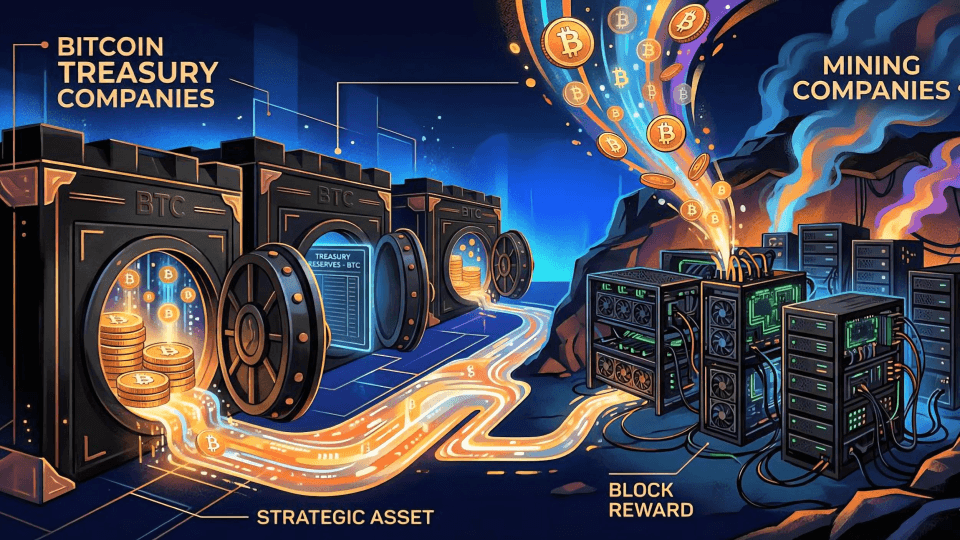
Mining companies operate under a fundamentally different cost model than Bitcoin treasury firms. Treasury companies like Twenty One Capital or Strategy simply buy Bitcoin at market price, while miners must produce each coin through computational work. This means their cost basis combines capital expenses (ASIC hardware), electricity, facility overhead, and equipment depreciation. Understanding these dynamics is essential for evaluating profitability and market strategy.
Comparing Average Cost of Mining vs. Treasury Holdings
Treasury Companies: Simple Cost Basis
Public treasury companies provide a clear benchmark: the average acquisition cost per Bitcoin is the total dollars spent divided by total BTC acquired.
-
Twenty One Capital (XXI): ~43,514 BTC, likely $90k–$100k average cost per BTC
-
Strategy: ~$70k per BTC (historic purchases)
These firms are exposed primarily to market price fluctuations, not operational efficiency. Their cost per Bitcoin is static and publicly disclosed.
Mining Companies: Layered All-In Costs
Miners must calculate a layered “all-in” cost per Bitcoin, which includes hardware, electricity, depreciation, and operating expenses. The result is a moving target influenced by network difficulty, block rewards, and energy pricing.
|
Company |
BTC Holdings |
Average Cost / BTC |
Value April 2026 |
Notes |
|
Riot Platforms |
15,680 |
~$43,000 |
$1.12B |
Extremely low energy cost ($0.028/kWh), fleet ~21 J/TH |
|
CleanSpark |
13,363 |
~$71,800 |
$958M |
Fleet efficiency ~16 J/TH, operational discipline reduces SG&A |
|
Hut 8 |
13,696 |
~$72,000 |
$981.69 M |
Energy-efficient U.S./Canada sites, hybrid hydro/nuclear power |
|
Galaxy Digital |
6,894 |
~$72,000 |
$494M |
Mining plus treasury accumulation, Helios mining facility |
|
Coinbase |
15,389 |
~$70,125 |
$1.10B |
HODL-focused treasury model, partially mined BTC |
Observation: Mining companies often achieve lower effective production costs than treasury acquisition prices, particularly in cases like Riot Platforms, where favorable energy pricing drives efficiency. However, these figures should be interpreted as estimates rather than precise disclosures, as exact all-in production costs are not always publicly reported and can vary based on accounting methods, energy contracts, and operational assumptions. Treasury companies, by contrast, generally disclose more direct and verifiable acquisition cost bases.
ASIC Hardware: Capital Expenditure and Depreciation
ASIC miners are the core hardware behind Bitcoin mining. Their cost and efficiency directly impact profitability.
-
Modern ASICs such as the Antminer S21 XP cost roughly thousands of dollars per unit
-
Newer models like the Bitmain S23 series may exceed $15,000
-
Efficiency has improved significantly, with newer machines operating below 16 J/TH
Depreciation is typically spread across a 24 to 36 month lifespan, contributing several hundred dollars per month per unit to the all-in cost of mining each Bitcoin
Electricity: The Largest Variable Cost
Electricity remains the most significant ongoing expense for miners. Access to low-cost power is often the primary determinant of profitability.
-
Riot Platforms benefits from ~$0.028/kWh electricity through grid participation
-
CleanSpark emphasizes efficient energy usage across its U.S. operations
-
Hut 8 utilizes a mix of hydro and nuclear energy sources
Energy efficiency, geographic location, and power contracts all play a major role in determining the final cost of production.
Comparative Takeaways
-
Riot Platforms demonstrates the strongest cost efficiency among major miners due to low electricity pricing and grid optimization.
-
CleanSpark and Hut 8 maintain competitive costs through efficient hardware and structured operations.
-
Treasury companies such as Strategy and Twenty One Capital operate with higher average acquisition costs but avoid operational complexity.
-
Hybrid firms like Galaxy Digital and Coinbase combine treasury exposure with operational or service-based models.
These comparisons highlight how mining companies compete on production efficiency, while treasury companies compete primarily on capital allocation.
Conclusion
Corporate Bitcoin adoption in 2026 reflects a maturing market where both treasury-focused firms and mining companies are deeply embedded in Bitcoin’s ecosystem, but with fundamentally different cost structures and risk profiles. Treasury holders such as Strategy Inc. and Twenty One Capital accumulate Bitcoin at market prices, making their performance highly sensitive to entry price and market cycles.
In contrast, mining companies like Marathon Digital Holdings Inc., Riot Platforms Inc., CleanSpark Inc., and Hut 8 Corp derive their Bitcoin exposure through production, where profitability depends on energy costs, hardware efficiency, and operational scale rather than direct purchase prices.
Across both models, cost basis remains the key lens for evaluating sustainability and financial health. Treasury companies must navigate price volatility relative to their acquisition costs, while miners must continuously optimize production economics to remain competitive as network difficulty rises.
Hybrid players such as Galaxy Digital Holdings and Coinbase Global Inc. further illustrate how Bitcoin can serve both as a strategic reserve asset and an operational component within broader financial services businesses.
Ultimately, the divergence in cost structures highlights a clear distinction: treasury firms are capital allocators exposed to market timing, while miners are operators competing on efficiency. As Bitcoin continues to evolve as a corporate reserve asset, the long-term winners will likely be those that maintain disciplined capital strategies, efficient cost management, and the flexibility to adapt to changing market conditions.
Frequently Asked Questions
Who are the top public companies holding Bitcoin in 2026?
Strategy (MicroStrategy), Marathon Digital, Metaplanet, Riot Platforms, Coinbase, Hut 8, CleanSpark, Galaxy Digital, Bullish, and Twenty One Capital are among the largest public Bitcoin holders.
What is Bitcoin cost basis in corporate treasuries?
It is the average purchase price per Bitcoin a company pays, calculated by dividing total BTC acquisition cost by total coins held.
How do Bitcoin mining companies determine their cost per BTC?
Mining firms calculate cost based on electricity, ASIC hardware, infrastructure, depreciation, and operational expenses per Bitcoin produced.
Which is cheaper: buying Bitcoin or mining it?
It depends on energy prices and efficiency, but mining can be cheaper in low-cost energy regions, while buying is more direct and less operationally complex.
Why do companies hold Bitcoin on their balance sheets?
Companies hold Bitcoin to hedge inflation, diversify reserves, improve capital allocation, and gain long-term exposure to potential price appreciation.