

Polymarket V2 Launch: A New Phase for Prediction Markets
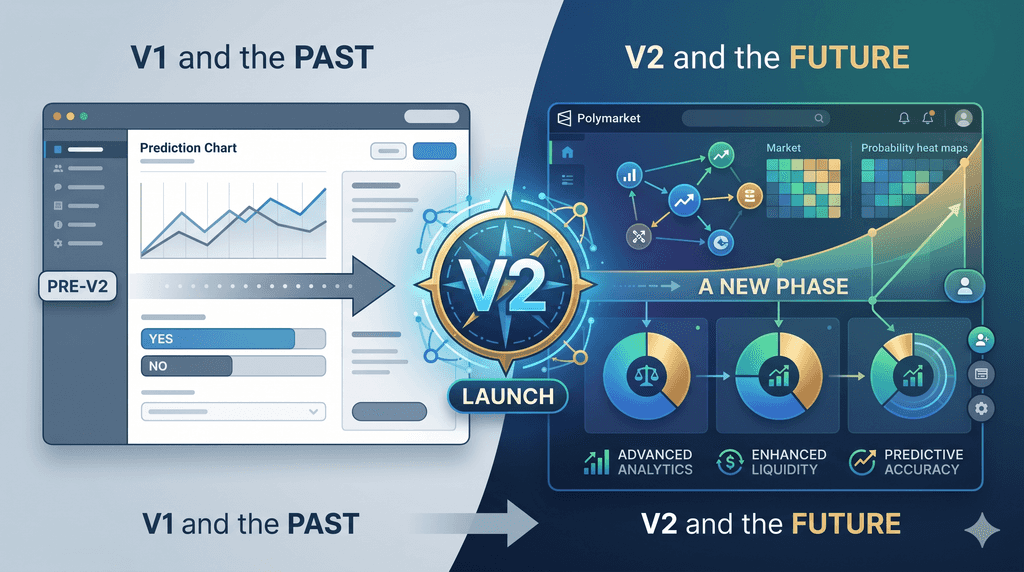
Prediction markets have moved well beyond their early reputation as a niche corner of the internet. What once felt experimental now sits at the intersection of finance, forecasting, media, and crypto infrastructure. Platforms in this space do more than let users speculate on future outcomes. They turn public uncertainty into price signals, giving traders, analysts, and observers a real-time view of what markets believe is most likely to happen next.
Polymarket has been one of the most visible names in that shift. Its markets on politics, macro events, crypto, and breaking news have helped push prediction markets into wider public discussion. Now, with the arrival of Polymarket V2, the platform is entering a more infrastructure-focused phase. This is not simply a front-end refresh or a routine feature release. According to Polymarket’s official changelog, V2 introduces new Exchange contracts, a rebuilt central limit order book backend, and a new collateral asset called pUSD, with the rollout scheduled for April 28, 2026, around 11:00 UTC. Polymarket also says the migration will include downtime and that open orders will be cleared during the cutover.
That combination of changes signals something bigger than a version update. It suggests Polymarket is trying to strengthen the foundation beneath its markets at a time when prediction markets are receiving more attention, more liquidity, and more scrutiny. If the first phase of this category was about proving that people wanted to trade on future events, the next phase is about whether these markets can operate with stronger infrastructure, cleaner settlement, better developer tooling, and a more scalable exchange model. V2 appears to be Polymarket’s answer to that challenge. That final point is an inference based on the scope of the rollout and the way the company now presents its platform publicly.
Inside Polymarket V2
To understand why V2 matters, it helps to understand what Polymarket is really upgrading. At its core, Polymarket runs on a hybrid trading model built around a central limit order book, or CLOB. In simple terms, users place buy and sell orders offchain, and matched trades are later settled onchain through exchange contracts. Polymarket’s documentation describes the platform as non-custodial, with orders signed using EIP-712 messages and settlements executed atomically. That structure is designed to preserve user control while keeping the trading experience fast enough for active markets.
V2 is a rebuild of this exchange layer, not just a surface-level update. The official changelog describes the launch as a coordinated migration involving a rewritten backend and new contracts. That matters because the quality of a prediction market does not depend only on what contracts are listed. It depends on how reliably orders are handled, how efficiently trades settle, how clearly collateral is managed, and how easily outside systems can interact with the platform. A strong market needs both visible liquidity and invisible plumbing.
This is where Polymarket’s positioning has started to shift. Its public documentation no longer reads like a simple product manual for end users. It increasingly reads like platform infrastructure for traders, developers, market makers, and builders who want direct access to data, order flow, and integration tools. That change in tone is important. It implies that Polymarket is no longer thinking only about user traffic. It is also thinking about ecosystem depth, which is often where stronger long-term network effects are built. That interpretation is analytical, but it is consistent with the company’s public emphasis on APIs, SDKs, builder tools, and market maker support.
Key Changes in the New Upgrade
One of the biggest changes in Polymarket V2 is the introduction of pUSD. According to Polymarket’s documentation, pUSD becomes the platform’s collateral token and replaces USDC.e in the upgraded system. The company describes pUSD as a standard ERC-20 token on Polygon that is backed by USDC, with the backing enforced onchain. Polymarket also states that the design is not algorithmic and not fractional reserve.
That change is more important than it may first appear. In any market structure, collateral is a trust layer. Traders want confidence that the value used for settlement is transparent and dependable. Developers want a clean and predictable funding asset. Market makers want to reduce operational friction when moving capital in and out of the system. By creating a platform-specific collateral token with clearly documented behavior, Polymarket seems to be aiming for a more standardized and more controlled market environment.
The order structure is also changing. Polymarket’s changelog says V2 removes fields such as nonce, feeRateBps, and taker, while adding fields like timestamp, metadata, and builder. The company also notes that fees will be determined at match time rather than embedded inside the order, and builder attribution will now work through builderCode.
These may look like technical details best left to developers, but they have broader implications. A cleaner order format can make integrations more efficient, reduce legacy complexity, and give the exchange more flexibility in how it supports external products. For builders creating dashboards, bots, interfaces, or execution tools, changes like this can matter just as much as a headline feature. They shape how easily the platform can be extended by third parties.
Another practical change is the migration itself. Polymarket has said that V2 is a hard cutover, meaning there will be no backward compatibility after launch. Developers must migrate to the V2 SDKs, update their clients, and prepare for existing open orders to be wiped during the transition. The primary production endpoint will remain in place after V2 takes over, but the underlying architecture will have changed. That makes this launch operationally significant for anyone building directly on the exchange.
What Polymarket V2 Means for Prediction Market Infrastructure
The larger significance of V2 is what it says about where prediction markets are heading. Early prediction market platforms often won attention by listing interesting or controversial events. But attention alone does not build durable market infrastructure. At scale, these platforms have to solve harder problems: order execution, collateral design, liquidity efficiency, real-time data delivery, developer interoperability, and reliable settlement.
Polymarket V2 looks like an attempt to meet those demands more directly. By rebuilding its exchange contracts and backend while standardizing collateral around pUSD, Polymarket is strengthening the systems that allow the market itself to function. In practical terms, this could make the platform easier to integrate, easier to scale, and potentially more resilient during heavy trading periods. That is still a forward-looking interpretation rather than a guaranteed outcome, but it aligns with the architecture Polymarket is publicly rolling out.
This matters because prediction markets are no longer competing only for casual user attention. They are increasingly competing on infrastructure quality. Traders want smooth execution and stable markets during major news events. Developers want APIs and SDKs that are not fragile or constantly changing. Market makers want systems that support consistent quoting and risk management. If a platform cannot support those needs, it may generate headlines without building durable market depth.
Polymarket’s public developer documentation already shows this platform-level ambition. The company offers official SDKs in TypeScript, Python, and Rust, along with data access tools and integration guidance. That is the language of a company trying to support an ecosystem, not just a website. V2 fits neatly into that direction. It suggests Polymarket wants to become the infrastructure layer that other products, interfaces, and tools connect to.
How V2 Could Reshape Event-Based Trading
Prediction markets have always been a specialized form of event-based trading. Users are not trading earnings multiples, bond yields, or quarterly growth targets directly. They are trading probabilities tied to specific outcomes. Will a candidate win? Will an approval happen? Will a market cross a certain threshold? Will a major event occur before a deadline? The appeal comes from simplicity on the surface and complexity underneath.
V2 could reshape this model by making the underlying rails more robust. If execution improves, if collateral becomes easier to manage, and if builders can create better tools around the exchange, then event-based trading becomes more scalable as a category. Better infrastructure can support tighter spreads, more responsive markets, and more sophisticated strategies. Those improvements do not automatically happen on launch day, but they are exactly the kinds of gains this type of exchange upgrade is usually designed to pursue.
There is also the question of accessibility. Polymarket’s documentation explains that users can trade without needing POL for gas because relayer infrastructure can cover those fees, while pUSD serves as the trading asset. That lowers friction significantly. One of the biggest barriers to onchain products is that users often need to understand wallets, bridge flows, gas tokens, and settlement mechanics before they can even begin. By reducing those steps, Polymarket makes event-based trading feel more like a streamlined digital market and less like a technical crypto workflow.
That matters for adoption. The broader event-based trading category is more likely to expand when users can interact with it without constantly thinking about blockchain operations in the background. A smoother experience can attract a wider mix of participants, from curious retail users to higher-frequency traders and developers building automation around live market signals.
There is also a strategic ecosystem angle here. When a platform improves the core exchange layer, outside builders often gain more confidence to invest time and resources into products around it. That can include analytics dashboards, market scanners, alerts, execution bots, portfolio trackers, research tools, and custom interfaces. If enough of that activity builds around one venue, the venue becomes stronger not only because of its own users, but because of the surrounding ecosystem. V2 may help push Polymarket further in that direction. That is an inference, but one supported by the company’s stated emphasis on builders and integrations.
Challenges and Risks to Watch
For all the promise around V2, major upgrades also create risk. The first is migration risk. Hard cutovers can create short-term disruption for users, developers, and liquidity providers. Polymarket has already said there will be downtime and that open orders will be cleared during the transition. Even when those steps are planned, they can still be disruptive in live markets where timing and order management matter.
The second risk is adoption risk. Technical improvements do not automatically translate into better market outcomes. A new backend, new contracts, and new collateral token can improve the structure of the system, but actual success depends on how traders, market makers, and developers respond after the rollout. If liquidity deepens, integrations improve, and user experience gets smoother, then V2 will likely be seen as a turning point. If not, it may be remembered as an ambitious but mainly internal rebuild.
There is also the broader category risk surrounding prediction markets themselves. As these platforms grow, they attract more public attention and more regulatory scrutiny. Recent reporting has highlighted Polymarket’s rising profile and the increasing seriousness with which investors and media are treating the sector. That growth can be positive, but it also raises expectations around compliance, market integrity, and the handling of sensitive or controversial event contracts. Stronger infrastructure helps with operational reliability, but it does not eliminate every external pressure facing the category.
Another challenge is perception. Prediction markets often sit in an unusual space between information discovery and speculative trading. Supporters argue that they aggregate dispersed knowledge into useful probability signals. Critics question the social incentives created when real-world events become tradeable instruments. As platforms like Polymarket expand, they will need to manage not only their technology stack but also the public narrative around what these markets are for and how they should operate.
The Future of Prediction Markets After V2
The launch of Polymarket V2 points to a broader transition in the prediction market industry. The first major question for the category was whether there was demand for event-based trading at all. That has already been answered. There is demand, and it spans politics, crypto, macro events, and countless news-driven topics. The next question is whether these platforms can evolve into dependable market infrastructure.
That is where V2 becomes important. It suggests the future of prediction markets will not be defined only by attention-grabbing contracts or viral moments. It will be defined by the strength of the systems underneath: exchange architecture, collateral design, data accessibility, settlement logic, and developer ecosystems. In other words, the category is maturing. The conversation is shifting from "Can prediction markets attract users?" to "Can they support serious scale?"
If Polymarket’s rollout performs as intended, it could become a reference point for what this next phase looks like. A prediction market venue with stronger backend systems, standardized collateral, builder-friendly tooling, and lower user friction would set a higher bar for the rest of the industry. That does not mean every platform will follow the same model, but it does suggest that infrastructure quality will increasingly determine who leads the space.
It is also possible that the next phase of prediction markets will be shaped as much by ecosystems as by platforms. If third-party developers build useful tools on top of Polymarket, the platform’s influence could grow beyond its core site and app experience. That kind of expansion matters because financial networks often become strongest when they stop being a single destination and start becoming a layer other services depend on.
V2 alone will not decide the future of the category. Market quality, liquidity, regulation, public trust, and product discipline will still matter. But the direction is clear. Prediction markets are moving toward a more structured and more infrastructure-heavy phase, and Polymarket V2 looks like one of the clearest signs of that shift so far.
FAQs
What is Polymarket V2?
Polymarket V2 is a major upgrade to Polymarket’s exchange infrastructure. According to the company’s changelog, it includes new Exchange contracts, a rebuilt CLOB backend, updated order structure, and a new collateral token called pUSD.
When is Polymarket V2 launching?
Polymarket says the V2 rollout is scheduled for April 28, 2026, at around 11:00 UTC, with roughly one hour of expected downtime during the migration.
What is pUSD in Polymarket V2?
pUSD is Polymarket’s collateral token for the V2 system. The company describes it as a standard ERC-20 token on Polygon backed by USDC, with backing enforced onchain.
Why is Polymarket V2 important?
V2 matters because it focuses on the infrastructure behind prediction markets, including exchange performance, collateral design, and developer tooling. Those factors are increasingly important as prediction markets grow and compete on reliability and scalability, not only on market listings. That last point is an analytical conclusion based on the scope of the upgrade.
Will Polymarket V2 affect developers and integrations?
Yes. Polymarket has said developers must migrate to the V2 SDKs and that there will be no backward compatibility after launch. Existing open orders will also be cleared during the cutover.
Could V2 change the future of prediction markets?
Potentially, yes. If the rollout improves execution, standardizes collateral, and supports a stronger builder ecosystem, it could help push prediction markets toward a more mature infrastructure phase. That remains a forward-looking assessment rather than a confirmed outcome.
Disclaimer: This content is for informational purposes only and should not be considered financial or investment advice. Cryptocurrency markets are volatile, and readers should do their own research before making any decisions.