

The Next U.S.-China Tech War Is About Robots—and Crypto Could Be Pulled In
2026/07/31 18:39:00
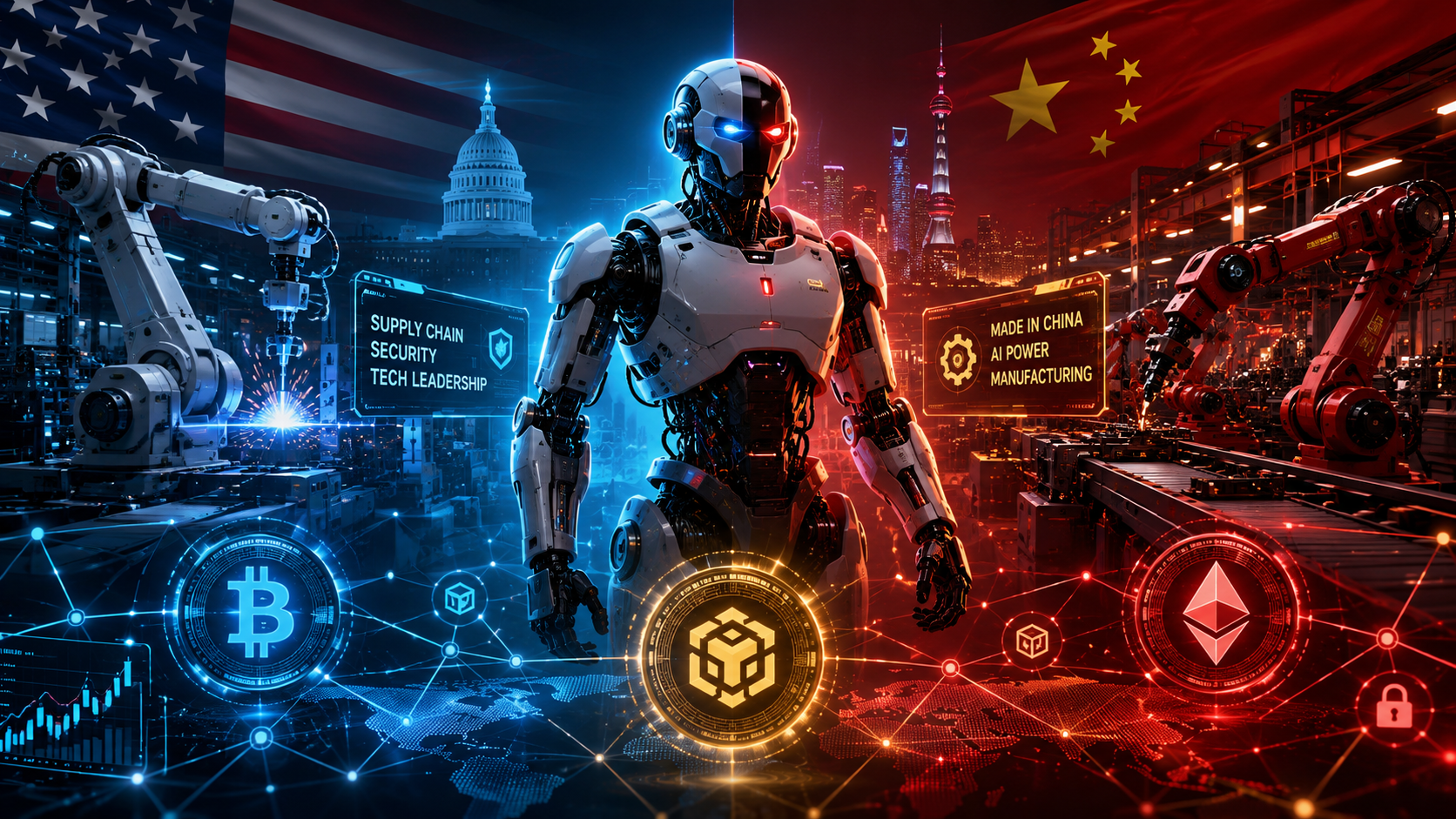
United States restrictions on Chinese microchips, telecommunications equipment, drones, and artificial intelligence technologies are now extending into a new frontier: robots capable of navigating environments and executing physical tasks. Unlike standard hardware targeted in previous trade disputes, modern robots combine advanced AI models, high-definition cameras, environmental sensors, wireless communication, and physical execution capabilities.
If robots serve as the primary vessels bringing AI into the physical world, will the emerging U.S.-China conflict over the robotics supply chain eventually impact AI tokens, Decentralized Physical Infrastructure Networks (DePIN), decentralized computing, and machine-to-machine payments?
This is not a piece predicting that a robotics ban will automatically send specific tokens to the moon. Rather, it is an analysis of the genuine transmission paths between global robotics industrial policy and the decentralized infrastructure attempting to support the future machine economy.
What the FCC Robot Ban Actually Does
To understand the implications for the broader technology and decentralized sectors, the facts of the recent regulatory action must be clear. On July 28, 2026, the Federal Communications Commission (FCC) introduced measures targeting new Chinese-manufactured humanoid robots, quadruped robots (robotic dogs), and specific networked power inverters.
While widely summarized in the media as a "Chinese robot ban," the regulatory mechanism operates through the FCC’s equipment authorization process and its Covered List, rather than traditional customs tariffs. It is vital to establish three boundaries regarding this policy:
-
It does not prohibit American consumers or businesses from continuing to use Chinese robots they have already purchased.
-
It does not equate to a blanket ban on all types of global industrial robotics.
-
It does not directly regulate, ban, or target any cryptocurrency, blockchain network, or AI token.
The underlying rationale is national security. Connected robots map indoor environments, record audio and video, monitor industrial data, and can potentially receive remote commands. By also restricting networked power inverters, the FCC indicates its focus extends beyond the robots themselves to energy grids, data centers, and critical infrastructure.
The ban is not merely about imported machines. It is about who controls the hardware layer of the AI economy.
Why Robots Are the New Front Line
Historically, the artificial intelligence race has been fought in server farms, focusing on large language models, GPU clusters, and cloud computing dominance. Robotics shifts this competition by taking AI out of the server and placing it into factories, warehouses, homes, and public spaces. Building an embodied AI requires much more than just code; it demands precision motors, actuators, environmental sensors, high-capacity batteries, and massive manufacturing pipelines.
This conflict is unfolding across three distinct layers:
-
The Intelligence Layer: The race to control the most capable AI models and the vast datasets required to train them.
-
The Hardware Layer: The capacity to manufacture reliable, complex physical machines at a low cost.
-
The Deployment Layer: The ability to rapidly integrate these robots into real-world environments to begin collecting feedback.
Robotics relies heavily on a "manufacturing feedback loop." The more robots a company deploys, the more real-world data it gathers. That data improves the underlying AI model, which in turn makes the robots more capable and accelerates further deployment. Control over the physical hardware dictates who gets to harvest the data.
China’s Manufacturing Lead by the Numbers
Is China's dominance in robotics manufacturing merely a media narrative, or does a structural gap already exist? Industrial robotics data offers the clearest picture, as the humanoid market remains in its early commercial stages while industrial arms reflect established manufacturing foundations.
According to the International Federation of Robotics (IFR), roughly 542,000 industrial robots were installed globally in 2024. Asia accounted for 74% of these new installations, with China alone responsible for 54%. China’s total operational stock of industrial robots has now surpassed 2 million units. To put this into perspective, China installed approximately 295,000 industrial robots in 2024, nearly nine times the volume installed in the United States.
These numbers matter deeply for the emerging humanoid sector. China has already cultivated a mature, deeply integrated network of suppliers for electronics, power systems, batteries, and sensors. Even though industrial robotic arms differ from bipedal humanoids, the two categories share underlying requirements for automation engineering, motion control, supply-chain logistics, and scaled production.
| Metric | China | United States | Why It Matters |
| Annual robot installations | ~295,000 | ~34,000 | Reflects deployment speed and market demand |
| Installed robot base | >2,000,000 | ~400,000 | Indicates the foundation of automation industry |
| Supply-chain depth | Highly concentrated | Relatively dispersed | Impacts production costs and scaling speed |
The FCC can utilize regulatory tools to block foreign products from entering the American market, but legislation cannot instantly replicate the manufacturing clusters and engineering ecosystems that China has spent decades building.
Elon Musk’s Warning Looks More Relevant Now
The current geopolitical maneuvering over robotics echoes previous industry warnings. In an interview published on February 5, 2026, Elon Musk discussed China's manufacturing capabilities, the scaling of robotics, and the challenge of global competition. Importantly, his comments were not an immediate reaction to the July FCC ban, but a broader assessment of the technological landscape.
Musk’s core assessment noted that while the United States likely maintains an edge in cutting-edge AI software and models, China holds a distinct advantage in manufacturing scale, supply chain depth, and engineering execution. He suggested that to bridge the gap in labor and manufacturing scale, the U.S. might eventually need to rely on robots to manufacture other robots. The true test of the industry, he argued, is not showcasing an impressive prototype, but achieving million-unit production reliably and affordably.
The FCC's actions give these prior statements renewed weight. The United States appears to be using market access restrictions to buy time for domestic robotics companies to mature. However, regulatory protection merely dampens external competition; it does not automatically generate component capacity, produce skilled hardware engineers, or accelerate actual physical deployment.
This is where the robotics conflict begins to overlap with crypto—not at the token level, but at the infrastructure level.
How Crypto Could Be Pulled In
If the U.S. and China are splitting the physical layer of the AI economy, how does blockchain technology fit into the picture? The connection lies in the underlying infrastructure required to support millions of autonomous machines.
First is decentralized computing. Robots require immense computational power for training, reasoning, and processing real-time environmental data. If global technology ecosystems continue to fragment, AI developers facing hardware export controls or localized cloud restrictions may increasingly turn to decentralized GPU networks and permissionless compute markets.
Next is DePIN (Decentralized Physical Infrastructure Networks). For robots to function autonomously at scale, they need highly accurate maps, constant wireless connectivity, edge sensor data, and charging infrastructure. Several DePIN projects utilize token incentives to crowdsource these physical resources from individuals and businesses. The mass deployment of robots drastically expands the potential customer base for these decentralized networks.
Third is the rise of machine-to-machine payments. An autonomous robot delivering packages or inspecting infrastructure will eventually need to pay for its own battery charging, data access, compute usage, or toll fees. Stablecoins and programmable smart wallets are uniquely suited for this type of frictionless, cross-platform micro-settlement, operating 24/7 without traditional banking limits.
Finally, there is a growing need for identity and audit trails. As robots gain autonomy, proving a machine's origin, verifying its software version, and auditing its maintenance history become critical security requirements. Blockchain networks could serve as immutable ledgers for device identity. However, it is essential to acknowledge that while a blockchain can secure a digital record, it cannot physically prevent a camera, sensor, or firmware from being tampered with at the hardware level.
None of these connections means the FCC ban has already created new demand for crypto tokens. They are possible infrastructure linkages, not confirmed token catalysts.
AI Tokens and DePIN May Gain Attention—but Not Every Token Will Benefit
When major geopolitical tech news breaks, cryptocurrency markets are quick to capitalize on the narrative. The FCC robotics restrictions are likely to boost market interest in decentralized AI, distributed GPU networks, robotics data marketplaces, wireless DePINs, and stablecoin-based autonomous payments.
However, investors must distinguish between a project benefiting from a narrative and one benefiting fundamentally. Simply placing "AI," "Robot," or "DePIN" in a project's whitepaper does not mean it possesses actual machine clients, active physical nodes, or sustainable revenue. Crypto markets frequently price in adoption years before it happens, leading to situations where token valuations far outpace actual utility.
| Question | What Investors Should Check |
| Does the project serve real machines? | Are there verifiable robots, sensors, or edge devices currently using the network? |
| Who pays for the service? | Is revenue generated by real enterprise clients or subsidized by token emissions? |
| Is the token necessary? | Could the system function identically using a traditional database and fiat currency? |
| Can it scale across borders? | Is the project vulnerable to the same hardware export and data localization laws? |
| Are metrics independently verifiable? | Can node counts, revenue streams, and device usage be verified on-chain? |
Investors should also be wary of "token exposure mismatch." For instance, a decentralized compute network might see increased demand from general AI developers, but that does not mean it will directly profit from a U.S. ban on Chinese hardware.
The Bigger Battle Is Over Chips, Energy and Data
Robots are simply the physical shell; the actual bottlenecks dictating the future of the AI economy run much deeper. The industry's growth is constrained by the availability of AI inference chips, high-torque motors, rare-earth magnets, battery materials, and the massive amounts of electricity required to run data centers and charge fleets.
The FCC’s decision to include networked power inverters in its restrictions is highly telling. Inverters bridge solar panels, battery storage, data centers, and the broader electrical grid. This inclusion proves that the U.S.-China technology competition is no longer confined to software and silicon; it has fully extended into the energy interfaces that will keep AI systems running.
This creates a cautious but real link to cryptocurrency mining and DePIN. Bitcoin miners, AI data centers, and decentralized compute networks are all competing for the same limited resources: advanced chips, electrical grid capacity, and physical facility space. As regulatory pressure forces supply chains to localize, the costs associated with hardware procurement, energy access, and cross-border deployment will inevitably shift. The U.S. government is increasingly viewing connected hardware, energy interfaces, and AI infrastructure as vital national security assets.
Who Could Win—and Who Could Lose
As supply chains bifurcate, distinct winners and losers will emerge across both traditional tech and decentralized infrastructure.
Potential beneficiaries include domestic U.S. robot manufacturers and allied-nation producers of sensors and actuators, who now face less price competition. In the crypto space, decentralized compute providers offering localized, compliant hardware could see a boost. DePIN projects that have already established dense, verifiable sensor or mapping networks may find new enterprise clients, while infrastructure providers enabling compliant stablecoin settlements for machines are positioned well for the future.
Conversely, the ban creates immense pressure for certain groups. U.S. robotics startups that previously relied on importing low-cost Chinese hardware for rapid prototyping now face skyrocketing R&D costs—a concern already voiced by industry insiders. DePIN networks that rely on shipping cheap, foreign-made hardware nodes across borders to scale their networks may face crippling logistical and regulatory hurdles. Finally, crypto projects lacking real revenue, surviving solely on AI hype, will likely struggle as the market demands tangible results.
A critical paradox exists: while blocking cheap imports protects established U.S. manufacturers, it simultaneously raises the barrier to entry for American researchers and startups. Meanwhile, Chinese firms are not entirely blocked from scaling; they can still deploy massively within their domestic market and export to non-aligned countries, continuing to gather the data necessary to improve their models.
Three Scenarios Crypto Investors Should Watch
How this geopolitical friction translates to the blockchain sector will depend on how aggressively the U.S. and China escalate the conflict.
Scenario 1: A Limited Trade Restriction
The FCC restrictions remain targeted, and the U.S. grants waivers to key allied manufacturers. The global robotics supply chain adjusts with minimal disruption. In the crypto markets, AI and DePIN narratives experience brief speculative spikes, but no sustained fundamental changes occur. The machine economy develops slowly via traditional centralized tech firms.
Scenario 2: A Broader Technology Split
The U.S. expands restrictions to cover a wider array of Chinese sensors, actuators, inverters, and robotics software. China retaliates with export controls on critical supply chain components. Two distinct global robotics ecosystems emerge. Demand for decentralized, cross-border compute, device identity verification, and permissionless stablecoin settlement rises as developers seek neutral infrastructure, though regulatory compliance costs surge across the board.
Scenario 3: The Machine Economy Accelerates
Despite trade frictions, robotics commercialization reaches an inflection point globally. Autonomous machines begin utilizing digital wallets to seamlessly purchase data, energy, and compute resources. Select blockchain infrastructure projects acquire their first massive cohort of non-human users. The "AI crypto" sector finally transitions from a speculative narrative into an industry driven by measurable, automated machine revenue.
The Robot War Will Test Crypto’s Real Utility
The next phase of the U.S.-China technology competition is leaving the digital realm and entering the physical world. The cryptocurrency industry will not automatically emerge victorious simply because the FCC restricted the import of foreign hardware.
However, the rapid expansion of a global robotics economy will serve as the ultimate proving ground for blockchain technology. It will test whether decentralized networks can actually solve the logistical nightmares of cross-machine settlement, verifiable device identity, distributed computing, data ownership, and physical infrastructure coordination.
The robot war may bring crypto into the conversation, but only projects that connect tokens to real machines, real infrastructure and real economic demand will remain relevant after the narrative fades.
|
KuCoin is celebrating its 9th anniversary with a special platform campaign filled with exclusive rewards, trading activities, and limited-time offers. Don’t miss the chance to participate and enjoy the benefits as the exchange marks nine years of growth and innovation. Visit the official campaign page now:
|

FAQs
Does the FCC robot ban apply to robots already owned by U.S. consumers?
No. The FCC’s Covered List and equipment authorization process target the approval and importation of new devices entering the U.S. market. It does not mandate the confiscation or deactivation of consumer robots that were purchased and authorized prior to the restrictions.
Does the policy ban Chinese Bitcoin mining machines?
No. The current FCC measures are specifically aimed at humanoid robots, quadruped robots, and certain networked power inverters. ASIC mining rigs represent an entirely different category of hardware and fall under separate regulatory and energy-policy discussions.
Can a blockchain record make a foreign robot compliant with FCC rules?
No. While putting a device's identity or firmware hash on a blockchain creates an immutable, traceable record, it cannot bypass federal law. Blockchain records cannot automatically satisfy FCC equipment authorization requirements, cybersecurity audits, or national origin trade restrictions.
Could robots hold and use their own crypto wallets?
Technically, yes. Software agents and autonomous machines can be programmed to manage cryptographic keys and execute transactions via smart contracts. However, the legal liability, strict private key security, and ultimate authorization for those payments still legally tie back to a human owner or a registered corporation.
Is tokenized ownership of robots the same as investing in a robotics company?
No. Buying a token that represents the fractional yield or operational revenue of a physical DePIN robot is vastly different from holding equity in the company that manufactured it. Tokens carry unique smart contract risks, regulatory uncertainties, and volatile tokenomics that do not apply to traditional company shares.
Could China retaliate by restricting robot components?
This is a closely monitored geopolitical risk. While China has publicly stated its intent to protect the interests of its domestic enterprises, an immediate, sweeping ban on exporting raw components has not occurred. However, future retaliatory export controls on rare earth metals, sensors, or specific manufacturing equipment remain a distinct possibility as the tech war evolves.
Disclaimer: This content is for informational purposes only and does not constitute investment advice. Cryptocurrency investments carry risk. Please do your own research (DYOR).