

Leverage Trading on KuCoin for Basic Arbitrage: ETH Example Explained
Crypto traders often hear that arbitrage is one of the “safer” ways to use leverage, but that description can be misleading. Arbitrage is not automatically low risk, and leverage does not make it better by default. On KuCoin, a basic ETH arbitrage setup usually means building a hedged position across two related markets, most commonly by going long ETH on spot or margin and short ETH on perpetual futures. The trade is designed to target a pricing gap, not to make a directional bet on whether ETH will rise or fall next. KuCoin’s current margin framework states that cross margin supports up to 5x leverage, while isolated margin supports 1x to 10x leverage depending on the pair, and the platform’s latest debt-ratio rules show a 92% margin-call threshold and 95% forced liquidation threshold.
That matters because many beginners approach leverage arbitrage as if it were a shortcut to easy returns. In practice, the real edge comes from understanding spread, funding, fees, borrow cost, liquidation rules, and execution quality. If those pieces are not lined up properly, a trade that looks like arbitrage on paper can turn into an expensive mistake. This guide breaks down how basic ETH arbitrage works on KuCoin, where leverage fits in, what the trade is actually trying to capture, and what traders need to calculate before calling it a viable setup. This is educational content only, not a recommendation to trade.
What Is Leverage Trading on KuCoin?
Leverage trading on KuCoin allows traders to control a larger position than their initial capital by borrowing funds or using derivatives margin. In the KuCoin margin trading guide, the platform explains that cross margin treats the entire margin account as one shared risk pool, while isolated margin separates risk by trading pair. Cross margin currently supports up to 5x leverage, and isolated margin supports between 1x and 10x leverage on supported markets.
That distinction matters for arbitrage. Cross margin can be more flexible because collateral is shared across positions, but that also means losses or stress in one part of the account can affect the whole margin balance. Isolated margin keeps the risk contained to one pair, which can make position-level risk management cleaner. For a beginner trying to understand ETH arbitrage on KuCoin, isolated margin is often easier to conceptualize because the debt ratio, borrowed amount, and liquidation exposure are tied to the individual trade rather than the broader account structure.
Leverage on KuCoin can be used through margin trading or through futures contracts. In arbitrage, those are not interchangeable. Margin leverage is typically used to finance the spot leg of a trade, while futures leverage is used to size the hedge leg with less capital. The main reason traders use leverage in arbitrage is not to make a bigger market bet. It is usually about capital efficiency. The problem is that better capital efficiency also introduces financing costs and tighter liquidation constraints.
What Is Crypto Arbitrage and How Does It Work?
Arbitrage in crypto refers to taking advantage of price differences between related markets, exchanges, or instruments. A basic example would be buying an asset in one place where it is cheaper and selling or shorting it in another place where it is more expensive. On KuCoin, the most practical beginner-friendly version is usually a basis trade, also called cash-and-carry arbitrage. That means buying ETH exposure on one side and shorting ETH exposure on another side when the futures market is trading at a premium to spot.
The reason this works conceptually is that spot and futures prices are related, even if they are not always identical. If ETH perpetual futures trade above spot, the short futures leg may benefit if the premium narrows over time. In some market conditions, the short side may also collect funding from long traders. KuCoin explains in its futures education and contract documentation that perpetual futures use a funding mechanism to keep contract prices aligned with the underlying market, and that for major pairs the funding interval is generally every 8 hours.
That sounds straightforward, but the execution is where the real complexity begins. A spread is only meaningful if it remains large enough after trading fees, funding changes, borrowing interest, and slippage. A trade that begins with a visible premium can still produce a poor outcome if those carrying costs consume the gap before the trader exits.
Why ETH Is a Common Example for KuCoin Arbitrage
ETH is one of the most commonly used examples for this kind of trade because it has deep liquidity across spot and derivatives markets. KuCoin’s ETHUSDTM contract specifications identify ETHUSDTM as a USDT-margined perpetual contract with no expiry date, and each contract is worth 0.01 ETH. That contract structure makes it relatively easy to build a hedge against a spot ETH position because the notional size is transparent and the product is liquid enough for small and mid-sized traders to understand position matching.
ETH also tends to have an active perpetual market where funding and basis conditions can change throughout the day. KuCoin’s funding-rate records for ETH contracts show the rate updates on an 8-hour schedule, which means anyone evaluating arbitrage on ETH needs to pay attention not just to price spread but also to how funding may help or hurt the position during the holding period.
Another reason ETH works well as an educational example is that it sits in the middle ground between ultra-high liquidity majors like BTC and smaller altcoins that may have thinner order books. That makes it easier to explain how spot, margin, and perpetuals connect without relying on a highly niche product.
How Basic ETH Arbitrage Works on KuCoin
A simple ETH arbitrage structure on KuCoin usually looks like this:
-
Buy ETH in spot, either fully funded or with borrowed margin.
-
Short an equivalent amount of ETH perpetual futures.
-
Hold the position while targeting spread convergence, favorable funding, or both.
-
Close both sides and repay any borrowed funds if margin was used.
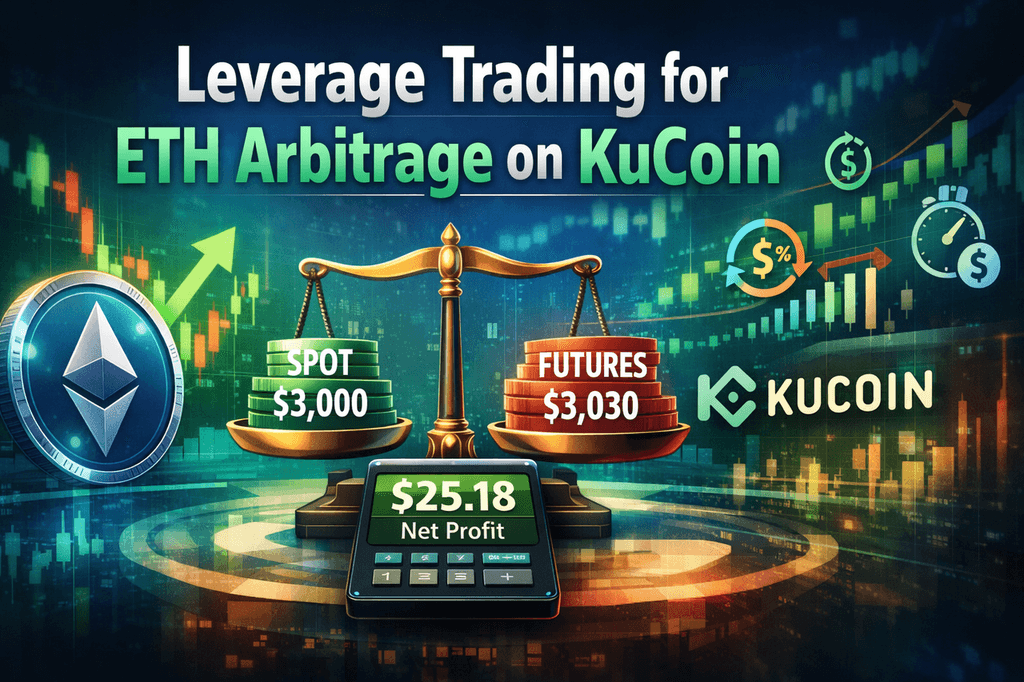
Suppose ETH spot is trading at $3,000 and the ETH perpetual contract is trading at $3,030. That means the perpetual is trading $30 above spot, or about 1% rich relative to the cash market. A trader who buys 1 ETH in spot and shorts 1 ETH equivalent in futures is trying to lock in that differential if the gap narrows later. If the perpetual premium collapses toward spot, the short futures leg gains relative to the long spot leg. If the market stays in a positive funding environment while the trader is short futures, the position may also receive funding payments from longs.
This is the core logic behind basic ETH arbitrage. The trade is not trying to predict that ETH will crash or explode upward. It is trying to exploit the relationship between two ETH markets. That makes the setup more disciplined than directional speculation, but only if the hedge is sized properly and the trade costs are controlled.
Spot vs Perpetual Futures: The Core Arbitrage Setup
The spot leg gives the trader long ETH exposure. This can be purchased outright with cash, or it can be acquired using borrowed funds through KuCoin margin. The futures leg, usually the ETHUSDTM perpetual, gives the trader a short hedge without needing to borrow and sell actual ETH.
This combination is popular because it stays within one platform. That reduces transfer friction, avoids some cross-exchange execution delays, and keeps collateral management centralized. But the convenience does not remove trading friction. KuCoin’s current spot fee documentation says standard reference rates are commonly based on 0.1% maker and 0.1% taker for many spot pairs, while the ETHUSDTM contract page shows futures reference fees of 0.0200% maker and 0.0600% taker, subject to tier and contract conditions.
That difference is important. The cost to enter the spot leg and the futures leg is not identical, and using market orders on both sides may eat into the spread immediately. The more the trader relies on aggressive execution, the more the trade depends on a wider initial premium to remain attractive.
Step-by-Step ETH Arbitrage Example on KuCoin
Let’s use a simplified example to make the math easier to visualize.
Assume the following:
-
ETH spot price: $3,000
-
ETH perpetual price: $3,030
-
Spread: $30
-
Position size: 1 ETH
The trader opens these two legs:
-
Long 1 ETH on spot at $3,000
-
Short 1 ETH equivalent in ETH perpetuals at $3,030
Because KuCoin’s ETHUSDTM specification says 1 contract = 0.01 ETH, a hedge of roughly 1 ETH would normally require about 100 contracts.
Now add the first layer of cost.
If the spot order is executed as a taker at a 0.1% fee, the entry cost is about $3.00. If the futures short is entered as a taker at 0.06%, the entry cost is about $1.82 on a $3,030 notional. That reduces the visible $30 spread to around $25.18 before considering exit fees, funding, slippage, or borrowing cost.
If the trader borrowed funds to buy the spot ETH, interest must also be paid when the loan is repaid. KuCoin’s margin framework makes clear that margin trading involves borrowing against existing collateral, then repaying principal and interest later. That financing cost is one of the most overlooked parts of beginner arbitrage math.
The simplified decision formula looks like this:
Net edge = spread captured + funding received − trading fees − borrowing interest − slippage − closing costs
If the spread narrows and funding is positive for the short side, the trade can work well. If the spread stays wide, funding flips against the short, or borrow interest remains elevated, the edge shrinks fast.
How Leverage Affects an ETH Arbitrage Trade
Leverage changes the trade in one major way: it reduces the amount of capital tied up per unit of exposure. Instead of using $3,000 in cash to buy 1 ETH spot, a trader might use margin collateral and borrowed funds to hold the same notional long position. On the futures side, the short hedge can also be opened with less capital than the full notional because futures operate on margin.
That sounds efficient, but the risk profile changes immediately. Once leverage is introduced, the trade can no longer be evaluated only as a spread strategy. It becomes a spread strategy with financing pressure and liquidation thresholds attached. KuCoin’s debt-ratio rules state that a warning is triggered at 92%, and forced liquidation occurs at 95%. On the futures side, liquidation is also tied to margin mode and mark price dynamics.
So leverage is not what creates the arbitrage. The spread does that. Leverage only changes how much capital is posted to express the trade. Used conservatively, it can improve capital efficiency. Used aggressively, it turns a hedged position into something that can still be liquidated even if the long-term trade thesis was reasonable.
KuCoin Fees, Funding Rates, and Borrowing Costs Explained
-
Spot Trading Fees
Spot fees are one of the first costs traders need to account for in an ETH arbitrage setup. KuCoin’s fee schedule uses a common base reference of 0.1% maker / 0.1% taker for many spot pairs, although the actual fee shown on the live trading page is the one that matters most. Even a small entry and exit fee can cut into a narrow arbitrage spread.
-
Futures Trading Fees
Futures fees apply to the hedge side of the trade. On the ETHUSDTM contract page, KuCoin lists reference fees of 0.0200% maker and 0.0600% taker. These costs can be lower for traders on better fee tiers, and they may also be reduced when orders are placed passively instead of crossing the spread with market execution.
-
Funding Rates
Funding is one of the most important moving parts in ETH arbitrage. KuCoin’s ETH perpetual funding records show that funding is assessed every 8 hours, and the rate can move between positive, negative, or neutral depending on market conditions. That means a short ETH perpetual position may receive funding in one interval and pay funding in the next. Funding should never be treated as fixed or predictable over time.
-
Borrowing Interest
If the spot leg is financed through margin, borrowing interest becomes part of the trade cost. This is often overlooked by beginners because it is not as visible as the trading spread. A position that looks profitable at entry can become far less attractive if borrowing costs continue to build over a longer holding period.
-
Total Cost
A visible premium on ETH futures is never enough on its own to justify an arbitrage trade. Spot fees, futures fees, funding changes, borrow interest, slippage, and exit costs all need to be included in the calculation. The real opportunity is not the headline spread but the spread that remains after the full cost stack is modeled.
Key Risks of Using Leverage for Arbitrage on KuCoin
-
Execution Mismatch
If a trader buys ETH on the spot market first but cannot open the short futures leg immediately, the position is exposed to ETH price movement before the hedge is in place. Even a short delay can turn a planned arbitrage setup into a temporary directional trade.
-
Hedge Sizing Error
A basic ETH arbitrage trade only works properly when both sides are sized accurately. If the trader buys 1 ETH in spot but shorts less than 1 ETH equivalent in futures, the account stays net long. If the trader shorts too much, it becomes net short. Precise contract sizing is essential.
-
Funding Reversal
A short ETH perpetual position may look attractive when funding is positive and appears likely to pay shorts, but funding rates can change quickly. A trade that begins with positive carry can shift into a position where the trader starts paying funding instead.
-
Liquidation Risk
Leverage introduces liquidation risk even in a hedged structure. If the account is too tightly margined, normal volatility or temporary spread expansion can trigger forced liquidation before the arbitrage trade has time to work. Thin collateral makes this risk more serious.
-
Fee Compression
Small arbitrage spreads can disappear once real costs are included. Entry fees, exit fees, borrow interest, and slippage all reduce the available edge. This becomes even more important when market orders are used on both the spot and futures legs.
-
False Sense of Safety
One of the most common misunderstandings is treating arbitrage as if it removes real market risk entirely. It does not. Leverage, funding changes, execution delays, and platform risk can all affect the outcome, even when the trade is designed to be market-neutral.
Common Mistakes Beginners Make With ETH Arbitrage
One common mistake is treating leverage as the opportunity instead of treating the spread as the opportunity. The spread is what matters. Leverage only changes the capital footprint.
Another common mistake is ignoring the contract specifications. On KuCoin, ETHUSDTM is sized in 0.01 ETH per contract, so futures exposure needs to be converted correctly before calling the position hedged.
A third mistake is using too much leverage because the trade “feels neutral.” Hedged does not mean immune from liquidation, especially when margin thresholds are tight.
A fourth mistake is focusing only on entry. Arbitrage without an exit condition is not really structured trading. The trader needs to know whether the goal is spread compression, funding collection over a specific window, or a time-based exit.
A fifth mistake is failing to monitor live costs. Spot fees, futures fees, and funding conditions can all change relative to the initial assumption. Static calculations are useful, but live numbers decide the real outcome.
Risk Management Tips for Leverage Trading on KuCoin
-
Hedge first, leverage second. Build a properly matched spot and futures position before thinking about increasing size. The hedge is what defines the arbitrage setup. Leverage only changes how much capital is used to hold it.
-
Keep a liquidation buffer. KuCoin’s 92% warning threshold and 95% liquidation threshold are practical risk limits, not distant numbers. If the account is too tightly margined, a normal market swing can force the trade out before the spread has time to work.
-
Use full-cost math, not headline spread. A visible ETH premium may look attractive at first, but the real calculation has to include spot fees, futures fees, borrow interest, slippage, and exit costs. A spread that looks profitable before costs can disappear after execution.
-
Watch funding timing closely. ETH perpetual funding on KuCoin is assessed every 8 hours, so holding through multiple funding windows can materially change the trade’s economics. A position that starts with favorable carry can become less attractive if funding shifts.
-
Stay realistic about the edge. Basic arbitrage trades usually rely on narrow pricing gaps, not oversized upside. If a setup only looks worthwhile when aggressive leverage is added, the trade may be too thin to justify the risk.
Is Basic ETH Arbitrage on KuCoin Worth It?
That depends entirely on the numbers at the time of the trade. Basic ETH arbitrage on KuCoin can make sense when there is a meaningful futures premium, manageable borrow cost, favorable or at least neutral funding, and enough liquidity to enter and exit without excessive slippage. It becomes much less attractive when the spread is thin, fees are high relative to the premium, or the position requires too much leverage to produce a decent capital-adjusted result.
For beginners, the most useful takeaway is not whether ETH arbitrage is “worth it” in the abstract. It is that the setup only works when the spread survives contact with real costs and risk rules. KuCoin provides the core building blocks for that analysis through its margin guide, debt-ratio rules, spot fee schedule, and ETH futures contract details.
Final Thoughts on Leverage Trading and ETH Arbitrage on KuCoin
Leverage trading for basic arbitrage on KuCoin is best understood as a market-neutral framework with real execution risk, not a shortcut to easy trading gains. Using ETH as the example, the classic structure is long spot or margin ETH on one side and short ETH perpetuals on the other. The trade aims to capture a pricing gap, favorable funding, or both, while limiting direct ETH price exposure. But the setup only makes sense when all the numbers line up: spread, fees, funding, borrow interest, contract sizing, and liquidation buffer.
That is the real lesson. Arbitrage is not defined by having two opposing positions. It is defined by having a measurable edge after costs and a structure robust enough to survive normal market stress. On KuCoin, the tools exist to build that kind of ETH trade. Whether the opportunity is attractive at any given moment depends on the live market, not the label attached to the strategy.
FAQs
What is leverage trading on KuCoin?
Leverage trading on KuCoin means using margin or derivatives to control a position larger than your initial capital. KuCoin currently states that cross margin supports up to 5x and isolated margin supports 1x to 10x on supported pairs.
How does ETH arbitrage work on KuCoin?
A common setup is buying ETH in spot or margin and shorting ETH perpetual futures when futures trade at a premium to spot. The goal is to capture spread convergence, funding, or both.
Is leverage trading for arbitrage risky?
Yes. Even a hedged ETH arbitrage trade still carries execution risk, funding risk, borrowing cost risk, and liquidation risk. KuCoin’s current debt-ratio rules show a margin call at 92% and forced liquidation at 95%.
What fees should traders check before doing ETH arbitrage on KuCoin?
They should check spot trading fees, futures fees, borrowing interest on the margin leg, and expected slippage. KuCoin’s standard spot reference is commonly 0.1% maker/taker for many pairs, and ETHUSDTM shows reference futures fees of 0.0200% maker and 0.0600% taker.
How many ETHUSDTM contracts equal 1 ETH on KuCoin?
KuCoin’s ETHUSDTM contract specification states that 1 contract = 0.01 ETH, so 1 ETH of futures exposure is about 100 contracts.
Disclaimer: The information in this article is provided for general information only and does not constitute investment advice, financial advice, or a recommendation to buy, sell, or hold any digital asset. Crypto assets involve risk and may not be suitable for all users. Readers should independently verify all information, assess their own risk tolerance, and consult qualified professionals where appropriate before making any financial decisions.