

What Is an ETP, and How Does It Differ From an ETF?
2026/03/30 18:18:02
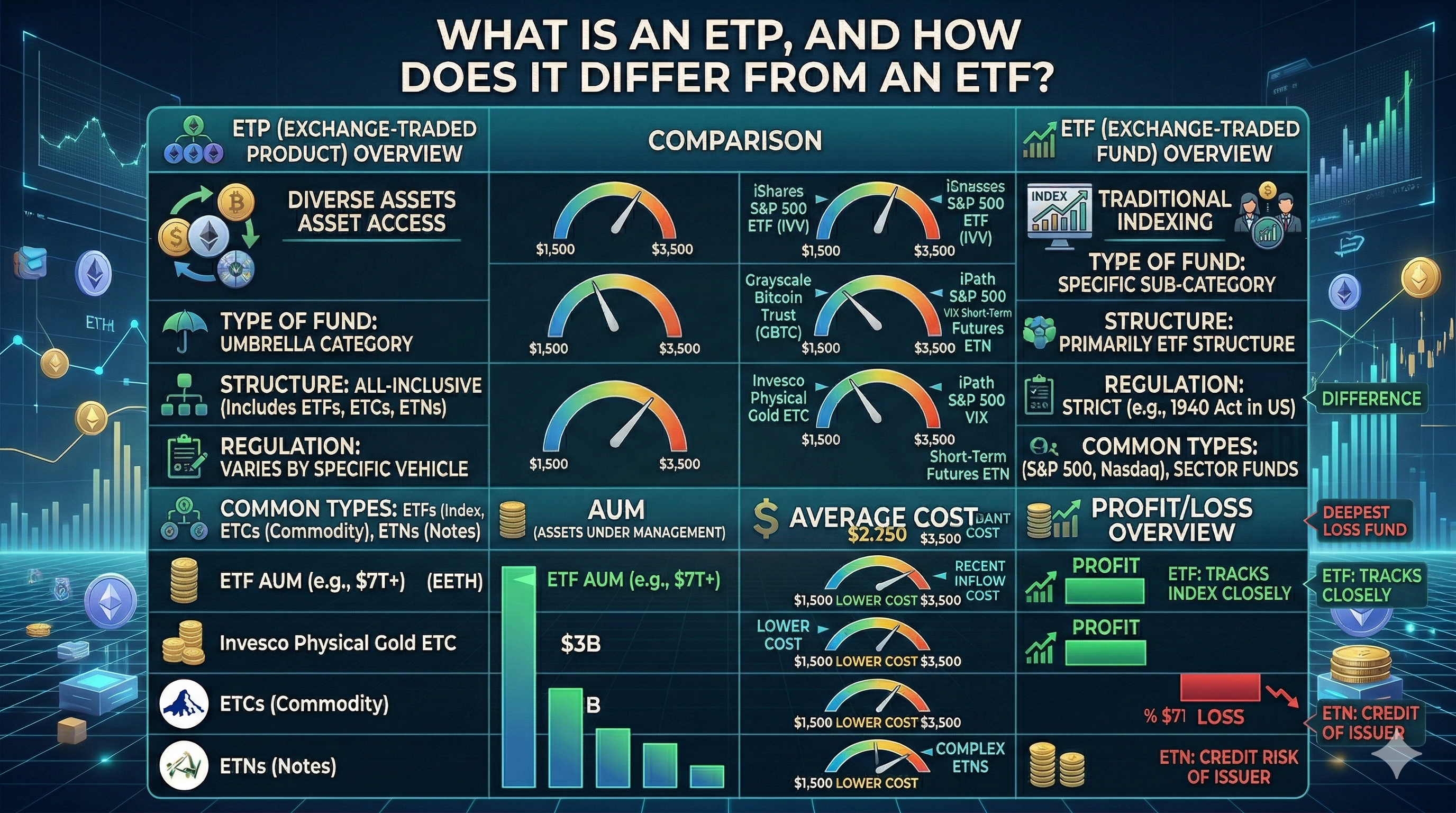
Exchange-Traded Products (ETPs) have become a central pillar of modern financial markets, offering investors flexible exposure to assets ranging from stocks to cryptocurrencies. While Exchange-Traded Funds (ETFs) are the most well-known type of ETP, the broader category includes structurally different instruments such as Exchange-Traded Notes (ETNs) and Exchange-Traded Commodities (ETCs), each carrying distinct risks, regulatory frameworks, and investment implications that are often misunderstood by retail participants.
Understanding Exchange-Traded Products (ETPs)
Exchange-Traded Products, commonly referred to as ETPs, are financial instruments that trade on stock exchanges in a similar way to individual equities. They are designed to track the performance of an underlying asset, index, or benchmark, allowing investors to gain exposure without directly owning the asset itself. This structure has made ETPs increasingly popular, particularly as markets expand into complex areas like commodities and digital assets.
Not like traditional mutual funds, ETPs are traded throughout the day, meaning their prices fluctuate in real time based on supply and demand. This feature provides flexibility for investors who want to react quickly to market movements. ETPs have seen rapid global growth, with trillions of dollars in assets under management as of recent reports, reflecting strong institutional and retail demand.
One key aspect that defines ETPs is their diversity. The category includes ETFs, ETNs, and ETCs, each structured differently. While they may appear similar on the surface, these instruments vary significantly in how they are constructed, taxed, and regulated. This distinction is critical, especially in volatile or emerging markets.
What Is an ETF? The Most Popular Type of ETP
Exchange-Traded Funds, or ETFs, are the most widely recognized and widely used form of ETPs. An ETF is essentially a fund that holds a basket of assets, such as stocks, bonds, or commodities, and issues shares that trade on an exchange. When investors buy shares of an ETF, they are indirectly investing in the underlying portfolio.
ETFs are often praised for their transparency and cost efficiency. Most ETFs passively track an index, such as the S&P 500, meaning they aim to replicate its performance rather than outperform it. This passive approach typically results in lower management fees compared to actively managed funds. According to Vanguard, ETFs have become a preferred vehicle for long-term investors due to their diversification and relatively low expense ratios.
Another defining feature of ETFs is their structure. Unlike some other ETPs, ETFs are backed by actual assets held in custody. This reduces counterparty risk and provides a layer of security for investors. Additionally, ETFs benefit from a creation and redemption mechanism that helps keep their market price closely aligned with their net asset value (NAV).
The Broader ETP Family: ETNs and ETCs Explained
While ETFs dominate headlines, the ETP category also includes less widely understood instruments such as Exchange-Traded Notes (ETNs) and Exchange-Traded Commodities (ETCs). These products expand the range of investment opportunities but introduce additional layers of complexity.
ETNs are unsecured debt instruments issued by financial institutions. Instead of holding underlying assets, they promise to pay returns based on the performance of a benchmark. This means investors are exposed to the credit risk of the issuer. If the issuing bank faces financial trouble, investors could incur losses regardless of the underlying index performance. The U.S. Securities and Exchange Commission highlights this as a key risk factor in ETNs.
ETCs, on the other hand, are designed to track commodity prices. They may be backed by physical assets, such as gold, or structured using derivatives. These products are particularly popular in markets where direct commodity ownership is impractical.
Understanding these distinctions is crucial because the term “ETP” is often used broadly, leading investors to assume all products carry similar risks and protections, which is not the case.
Key Structural Differences Between ETPs and ETFs
The primary difference between ETPs and ETFs lies in structure. While ETFs are funds that hold underlying assets, other ETPs like ETNs are debt instruments, and ETCs may rely on derivatives or physical backing. This structural variation has direct implications for risk, taxation, and performance.
ETFs are typically structured as investment funds regulated under strict frameworks, such as the Investment Company Act in the United States. This regulatory oversight provides investor protections, including asset segregation and transparency requirements. In contrast, ETNs are not funds but obligations of the issuing institution, making them more sensitive to credit risk.
Another difference lies in how returns are generated. ETFs derive returns from the performance of their underlying assets, while ETNs rely on the issuer’s ability to deliver promised returns. This distinction can become critical during periods of financial stress.
According to Morningstar, investors often underestimate these differences, particularly when products are marketed under the broad “ETP” label. This can lead to mismatched expectations and unintended exposure to risk.
Liquidity and Trading Behavior in ETPs vs ETFs
Liquidity is one of the most important factors investors consider when trading ETPs and ETFs. While both trade on exchanges, their liquidity profiles can differ significantly depending on their structure and underlying assets. ETFs generally benefit from high liquidity due to their widespread adoption and the presence of authorized participants who facilitate the creation and redemption of shares.
This mechanism ensures that ETF prices remain closely aligned with their net asset value. In contrast, some ETPs, particularly niche ETNs or commodity-based ETCs, may experience lower trading volumes and wider bid-ask spreads. This can increase trading costs and reduce efficiency.
The liquidity of an ETP is not solely determined by its trading volume but also by the liquidity of its underlying assets. For example, an ETF tracking a major stock index will typically be more liquid than an ETC linked to a less frequently traded commodity.
Risk Profiles: What Investors Often Overlook
Risk is where the differences between ETPs and ETFs become most pronounced. While ETFs are generally considered lower-risk due to their asset-backed structure, they are not risk-free. Market risk, tracking error, and liquidity constraints can all impact performance.
ETNs introduce an additional layer of risk, credit risk. Because they are unsecured debt instruments, their value depends on the financial health of the issuer. This risk became particularly evident during financial crises when some ETNs experienced significant price deviations.
Commodity-based ETPs also carry unique risks, including volatility and exposure to futures markets. These factors can lead to performance that diverges from spot prices, especially over longer periods.
The Financial Industry Regulatory Authority emphasizes that investors should carefully read product disclosures to understand these risks fully. Misunderstanding the structure of an ETP can lead to unexpected outcomes, particularly in complex or leveraged products.
The Rise of Crypto ETPs and ETFs
In recent years, digital assets have entered the ETP space, with crypto-linked products gaining traction among institutional and retail investors. These include Bitcoin ETFs, Ethereum ETPs, and various structured products that provide exposure to cryptocurrencies without requiring direct ownership.
The approval of spot Bitcoin ETFs in major markets marked a turning point, signaling increased regulatory acceptance. Firms like BlackRock and Fidelity have launched products that track the price of Bitcoin, attracting billions in inflows.
Crypto ETPs differ from traditional ones in several ways. They must address custody challenges, regulatory uncertainty, and high volatility. Some are physically backed, while others rely on futures contracts or synthetic exposure.
Tracking Error and Performance Gaps: Why Similar Products Don’t Always Deliver the Same Returns
At first glance, many ETPs and ETFs appear to offer identical exposure. Two products may track the same index or asset class, yet deliver noticeably different returns over time. This gap, known as tracking error, is one of the most misunderstood aspects of exchange-traded products and can significantly affect investor outcomes.
Tracking error refers to the difference between the performance of the product and the performance of its underlying benchmark. In ETFs, this difference is often small but still present, typically due to management fees, transaction costs, and portfolio rebalancing. Even a low-cost ETF tracking a major index like the S&P 500 may slightly underperform the index over time because of these operational frictions.
The situation becomes more complex with other types of ETPs. For example, commodity-based ETPs that rely on futures contracts may experience performance drag due to a process known as “roll yield.” When futures contracts are rolled over, the cost of maintaining exposure can erode returns, especially in markets where future prices are higher than spot prices. According to CME Group, this effect can lead to significant divergence between expected and actual performance in commodity-linked products.
ETNs introduce another layer of complexity. While they are designed to track an index precisely, their performance can still deviate due to issuer fees or market pricing dynamics. In some cases, ETNs have traded at premiums or discounts to their indicative value, creating unexpected outcomes for investors.
Understanding tracking error is essential because it highlights a key reality: exposure is not always equal to performance. Two products that seem identical on paper may behave very differently in practice. For investors, this means looking beyond the headline objective of a product and examining how it actually delivers returns over time.
Costs and Fees Comparison
Cost efficiency is one of the main reasons investors choose ETFs. Most ETFs have relatively low expense ratios, especially those that track major indices. This makes them attractive for long-term investment strategies.
Other ETPs may have higher costs due to their complexity. ETNs, for example, may include embedded fees related to their structure, while commodity ETPs may incur costs associated with storage or rolling futures contracts. Theoretically, investors should look beyond headline expense ratios and consider total cost of ownership, including trading spreads and hidden fees.
Use Cases: When to Choose an ETF vs an ETP
Choosing between an ETF and other types of ETPs depends on the investor’s goals, risk tolerance, and market outlook. ETFs are generally preferred for broad market exposure and long-term investing due to their transparency and lower risk profile.
Other ETPs may be suitable for more specialized strategies. For example, an ETN might be used to gain exposure to a niche index, while an ETC could provide access to commodities like gold or oil.
However, these use cases require a deeper understanding of the underlying structure and risks. Investors should carefully evaluate whether the potential benefits outweigh the additional complexities.
Market Trends and Institutional Adoption
Institutional adoption has been a major driver of growth in the ETP market. Large asset managers and hedge funds increasingly use these products for portfolio diversification and risk management.
The expansion into new asset classes, including cryptocurrencies and thematic investments, has further broadened the appeal of ETPs. According to recent industry reports, global ETP assets have reached record levels, reflecting strong demand.
This trend is likely to continue as financial innovation and regulatory clarity improve.
The Outlook of ETPs and ETFs
The future of ETPs is closely tied to technological advancements and regulatory developments. Innovations in blockchain, data analytics, and financial engineering are expected to drive the creation of new products.
At the same time, regulators will play a crucial role in ensuring that these products remain safe and transparent. As markets grows, the distinction between different types of ETPs may become more important, not less.
Investors who understand these differences will be better positioned to navigate the changing landscape.
Conclusion
ETPs have changed the way investors access financial markets, offering flexibility, diversification, and efficiency. However, not all ETPs are created equal. While ETFs provide a relatively straightforward and transparent investment vehicle, other types of ETPs introduce additional risks and complexities that require careful consideration.
Understanding these differences is essential for making informed investment decisions. As the market continues to evolve, education and due diligence will remain key to navigating the opportunities and challenges presented by ETPs.
FAQ
-
What is an ETP in simple terms?
An ETP is a financial product traded on an exchange that tracks an asset or index.
-
Is an ETF the same as an ETP?
No. An ETF is a type of ETP, but not all ETPs are ETFs.
-
Are ETPs safe?
Some are safer than others. ETFs are generally lower risk than ETNs.
-
Can beginners invest in ETFs?
Yes, ETFs are often considered beginner-friendly due to their simplicity.
-
What is the biggest risk in ETPs?
Structural differences, especially credit risk in ETNs, are often overlooked.
Disclaimer
This content is for informational purposes only and does not constitute investment advice. Cryptocurrency investments carry risk. Please do your own research (DYOR).