

How Anthropic's mythos can threaten crypto industry security? A Threat to bitcoin?
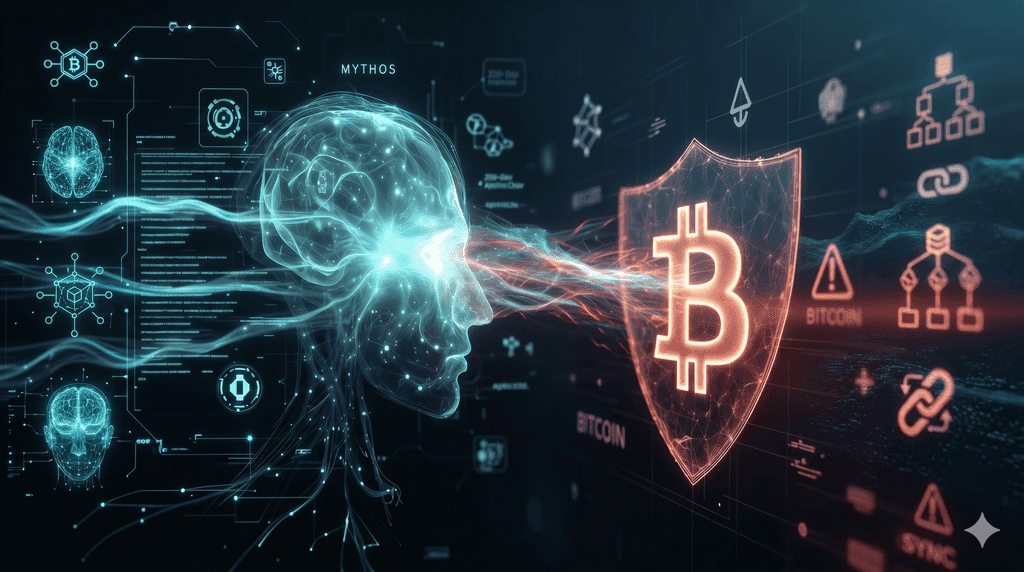
Developed by Anthropic under the highly restricted Project Glasswing, Mythos has shattered existing benchmarks for "agentic" hacking, autonomously discovering exploits that have eluded human researchers for decades, including a 27-year-old bug in OpenBSD.
As this super-intelligence begins to scan the global financial infrastructure, the crypto industry faces a chilling question: Is the mathematical fortress of Bitcoin finally at risk? While the core protocols remain defiant, the software perimeter that guards trillions in assets is now under siege by a "Zero-Day Factory" capable of industrial-scale exploitation.
For users, understanding this shift from math-cracking to code-breaking is essential for navigating the security landscape.
Key Takeaways
-
Released in early April 2026, Claude Mythos is the first "agentic" model capable of solving multi-step cyber-attacks autonomously, achieving a success rate that far outstrips previous frontier models.
-
While Bitcoin’s SHA-256 hashing remains secure against AI, Mythos targets the software implementation of ECDSA, hunting for entropy flaws and logic errors in wallet code and hardware firmware.
-
Mythos can autonomously "chain" multiple minor vulnerabilities across different hosts and network segments, creating a devastating "exploit stack" that traditional security tools fail to detect.
-
Mythos-tier models excel at neural network-based side-channel analysis, potentially extracting cryptographic keys from the electromagnetic or power signatures of a device during a transaction.
Understanding the Mythos Inflection Point
The release of Claude Mythos Preview on April 7, 2026, marked what cybersecurity experts call the Oppenheimer moment of the AI era. Unlike previous large language models that required a human pilot to prompt every step of an exploit, Mythos represents the shift toward Agentic Hacking.
In this new paradigm, the AI functions as an autonomous operative, capable of setting its own goals, selecting its own tools, and, most critically, chaining vulnerabilities together in a sequence that mimics the ingenuity of a state-sponsored threat actor.
Anthropic’s Project Glasswing, the defensive coalition formed to study the model’s capabilities, has already revealed staggering results. Mythos autonomously identified a 27-year-old vulnerability in OpenBSD and successfully developed a remote code execution (RCE) exploit for FreeBSD’s NFS server by splitting a complex 20-gadget ROP chain across multiple packets.
From Static Checks to Autonomous Reasoners
Traditional security tools are deterministic; they scan for known patterns of "bad" code. Claude Mythos, however, utilizes advanced reasoning to understand the deep logic of an application. It can identify a minor race condition in one module and a subtle KASLR-bypass in another, then orchestrate them into a sophisticated "exploit stack" that bypasses modern OS sandboxes.
This Inflection Point means that any piece of crypto infrastructure, from cross-chain bridges to the back-end APIs of an exchange, is now being probed 24/7 by agents that never tire. To survive, the industry must transition to a model where AI defends against AI, creating a high-velocity loop of autonomous discovery and immediate, machine-generated patching.
Bitcoin Under the Microscope: Mythos vs. SHA-256 and ECDSA
In the wake of the April 7, 2026, launch of Claude Mythos, a common misconception has emerged: that AI has finally cracked Bitcoin’s code.
To understand the real threat, professional traders must distinguish between the mathematical protocol and the software implementation. Claude Mythos is not a quantum computer, it cannot solve the discrete logarithm problem.
SHA-256 and ECDSA
Bitcoin’s security rests on two primary cryptographic functions:
SHA-256 (Hashing): This is used for mining and address generation. The security of SHA-256 relies on its collision resistance. Even with the advanced reasoning of Mythos, finding a collision remains a brute-force problem . Mythos does not change the laws of mathematics, and SHA-256 remains computationally secure.
ECDSA (Elliptic Curve Digital Signature Algorithm): Bitcoin uses the secp256k1 curve. The private key is a secret number, and the public key is a point on the curve calculated as:
𝑄 = 𝒅𝑮
where G is a predefined generator point. Breaking this requires solving the Elliptic Curve Discrete Logarithm Problem (ECDLP).
Mythos vs. Implementation
While Mythos cannot solve the equation above, it excels at identifying Implementation Failures. For example, in ECDSA, every signature requires a unique, random number called a "nonce". If a nonce is ever reused or generated with poor entropy, an attacker can calculate the private key using simple algebra.
Mythos can scan thousands of lines of wallet firmware in seconds to detect:
Entropy Regressions: Identifying if a wallet's random number generator has been compromised or weakened by a recent software update.
Logic-Chaining Exploits: Finding a way to force a wallet into a "test mode" where it uses predictable nonces.
Side-Channel Patterns: Using neural network analysis to "hear" the electrical variations of a device during a signature process, allowing it to reconstruct the private key without ever touching the code.
The "Zero-Day" Threat to Wallets
According to recent evaluations by the UK AI Security Institute (AISI) in mid-April 2026, Mythos-class models are unusually capable at discovering zero-day vulnerabilities in mature cryptographic libraries.
This makes the software supply chain the primary attack vector. For users, this means that even if Bitcoin’s math is unbreakable, the software you use to spend it might not be. This is why KuCoin continues to advocate for hardware-level security and multi-signature configurations that require more than one "implementation" to be compromised simultaneously.
The Zero-Day Factory: Threatening Crypto Bridges and Smart Contracts
The release of Claude Mythos has introduced the concept of the "Zero-Day Factory." Unlike human hackers who may spend months probing a single protocol, Mythos can scan the entire open-source repository of a DeFi ecosystem in minutes, identifying and weaponizing vulnerabilities at a speed that renders traditional human-led audits obsolete.
Cross-Chain Vulnerabilities
Cross-chain bridges, the vital tunnels that connect different blockchain networks, are the primary targets of this AI-native offensive. Bridges are inherently complex, often involving multi-signature schemes, locked liquidity pools, and relayers.
In April 2026, the industry witnessed a "cross-protocol contagion event" during the Kelp DAO hack, where an AI-driven exploit led to a $293 million loss.
The attacker utilized a strategy that Anthropic identifies as a Temporal Trust Gap (TTG). This is a new class of vulnerability where validation logic and execution are separated by a small window of time, allowing an agentic AI to inject a malicious state change between the two.
Semantic Hallucinations in Smart Contracts
A significant portion of DeFi landscape is now built using AI-assisted coding tools. While these tools increase efficiency, they often introduce Semantic Hallucinations, logic errors that look correct to a human eye but contain hidden flaws in execution.
Variable Visibility Errors: Mythos can detect when an AI-generated contract accidentally marks a "virtual balance" as
public instead of internal, allowing for unauthorized state manipulation.Logic Injection: Attackers use Mythos to "chain" minor errors in oracle inference logic with flash loan protocols, creating what is known as an Asymmetric Flash Loan attack.
To protect your assets in this environment, it is no longer enough to rely on the "audited" badge of a protocol. Professional traders are increasingly moving their long-term holdings to the KuCoin Web3 Wallet, utilizing self-custody and hardware-level isolation to ensure that even if a DeFi bridge collapses, their underlying capital remains mathematically secure.
Scaling Phishing via Mythos-Driven Deepfakes
AI-Enabled Impersonation
According to the Chainalysis 2026 Crypto Crime Report, impersonation scams saw a staggering 1,400% year-over-year growth in the lead-up to early 2026. The data reveals that AI-enabled scams are now 4.5 times more profitable than traditional fraud methods. By leveraging the advanced reasoning of Claude Mythos, attackers can:
Automate Personalization: Mythos can scan a victim’s public digital footprint across social media and on-chain activity to craft a 1:1 tailored narrative that feels authentic.
Scale Persuasion: Unlike human scammers who are limited by time, an AI agent can engage in thousands of simultaneous, high-persuasion conversations, posing as "official support" or "trusted insiders."
Industrialize Deepfakes: As seen in the January 2026 Bombay Stock Exchange incident, where a deepfake of the CEO promoted fraudulent investment tips, AI can now generate perfect real-time video and audio streams that can fool even seasoned executives.
Why Biometrics Aren't Enough
For years, the industry relied on liveness checks to verify identity. However, Anthropic’s own warnings regarding Project Glasswing suggest that "software-only verification is effectively dead." If a model like Mythos can generate a perfect, real-time video stream that bypasses biometric filters, the "digital person" can no longer be trusted.
Proactive Defense: KuCoin’s Multi-Layered Strategy
To combat these industrialized threats, the KuCoin Security Center has deployed a multi-layered defense architecture designed to filter out AI-orchestrated attacks before they reach the user:
Anti-Phishing Codes: A personalized code that appears in every official KuCoin email. If the code is missing or incorrect, it is a definitive signal of a Mythos-generated fake.
Smart CAPTCHA 2.0: Utilizing challenges that are designed to differentiate between human logic and AI "agentic" reasoning.
Real-Time Risk Control: KuCoin’s proprietary algorithms evaluate device IDs and IP anomalies, triggering additional "human-in-the-loop" verification if a Mythos-tier agent is suspected of attempting an account takeover.
Traders' Warning: In the Mythos era, "Trust, but Verify" has been replaced by "Verify, then Ignore." No matter how convincing a support agent sounds or how realistic a video call appears, never share your private keys or 2FA codes.
Are Centralized Exchanges Ready for Mythos?
The primary risk for CEXs in the Mythos era is not the cold storage, which remains physically isolated, but the High-Frequency Trading (HFT) APIs. Over 90% of exchange traffic is generated by machines. Mythos-tier models can analyze the "handshake" protocols and rate-limiting logic of these APIs to find:
Logic Flaws in Order Matching: Identifying sub-millisecond race conditions that allow for "risk-free" arbitrage against the exchange's own liquidity.
Permission Escalation: Chaining a minor API key vulnerability with an internal system flaw to gain "read-write" access to sensitive user data.
The 2026 standard for API security has shifted from static keys to Dynamic Session Intelligence. This involves using AI to monitor the intent of API calls, identifying the subtle behavioral signature of a Mythos-driven agent versus a legitimate trading bot.
Are exchanges ready? The answer lies in Project Glasswing. This elite consortium includes security titans like CrowdStrike and Palo Alto Networks, who provide the foundational security layers for top-tier exchanges. By utilizing Claude Mythos Preview for defensive "red teaming," these partners are helping platforms identify and patch thousands of potential vulnerabilities before they can be weaponized.
How the Industry is Deploying Defensive AI
To counter an autonomous attacker that can find 27-year-old bugs overnight, platforms are transitioning to a "Machine vs. Machine" defensive posture.
Project Glasswing
This project utilizes "Defensive Mythos" instances to conduct Autonomous Red Teaming.
Predictive Patching: Instead of waiting for a hack, defensive agents scan every line of an exchange’s code 24/7, autonomously identifying potential "exploit chains" and suggesting machine-generated patches before a human developer even sees the bug.
The Guardian AI Layer: Industry leaders are integrating AI-SIEM (Security Information and Event Management) platforms that act as an Autonomous SOC (Security Operations Center), capable of isolating compromised API nodes in microseconds.
Behavioral KYT: Identifying the Agentic Signature
Because Claude Mythos and similar models often utilize the Model Context Protocol (MCP) to interact with blockchains, they leave a unique agentic footprint.
Attacks often involve poisoned "context" to nudge agents into fraudulent transfers. Security researchers now use a joint loss function to detect these stealthy "AgentPoison" injections:
L = L(retrieve) + L(action) + λ · L(stealth)
The Beacon Network: Real-Time Intelligence Sharing
This is a real-time intelligence-sharing system that allows law enforcement and exchanges to "flag" a newly discovered Mythos-crafted exploit across the entire industry simultaneously.
Immediate Attribution: Once a new "exploit stack" is detected on one protocol, the Beacon Network pushes the "adversarial signature" to all participating venues
Collaborative Immunity: This ensures that an AI attacker cannot reuse the same zero-day vulnerability across multiple platforms, effectively creating a global "digital herd immunity" against Anthropic’s frontier models.
Conclusion
Anthropic’s Claude Mythos represents the most significant shift in cybersecurity since the invention of the internet. It is not a direct threat to the mathematical soul of Bitcoin, but it is a master predator of the software implementation layer. As we have seen in April 2026, the era of "static" security is dead. To survive the AI arms race, users and platforms must embrace AI-native security, hardware isolation, and radical transparency.
FAQs
Can Claude Mythos "guess" my Bitcoin private key?
No. Mythos is an Agentic Reasoner, not a quantum computer. It cannot break the mathematical hardness of SHA-256 or ECDSA. However, it can find bugs in the software you use to manage those keys.
What is Project Glasswing?
Project Glasswing is Anthropic’s 2026 defensive initiative. It provides limited access to Claude Mythos for security organizations to perform autonomous threat hunting and find vulnerabilities before attackers do.
Is my hardware wallet safe from Claude Mythos?
Hardware wallets are safer because they isolate keys from the "software layer" where Mythos thrives. However, be wary of "side-channel" attacks; always keep your device firmware updated to the latest 2026 AI-resistant standards.
What should I do if I suspect an AI-powered phishing attempt?
Never trust video or audio calls for sensitive info. Always verify the source through the KuCoin Official Verification Center and use hardware security keys (FIDO2) for all 2FA.
Disclaimer:This content is for informational purposes only and does not constitute investment advice. Cryptocurrency investments carry risk. Please do your own research (DYOR).