

SUI Price Prediction for Late 2026: Can Post-Vesting Tokenomics Trigger a Breakout?
2026/05/20 13:30:02
Introduction
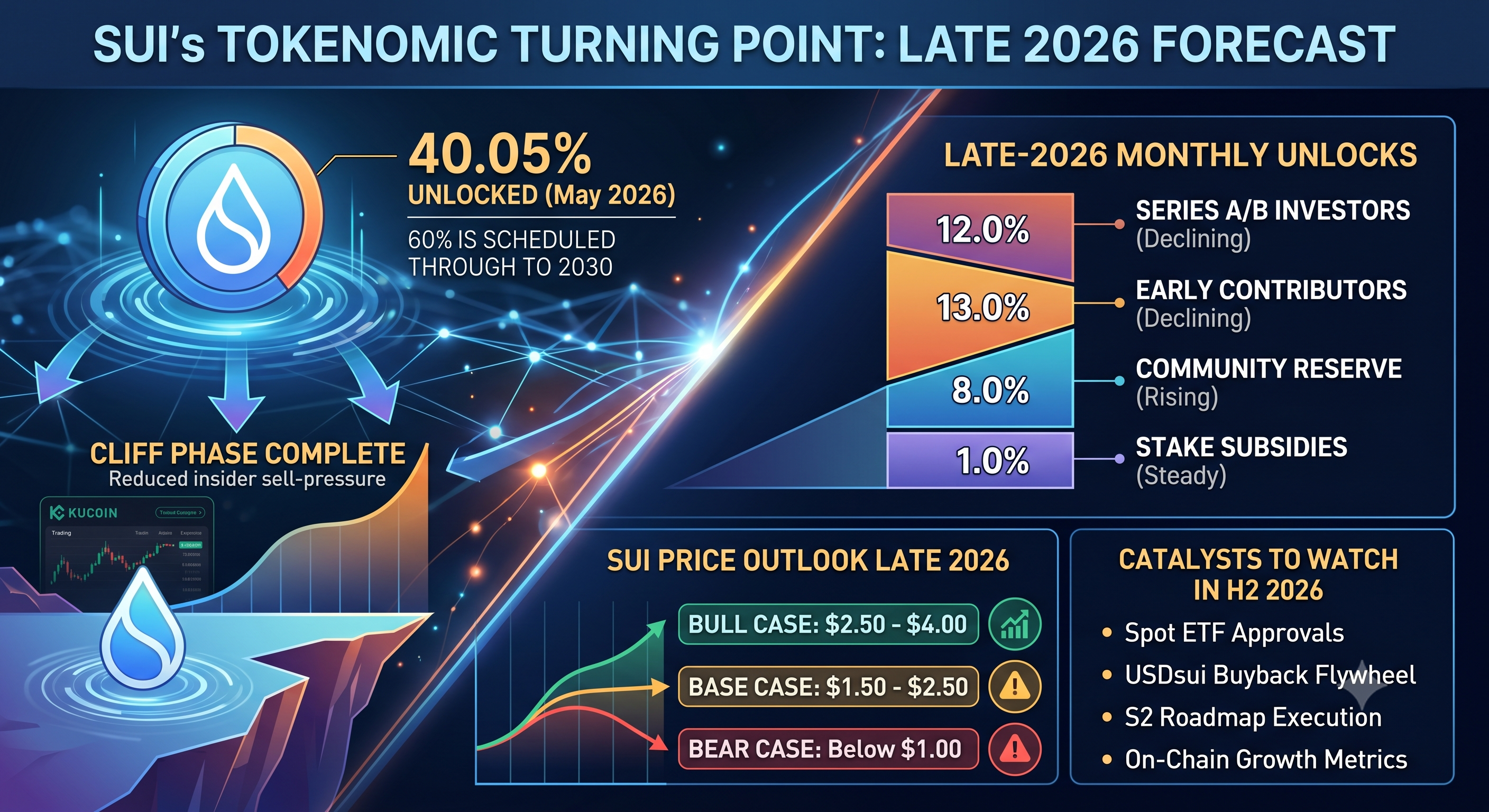
According to Tokenomist data as of May 2026, approximately 4,005,418,369 SUI — about 40.05% of total supply — has been unlocked, with the remaining 60% still scheduled to enter circulation through 2030. Yet SUI now sits at a turning point: the heaviest three-year cliff phase covering early VC and team allocations is winding down, and based on AInvest analysis, SUI is trading near $0.91 in a tight consolidation range with RSI at 45.59 and MACD flattened — a coiled-spring setup typical of pre-breakout phases. Late 2026 may therefore mark the first moment when fundamentals — not vesting — drive SUI's price.
To understand the full context, the below are recommended readings:
-
SUI Token Unlocks breaks down the exact post-vesting supply schedule and which buckets still pressure the chart.
-
Crypto Token Unlocks explains how predictable vesting events historically translate into price action across the broader market.
What Is the Current State of SUI After Three Years of Vesting?
SUI is past its most fragile supply phase but not yet free of vesting overhang. A meaningful portion of supply is already circulating, so SUI is past its most fragile early phase, but a large amount of supply is still scheduled, which keeps unlock events relevant for years — not weeks.
As of May 2026, according to Tokenomist, the circulating supply of SUI is 4,005,418,369 tokens against a total supply of 10,000,000,000, and SUI's FDV is $10.47 billion — a figure that helps estimate long-term dilution risks. The market cap sits around $3.6 billion based on Coincub's late-cycle snapshot, leaving the FDV gap as the single largest structural headwind on the chart.
Why the "Three-Year Cliff End" Matters
The mainnet launched in May 2023, meaning the standard three-year cliff for early-stage investor tranches and core contributor allocations is materially completing through 2026. SUI's unlock timeline runs from TGE in May 2023 through roughly May 2030, and traders tend to focus less on daily emissions and more on milestone dates — especially cliff endings that change perceived supply risk.
The key implication: the most concentrated insider sell-pressure window is shifting from "active distribution" to "tail emissions." That changes both the math and the narrative going into H2 2026.
How Much SUI Supply Will Hit the Market in Late 2026?
Roughly 64 million SUI per month will continue to unlock through year-end 2026, but the composition shifts toward community-weighted buckets. Based on Coincub's tokenomics breakdown, monthly unlocks are around 64M SUI, currently working out to roughly 1–1.7% of circulating supply per month, with emissions extending into 2030 — a long, steady program rather than one giant cliff that avoids single event risk but creates continuous sellable supply into every rally.
Breakdown of the Late-2026 Unlock Pipeline
According to BeInCrypto reporting on the May 1, 2026 event, SUI unlocked 42.62 million tokens worth approximately $40.39M, with 19.32 million going to Series B investors, 12.63 million to the community reserve, 8.60 million to early contributors, and 2.07 million to Mysten Labs. From June onward, the mix tilts further toward the Community Reserve. Per Tokenomist, the next unlock for SUI is scheduled for June 1, 2026, released to Community Reserve.
|
Unlock Bucket
|
Typical Market Reaction
|
Late-2026 Weight
|
|
Series A/B Investors
|
Higher sell-through (profit-taking)
|
Declining
|
|
Early Contributors
|
Mixed — partial staking
|
Declining
|
|
Community Reserve
|
Lower direct sell-pressure
|
Rising
|
|
Stake Subsidies
|
Largely restaked
|
Steady
|
This compositional shift is the quiet bullish catalyst most price models underweight.
What Is the SUI Price Prediction for Late 2026?
Late-2026 SUI price targets range from a bearish sub-$1 to a bullish $3+, with the base case clustering between $1.50 and $2.50. According to AInvest analysts, $3 is a feasible mid-2026 price target if support holds, and per BitcoinWorld's published outlook, SUI may trade between $2 and $5 by 2027 in a steady-growth scenario reflecting moderate adoption and market maturity.
Bull Case: $2.50 to $4.00
The bull case requires institutional flows to absorb monthly unlocks. Based on CoinMarketCap's analysis, ETF inflows and institutional staking reduce liquid supply, which can amplify price moves on rising demand — evident in SUI's 19% surge on May 8, 2026 after the SUIG stake — yet predictable unlock sell-pressure acts as a persistent overhang, capping rallies and testing buyer absorption each month.
If Grayscale's Sui Staking ETF and the pending Bitwise/Canary products approve into Q3–Q4 2026, the demand side gains a structural buyer that does not exist today.
Base Case: $1.50 to $2.50
The base case assumes ETF approvals trickle through but macro stays mixed. Sui looks like a high-conviction, high-volatility bet on next-gen L1s and the Move ecosystem, fitting better in a long-term allocation with a 2027+ horizon than in a short-term trade that cannot stomach 50–70% drawdowns. In this regime, SUI grinds higher with the broader altcoin tape but does not decouple.
Bear Case: Below $1.00
The bear case is straightforward: unlocks keep landing on thin demand. Tokenomics remain SUI's primary vulnerability — a separate $63.4 million unlock previously triggered a 9.1% price slide, and high fully diluted valuation exposes the token to volatility during low-liquidity periods. If institutional flows stall and macro turns risk-off, SUI revisits its 2025–2026 lows.
What Catalysts Could Drive SUI Higher in H2 2026?
Four catalysts could meaningfully change SUI's risk/reward into late 2026: spot ETF approvals, the USDsui buyback flywheel, the S2 roadmap, and on-chain growth metrics.
1. Spot SUI ETF Approvals
The SEC's delayed decisions on SUI ETF approvals until January 2026 created regulatory uncertainty, yet the introduction of generic listing standards in October 2025 has accelerated the path for qualifying products, with Bitwise filing for a spot SUI ETF in December 2025 and applications from Grayscale, 21Shares, and Canary Capital signaling growing institutional confidence.
2. USDsui Buyback Mechanism
Per CoinMarketCap's analysis, the native stablecoin USDsui launched in March 2026, designed to recycle yield into SUI buybacks — successful execution could drive organic demand, and the buyback mechanism is a direct, deflationary price support.
3. S2 Roadmap Execution
According to CoinMarketCap, Sui's 2026 plan, dubbed S2 (Sui StackStack), aims to evolve from an L1 to a unified developer platform with native privacy and gasless stablecoin transfers. Delivery on this would expand SUI's addressable market beyond DeFi and gaming.
4. On-Chain Growth
According to CoinMarketCap data, on-chain momentum is strong, with Sui processing over $111 billion in stablecoin transfers in January 2026 and developer growth of 219% YoY, while the community's governance response to the $162M Cetus hack in May 2025 demonstrated resilience.
What Are the Biggest Risks to SUI's Late-2026 Forecast?
The three biggest risks are continued unlock dilution, L1 competition, and execution failures on the S2 roadmap.
Tokenomic Overhang
Even with the cliff phase ending, vesting continues. SUI's tokenomics reward patient stakers and long-term believers but punish anyone looking for a quick supply squeeze — until unlocks slow after 2030, price will keep reflecting both fundamentals and a constant hidden tax from vesting.
Competitive L1 Pressure
Per AInvest's comparative analysis, SUI's theoretical throughput ceiling is higher at approximately 120,000 TPS, but its real-world volume remains lower than Solana's, though SUI's TVL grew 220% in 2024–2025, outpacing Solana, driven by leadership in Web3 gaming and NFT infrastructure. The question is whether that growth differential persists.
Execution and Outage Risk
According to CoinMarketCap, the risk is delayed delivery or technical setbacks, like the January 2026 mainnet outage, which could erode confidence while competitors advance.
Should You Trade SUI on KuCoin?
KuCoin offers one of the most direct ways to position around SUI's post-vesting catalysts, with deep spot liquidity, SUI perpetual futures, and staking products under one account. For traders tracking the unlock calendar, KuCoin's order books for SUI/USDT remain among the deepest in the global market, allowing both scaled accumulation and tactical hedging around monthly unlock dates.
Whether you favor the bull thesis (ETF approvals + USDsui buybacks compressing float) or want to hedge unlock-day volatility via short-dated perps, KuCoin provides the tooling. New users can complete verification in minutes, deposit SUI or stablecoins, and access spot, margin, and futures markets immediately. For longer-horizon holders, KuCoin Earn offers SUI staking products to capture network yield while waiting out the remaining vesting schedule.
Sign up on KuCoin, fund your account, and trade SUI with the liquidity and product range needed to navigate the most consequential six months of SUI's tokenomic life cycle. New users can now register at KuCoin and Get Up to 11,000 USDT in New User Rewards.

Conclusion
SUI's late-2026 price outlook hinges on a single structural question: will institutional demand finally outpace the predictable monthly supply unlocks? Based on current data, the math is shifting in favor of bulls — the heaviest insider cliff phase is ending, the unlock mix is tilting toward community reserves, and at least four major spot ETF applications sit in front of the SEC. According to CoinMarketCap, SUI's near-term price hinges on whether institutional demand can outmuscle monthly unlock sell-pressure, while its long-term valuation depends on translating an ambitious tech roadmap into sustained adoption.
The base case targets $1.50–$2.50 by year-end 2026, with upside to $3–$4 if ETF approvals and USDsui buybacks materialize, and downside below $1 if macro turns risk-off. Traders should size positions to survive 50%+ drawdowns, treat each monthly unlock as a known event rather than a surprise, and watch the Community Reserve composition shift as the leading bullish tell. Late 2026 is when SUI's three-year tokenomic story finally gets tested against demand.
FAQs
1. When does SUI's vesting fully end?
SUI's vesting schedule extends to May 1, 2030. According to Tokenomist, the full unlock schedule extends into 2030, with the next unlock scheduled for June 1, 2026 to the Community Reserve. The most concentrated insider cliffs largely complete through 2026, but tail emissions to ecosystem buckets continue for four more years.
2. How much SUI is unlocked each month in 2026?
Roughly 64 million SUI, or 1–1.7% of circulating supply. Per Coincub data, monthly unlocks are around 64M SUI, which currently works out to roughly 1–1.7% of circulating supply per month.
3. Is staking SUI a viable hedge against unlock dilution?
Yes, particularly for long-horizon holders. Per KuCoin's analysis of recent unlock events, high staking ratios on SUI mean many new tokens get locked up again rather than sold, partially offsetting inflation pressure.
4. How did SUI handle previous large unlock events?
With surprising resilience in early 2026. According to AInvest, SUI weathered a major $60 million token unlock event with minimal price disruption, maintained prices above $1.34 despite the supply injection, and network activity held steady at 866 transactions per second following Mysticeti v2's rollout.
5. What's the realistic best-case SUI price by end of 2026?
Most published forecasts cap the bullish 2026 scenario around $3–$4, with breakout to higher levels reserved for 2027. Analyst scenarios range from bullish $5–10 by 2027 (up to $15–25 by 2030) to bearish below $1 by 2027, contingent on adoption, the unlock schedule, and macro/regulatory trends.