

Follow the Smart Money: Which Altcoins Are the Top 4 Market Makers Betting On?
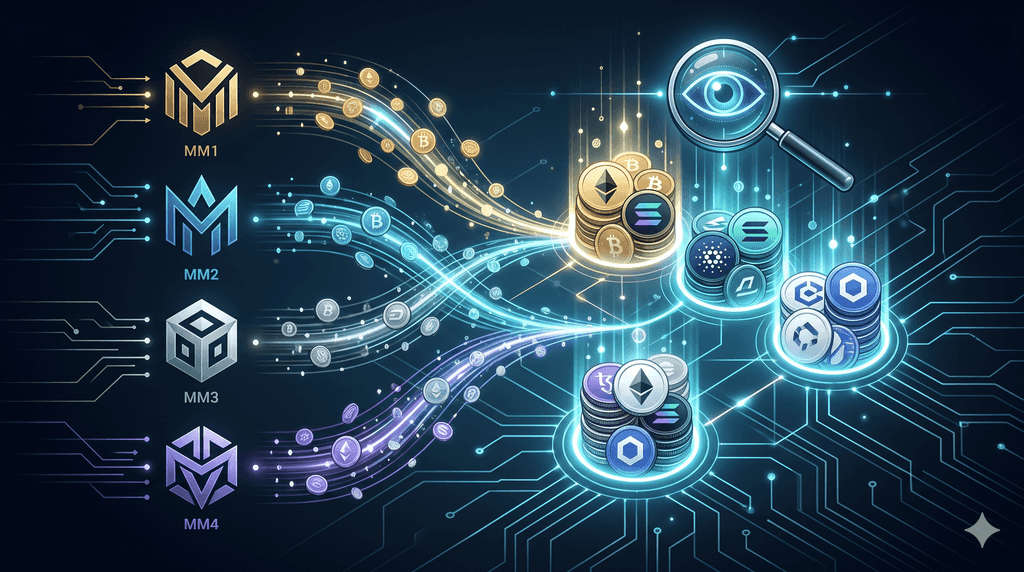
Here is the most useful signal in crypto that most retail traders completely ignore: firms like Wintermute execute around $15 billion in daily trading volume, covering 65+ trading venues and supporting 150+ token liquidity partnerships. At that scale, these firms are not simply providing order-book depth — they are co-investing in, incubating, and accumulating the tokens they believe will dominate the next cycle.
Market makers see the order books, the institutional OTC deals, the pre-listing token flows, and the on-chain wallet movements before almost anyone else. When Wintermute seeds a new DeFi protocol, when DWF Labs backs a token with a $75 million fund, when GSR launches a Solana ETF, and when Jump Crypto commits engineers to rebuilding Solana's validator client — these are not passive liquidity plays. They are high-conviction conviction bets on the altcoins they expect to lead the market.
Here is what the top four market makers are betting on right now.
Key Takeaways
-
The top four crypto market makers in 2026 are Wintermute, DWF Labs, GSR Markets, and Jump Crypto/Cumberland — each with distinct investment philosophies and altcoin positioning.
-
Wintermute's 110+ venture portfolio includes Solana, Ondo Finance, Aave, Starknet, and Euler — a deep bias toward infrastructure and liquid restaking narratives.
-
DWF Labs launched a $75 million DeFi fund targeting Ethereum, Solana, BNB Chain, and Base — betting on dark pool DEXs, yield protocols, and on-chain lending.
-
GSR launched the BESO ETF on Nasdaq, giving it direct regulated exposure to BTC, ETH, and SOL with staking yield — signaling SOL as an institutional-grade asset.
-
Jump Crypto is backing Hyperliquid, Pyth Network, Solana, and Aptos — with engineers actively rebuilding Solana's validator client (Firedancer) to keep it competitive.
-
Hyperliquid (HYPE), Solana (SOL), Bittensor (TAO), and Ondo Finance (ONDO) are the tokens with the most concentrated market maker overlap in 2026.
Why Following Market Makers Works as a Strategy
Market Makers Are the First Money In — and the Most Informed
Market makers are uniquely positioned at the intersection of every capital flow in crypto: institutional OTC desk orders, pre-listing token allocations, DEX liquidity seeding, and governance participation. Their investment decisions are informed by data that no retail trader has access to.
By 2026, crypto market makers are everywhere and play a key role in keeping markets running across centralized exchanges, DeFi platforms, and tokenized assets. Market making will become more regulated, work across more venues, use more AI, and be closely linked to real-world assets.
When a top-tier market maker takes a liquidity partnership and simultaneously makes a venture investment in the same token, it creates a structural alignment of incentives. The firm wants that token to succeed — and it has the tools, relationships, and capital to help make that happen. That combination makes their public investments worth tracking closely.
The 2026 Context: Liquidity Concentration and Selective Altcoins
Wintermute's January 2026 OTC Markets Report revealed a fundamental shift: trading activity clustered around BTC, ETH, and a narrow group of large-cap tokens. Capital became increasingly "trapped" in institutional channels, reinforcing depth at the top while limiting spillover into altcoins. The average altcoin rally lasted approximately 19 days in 2025, down from 61 days in 2024, reflecting reduced follow-through.
This is the critical context for tracking market maker bets. In a market where broad altcoin seasons are compressed and capital is selectively concentrated, the altcoins that market makers are actively backing have a structural liquidity advantage over the rest of the field.
Market Maker #1: Wintermute — The DeFi Infrastructure Bet
Who Wintermute Is Backing
Wintermute is the world's largest crypto-native algorithmic market maker, and its venture portfolio of 110+ investments is the clearest public signal of where its conviction lies.
Wintermute's key clients and partnerships include Solana, Binance, 1inch, Zerion, Optimism, Ondo Finance, Flare, Euler, Aave, and Starknet. The pattern across these names is unmistakable: Wintermute is betting on liquid restaking, DeFi lending infrastructure, Ethereum scaling, and RWA tokenization — all the structural narratives that institutional capital is flowing into.
Ondo Finance is particularly significant. By early 2026, Ondo's total value locked had grown significantly, with its combined OUSG and USDY offerings surpassing $2.5 billion and continuing to attract steady inflows. Much of this activity flows through or alongside BlackRock's BUIDL as an underlying holding. Wintermute providing liquidity for Ondo while simultaneously participating as a venture partner creates the kind of symbiotic relationship that tends to produce sustained price support.
Wintermute's Market Outlook for 2026 Altcoins
Wintermute identifies three conditions that could kickstart an altcoin boom in 2026: expansion of ETF and DAT mandates beyond majors, strong Bitcoin/ETH performance creating wealth effects, and a return of retail mindshare to crypto.
In 2026, outcomes will depend on whether one of these catalysts meaningfully broadens liquidity beyond a handful of large-cap assets, or whether concentration persists. Wintermute is effectively telling the market that only a handful of altcoins — specifically those with institutional-grade liquidity, real revenue, or ETF eligibility — are positioned to benefit even in the best-case scenario.
Market Maker #2: DWF Labs — The DeFi Structural Problem Bet
The $75 Million DeFi Conviction Fund
DWF Labs is one of the most active market makers in terms of direct token investment, and its 2026 positioning is the most explicitly thematic of any firm in this list.
DWF Labs launched a $75 million DeFi-focused investment fund targeting projects building on Ethereum, BNB Chain, Solana, and Base. The fund is set up to invest in founders who are "solving real structural problems in liquidity, settlement, credit, and on-chain risk management," including dark pool DEXs and yield products.
DWF co-founder Andrei Grachev was specific about his investment framework. When evaluating a crypto project, DWF Labs looks at whether it can compete in trading, lending and money markets, payments, investments, infrastructure, and yield — "enduring narratives" that will matter across cycles. "The token should enhance the product, not be the product itself," Grachev stressed, citing Hyperliquid as an example where people were actively trading on the platform before the token existed.
DWF Labs' Structural Token Picks
DWF Labs is more focused on investing in developing Web3 projects, incubating them, and helping them grow rather than buying tokens simply because prices have fallen. Institutions, structured products, better UX, and a cleaner market after the leverage flush — together, that is the real catalyst they are betting on.
The explicit endorsement of Hyperliquid's model — real usage before token, not token before usage — aligns DWF's conviction with HYPE as a structural pick. Combined with the fund's focus on Solana-native DeFi infrastructure, DWF's public investment thesis points directly toward HYPE, SOL, and dark pool/yield protocol tokens emerging on Base and BNB Chain.
Market Maker #3: GSR Markets — The Regulated Institutional Bet
GSR's ETF Move: The Loudest Signal of the Year
GSR made the single most explicit public signal of any market maker in 2026 when it launched a regulated ETF product directly tied to its institutional conviction.
GSR launched its first exchange-traded fund on Nasdaq — the GSR Crypto Core3 ETF, trading under the ticker BESO — giving investors actively managed exposure to Bitcoin, Ethereum, and Solana, along with staking rewards from its ETH and SOL holdings. The management fee is set at 1.00% with weekly rebalancing using research-driven signals. GSR CEO Xin Song said the firm spent over a decade building efficient crypto markets, and Core3 extends that expertise to a broader range of investors.
The decision to include SOL alongside BTC and ETH — and to incorporate staking yield as a structural feature — is the clearest institutional validation that Solana has achieved blue-chip status in the eyes of one of crypto's most experienced market makers.
Solana is no longer treated purely as a speculative altcoin. It now sits inside regulated ETF products and publicly traded treasury strategies worth close to a billion dollars in combined SOL holdings. As crypto ETF competition grows and staking yield becomes a differentiator, SOL's role as a yield-generating institutional asset looks increasingly well established.
GSR's Broader Portfolio: EtherFi, Ethena, and Ripple
GSR has backed and invested in 300+ crypto companies, including Coinlist, Hashwave, Arkham, EtherFi, and Maple Finance, supporting multiple institutional-grade DeFi protocols. GSR's client list also includes Ripple, Ethena Labs, Sei, Kiln, and EtherFi — indicating meaningful positioning in liquid restaking (EtherFi), institutional stablecoins (Ethena), and cross-border settlement (Ripple/XRP).
Market Maker #4: Jump Crypto/Cumberland — The Infrastructure Architecture Bet
Jump's Unique Position: They Are Rebuilding Solana
Jump Crypto stands apart from every other market maker because it is not just trading and investing in altcoins — it is actively engineering the blockchain infrastructure those altcoins run on.
Jump's team of engineers actively builds blockchain software. Key projects include Firedancer — rewriting Solana's validator client for performance gains — done in partnership with the Solana Foundation. Jump provides continuous liquidity on major exchanges and has historically provided substantial liquidity on Solana's Serum DEX, Ethereum's Uniswap v3, and Solana's OpenBook and Phoenix post-FTX.
This is an extraordinary commitment. A market maker investing engineering resources to rebuild a blockchain's core validation software is not making a trading bet — it is making a multi-year infrastructure bet on that blockchain's success. Solana is Jump's most explicit altcoin conviction play of the cycle.
Jump Crypto provides liquidity for projects like Solana, Aptos, and Pyth Network. Its investment focus covers Layer 1 blockchains, DeFi, NFTs, and infrastructure, with notable investments in Solana ecosystem projects including Wormhole, Pyth, and Sei.
Cumberland's ETH and Institutional DeFi Play
Cumberland, Jump's sister firm under DRW, focuses on institutional OTC rather than venture bets — but its asset coverage signals where institutional demand is concentrated.
Grayscale's 2026 Digital Asset Outlook — widely read by institutional market makers — expects core DeFi protocols to benefit including lending platforms like AAVE, decentralized exchanges like UNI and HYPE, and related infrastructure like LINK, as well as the blockchains processing the most tokenized asset transactions.
Cumberland's institutional OTC desk serving the largest buyers in ETH, SOL, and major DeFi governance tokens is directionally aligned with this institutional conviction map.
The Market Maker Altcoin Consensus Table
| Altcoin | Market Maker Backing | Core Thesis |
| SOL | GSR (BESO ETF), Jump (Firedancer), Wintermute | Institutional-grade L1, staking yield, ETF product anchor |
| HYPE | DWF Labs (model endorsement), institutional overlap | #1 perp DEX, 97% fee buybacks, oil/commodity perpetuals |
| ONDO | Wintermute (LP + venture), GSR (institutional yield) | RWA tokenization leader, BlackRock integration |
| AAVE | Wintermute (venture), Cumberland (OTC depth), GSR | DeFi lending blue chip, $20B+ TVL, institutional DeFi |
| TAO (Bittensor) | Jump (AI infrastructure thesis), DWF (structural bets) | Decentralized AI layer, cycles with AI narrative |
Trade Smart Money Altcoins on KuCoin
Following the market makers' altcoin bets is only useful if you have the infrastructure to act on those signals with precision. KuCoin offers deep spot and futures markets across every token on the market maker conviction map above — SOL, HYPE, ONDO, AAVE, and TAO — with professional execution tools that put retail traders on equal footing with institutional order flow.
KuCoin's grid trading bots, dollar-cost averaging plans, and real-time market depth analytics make it possible to build positions in market-maker-backed altcoins systematically, without relying on perfect timing. The average altcoin rally lasted approximately 19 days in 2025 — in a market that moves this fast, having the right tools to execute and exit efficiently is not optional. Whether you are accumulating SOL as a staking yield play or positioning in HYPE ahead of a potential spot ETF approval, KuCoin's altcoin liquidity depth and automated trading tools give you a structured advantage.
💡 Tips: New to crypto? KuCoin's Knowledge Base has everything you need to get started.
Conclusion
Following smart money in 2026 means tracking the public signals of the four most powerful liquidity firms in crypto: Wintermute, DWF Labs, GSR Markets, and Jump Crypto/Cumberland. Their altcoin bets are not speculation — they are informed, well-resourced conviction plays backed by order book data, venture capital commitments, and in Jump's case, actual engineering work.
The altcoin market has fundamentally changed. Liquidity is increasingly selective, with more structured execution and concentrated risk. The four-year cycle has been replaced by a regime where only tokens with institutional-grade liquidity, real protocol revenue, or ETF eligibility attract sustained market maker support.
The overlapping consensus across all four firms points to five names: SOL (the institutional-grade L1 with staking yield and ETF coverage), HYPE (the highest-revenue DeFi protocol with aggressive token buybacks), ONDO (the RWA tokenization leader with BlackRock backing), AAVE (the DeFi lending blue chip), and TAO (the AI infrastructure play for the next cycle narrative). None of these are sure bets — every altcoin carries significant risk. But in a market where capital is selectively concentrated, positioning alongside the firms moving the most money is the closest thing to an informed edge that retail traders can get.
FAQs
How can retail traders track market maker on-chain movements in real time?
The practical way to track crypto market makers is to combine on-chain wallet tracking with live order-book and trade data from exchanges. Tools such as Arkham and Nansen help identify labeled wallets. Arkham Intelligence specifically labels known market maker wallets across Ethereum, Solana, and other chains, allowing you to monitor inflows, outflows, and new token accumulation in near-real time.
What is the difference between a market maker's liquidity provision and its venture investment?
Liquidity provision means a market maker places continuous buy and sell orders on an exchange for a token — earning the bid-ask spread. A venture investment means the market maker buys a token at early-stage pricing with the intention of holding for capital appreciation. Wintermute offers a diversified stack that includes DeFi market making, OTC trading, algorithmic trading, and a venture division with 110+ portfolio investments. When both are present simultaneously, the market maker has financial incentives to support the token's price and ecosystem.
Is DWF Labs considered as reputable as Wintermute or GSR?
DWF Labs is one of the most active market makers and venture investors in crypto but has faced more scrutiny than its peers. The Wall Street Journal reported that Binance's internal market-surveillance team investigated DWF Labs after complaints from other market maker firms and concluded the firm engaged in wash trading practices. Rival market makers including GSR and Wintermute have publicly questioned DWF's practices. Traders should factor this context in when evaluating DWF-backed tokens: the firm has deal flow and capital, but its investment structures and trading practices carry more controversy than those of Wintermute or GSR.
Why is Hyperliquid considered a strong market maker conviction bet despite having no VC funding?
Hyperliquid has $6.2 billion in TVL with no VC funding — entirely community-bootstrapped. As of April 2026, Hyperliquid alone shows 24-hour trading volume of approximately $21.8 billion and open interest of almost $7.3 billion. Market makers backing HYPE are betting on its revenue model — where 97% of fees fund token buybacks — rather than on venture returns. This makes HYPE unusual: it earns market maker support through pure platform utility rather than structured deals.
How does the Firedancer upgrade affect Jump Crypto's Solana bet?
Jump Crypto is rewriting Solana's validator client (Firedancer) in partnership with the Solana Foundation, contributing the code open-source. Firedancer dramatically increases Solana's throughput and reliability — which directly benefits Jump's trading infrastructure, reduces network congestion during peak meme/DeFi seasons, and makes SOL more attractive as an institutional asset. Jump is not just betting on SOL's price; it is building the infrastructure that makes Solana competitive against Ethereum for years to come.
Disclaimer: This article is for informational purposes only and does not constitute financial or investment advice. Cryptocurrency investments carry significant risk. Always conduct your own research before trading.