

Top 10 Bitcoin Mining Machines: Energy Efficiency and Shutdown Cost Comparison
2026/06/12 17:24:00
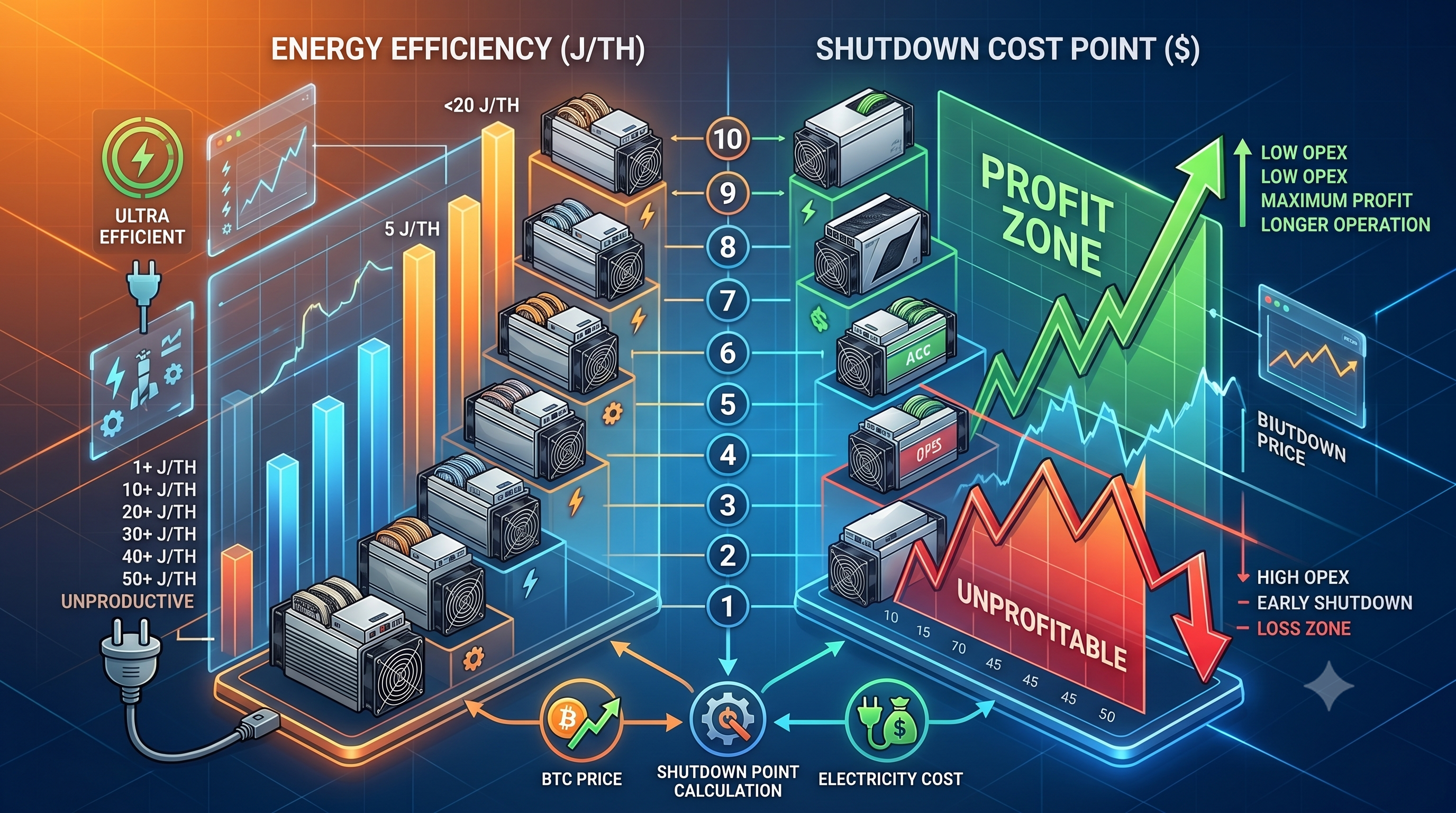
The Bitcoin mining landscape is defined by raw numbers. In today's highly competitive network, guessing your margins is a recipe for failure. As difficulty adjustments climb and block rewards compress, the boundary between an enterprise generating massive capital and one facing forced liquidation comes down to math. The absolute baseline for survival is understanding the correlation between Energy Efficiency (J/TH) and your Shutdown Price. If your hardware cannot deliver hashes at an operational cost lower than the spot price of Bitcoin, your rigs become nothing more than expensive space heaters.
This guide provides a strictly data-driven comparative analysis profiling the top 10 ASIC miners on the market. By calculating concrete operational limits, we reveal exactly which machines will survive the next market dip and which ones are vulnerable to immediate closure.
The Core Metrics: Energy Efficiency vs. Shutdown Price
Before analyzing specific hardware, we must clarify the two fundamental metrics that govern mining viability:
-
Energy Efficiency (J/TH): Joules per Terahash is the true heartbeat of profitability. It measures the electrical energy (Joules, which equals Watts per second) consumed to produce one Terahash of computing power. Lower is always better. A lower J/TH rating means the machine extracts more cryptographic security out of every single kilowatt-hour (kWh) consumed.
-
Shutdown Price: This is the critical baseline threshold. It represents the exact BTC market price where daily mining revenue perfectly equals daily electricity costs. If the live market price of Bitcoin drops even a single dollar below this threshold, the miner is losing money for every second the machine remains turned on.
Data Insights: The Top 10 Bitcoin Miners Comparative Chart
The following data reflects performance metrics compiled for top-tier ASIC miners.
Baseline Assumptions for Calculations:
-
Global Electricity Cost: $0.06 per kWh (standard competitive industrial rate).
-
Network Difficulty & Hashrate Projections: Adjusted to mid-2026 baseline network conditions ($0.045 estimated daily revenue per TH/s at current network density).
-
Note: Estimated Shutdown Prices fluctuate dynamically based on network-wide difficulty shifts.
| Miner Model | Hashrate (TH/s) | Energy Efficiency (J/TH) | Estimated Shutdown Price (BTC) | Risk Level |
| Bitmain Antminer U3S23H | 230 TH/s | Sub-12.0 J/TH (~11.5) | ~$22,500 | Extremely Low |
| Bitmain Antminer S21 XP Hydro | 473 TH/s | 12.0 J/TH | ~$23,400 | Extremely Low |
| Bitdeer SealMiner A3 Pro Hydro | 660–690 TH/s | 12.5 J/TH | ~$24,400 | Very Low |
| Bitmain Antminer S23 Hyd | 505 TH/s | 13.0 J/TH | ~$25,350 | Very Low |
| Bitmain Antminer S21 XP (Air) | 270 TH/s | 13.5 J/TH | ~$26,300 | Low |
| Bitdeer SealMiner A2 Pro | 255 TH/s | 14.9 J/TH | ~$29,050 | Moderate |
| MicroBT WhatsMiner M79S | 440 TH/s | 14.9 J/TH | ~$29,050 | Moderate |
| Canaan Avalon A16XP | 315 TH/s | 15.0 J/TH | ~$29,250 | Moderate |
| MicroBT WhatsMiner M70S+ | 240 TH/s | 16.0 J/TH | ~$31,200 | High |
| Canaan Avalon A1566HA | 480 TH/s | 16.8 J/TH | ~$32,750 | High |
Shutdown Price & Efficiency Profile for Each Top Miner
-
Bitmain Antminer U3S23H
Key Data: 230 TH/s | Sub-12 J/TH (~11.5 J/TH) | Hydro-Cooled
Data Insight: Breaking the 12 J/TH barrier sets an entirely new industry standard. By driving power consumption down to an ultra-efficient window, the U3S23H guarantees the lowest shutdown price on this list. This makes it the safest, most resilient digital asset for next-generation data centers looking to insulate themselves completely from devastating bear market contractions.
-
Bitmain Antminer S21 XP Hydro
Key Data: 473 TH/s | 12.0 J/TH | Liquid-Cooled
Data Insight: Liquid cooling allows this unit to maintain a strict, unyielding 12.0 J/TH efficiency curve. It anchors its shutdown price at an extremely safe level (sub-$24,000). For institutional miners deploying high-capital allocations alongside low-cost power agreements, this rig offers a perfect blend of high-density output and elite risk mitigation.
-
Bitdeer SealMiner A3 Pro Hydro
Key Data: 660–690 TH/s | 12.5 J/TH | Hydro-Cooled
Data Insight: The data correlation between a massive, near-700 TH/s output combined with a highly competitive 12.5 J/TH tier is a massive achievement for hardware diversification. The SealMiner A3 Pro Hydro heavily impacts enterprise risk modeling, offering massive computing blocks while keeping the economic shutdown floor low enough to challenge Bitmain's historic monopoly.
-
Bitmain Antminer S23 Hyd
Key Data: 505 TH/s | 13.0 J/TH | Hydro-Cooled
Data Insight: Built to sustain extreme operational uptime, this model focuses on maximizing daily profit margins for massive industrial-scale deployments. Its 13.0 J/TH efficiency ensures that even if network difficulty spikes aggressively, the unit retains an incredibly safe cushion above its operational shutdown threshold.
-
Bitmain Antminer S21 XP (Air-Cooled)
Key Data: 270 TH/s | ~13.5 J/TH | Forced-Air
Data Insight: This model highlights the classic infrastructure trade-off. While it sacrifices a bit of efficiency compared to its hydro-cooled siblings, it delivers the absolute best shutdown price protection available for standard forced-air setups. It allows operators to sit comfortably in the low-risk tier without incurring the massive plumbing, radiator, and fluid-management capex of hydro facilities.
-
Bitdeer SealMiner A2 Pro
Key Data: 255 TH/s | 14.9 J/TH | Air-Cooled
Data Insight: Breaking down the math on a 14.9 J/TH rating positions this machine on the threshold of the moderate-risk tier. While its shutdown price is vulnerable to sudden macro drops, its affordable upfront hardware cost offers an excellent, reliable path to rapid ROI for mid-tier commercial operations running stable, low-cost utility power.
-
MicroBT WhatsMiner M79S
Key Data: High-Density Output | <15.0 J/TH | Hydro-Cooled
Data Insight: Known for legendary structural durability, this hydro rig brings sub-15 J/TH efficiency into high-density environments. When calculating shutdown margins, its ability to run continuously in harsh industrial settings without overheating keeps real-world operational costs highly predictable.
-
Canaan Avalon A16XP
Key Data: High-Yield Output | Sub-15 J/TH | Advanced Air Management
Data Insight: Canaan's specialized air-redirection engineering allows the A16XP to maintain sub-15 J/TH performance even when ambient data center temperatures spike. By preventing thermal throttling, it maintains a highly stable, predictable shutdown price in challenging regional climates like West Texas or the Middle East.
-
MicroBT WhatsMiner M70S+
Key Data: Advanced Mid-Gen | ~16.0 J/TH | Air-Cooled
Data Insight: Looking closely at the numbers, the shutdown price rises significantly once you hit 16.0 J/TH. At this efficiency tier, profitability becomes highly sensitive to energy prices. This machine is best deployed by operators specializing in grid-balancing or demand-response programs, where they can utilize ultra-cheap, excess curtailed power.
-
Canaan Avalon A1566HA
Key Data: 480 TH/s | 16.8 J/TH | Air/Hydro Hybrid
Data Insight: Having the highest J/TH rating on this list means carrying the highest shutdown price—making it highly vulnerable to prolonged market drops. However, its economic advantage lies in its incredibly low Capex footprint (historically tracking around $10.60/TH). This makes it a highly calculated choice for short-term, budget-conscious expansions when mining margins are temporarily wide.
The Mathematics of Survival: Calculating the Shutdown Price
To run a truly resilient mining operation, you must move away from generic estimates and calculate your own local operational metrics.
The formal mathematical equation used to calculate your exact Bitcoin shutdown price is:
Shutdown Price = (Energy Efficiency * 24 * Electricity Cost) / (Revenue per TH * 1000)
Where:
-
Energy Efficiency = The machine's actual energy efficiency measured in Joules per Terahash (J/TH).
-
24 = Total hours in a single operational day.
-
Electricity Cost = Your all-in local electricity cost per kilowatt-hour ($/kWh), including transmission fees and taxes.
-
Revenue per TH = The current daily Bitcoin revenue generated per Terahash of hashing power (expressed in decimal BTC/TH/day).
-
1000 = Metric conversion factor converting kilowatts to watts.
Real-World Scenario Example:
Let us compare two vastly different machines—the Canaan Avalon A1566HA (16.8 J/TH) and the Antminer S21 XP Hydro (12.0 J/TH)—running at a fixed commercial electricity rate of $0.07/kWh.
-
Antminer S21 XP Hydro: Utilizing 12.0 J/TH at $0.07/kWh keeps its real-world operational floor exceptionally low. It can comfortably mine straight through market crashes that bankrupt other operations.
-
Avalon A1566HA: Utilizing 16.8 J/TH at $0.07/kWh pushes its operational costs up significantly. It burns through an additional 40% in daily power expenses to generate the exact same volume of hashes as the S21 XP Hydro.
If the price of Bitcoin slides below the Avalon's elevated shutdown line, the operator must switch off the Avalon units completely, while the S21 XP Hydro units continue to safely generate profit.
Capex vs. Opex: Does the Lowest Shutdown Price Guarantee the Best ROI?
It is tempting to assume that acquiring the machine with the absolute lowest shutdown price automatically guarantees the best Return on Investment (ROI). However, enterprise mining is a high-stakes balancing act between Capital Expenditures (Capex)—the upfront cost of the hardware and facility infrastructure—and Operating Expenses (Opex)—your ongoing electricity and maintenance costs.
-
The Efficiency Premium: Ultra-efficient hardware, such as the Antminer U3S23H or the SealMiner A3 Pro Hydro, commands a massive premium on the open market. While your daily operational costs (Opex) are minimized and your shutdown price remains incredibly safe, recovering that massive initial Capex takes significantly longer.
-
The Bull Market Budget Strategy: Mid-tier efficiency machines, like the Avalon A1566HA, allow you to acquire drastically more total hashrate for the exact same initial investment. During a raging bull market, when the spot price of Bitcoin is soaring high above everyone's shutdown threshold, these lower-Capex machines will actually reach break-even (100% ROI) much faster.
-
The Bear Market Reality: When market sentiment shifts and a deep bear market takes hold, the dynamic violently flips. Operators of cheap, inefficient hardware are forced to unplug and generate zero revenue. Meanwhile, the operators who paid the Capex premium for high-efficiency rigs keep their machines running. Alternatively, for investors looking to bypass massive hardware Capex and maintenance entirely, utilizing a reliable ecosystem like KuMining offers a streamlined way to participate in network rewards without managing physical infrastructure.
Ultimately, your optimal ROI relies heavily on your specific Power Purchase Agreement (PPA). If your facility has access to ultra-cheap, sub-$0.03/kWh power, paying top dollar for sub-12.0 J/TH efficiency is an inefficient use of capital.
Beyond the Spec Sheet: Real-World Factors That Alter Your Shutdown Price
Manufacturer specifications are established in perfectly climate-controlled testing laboratories. On the ground, your actual shutdown price is a moving target, heavily influenced by environmental and operational realities.
-
Thermal Degradation: Running air-cooled hardware in extreme ambient temperatures (such as summer in Texas or the UAE) forces the machine's internal fans to run at maximum RPM, drawing significant extra wattage. This drastically worsens your actual J/TH efficiency and pushes your operational shutdown price higher than the spec sheet claims.
-
Firmware Optimization: Savvy operators utilize aftermarket autotuning firmware (like Braiins OS or Vnish). This allows miners to "underclock" their chips—intentionally dropping the total TH/s output to achieve a significantly better J/TH efficiency. This is a vital survival tactic to artificially lower a machine's shutdown price during a bear market.
-
Uptime and Grid Curtailment: Many industrial miners utilize demand-response programs, voluntarily turning off their machines when the local power grid is stressed. While this earns energy credits and lowers average power costs, frequent downtime reduces total hash volume, altering the mathematical baseline of your break-even point.
-
Hardware Aging: Silicon degrades over time. A machine that clocks exactly 13.5 J/TH out of the box will naturally experience "efficiency drift" as thermal paste dries, heat sinks clog with dust, and internal components age.
Conclusion:
The Bitcoin mining landscape of 2026 takes no prisoners. As the network's global hashrate and difficulty continue their relentless upward trajectory, operational margins are razor-thin. The comparative data clearly proves that the baseline for long-term survival has firmly shifted into the 12.0 to 13.0 J/TH range for top-tier operations.
Operators who ignore their hardware's specific shutdown thresholds are flying blind into a storm. Whether you deploy capital into the hydro-cooled supremacy of Bitmain's U3S23H or optimize for the high-yield, low-Capex advantage of Canaan’s air-cooled fleet, your survival depends entirely on aligning your hardware’s efficiency curve with your local power costs. Do the math, calculate your exact shutdown floor, and build a fleet engineered to weather any market cycle.
Frequently Asked Questions (FAQs)
What happens to my shutdown price during a Bitcoin network halving?
Because a halving cuts the network block reward by precisely 50%, your daily revenue per terahash is slashed in half (assuming network difficulty and BTC spot price remain static). Mathematically, this instantly doubles your shutdown price, rendering older, inefficient hardware immediately unprofitable.
Can I lower my shutdown price without buying brand-new hardware?
Yes. You have three primary levers: aggressively negotiating lower electricity rates, relocating your hardware to regions with cheap "stranded" energy, or utilizing custom autotuning firmware. Firmware allows you to underclock the ASIC chips, notably improving your J/TH efficiency at the expense of total hashrate output.
Why do hydro-cooled miners have better efficiency and lower shutdown prices than air-cooled miners?
Liquid transfers thermal energy exponentially better than forced air. Hydro-cooling completely eliminates the need for the massive, power-hungry cooling fans attached to standard miners. Furthermore, liquid cooling keeps the silicon hashing chips at a lower, much more stable operating temperature, allowing them to process cryptographic hashes with less electrical resistance.
How does network difficulty impact my calculated shutdown price over time?
As network difficulty rises, your daily Bitcoin revenue per Terahash drops. Because you earn less BTC for the same electrical cost, your shutdown price automatically increases, even if your power rates and hardware remain unchanged.
Should I immediately turn off my machines the moment the spot price hits my shutdown threshold?
Not always. Frequently turning machines on and off causes thermal stress that can crack delicate hashboards. Additionally, if you are locked into a "take-or-pay" power contract, running at a slight loss is often cheaper than paying for electricity you aren't using.
How do mining pool fees and transaction fee spikes alter the baseline shutdown math?
Mining pool fees (typically 1–3%) reduce your net payout, which slightly increases your shutdown price. Conversely, when network congestion causes transaction fees to spike, your daily revenue jumps, temporarily lowering your shutdown price and providing a financial buffer.
Disclaim: This article is for informational purposes only and does not constitute financial or investment advice. Cryptocurrency investments carry significant risk. Always conduct your own research before trading.