

Q1 2026 Big Tech Earnings: How AI Investments Paid Off for Microsoft, Alphabet, Meta & Amazon
Introduction
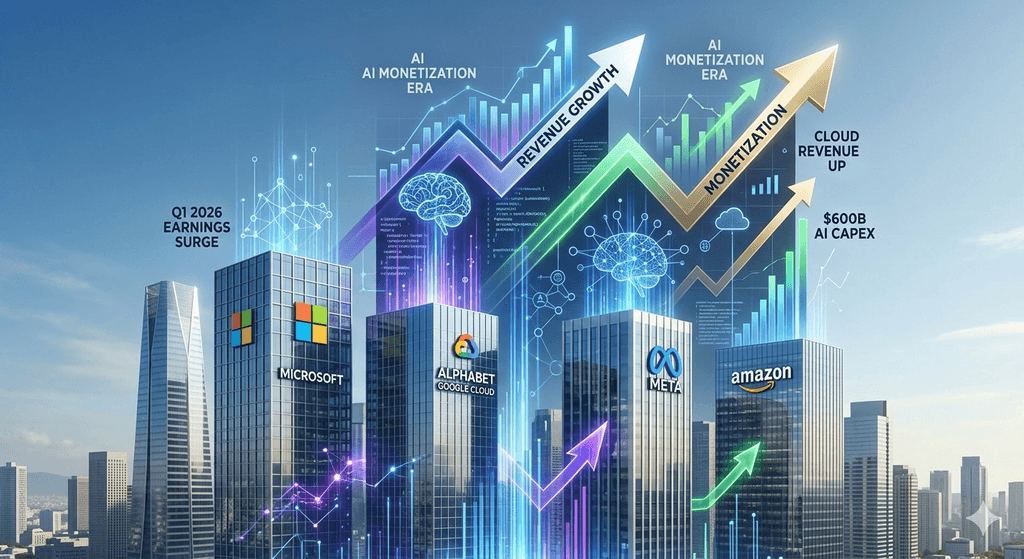
Big Tech's aggressive pivot toward artificial intelligence has transitioned from a speculative venture into a primary revenue driver, as evidenced by the massive Q1 2026 earnings reports. According to recent market data as of April 30, 2026, Microsoft, Alphabet, and Meta all reported significant revenue surges directly attributed to AI integration in cloud services and digital advertising.
While the "Magnificent Seven" are projected to spend a staggering $600 billion in AI capital expenditure (Capex) throughout 2026, the initial quarterly results suggest that these investments are finally generating the high-margin returns investors demanded. Microsoft saw its revenue climb to $81.3 billion, while Meta’s AI-generated video ads reached a $10 billion annual run-rate. This shift marks the end of the "AI hype" phase and the beginning of the "AI monetization" era, where tangible growth metrics now justify the historic spending levels seen across the Silicon Valley landscape.
Microsoft’s Cloud Dominance Driven by Generative AI
Microsoft’s fiscal Q2 2026 results confirm that Azure remains the primary beneficiary of enterprise AI adoption, with cloud revenue exceeding all previous analyst projections. Based on the official earnings report released in early 2026, Microsoft generated $81.3 billion in total revenue, representing a 17% year-over-year increase. The core of this growth was the Azure cloud platform, which, along with other cloud services, is expected to maintain a growth rate of 39% to 40% throughout the next quarter. This acceleration is almost entirely fueled by the integration of OpenAI’s models and Microsoft’s proprietary Copilot features across its commercial stack.
The company’s adjusted earnings per share (EPS) reached $4.14, signaling that Microsoft is successfully managing the high costs of infrastructure while maintaining profitability. According to Reuters, Microsoft’s Q3 2026 revenue guidance is set between $80.7 billion and $81.8 billion, suggesting a sustained upward trajectory. Investors are no longer looking for proof of concept; they are looking at the 40% cloud growth as a benchmark for how AI can scale traditional SaaS (Software as a Service) businesses into high-performance computing powerhouses.
Microsoft’s capital allocation strategy has prioritized data center expansion to meet the insatiable demand for AI training and inference. By securing long-term partnerships and investing heavily in hardware, the company has positioned itself as the essential "toll booth" for the AI economy. According to market analysts, the synergy between Microsoft’s productivity software and its cloud infrastructure has created a flywheel effect where AI features drive software renewals, which in turn drive higher Azure consumption.
Alphabet’s Google Cloud Reaches New Heights
Alphabet’s Q1 2026 performance silenced skeptics by demonstrating that Google Cloud has become a formidable profit center through AI-optimized infrastructure. Alphabet shares rose 4% following its April 2026 report, which beat both top and bottom-line estimates across the board. The standout figure was Google Cloud revenue, which reached $18.4 billion, reflecting an approximate 49.6% year-over-year growth rate. This surge highlights how enterprises are migrating to Google’s ecosystem to leverage its Gemini AI models and specialized Vertex AI development platform.
Alphabet’s earnings per share (EPS) stood at $2.64, marking a 5.2% increase since January 2026 estimates, according to Yahoo Finance Canada. The company’s ability to grow its cloud division at nearly 50% year-over-year indicates that it is successfully capturing market share from competitors by offering superior AI integration for developers. While Google Search remains the primary revenue engine, the cloud division's rapid scaling provides a necessary cushion against potential shifts in search behavior driven by AI-powered chatbots.
The company has successfully balanced its traditional advertising business with its emerging AI services. By embedding generative AI features directly into Google Search and YouTube, Alphabet has maintained its dominance in the attention economy while simultaneously building the infrastructure needed for the next generation of the web. Based on recent earnings calls, Alphabet’s management remains committed to aggressive AI spending, viewing the current cycle as a critical period for establishing long-term technological leadership.
Meta’s $10 Billion AI Advertising Success
Meta Platforms has effectively utilized AI to revitalize its advertising ecosystem, leading to a 24% year-over-year revenue increase in Q1 2026. According to the April 2026 financial disclosure, Meta’s revenue climbed to $59.9 billion, driven by an 18% growth in ad impressions and a 6% increase in the average price per ad. The most significant milestone reported was that AI-generated video ads—specifically those used in Reels and automated campaigns—have reached an annual run-rate of $10 billion.
This performance demonstrates that Meta’s heavy investment in recommendation algorithms and generative creative tools is yielding immediate financial benefits for advertisers. By using AI to predict user preferences more accurately and automate the creation of high-performing ad content, Meta has increased the efficiency of its platform. This technological edge has allowed Meta to maintain high growth even as the global digital advertising market becomes increasingly competitive and regulated.
However, Meta’s growth comes with a substantial price tag in the form of capital expenditure. The company’s 2026 Capex guidance is set between $115 billion and $135 billion, which represents a massive 67% to 97% increase compared to 2025 levels. Based on Yahoo Finance Singapore reports, Mark Zuckerberg’s strategy involves building the world’s most advanced AI infrastructure to power both current social media products and future "Metaverse" or "AI Agent" initiatives. While the spending is unprecedented, the $10 billion AI ad run-rate provides a clear "proof of payout" that has satisfied Wall Street for the time being.
Amazon’s AWS and Retail Resilience
Amazon’s Q1 2026 results showcased steady growth in its AWS cloud division and retail sectors, though investor reaction was tempered by the company’s massive capital expenditure plans. Despite positive earnings, Amazon’s stock fell 1.5% as the market reacted to the costs associated with maintaining its logistics and AI infrastructure. According to Yahoo Finance, Amazon’s sales grew 14.3% year-over-year, while earnings growth remained modest at 1.3%, reflecting the thin margins and high reinvestment rates currently defining the company’s operations.
The AWS (Amazon Web Services) division remains the primary driver of market sentiment for Amazon. As businesses shift their workloads to the cloud to take advantage of AI training capabilities, AWS has seen a resurgence in demand. Amazon has responded by doubling down on custom silicon chips, such as Trainium and Inferentia, to lower the costs of running AI models for its clients. This vertical integration is a key component of Amazon's strategy to maintain its lead in the cloud infrastructure market.
In the retail space, AI has played a critical role in optimizing supply chains and personalizing the shopping experience. Amazon’s ability to deliver goods faster and more efficiently than competitors is increasingly dependent on AI-driven logistics. However, the high costs of 2026 Capex guidance suggest that Amazon is in a heavy build-out phase. According to analysts, the focus for Amazon in the coming quarters will be proving that its AI investments can improve the profitability of its retail segment as effectively as they have for AWS.
The $600 Billion AI Capex Trend in 2026
The "Magnificent Seven" tech giants are on track to spend a combined $600 billion on AI-related capital expenditures in 2026, marking the largest infrastructure build-out in corporate history. This level of spending reflects a collective belief among Big Tech leaders that the window to secure AI leadership is narrow and requires massive upfront investment. Based on data from Yahoo Finance, this spending is primarily directed toward high-end GPUs, specialized data centers, and power infrastructure required to run large language models (LLMs).
This massive capital outlay has shifted the investor narrative from "AI potential" to "AI discipline." While the Q1 2026 earnings were largely positive, the sheer volume of spending has created a high bar for future performance. The market is now closely monitoring the Return on Invested Capital (ROIC) for these firms. According to recent financial analysis, the divergence between companies that can monetize AI (like Microsoft and Meta) and those still in the "spending phase" is becoming more pronounced.
| Company | Q1 2026 Revenue | YoY Revenue Growth | Key AI Metric |
| Microsoft | $81.3 Billion | 17% | 40% Azure Growth |
| Alphabet | $18.4B (Cloud) | ~50% | $2.64 EPS |
| Meta | $59.9 Billion | 24% | $10B AI Ad Run-rate |
| Amazon | Not Disclosed | 14.3% (Sales) | 1.3% Earnings Growth |
Market Sentiment: From Enthusiasm to Monetization
Investors have transitioned from rewarding companies for simply mentioning AI to demanding proof of how AI contributes to the bottom line. The Q1 2026 earnings season highlighted this "show me the money" attitude, as companies like Alphabet and Microsoft saw stock gains due to clear AI-driven revenue, while Amazon faced pressure despite solid sales. The central question for the remainder of 2026 is who can sustain this growth while managing the inflationary pressures of massive Capex.
The shift in sentiment is also influencing the broader financial markets, including the cryptocurrency and blockchain sectors. As Big Tech proves the viability of AI, decentralized AI and blockchain-based compute protocols (DePIN) are gaining traction as alternative or complementary infrastructures. According to market analysts, the success of AI in the traditional equity markets often serves as a "risk-on" signal for the crypto market, leading to increased interest in AI-themed digital assets and infrastructure projects.
Furthermore, the concentration of power among the top four tech companies has led to increased regulatory scrutiny. Governments are concerned about the monopolization of AI infrastructure, which may lead to new compliance costs in the latter half of 2026. Based on current trends, companies that can navigate these regulatory hurdles while continuing to deliver double-digit growth in AI services will likely lead the market into 2027.
The Impact on Global Markets and Tech Stocks
The massive revenue beats by Microsoft and Alphabet have solidified the technology sector's role as the primary engine of global economic growth in 2026. Because tech stocks represent a significant portion of major indices like the S&P 500 and Nasdaq-100, the success of AI monetization has a direct impact on pension funds, retail portfolios, and global liquidity. According to recent data from Yahoo Finance, the "Magnificent Seven" alone accounted for a disproportionate share of the S&P 500’s gains in the first four months of 2026.
However, the high Capex guidance has also raised concerns about a potential "AI bubble" if growth begins to stall. If the $600 billion in annual spending does not continue to yield high-margin revenue, the tech sector could face a significant valuation reset. Analysts suggest that the key to avoiding this scenario is the continued expansion of AI into non-tech industries, such as healthcare, finance, and manufacturing, which would create a broader and more sustainable demand for the cloud services provided by Microsoft, Google, and Amazon.
| Metric | 2025 Actual (Avg) | 2026 Projection (Avg) | Change |
| AI Capex | ~$350 Billion | $600 Billion | 0.71 |
| Cloud Growth | 25-30% | 35-50% | 9.8 |
| AI Ad Revenue | Minimal | $10B+ (Meta only) | Significant |
Should You Trade Big Tech and AI Stocks on KuCoin?
The convergence of Big Tech’s AI dominance and the evolution of decentralized finance (DeFi) has created unique opportunities for traders to capitalize on the AI revolution. KuCoin provides a robust platform for users to engage with this trend through various financial instruments and tokens that track the intersection of AI and blockchain technology. As traditional tech earnings continue to beat expectations, the demand for AI-related assets on KuCoin—ranging from decentralized compute tokens to AI-driven trading bots—has seen a marked increase.
Trading these assets on KuCoin allows investors to participate in the "AI trade" with the added benefits of 24/7 market access and deep liquidity. Whether you are looking to hedge your traditional tech stock portfolio or seek high-alpha opportunities in the emerging AI-crypto sector, KuCoin now offers the perpetuals for the tokenized stocks below:
-
And others
To get started, you can register an account on KuCoin and explore the "AI" category in the markets section. New users can now register at KuCoin and Get Up to 11,000 USDT in New User Rewards.

Conclusion
The Q1 2026 earnings reports from Microsoft, Alphabet, Meta, and Amazon have definitively proven that AI is no longer a speculative investment but a powerful engine of corporate revenue. Microsoft’s $81.3 billion revenue and Alphabet’s 50% cloud growth demonstrate that the infrastructure for the AI era is being scaled at an unprecedented rate. Meanwhile, Meta has shown that AI can be directly converted into advertising dollars, reaching a $10 billion run-rate for AI-driven video ads. While the $600 billion in projected capital expenditure for 2026 represents a significant risk, the initial returns suggest that the investment is paying off through increased efficiency and new product categories.
Investors have shifted their focus from general AI enthusiasm to rigorous demands for monetization and ROI. This transition has created a divergence in the market, favoring companies with clear AI integration and robust cloud pipelines. As the "Magnificent Seven" continue to pour capital into data centers and custom chips, the broader impact on the global economy and the cryptocurrency markets remains a focal point for traders. The success of these tech giants serves as a bellwether for the entire digital economy, indicating that the AI revolution is deeply rooted in financial reality and poised for sustained growth throughout 2026 and beyond.
FAQs
Which Big Tech company saw the highest AI-driven growth in Q1 2026?
Alphabet recorded the highest growth in its AI-centric division, with Google Cloud revenue surging by approximately 49.6% year-over-year. This growth was driven by the widespread enterprise adoption of Gemini AI and the Vertex AI platform, allowing Alphabet to beat top and bottom-line estimates significantly.
How much are the "Magnificent Seven" expected to spend on AI in 2026?
The "Magnificent Seven" are projected to spend a combined $600 billion in capital expenditure (Capex) during 2026. This record-breaking investment is primarily focused on building out the data center infrastructure and purchasing the high-performance hardware necessary for AI training and inference.
Did Meta’s AI investment lead to higher advertising revenue?
Yes, Meta’s AI investment resulted in a 24% revenue increase, with AI-generated video ads reaching a $10 billion annual run-rate. The company also saw an 18% increase in ad impressions, proving that its AI recommendation engines are effectively driving user engagement and advertiser ROI.
Why did Amazon’s stock fall despite positive earnings in April 2026?
Amazon’s stock fell by 1.5% due to investor concerns over the company’s massive capital expenditure guidance for 2026. While sales grew by 14.3%, the high costs of building AI infrastructure and logistics systems pressured short-term earnings growth, which remained at a modest 1.3%.
What was Microsoft’s total revenue for the fiscal quarter ending in early 2026?
Microsoft reported total revenue of $81.3 billion for its fiscal Q2 2026, marking a 17% increase compared to the previous year. The growth was largely supported by its Azure cloud services, which are expected to maintain a 39% to 40% growth rate due to heavy AI integration.