

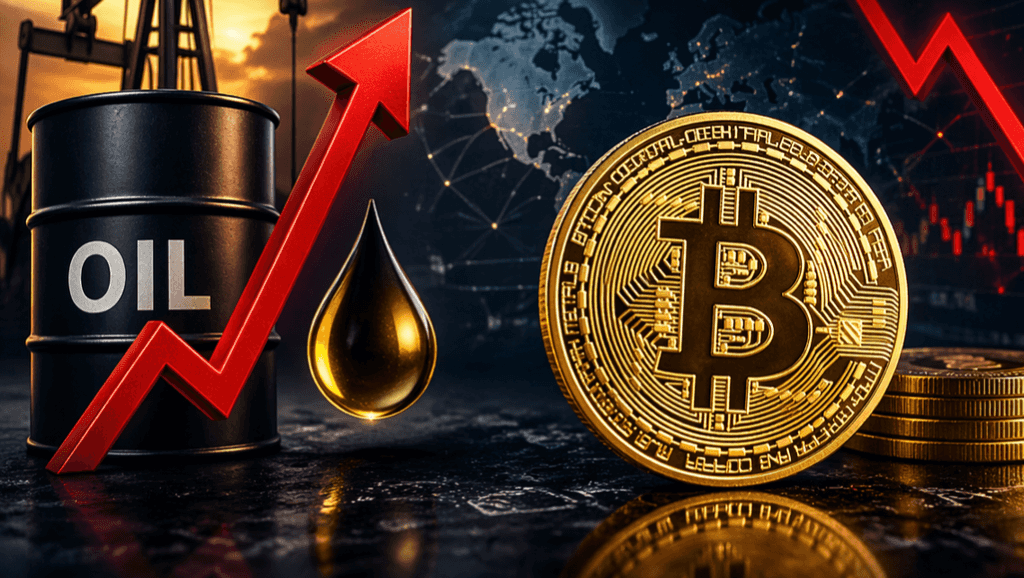
Oil Up, Stocks Down: How Macro Uncertainty Impacts Bitcoin
Key Takeaways
-
Rising oil prices can increase inflation concerns and make the market more cautious toward Bitcoin.
-
Falling stocks often reflect a risk-off environment, and Bitcoin usually feels that pressure as well.
-
In the short term, Bitcoin often behaves like a risk asset during macro uncertainty.
-
Tighter monetary policy and weaker liquidity can reduce demand for Bitcoin and other volatile assets.
-
Geopolitical tension can raise volatility by affecting oil, inflation expectations, and investor sentiment at the same time.
-
Bitcoin can still attract long-term interest as a scarce and decentralized asset when confidence in traditional systems weakens.
-
Investors tracking this theme can follow the live Bitcoin price on KuCoin and read KuCoin’s explainer on how CPI affects crypto and Bitcoin volatility. These are directly relevant to the inflation-and-Bitcoin angle of your article.
-
Macro uncertainty does not always hurt Bitcoin in the same way, but it usually makes price action more sensitive and less predictable.
Bitcoin is often framed as a world of its own, separate from stocks, commodities, and central-bank policy. In reality, it still trades inside the same macro environment that shapes every other major asset. When oil rises, stocks fall, and uncertainty starts spreading across markets, Bitcoin rarely stays untouched for long. That is because macro stress changes the way investors think about inflation, liquidity, rates, and risk. Those factors can overpower even the strongest crypto-native narrative in the short term. The IMF says the global economy is now dealing with slower growth, firmer inflation expectations, and tighter financial conditions as conflict-driven energy disruption reshapes the outlook.
Rising Oil Prices, Falling Stocks, and the Bitcoin Outlook
Rising oil prices and falling stocks often point to the same broader issue: macro pressure is building across the market. Oil sits at the center of the real economy, affecting transportation, freight, manufacturing, aviation, heating, and a wide range of consumer costs. When crude moves sharply higher, investors do not treat it as just an energy-market event. It quickly becomes part of a bigger story about inflation, slower growth, tighter policy, and weaker confidence. That shift matters for Bitcoin because it changes the environment in which the asset trades.
For Bitcoin, the key issue is not oil alone but what higher oil prices do to inflation expectations and central-bank thinking. When energy costs rise, markets begin reassessing how long policymakers may need to keep interest rates elevated or financial conditions tight. That can affect risk assets almost immediately. Bitcoin tends to perform best when liquidity is improving, real yields are stable or falling, and investors are comfortable taking on volatility. If rising oil pushes markets toward tighter financial conditions and more caution, Bitcoin often loses support alongside other speculative assets.
Falling stocks strengthen that pressure. A weak stock market is one of the clearest signals that investors are entering a risk-off phase. Equities usually come under strain when markets worry about slower growth, weaker margins, persistent inflation, or restrictive monetary policy. Oil shocks can intensify all of those concerns at once. Companies face higher input costs, consumers face more pressure, and confidence in future earnings begins to weaken. When stocks reprice under that kind of stress, the message is clear: investors are becoming less willing to hold risk.
That defensive mood rarely stays limited to equities. Once markets turn cautious, selling often spreads across asset classes, especially in the most liquid and volatile parts of the market. Bitcoin is frequently caught in that move. Even though it does not have earnings and is often described as an alternative asset, it is still widely traded as a high-risk asset during short-term macro stress. As a result, Bitcoin is often sold alongside stocks rather than treated as a safe alternative.
Liquidity becomes especially important in this environment. In a strong market, investors can focus on Bitcoin’s long-term story, including scarcity, decentralization, and its distance from traditional financial systems. In a stressed market, those narratives often move into the background. What matters more is how quickly investors want to reduce exposure and how much liquidity is available across markets. Because Bitcoin trades around the clock and remains highly liquid, it can become one of the first assets investors sell when they need to cut risk quickly.
Market Reaction
Inflation fears do not automatically help Bitcoin, even though the asset is often linked to scarcity and long-term protection against fiat weakness. In the short term, the market reaction is usually more mechanical. If rising oil leads investors to expect tighter policy, weaker growth, and falling stocks, Bitcoin may come under pressure rather than benefit. This does not weaken the long-term case for Bitcoin, but it shows that during immediate macro stress, investors usually focus first on liquidity, policy expectations, and risk sentiment.
What This Means for Bitcoin
Taken together, rising oil and falling stocks create a tougher outlook for Bitcoin because they signal a less supportive macro environment. Oil adds inflation pressure, falling equities reflect weaker confidence, and tighter liquidity reduces appetite for volatile assets. In that setting, Bitcoin is often pulled into the same broader risk-off trade shaping the rest of the market, even while its longer-term appeal as an alternative asset remains intact.
How Macro Uncertainty Impacts Bitcoin
1. Inflation Expectations and Price Pressure
Macro uncertainty often begins with rising concern about inflation. Higher oil prices, supply chain disruptions, and geopolitical tensions can push production and transportation costs higher across the economy. As those costs increase, markets begin to worry that inflation will remain elevated for longer than expected. That matters for Bitcoin because inflation changes the entire investment backdrop. In theory, Bitcoin can attract attention as a scarce asset when inflation fears rise. In practice, the short-term reaction is often more complicated, because investors also start thinking about how central banks will respond.
2. Interest Rates and Central Bank Policy
When inflation stays high or looks difficult to control, central banks may delay rate cuts or maintain a tighter policy stance. Higher interest rates generally make borrowing more expensive and reduce the flow of easy money into financial markets. That tends to hurt speculative and high-volatility assets first. Bitcoin is often included in that group, especially during uncertain periods when traders are focused more on policy risk than on long-term narratives. As a result, macro uncertainty can pressure Bitcoin by increasing expectations for tighter monetary policy.
3. Liquidity and Market Conditions
Liquidity plays a major role in Bitcoin’s performance. When markets are full of capital and investors are comfortable taking risk, Bitcoin often benefits. But when uncertainty rises, liquidity usually becomes tighter. Investors become more selective, leverage is reduced, and capital moves toward safer assets. In that environment, Bitcoin can lose momentum quickly because it depends heavily on active participation and strong market confidence. Even if the long-term outlook remains positive, reduced liquidity can still weigh on short-term price action.
4. Risk-Off Sentiment in Global Markets
Macro uncertainty usually pushes markets into a risk-off mood. This means investors start avoiding assets that are seen as volatile or speculative and move toward safer positions like cash, bonds, or defensive sectors. Bitcoin often struggles in this kind of setting because it is still widely treated as a risk-sensitive asset during periods of stress. When stocks are falling and broader market sentiment turns negative, Bitcoin can move lower as part of the same defensive shift.
5. Bitcoin as a Short-Term Risk Asset
One of the clearest effects of macro uncertainty is that Bitcoin often behaves like a short-term risk asset. Even though it has a unique structure and a separate long-term story, traders frequently sell Bitcoin during market stress because it is liquid and easy to exit. This makes it behave more like a high-growth, high-volatility asset than a traditional hedge in the early stage of a macro shock. That is why Bitcoin can fall alongside equities when markets are under pressure.
6. Bitcoin as a Long-Term Alternative Asset
At the same time, macro uncertainty can strengthen Bitcoin’s long-term appeal. If investors begin to question the stability of fiat currencies, central-bank credibility, or the long-term value of traditional financial systems, Bitcoin may gain support as a scarce and decentralized alternative. This usually does not happen instantly. In many cases, Bitcoin weakens first during the initial wave of uncertainty, then attracts renewed attention later when the focus shifts from short-term panic to long-term monetary concerns.
7. Geopolitical Tension and Investor Behavior
Geopolitical events add another layer to Bitcoin’s market behavior. War, sanctions, trade disruption, and energy shocks can increase volatility across all major asset classes. These events often raise oil prices, damage confidence, and push investors into more defensive positioning. Bitcoin may react negatively at first because markets are reducing exposure broadly. However, if geopolitical instability creates deeper distrust in traditional systems, Bitcoin can later regain relevance as an asset outside government control.
8. The Broader Macro Outlook for Bitcoin
The bigger picture is that Bitcoin does not move based on crypto news alone. Its price is increasingly shaped by inflation expectations, central-bank signals, liquidity conditions, stock-market sentiment, and geopolitical developments. Macro uncertainty matters because it influences all of these factors at once. In the short term, that often creates pressure on Bitcoin as investors reduce risk. Over the longer term, it can also strengthen the case for Bitcoin as an alternative asset. That balance between short-term pressure and long-term interest is what makes macro uncertainty such an important force in the Bitcoin market.
Bitcoin’s Role During Macro Uncertainty
Bitcoin behaves differently during periods of macro uncertainty because investors do not always treat it the same way. In calmer conditions, Bitcoin is often discussed as a scarce digital asset with long-term potential, but when inflation fears rise, stocks weaken, and markets turn defensive, its short-term role usually changes. Instead of trading purely on crypto-specific narratives, Bitcoin often starts reacting to the same forces shaping the rest of the financial system. Oil prices, interest-rate expectations, liquidity conditions, and overall market sentiment all begin to carry more weight.
In the short run, Bitcoin is frequently treated as a risk asset. When investors become more cautious, they usually reduce exposure to volatility across the board, and Bitcoin often gets caught in that move. This is especially common when higher oil prices raise inflation concerns and falling stocks signal a broader risk-off environment. During those periods, traders are less focused on Bitcoin’s long-term scarcity and more focused on capital preservation, funding conditions, and market stability. That is why Bitcoin can decline alongside equities even when its underlying long-term story remains unchanged.
Bitcoin does not lose its alternative-asset appeal entirely. If macro uncertainty deepens and starts raising bigger questions about inflation persistence, monetary policy credibility, or the stability of fiat-based systems, Bitcoin can begin to look more attractive again. Its fixed supply and decentralized structure make it appealing to investors who want exposure to an asset outside the traditional financial system. This usually becomes more relevant over longer time frames rather than in the first stage of a market shock, when defensive positioning tends to dominate.
Geopolitical tension adds even more complexity to Bitcoin’s role. Events such as war, sanctions, trade disruption, or energy shocks can affect oil prices, inflation expectations, and investor confidence all at once. That can create a difficult environment where Bitcoin faces immediate selling pressure while also attracting longer-term interest from those looking for alternatives to traditional monetary systems. In other words, Bitcoin can act like a risk asset in the early stage of uncertainty and a hedge-like alternative in the later stage, depending on what investors are focusing on.
This is what makes Bitcoin’s role during macro uncertainty so important and so difficult to simplify. It is not just reacting to crypto headlines or market speculation. It is being shaped by the wider macro backdrop, including inflation, rates, liquidity, and global risk sentiment. In the short term, that often makes Bitcoin more vulnerable when markets are under stress. Over the longer term, the same uncertainty can strengthen the case for Bitcoin as an independent and scarce asset.
Conclusion
Bitcoin may operate outside the traditional financial system, but it does not trade outside macro reality. When oil prices rise and stocks fall, the pressure usually spreads across markets through inflation concerns, tighter financial conditions, and weaker risk appetite. In that kind of environment, Bitcoin often behaves less like an isolated asset and more like part of the broader risk landscape.
At the same time, macro uncertainty does not affect Bitcoin in only one way. In the short term, it can create downside pressure as investors move away from volatility. Over the longer term, the same uncertainty can strengthen Bitcoin’s appeal as a scarce and decentralized asset, especially when confidence in monetary policy or fiat purchasing power begins to weaken. That is what makes Bitcoin unique during unstable periods. It can face immediate pressure while still remaining relevant as a long-term alternative.
The bigger takeaway is that Bitcoin should not be viewed only through a crypto lens. Oil, inflation, central-bank policy, liquidity, and stock-market sentiment all help shape its direction. When those forces turn negative, Bitcoin often struggles. When the broader market starts searching for alternatives to traditional systems, Bitcoin can find support again. Its role during macro uncertainty is not fixed, but it remains closely tied to the wider financial environment.
FAQs
Does rising oil always push Bitcoin lower?
No. Rising oil can increase inflation concerns and tighten financial conditions, which may pressure Bitcoin in the short term. But if those same conditions increase concern about fiat currencies or long-term monetary stability, Bitcoin can also regain support later.
Why does Bitcoin fall when stocks are down?
Bitcoin often trades like a risk-sensitive asset during uncertain market conditions. When investors reduce exposure to volatility and move into safer assets, Bitcoin can fall alongside equities as part of a broader risk-off shift.
Is Bitcoin still considered a hedge during macro uncertainty?
It can be, but not always immediately. In the early phase of market stress, Bitcoin often behaves like a risky asset. Over a longer period, it may attract interest as a scarce alternative asset if inflation, policy credibility, or currency stability become bigger concerns.
What macro factors matter most for Bitcoin?
The most important macro factors usually include oil prices, inflation expectations, interest rates, central-bank policy, liquidity conditions, stock-market sentiment, and the strength of the U.S. dollar.
Can Bitcoin recover even if macro uncertainty stays high?
Yes. Bitcoin can recover if investor focus shifts from short-term panic to longer-term concerns about monetary stability, inflation persistence, or confidence in traditional financial systems. Market tone and liquidity conditions often determine how quickly that shift happens.
Does Bitcoin move only on crypto news?
No. Crypto-specific developments matter, but during major macro events Bitcoin is often influenced more by broader financial conditions than by crypto headlines alone.
Disclaimer: The information in this article is provided for general information only and does not constitute investment advice, financial advice, or a recommendation to buy, sell, or hold any digital asset. Crypto assets involve risk and may not be suitable for all users. Readers should independently verify all information, assess their own risk tolerance, and consult qualified professionals where appropriate before making any financial decisions.