

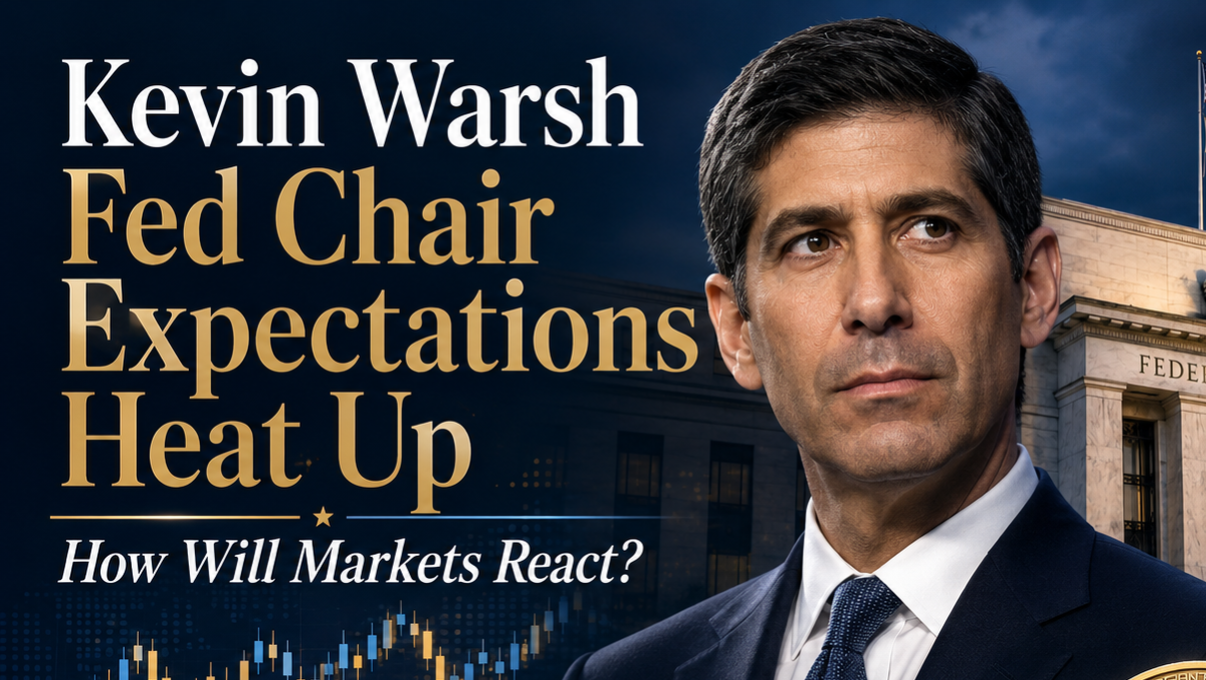
Kevin Warsh Fed Chair Expectations Heat Up: How Will Markets React?
Introduction
The expectation of Kevin Warsh taking over as chairperson of the Federal Reserve is heating up, and global investors are watching closely. A change in Fed leadership can affect interest rates, inflation expectations, bond yields, stock valuations, the U.S. dollar, gold, and cryptocurrency.
Warsh is a familiar name in Federal Reserve circles. He previously served as a Fed governor and is often linked with views on monetary policy, market stability, and central bank reform.
The key question is: how will markets react if Kevin Warsh becomes Fed chair?
Some investors may see him as supportive of lower interest rates, which could benefit stocks, crypto, and other risk assets. But others may focus on his reform-minded approach, inflation discipline, and possible support for a smaller Fed balance sheet.
Because of this, the market reaction may not be a simple rally or selloff. Instead, investors could face higher volatility as they adjust to a new Federal Reserve leadership style.
The Expectation of Kevin Warsh Taking Over as Chairperson of the Federal Reserve Is Heating Up
The expectation of Kevin Warsh taking over as chairperson of the Federal Reserve is heating up because markets are already sensitive to interest rate expectations. Inflation, employment data, bond yields, and central bank communication have become major drivers of market sentiment.
When investors believe the Fed is close to cutting rates, stock prices often rise. When investors believe inflation is sticky and the Fed may keep rates higher for longer, markets often become defensive. This is why the possibility of a new Fed chair is so important.
Kevin Warsh could represent a shift in tone, priorities, and communication style at the Federal Reserve. Markets will want to know whether he would focus more on fighting inflation, supporting growth, reducing the Fed’s balance sheet, or protecting the central bank’s independence.
1. Why Kevin Warsh’s Potential Fed Appointment Matters for Markets
Kevin Warsh’s potential appointment matters because the Fed chair plays a major role in shaping market expectations. The chair does not act alone, but their communication carries enormous weight. Every speech, testimony, press conference, and policy signal can move markets.
If Warsh becomes Fed chairperson, traders will immediately look for clues about future policy. Will the Fed cut rates more quickly? Will it stay cautious on inflation? Will it change its approach to the balance sheet? Will it become less predictable?
These questions matter because financial markets are forward-looking. Investors do not wait for policy changes to happen. They try to price them in before they occur.
That means the reaction to Kevin Warsh taking over the Fed could begin even before any actual policy decision is made.
2. Interest Rate Expectations Will Drive the First Market Reaction
The first and most important market reaction will likely come from interest rate expectations.
If investors believe Kevin Warsh would support faster interest rate cuts, the stock market could initially react positively. Lower interest rates usually help companies by reducing borrowing costs. They also make bonds and cash less attractive compared with stocks, encouraging investors to take more risk.
This could support technology stocks, small-cap stocks, real estate companies, consumer discretionary stocks, and other rate-sensitive sectors.
However, if investors believe rate cuts would come too early while inflation remains above target, the reaction could become more complicated. Bond investors may worry that the Fed is becoming too loose. This could push long-term Treasury yields higher, even if short-term rate expectations fall.
That kind of reaction would create a mixed market environment. Stocks may initially rise on rate-cut hopes, but higher long-term yields could later pressure valuations.
3. Bond Yields Could Move Before Stocks
The Treasury market may be the first major market to react to expectations of Kevin Warsh taking over the Federal Reserve.
Short-term Treasury yields are usually more sensitive to expected Fed rate cuts or rate hikes. If traders believe a Warsh-led Fed would cut rates sooner, short-term yields may fall.
Long-term Treasury yields are more complicated. They are influenced not only by Fed policy, but also by inflation expectations, government borrowing needs, investor confidence, and the Fed’s balance sheet.
If investors believe Warsh would push for a smaller Fed balance sheet, long-term yields could rise. A smaller balance sheet means the Fed may hold fewer bonds, which could reduce demand for Treasuries. When demand falls, yields can rise.
This could create a steeper yield curve, where long-term rates are higher relative to short-term rates. A steeper yield curve can be good for banks, but it can be negative for growth stocks, real estate, and highly leveraged companies.
4. Stock Market Reaction May Be Volatile
The stock market reaction to Kevin Warsh taking over as Fed chairperson may be volatile because investors may disagree on what his leadership means.
The bullish argument is that Warsh could support easier monetary policy if economic growth weakens. A more dovish Fed could help stocks by lowering rates, improving liquidity, and supporting investor confidence.
The bearish argument is that Warsh could bring uncertainty. If he changes the Fed’s policy framework, reduces the balance sheet more aggressively, or sends mixed signals about inflation, markets may become nervous.
Stocks dislike uncertainty. Investors can accept higher rates if they understand the Fed’s plan. But if policy becomes harder to predict, market volatility can rise.
This is why the stock market may first rally on hopes of lower rates, then become more cautious as investors analyze the details of Warsh’s policy approach.
5. Growth Stocks Could Face the Biggest Test
Growth stocks may be among the most sensitive assets if Kevin Warsh becomes Federal Reserve chairperson.
Technology, artificial intelligence, software, and other high-growth companies often trade at expensive valuations because investors expect strong profits in the future. When interest rates are low, those future profits are worth more today. When long-term yields rise, those valuations become harder to justify.
If a Warsh-led Fed leads to lower rates and easier liquidity, growth stocks could perform well. But if his leadership leads to higher long-term yields, growth stocks could face pressure.
This means the key market signal for growth investors may not be the Fed chair announcement itself. It may be the movement in the 10-year Treasury yield after investors digest Warsh’s policy direction.
6. Banks and Financial Stocks Could Benefit From a Steeper Yield Curve
Banks and financial stocks could benefit if Kevin Warsh’s leadership leads to a steeper yield curve.
Banks often make money by borrowing short-term and lending long-term. When long-term rates are higher than short-term rates, lending can become more profitable.
If markets expect short-term interest rates to fall while long-term yields remain firm, financial stocks may attract more investor interest. This could help large banks, regional banks, insurance companies, and other financial firms.
However, this positive effect is not guaranteed. If higher long-term rates hurt the economy, increase loan defaults, or weaken credit demand, banks could also face pressure.
So financial stocks may benefit from a Warsh-led Fed only if the yield curve steepens in a healthy way.
7. Inflation Policy Will Be a Key Market Driver
Inflation will be one of the most important issues under a Kevin Warsh-led Federal Reserve.
If investors believe Warsh is serious about controlling inflation, markets may view his leadership as credible. That could support the U.S. dollar and help stabilize long-term inflation expectations.
However, if investors believe the Fed is becoming too willing to cut rates before inflation is fully controlled, bond markets may react negatively. Long-term yields could rise as investors demand more compensation for inflation risk.
Inflation credibility is extremely important for the Fed. If markets trust the central bank, the Fed can guide expectations more easily. If markets lose trust, it becomes harder to control inflation without causing economic pain.
That is why Warsh’s first comments on inflation would be closely watched.
8. Fed Independence Will Be Closely Watched
Federal Reserve independence will also be a major issue.
Markets generally prefer a Fed that makes decisions based on economic data, not political pressure. If investors believe the Fed is becoming too political, they may demand higher returns to hold U.S. assets.
This could affect Treasury yields, the U.S. dollar, stocks, and cryptocurrencies.
If Kevin Warsh is seen as independent and disciplined, markets may react more calmly. But if investors believe monetary policy is being influenced by political goals, volatility could rise.
Fed credibility is one of the most important foundations of financial stability. A central bank that is seen as independent can anchor inflation expectations more effectively. A central bank that is seen as politically influenced may struggle to maintain investor confidence.
How Will the Cryptocurrency Market React?
The cryptocurrency market could react sharply if Kevin Warsh takes over as chairperson of the Federal Reserve. Crypto assets such as Bitcoin, Ethereum, and major altcoins are highly sensitive to interest rates, liquidity conditions, investor risk appetite, and the strength of the U.S. dollar.
Crypto investors often focus on liquidity. When money is easier, rates are lower, and risk appetite is strong, crypto markets usually perform better. When rates are high, liquidity is tight, and investors become defensive, crypto markets often struggle.
A Kevin Warsh-led Fed could therefore create both bullish and bearish forces for the cryptocurrency market.
1. Bitcoin Could Benefit From Lower Rate Expectations
Bitcoin could react positively if investors believe Kevin Warsh will support faster interest rate cuts.
Lower rates reduce the appeal of cash and short-term government bonds. This can encourage investors to move into higher-risk assets, including stocks, commodities, and cryptocurrencies.
Bitcoin has increasingly become a macro-sensitive asset. It often reacts to changes in real yields, liquidity expectations, and the U.S. dollar.
If markets believe a Warsh-led Fed will create easier financial conditions, Bitcoin could attract renewed demand from traders, institutional investors, and long-term holders.
2. Crypto Could Rally If Liquidity Improves
The broader cryptocurrency market could rally if investors expect liquidity to improve.
A more liquid market environment can support Bitcoin, Ethereum, large-cap altcoins, decentralized finance tokens, AI-related crypto projects, gaming tokens, and layer-2 blockchain networks.
Crypto-related stocks could also benefit. Bitcoin miners, crypto exchanges, and blockchain infrastructure companies often move sharply when digital asset prices rise.
However, liquidity-driven crypto rallies can be fragile. If investors later worry about inflation or higher Treasury yields, the rally could quickly reverse.
3. Higher Treasury Yields Could Pressure Bitcoin and Altcoins
The main bearish risk for crypto is higher Treasury yields.
When government bonds offer attractive returns, investors may become less willing to hold speculative assets. Higher real yields can be especially negative for Bitcoin and other cryptocurrencies because they increase the opportunity cost of holding non-yielding assets.
If Kevin Warsh’s leadership leads to higher long-term yields, Bitcoin may struggle. Ethereum and altcoins could face even greater pressure because they are usually more sensitive to risk appetite.
In a defensive market, investors often move away from smaller tokens and into Bitcoin, stablecoins, or cash.
4. Ethereum and Altcoins May Be More Volatile Than Bitcoin
Ethereum and altcoins may react more sharply than Bitcoin to a change in Federal Reserve leadership.
If investors become optimistic about lower rates and stronger liquidity, altcoins could outperform. Traders often rotate into higher-risk crypto assets when market sentiment improves.
But if the market becomes defensive, altcoins may fall harder. Smaller tokens usually have less liquidity, higher volatility, and greater dependence on speculative demand.
This means a Kevin Warsh-led Fed could create a highly uneven crypto market. Bitcoin may act as the main macro asset, while altcoins may behave like high-beta risk assets.
5. Stablecoins Could See Higher Demand During Uncertainty
Stablecoins may see higher demand if uncertainty around Fed policy increases.
During volatile periods, crypto investors often move into stablecoins instead of leaving the digital asset market completely. This allows them to protect capital while staying ready to re-enter Bitcoin, Ethereum, or altcoins.
If investors are unsure whether Kevin Warsh will be bullish or bearish for liquidity, stablecoin trading volumes could rise.
Stablecoins may therefore become an important part of the market reaction, especially during the first phase of uncertainty.
6. Crypto-Related Stocks Could Move Sharply
The reaction may not be limited to cryptocurrencies themselves. Crypto-related stocks could also move sharply.
Bitcoin mining companies, crypto exchanges, blockchain technology firms, and public companies holding Bitcoin may all react to changes in rate expectations and digital asset prices.
If Bitcoin rises on lower-rate expectations, crypto stocks could outperform. But if bond yields rise and risk appetite weakens, these stocks could fall more sharply than Bitcoin because they carry both equity-market risk and crypto-market risk.
What a Kevin Warsh-Led Federal Reserve Could Mean for Major Assets
A Kevin Warsh-led Federal Reserve would likely affect different markets in different ways. The reaction would depend on whether investors focus more on rate-cut hopes or policy uncertainty.
1. U.S. Stocks
U.S. stocks may initially rise if investors expect faster interest rate cuts. Lower rates can support corporate earnings, reduce borrowing costs, and improve investor sentiment.
However, the rally could fade if long-term Treasury yields rise or if investors worry about Fed credibility. Growth stocks may be most vulnerable, while banks, value stocks, and cash-flow-heavy companies may perform better.
2. Treasury Bonds
Treasury bonds could experience major volatility.
Short-term yields may fall if traders expect rate cuts. Long-term yields could rise if investors worry about inflation, Fed independence, or balance-sheet reduction.
This could lead to a steeper yield curve and large moves across bond markets.
3. U.S. Dollar
The U.S. dollar could move in either direction.
If investors believe Kevin Warsh will defend inflation credibility, the dollar may strengthen. If markets expect aggressive rate cuts or political pressure on the Fed, the dollar could weaken.
The dollar’s reaction will depend on whether investors see Warsh as disciplined, dovish, or unpredictable.
4. Gold
Gold may also react in a mixed way.
Lower interest rates usually support gold because gold does not pay interest. But higher real yields can pressure gold prices.
Gold could also benefit if investors become concerned about Fed independence, inflation credibility, or financial instability.
5. Cryptocurrency
Cryptocurrency may rally if investors expect easier monetary policy and improved liquidity. Bitcoin and Ethereum could benefit from lower-rate expectations, while altcoins may outperform in a risk-on environment.
However, crypto could fall if long-term yields rise, the dollar strengthens, or investors move away from speculative assets.
Conclusion
The expectation of Kevin Warsh taking over as chairperson of the Federal Reserve is heating up because Fed leadership can strongly influence markets. Interest rates, inflation expectations, bond yields, stock prices, the U.S. dollar, gold, and cryptocurrency could all react to a change in policy direction.
If Warsh is seen as supportive of lower interest rates, stocks and crypto may initially benefit. Bitcoin, Ethereum, small-cap stocks, and growth assets could gain momentum as investors price in easier financial conditions.
However, the reaction may not be fully bullish. If investors worry about inflation credibility, Fed independence, or aggressive balance-sheet reduction, markets could become more volatile. Treasury yields may rise, growth stocks may face pressure, and crypto could see sharp swings.
Frequently Asked Questions
1. Why is Kevin Warsh’s possible Federal Reserve appointment important?
Kevin Warsh’s possible appointment is important because the Federal Reserve strongly influences interest rates, inflation expectations, bond yields, stock prices, and overall market confidence. A new Fed chair can change how investors view the future direction of monetary policy.
2. How could markets react if Kevin Warsh becomes Fed chair?
Markets may react with volatility. Stocks and crypto could rise if investors expect lower interest rates, but bond yields could move higher if investors worry about inflation, Fed independence, or balance-sheet reduction.
3. Would Kevin Warsh be good for the stock market?
It depends on his policy signals. If he supports lower rates and easier financial conditions, stocks may benefit. However, if his leadership creates uncertainty or pushes long-term yields higher, growth stocks could face pressure.
4. How could Bitcoin and crypto react to a Warsh-led Fed?
Bitcoin and crypto could rally if markets expect lower interest rates and more liquidity. But if Treasury yields rise or investors become more risk-averse, crypto prices could become volatile or decline.
5. Why do interest rates matter so much for markets?
Interest rates affect borrowing costs, company profits, consumer spending, and investor appetite for risk. Lower rates usually support stocks and crypto, while higher rates often pressure risk assets.
6. Could a Kevin Warsh-led Fed affect the U.S. dollar?
Yes. The U.S. dollar could strengthen if investors believe Warsh will protect inflation credibility. But it could weaken if markets expect aggressive rate cuts or less confidence in Fed independence.
7. What should investors watch if Kevin Warsh takes over?
Investors should watch Warsh’s comments on interest rates, inflation, the Fed balance sheet, and central bank independence. These signals will likely shape the market reaction more than the appointment itself.
Disclaimer
This article is for informational purposes only and is not financial advice. Always do your own research before making any investment or trading decisions.