

The Biggest Crypto Scams in History: Real Examples, Who They Target, and How to Stay Safe 2026?
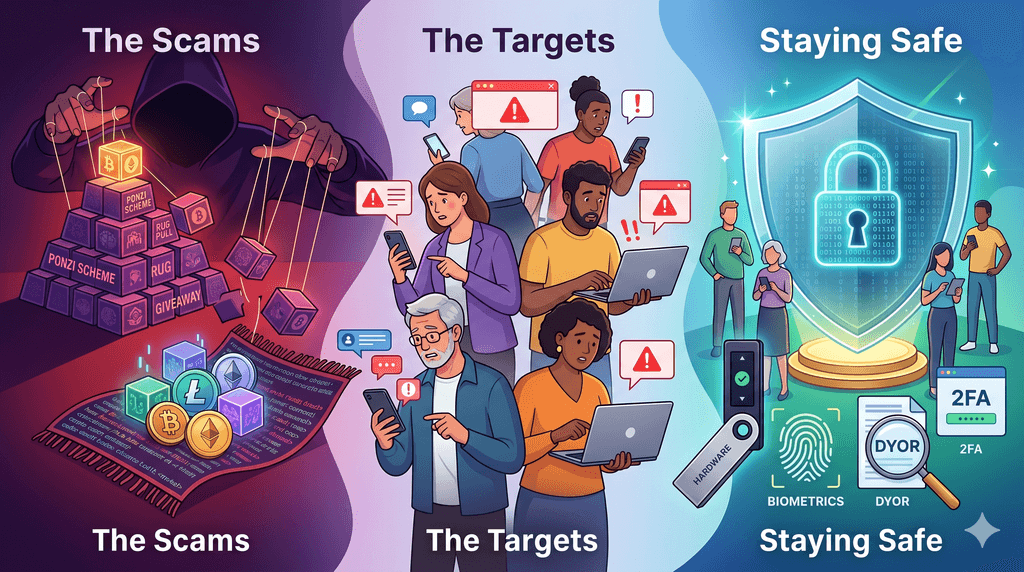
Did you know that in 2025 alone, cryptocurrency scams and fraud drained an estimated $17 billion from global investors, with impersonation tactics growing by a staggering 1,400% year-over-year? As we move through May 2026, the threat has shifted from simple "get rich quick" schemes to sophisticated, AI-industrialized operations that extract nearly 4.5 times more money per victim than traditional scams. The short answer to staying safe is this: The most dangerous scams in 2026 are AI-powered deepfakes and "Pig Butchering" operations that target emotional vulnerability; protecting yourself requires mandatory hardware-based 2FA, verifying all "celebrity" endorsements through official channels, and never moving funds to platforms outside of regulated global exchanges.
While the "industrialization of fraud" has made attacks more efficient, understanding the anatomy of these historic and modern-day heists is your first line of defense. This article deconstructs the largest scams in history and the cutting-edge threats of 2026 to ensure your portfolio remains a fortress.
Key Takeaways
-
AI Deepfakes (2026): Fraudsters use real-time AI to impersonate CEOs, leading to $577 million in losses in Q1 2026 alone.
-
Pig Butchering Evolution: Southeast Asian compounds now target high-net-worth professionals via LinkedIn and dating apps, using months-long "grooming" phases.
-
Legacy Ponzis: Schemes like OneCoin and PlusToken stole over $7 billion, proving that MLM-style "education packages" are massive red flags.
-
Address Poisoning: A low-tech but lethal scam targeting active traders by mimicking their own transaction history.
-
Security is Hardware: In 2026, software-based 2FA is no longer sufficient; hardware keys and "Safety Phishing Codes" are the new industry standards.
OneCoin: The $4 Billion "Crypto Queen" Ponzi
OneCoin remains the largest cryptocurrency scam in history by volume, defrauding over 3 million people of $4 billion by selling a "currency" that never actually existed on a blockchain. Founded by Ruja Ignatova (the "Crypto Queen") in 2014, it operated as a classic Ponzi scheme disguised as a revolutionary digital asset.
The Real-World Case: The Global MLM Trap
Between 2014 and 2019, OneCoin lured investors into buying "educational packages" ranging from €110 to €118,000. These packages supposedly included tokens that could be "mined" into OneCoin. However, as revealed in U.S. Department of Justice filings from April 2026, the project had no private or public blockchain—it was simply a centralized database where numbers were manually adjusted. While key leaders have been sentenced to decades in prison, Ignatova remains on the FBI's Ten Most Wanted list.
Who They Targeted: The Non-Technical "Dreamer"
OneCoin specifically targeted people in developing nations and non-technical demographics in Europe and China.
-
Demographic: Working-class individuals with little crypto knowledge but a high desire for financial freedom.
-
Hook: Multi-level marketing (MLM). Investors earned massive commissions for recruiting friends and family, turning victims into unwitting perpetrators.
PlusToken: The $3 Billion Wallet "Black Hole"
PlusToken was a massive fraudulent wallet and exchange that targeted Asian investors, promising monthly returns of up to 30% through "trading bots" that didn't exist. It is a prime example of a "High-Yield Investment Program" (HYIP) scam that utilized the burgeoning Korean and Chinese markets to siphon off $2.9 billion in BTC, ETH, and EOS.
The Real-World Case: The 2020 Takedown
In 2020, Chinese authorities arrested 109 individuals associated with PlusToken. The scam worked by having users download a "PlusToken Wallet" and deposit crypto to earn dividends. When the founders tried to "exit" in 2019, they attempted to wash the stolen Bitcoin through various mixers, which was so massive it caused a noticeable drop in the global market price of Bitcoin. As of early 2026, the recovered funds (nearly 194,000 BTC) are still cited as one of the largest asset seizures in legal history.
Who They Targeted: The "Passive Income" Seeker
PlusToken focused on the growing middle class in South Korea and China.
-
Demographic: Early-adopter retail investors looking for "safe" ways to grow their crypto holdings.
-
Hook: The promise of a "proprietary trading bot" that would perform arbitrage while the user slept.
Pig Butchering: The 2026 Industrialized Crisis
"Pig Butchering" is a psychological scam where victims are "fattened up" through emotional manipulation before being "slaughtered" for their entire life savings on fake trading platforms. In May 2026, this has become the fastest-growing category of crypto fraud, with the FBI's IC3 reporting a 37% increase in losses for investors over 60.
The Real-World Case: The Burmese Compound Disruptions
In April 2026, a joint international task force disrupted a "scam compound" in Burma (Myanmar). These compounds are essentially slave labor camps where human trafficking victims are forced to spend 14 hours a day messaging people worldwide. One victim, a retired engineer in Florida, lost $1.2 million after a "romantic interest" met on a dating app convinced him to transfer his retirement fund into a fraudulent DeFi liquidity pool.
Who They Targeted: The Lonely and the Professional
The modern pig butchering scam has two distinct targets:
-
The Lonely Heart: Targeted through dating apps like Tinder or Bumble using AI-enhanced profile pictures.
-
The High-Net-Worth Professional: Targeted through LinkedIn with "business opportunities" or "wrong number" texts that lead to professional networking.
AI Deepfakes: The $577 Million "Celebrity" Giveaway
In 2026, AI-generated deepfakes have become the primary tool for "Giveaway Scams," where high-quality video clones of Elon Musk, Donald Trump, or exchange CEOs are used to trick people into sending crypto to "double" their money. In the first four months of 2026 alone, these attacks have resulted in $577 million in verified losses.
The Real-World Case: The April 2026 "Elon" YouTube Blitz
During a high-profile rocket launch in late April 2026, a hacked YouTube channel with 2 million subscribers broadcasted a deepfake of Elon Musk. The AI clone claimed SpaceX was "giving back" to the community and promised to send back 2 BTC for every 1 BTC sent to a specific address. Within 6 hours, over $14 million was sent to the scammer's wallet.
Who They Targeted: The FOMO-Driven Retailer
This scam targets anyone spending time on social media platforms like X, YouTube, or TikTok.
-
Demographic: Younger retail investors who follow tech celebrities and suffer from high FOMO (Fear Of Missing Out).
-
Hook: "Live" video broadcasts that look 100% authentic, complete with real-time AI voice modulation.
Address Poisoning: The Stealthy "Copy-Paste" Trap
Address poisoning is a 2026-era scam that exploits the human habit of only checking the first and last few characters of a crypto address to redirect funds to a thief. Unlike traditional hacks, this does not require stealing a private key; it only requires the user to make a mistake.
The Real-World Case: The 2026 "Vanity Address" Surge
In March 2026, a USENIX study found that over 6,600 victims lost a combined $83.8 million to address poisoning. The scammer uses a "vanity address generator" to create a wallet that starts with the same 4 digits and ends with the same 4 digits as your own. They send you a "zero-value" transaction, so their address appears in your recent history. When you go to send yourself funds later, you copy their address from your history instead of yours.
Who They Targeted: The Active On-Chain Trader
This scam specifically targets decentralized wallet users (MetaMask, Phantom, Ledger) who frequently move funds between their own accounts.
-
Demographic: DeFi power users and airdrop farmers.
-
Hook: The psychological shortcut of "it looks like my address."
Comparing the Scams: 2026 Threat Matrix
| Scam Type | Methodology | Primary Target | 2026 Risk Level |
| OneCoin / PlusToken | Ponzi / MLM | Non-technical investors | Low (Public Awareness is high) |
| Pig Butchering | Emotional Grooming | Retirees & Professionals | Extreme (Highest loss per victim) |
| AI Deepfakes | Impersonation | Social media users | Critical (Hardest to detect) |
| Address Poisoning | Visual Deception | Active On-Chain Traders | High (Targeting habit) |
How to Stay Safe: A Practical 2026 Protection Playbook
Protecting yourself in 2026's threat environment requires more than generic caution. Here are the specific behaviors that matter most:
1. Treat any unsolicited investment opportunity as fraudulent by default. No matter how polished the platform, how warm the relationship, or how impressive the early returns look — if someone you met online is guiding you toward a specific investment platform, it is almost certainly a scam. This is not paranoia; it is the defining characteristic of pig butchering.
2. Verify every wallet address character by character before any transaction. Do not copy from transaction history. Type it out manually or use address book features in trusted wallets. Address poisoning exploits the shortcuts that even experienced users take.
3. Never share your seed phrase or private key with anyone, under any circumstances. No legitimate exchange, platform, wallet provider, or support representative will ever request it. Anyone asking for your seed phrase is attempting to steal everything in your wallet.
4. Apply multi-channel verification to any communication referencing your crypto accounts. If you receive a call or message from "support" at your exchange, hang up and contact the exchange directly through its official website. AI voice cloning now makes phone-based impersonation nearly undetectable.
5. Use hardware wallets for significant holdings. The hardware wallet market reached $560 million in 2025 for a reason — keeping private keys entirely offline eliminates the largest class of remote theft vectors.
6. Check smart contract permissions. Wallet drainer attacks execute because victims unknowingly grant malicious smart contracts permission to move funds. Use tools like Revoke.cash regularly to audit and revoke unnecessary token approvals from your connected wallets.
7. Pause at urgency signals. Scammers create artificial time pressure to prevent rational evaluation. "This offer expires in 24 hours," "You must act now to avoid account closure," and "Your funds are at risk" are manipulation triggers, not legitimate warnings.
Trading Safely on Platforms You Can Trust
One of the most effective defenses against crypto fraud is choosing to trade on platforms with transparent security infrastructure, regulatory standing, and verifiable track records. KuCoin has operated since 2017, supports robust KYC and anti-fraud protections, and offers institutional-grade security across its trading environment. For investors concerned about the explosion of fake exchange apps and phishing websites impersonating legitimate platforms, using an established exchange with a verifiable domain, two-factor authentication, and documented security audits is not just convenient — it is a meaningful layer of protection.
KuCoin's trading tools also let you move quickly and confidently in volatile market conditions, without the platform friction that pushes traders toward less reputable alternatives in moments of haste. When the threat environment is sophisticated, your platform choice matters.
💡Tips: New to crypto? KuCoin's Knowledge Base has everything you need to get started.
Conclusion
The evolution of crypto scams in 2026 reflects a broader trend of psychological and technical convergence. We have moved from the era of "Classic Ponzis" like OneCoin and PlusToken, which relied on mass-market MLM greed, into a dangerous new world of Pig Butchering and AI Deepfakes. Today’s scams are no longer just about stealing money; they are about stealing trust through months of emotional grooming or perfect digital impersonation. With over $17 billion lost last year, the data proves that no one is "too smart" to be scammed if they aren't using the right tools.
Staying safe in this environment requires a shift to a "Zero Trust" model. Mandatory hardware 2FA, verifying every celebrity "giveaway" through official media tools, and never copying addresses from transaction histories are no longer suggestions—they are requirements for survival. As institutional adoption grows, the criminals will only get more sophisticated. By choosing platforms with transparent reserves and AI-driven protection, you can ensure that you are the one benefiting from the crypto revolution, rather than becoming a statistic in the next global fraud report.
FAQs
How can I tell if a YouTube Live "Giveaway" is a deepfake?
Check the channel's "About" section and the date it was created. Scammers often hack old, unrelated channels with high subscriber counts. Also, look for the "Official Media Verifier" on major exchange websites to see if the event is officially listed.
Can I get my money back if I fell for a Pig Butchering scam?
Recovery is extremely difficult because funds are often moved to Southeast Asian "special economic zones" that are beyond international law. However, if the funds were sent via a centralized stablecoin like USDT, the issuer (Tether) can sometimes freeze the funds if you have a court order or immediate law enforcement report.
Why did my wallet show a transaction I didn't make?
This is likely a "Zero-Value" transaction used in Address Poisoning. Scammers do this to "poison" your transaction history so that you accidentally copy their address next time you send funds. It doesn't mean your wallet is hacked, but you must be extremely careful when copying addresses.
Are LinkedIn "Recruiters" asking for a crypto wallet connection legitimate?
Almost certainly not. In 2026, a common "Ice Phishing" tactic involves fake recruiters asking you to "test" a new crypto app or connect your wallet to their hiring portal. This grants them "Set Approval For All," allowing them to drain your tokens instantly.
What should I do if my elderly relative is being targeted?
Immediately move their funds to a hardware wallet or a custodial exchange with "Whitelisting" enabled. Whitelisting prevents withdrawals to any address not previously approved, which is the most effective way to stop "Pig Butchering" victims from sending their life savings to scammers.
Disclaimer: This article is for informational purposes only and does not constitute financial or investment advice. Cryptocurrency investments carry significant risk. Always conduct your own research before trading.