

Investors Dump Stocks for SpaceX IPO: US Markets Face Volatility Before Biggest Ever Listing
2026/06/10 17:21:00
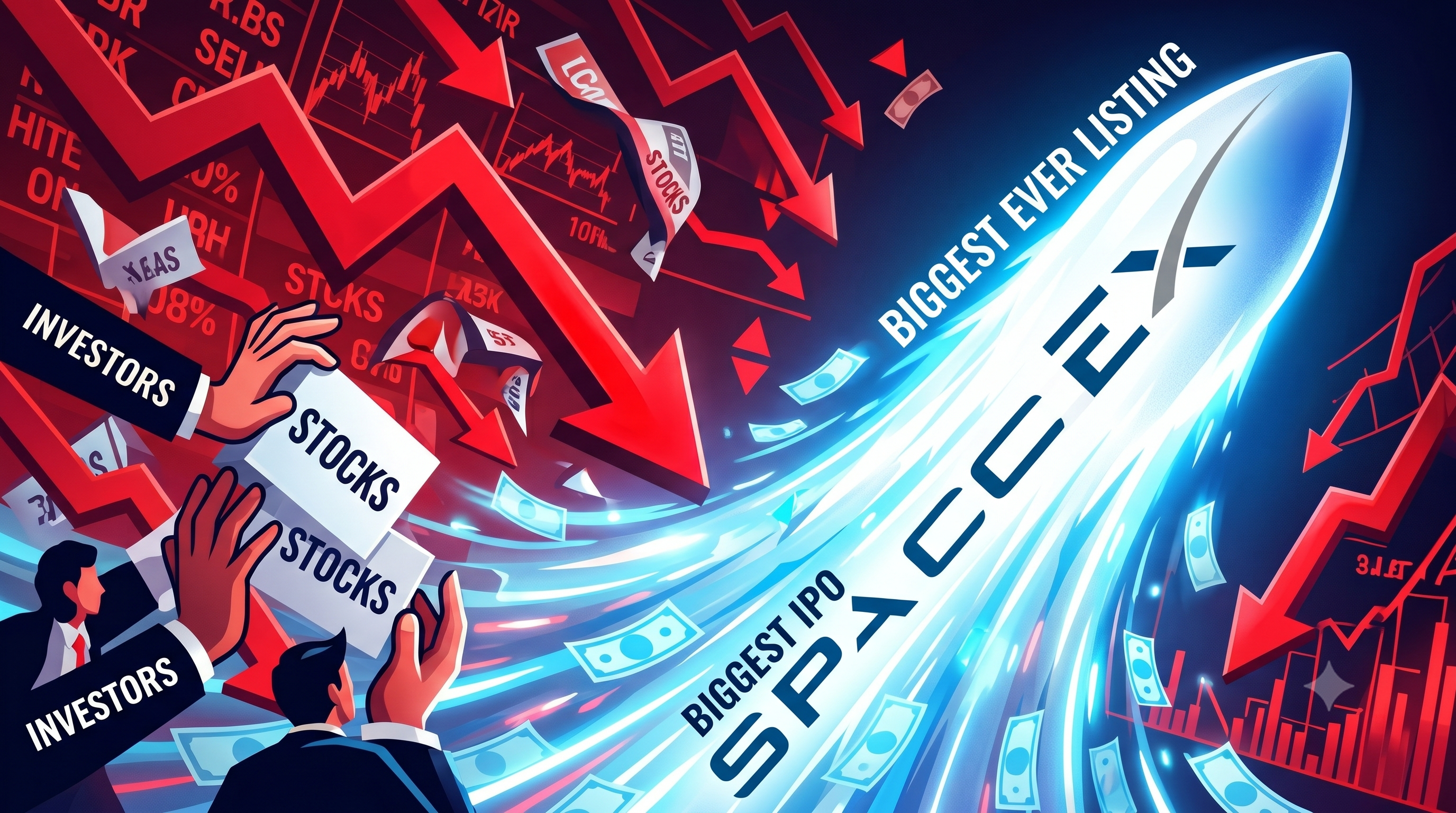
The financial world is currently witnessing an unprecedented seismic shift that is catching even the most seasoned Wall Street veterans off guard. As the highly anticipated SpaceX Initial Public Offering (IPO) officially approaches its historic trading debut on Friday, June 12, 2026, Wall Street and retail investors alike are frantically scrambling for cash. This massive, coordinated capital mobilization has led to a widely documented market phenomenon: investors dump stocks across multiple sectors to free up immediate liquidity. This sudden and violent capital reallocation is triggering significant US market volatility right before what is unequivocally projected to be the biggest ever listing in the history of the global financial markets.
With a jaw-dropping target valuation ranging between $1.75 trillion and $1.78 trillion, and an expected $75 billion capital raise, Elon Musk’s integrated space, telecommunications, and artificial intelligence behemoth is essentially sucking liquidity out of the broader market like a financial black hole. From multi-billion-dollar institutional fund managers to everyday retail traders operating from their smartphones, market participants are systematically liquidating their current equity holdings. The sole goal? To secure a front-row ticket to this historic financial milestone.
But what exactly is driving this massive, market-wide sell-off? Which specific sectors are bleeding the most cash, and more importantly, what does this unprecedented market turbulence mean for your personal investment portfolio? In this comprehensive, deeply researched guide, we will break down the mechanics behind the record-breaking SpaceX listing, analyze the underlying financial data from their S-1 filing, explain why it is causing the current Wall Street shakeup, and provide actionable insights on how to navigate the ensuing chaos.
💡 Tips: New to crypto? KuCoin's Knowledge Base has everything you need to get started.
The "Biggest Ever" SpaceX IPO Explained: Breaking Down the $1.78 Trillion Giant
To genuinely understand the current market panic and the spiking volatility indices, we first need to comprehend the sheer scale and structural gravity of the SpaceX public offering. Wall Street has seen massive public listings before—such as the tech booms of the late 1990s, the historic tech debuts of the 2012–2014 era, or the massive state-backed oil listings of 2019—but nothing in modern economic history comes close to the sheer financial magnitude of this event. Priced at a target valuation of $1.75 trillion, SpaceX is entirely bypassing the traditional growth phases of a public company. It is entering the open market not as a mid-cap or standard large-cap stock, but as an instant mega-cap giant, larger than the gross domestic product (GDP) of many developed sovereign nations.
The Unprecedented Fixed-Price Strategy
In a radical departure from established Wall Street norms, SpaceX and its syndicate of 21 underwriting banks—led by financial powerhouses Goldman Sachs, Morgan Stanley, and Citigroup—chose to bypass the traditional IPO pricing range. Normally, an underwriting syndicate offers a flexible preliminary price range (e.g., $110 to $130) to gauge institutional investor appetite during a multi-week roadshow. Instead, SpaceX filed an amended S-1 disclosure with the Securities and Exchange Commission (SEC) revealing a massive, fixed issuance price of $135 per share for exactly 555,555,555 Class A common shares.
This aggressive, take-it-or-leave-it pricing strategy aims to raise a base of $75 billion in gross proceeds. However, the financial engineering does not stop there. If the underwriters choose to exercise their over-allotment option (commonly known as the "greenshoe option") to sell additional shares due to overwhelming institutional demand, the total fundraising could easily swell to $86.2 billion. This would push the company's ultimate post-listing market capitalization to a staggering $1.78 trillion, positioning it firmly within the top five most valuable companies on Earth on day one.
To put this historic listing into proper macroeconomic perspective, let us look at how the SpaceX IPO compares to the largest historical financial milestones:
| Company | IPO Year | Amount Raised | Market Valuation at IPO | Primary Industry |
| SpaceX (SPCX) | 2026 | $75B - $86.2B | $1.75 Trillion | Aerospace / AI / Telecom |
| Saudi Aramco | 2019 | $29.4 Billion | $1.70 Trillion | Energy / Oil & Gas |
| Alibaba Group | 2014 | $25.0 Billion | $168 Billion | E-commerce / Tech |
| Meta (Facebook) | 2012 | $16.0 Billion | $104 Billion | Social Media / Tech |
| Visa Inc. | 2008 | $17.9 Billion | $86 Billion | Financial Services |
As the data explicitly demonstrates, SpaceX is set to shatter the global capital-raising record held by Saudi Aramco by more than double. This creates an enormous, unprecedented capital vacuum in the domestic equity market, requiring tens of billions of dollars to be mobilized and transferred instantly across global clearinghouses.
The Three Pillars Justifying a Multi-Trillion Dollar Price Tag
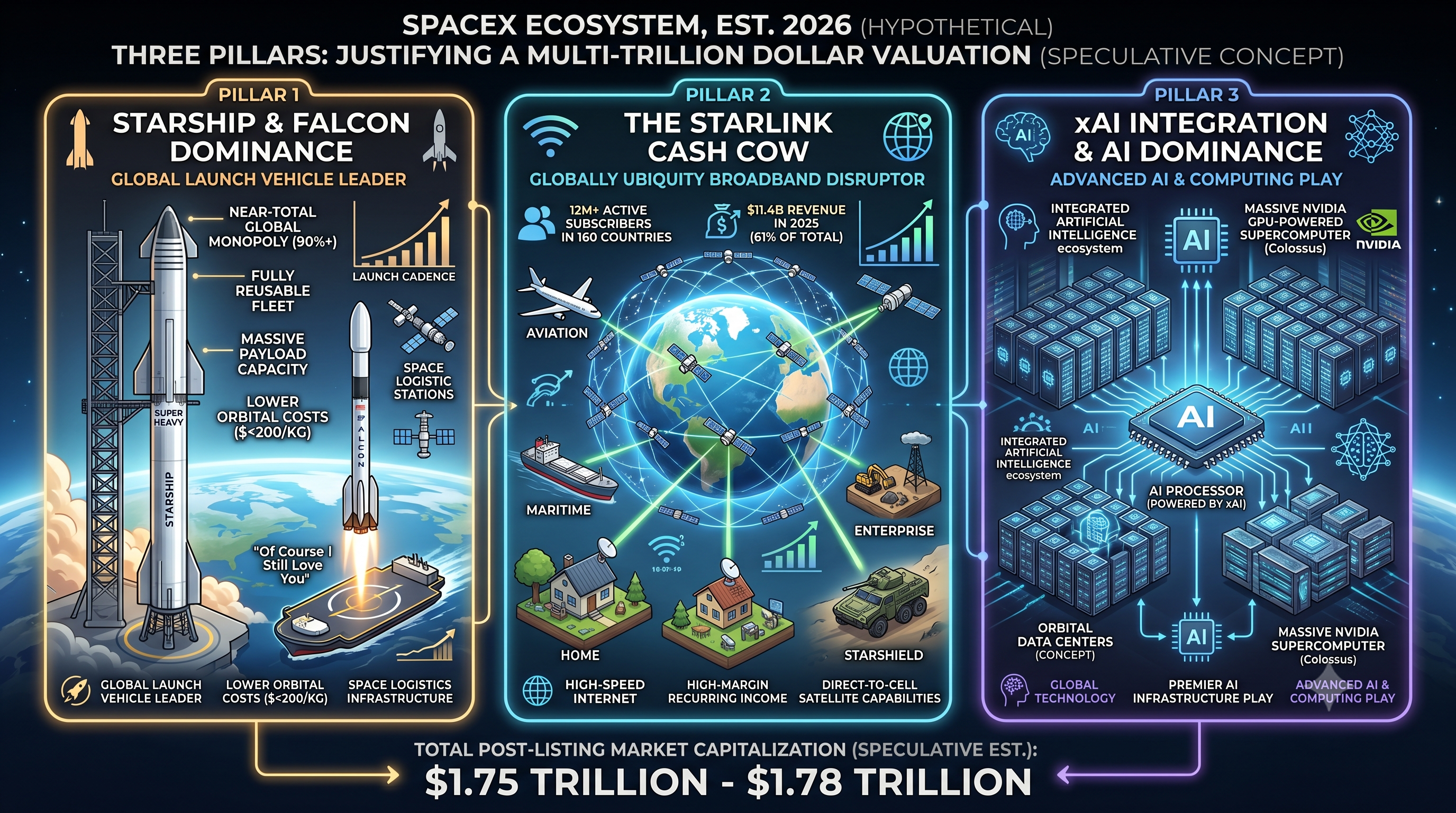
Why is the valuation so incredibly high, and why are both institutional and retail investors willing to pay such an aggressive premium for a company that is currently deploying massive amounts of capital? Unlike traditional legacy enterprises that dominate a single specific sector, investors buying into the SpaceX IPO (under the newly minted ticker symbol SPCX) are essentially acquiring a stake in a highly diversified ecosystem comprising three distinct, interlocking, and world-dominating industrial monopolies.
-
Starship & Falcon Dominance: The Logistics Moat of Low-Earth Orbit
SpaceX has achieved what many antitrust economists consider a near-total practical monopoly on the global commercial space launch market. According to recent industry data from 2025 and early 2026, SpaceX controls approximately 91% of all commercial domestic launches and over 70% of international payloads.
With the workhorse Falcon 9 rocket flying at an unprecedented cadence of over 140 launches per year, and the massive, fully reusable Starship vehicle entering its synchronized operational phase, the unit economics of space travel have fundamentally changed. The cost of sending a single kilogram of payload into Low-Earth Orbit (LEO) has plummeted from roughly $10,000 under the old NASA Space Shuttle paradigm to less than $200 via Starship. This technological and logistical moat effectively renders legacy aerospace competitors obsolete, turning SpaceX into the sole infrastructure provider for the emerging trillion-dollar off-world economy.
-
The Starlink Cash Cow: Global Broadband Disruptor
Starlink is no longer just a speculative beta project or a niche service for rural off-grid homes; it has matured into a globally ubiquitous telecommunications giant. As revealed in the confidential financial schedules attached to the 2026 IPO filings, Starlink generated an astonishing $11.4 billion in high-margin revenue in 2025 alone. This represents a massive 61% of SpaceX's total consolidated revenue profile.
Boasting over 12 million active subscribers across 160 countries—and holding highly lucrative, exclusive contracts with commercial maritime fleets, global aviation giants, enterprise remote mining operations, and the US Department of Defense via the "Starshield" initiative—Starlink provides the highly predictable, recurring SaaS-like cash flow that institutional investors crave. Management boldly pitched investors during the London roadshow that Starlink's total addressable market (TAM) sits at an astounding $2.5 trillion as it begins rolling out Direct-to-Cell satellite capabilities natively to billions of standard smartphones.
-
The xAI Integration: The Ultimate Artificial Intelligence Infrastructure Play
In a masterstroke of corporate engineering that fundamentally altered the valuation dynamics of the IPO, Elon Musk formally merged his advanced artificial intelligence venture, xAI, into the core SpaceX corporate umbrella in February 2026. This move instantly transformed SpaceX from a purely hardware-focused aerospace engineering firm into the stock market's premier, vertically integrated AI infrastructure play, capable of rivaling Alphabet, Microsoft, and Nvidia.
SpaceX now directly owns and operates the massive "Colossus" supercomputer data center, powered by an array of 220,000 liquid-cooled Nvidia H100 and B200 GPUs. By using the global Starlink satellite network to pipe low-latency data directly into xAI’s proprietary "Grok" LLM models, SpaceX has created a closed-loop system where data can be collected, processed, and deployed globally without relying on terrestrial fiber networks. This integration allows SpaceX to command a multi-trillion-dollar tech multiple rather than a traditional defense contractor multiple.
The Financial Reality: Surging Revenues Against Multi-Billion Dollar Capital Expenditure Losses
While the technological narrative surrounding SpaceX is undeniably flawless, the actual financial disclosures made public within the pages of the SEC S-1 filing present a stark, high-risk financial contradiction. This divergence has fueled intense debate across trading floors from New York to London.
On one hand, SpaceX is experiencing explosive, exponential top-line revenue growth. In the full fiscal year of 2025, the company's consolidated revenue climbed 33% year-over-year to reach a record $18.7 billion. However, true net profitability remains entirely elusive due to the company's aggressive internal reinvestment cycles. Despite generating an adjusted EBITDA profit, SpaceX posted a massive GAAP net loss of $4.94 billion for the full year of 2025.
This cash burn accelerated dramatically in the first quarter of 2026, where the company posted a jaw-dropping $4.28 billion net loss in a single three-month trading period. Currently, SpaceX is carrying an accumulated balance sheet deficit of $41.3 billion.
The primary driver behind these staggering losses is the company's relentless, unyielding push into frontier artificial intelligence development. The computing infrastructure, power procurement, and top-tier engineering talent required for xAI operations burned through more than $6.1 billion in 2025 and an additional $2.5 billion in Q1 2026 alone.
Furthermore, prospective shareholders must digest the fact that a significant chunk of the $75 billion IPO proceeds will not be used for future R&D. Instead, it must be used to immediately repay a massive $20 billion bridge loan extended by the underwriting bank syndicate back in March 2026, which was utilized to refinance legacy debt structures across Musk's broader portfolio of companies. At a $1.78 trillion valuation, SpaceX is pricing its shares at roughly 94.7 times its 2025 annual sales. This is an exceptionally demanding valuation multiple—far richer than established, highly profitable tech giants like Apple, Microsoft, or Alphabet. Yet, investors are aggressively lining up to overlook the current financial bleeding, betting heavily that Musk's long-term monopoly power will inevitably monetize into trillions of dollars of future downstream value.
Why Are Investors "Dumping" Other Stocks? The Liquidity Squeeze Explained
The dramatic headline stating that "investors dump stocks" sounds deeply alarming to the general public, but within institutional finance, it represents a completely logical, mechanical reaction to a macroeconomic capital event of this scale. In the world of quantitative asset management, this phenomenon is categorized as a "structural liquidity squeeze," heavily amplified by a severe, universal case of institutional "FOMO" (Fear Of Missing Out).
To understand the core mechanics, consider a simple economic analogy. Imagine a highly anticipated, strictly limited-edition luxury asset is about to be released at a local auction house. To bid on it, every wealthy individual in the town suddenly requires millions of dollars in cold, hard cash. Because their wealth is currently tied up in real estate, fine art, and corporate bonds, they are forced to simultaneously sell off portions of those assets at a discount just to build a mountain of liquid cash before the auction begins. The US stock market is currently experiencing this exact sequence of events, but on a macroeconomic scale involving hundreds of billions of dollars.
The Institutional Capital Mandate Constraint
Most institutional investors—such as mutual funds, public pension funds, and sovereign wealth vehicles—operate under strict mandate constraints regarding cash allocations. They are legally or structurally discouraged from holding large, uninvested cash positions due to a phenomenon known as "cash drag," which erodes fund performance relative to benchmark indices.
Consequently, because these multi-billion-dollar funds are almost fully invested in equities at any given time, the only way they can physically accumulate the necessary capital to subscribe to the $75 billion SpaceX primary offering is by systematically liquidating pieces of their existing portfolios. Over the past three weeks, institutional desks have been executing massive block trades, selling off highly reliable blue-chip assets to free up dry powder for the June 12 settlement date.
The Index Fast-Track Algorithm Effect
Adding immense fuel to the market volatility is the underlying structure of modern passive investing and index rebalancing mechanics. The Nasdaq exchange has already announced that due to the historic nature of the listing, it will utilize an expedited "Fast-Track" inclusion rule. This rule will allow SpaceX (SPCX) to bypass the standard multi-month waiting period and join the prestigious Nasdaq-100 index after just 15 days of public trading, provided its market cap remains above the top-40 threshold.
Because of this impending, guaranteed inclusion, massive passive index-tracking funds and Exchange Traded Funds (ETFs)—such as the ultra-popular Invesco QQQ Trust, which manages hundreds of billions of dollars—are legally and algorithmically obligated to purchase tens of billions of dollars of SpaceX stock the moment it joins the index. To maintain their strict mathematical sector weightings and free up the cash required to buy a $1.75 trillion behemoth, these passive algorithms must automatically execute programmatic sell orders across the remaining companies currently sitting within the index. This mechanical, non-fundamental selling creates a wave of downward pressure across the wider equity landscape, entirely detached from the actual health of the economy.
Which Sectors Are Taking the Biggest Hit in the Wall Street Shakeup?
While the entire US equity market is feeling the structural pull of the SpaceX capital migration, the damage across the board is highly asymmetrical. The mass liquidation event is targeting specific industries and companies, creating a highly volatile environment where certain sectors are experiencing bear-market conditions while others remain relatively stable.
-
Legacy Aerospace and Defense: The Great Capitulation
Traditional defense and aerospace giants like Boeing, Lockheed Martin, Northrop Grumman, and General Dynamics are experiencing severe, sustained institutional capitulation. Investors increasingly view the public entry of SpaceX as a permanent, existential threat to the legacy "cost-plus" government contracting model.
For decades, these defense primes enjoyed reliable margins on expensive, non-reusable military hardware and satellite launch vehicles. Now, with SpaceX aggressively capturing national security space launch contracts via Starshield and driving launch costs down by 95%, Wall Street analysts are aggressively downgrading legacy aerospace firms. Capital is fleeing the old guard of defense to chase the hyper-efficient, vertically integrated model championed by SpaceX.
-
Big Tech "ATMs": Liquidating the Winners
In a twist of market irony, some of the strongest, most consistently profitable corporations in human history—such as Apple, Nvidia, Microsoft, Meta, and Amazon—are seeing their stock prices suffer significant downward pressure. This has absolutely nothing to do with their internal business health or earnings potential. Rather, it is a direct consequence of their immense market liquidity.
When a massive hedge fund or an international sovereign wealth fund needs to raise $1 billion in liquid cash within a 48-hour window to meet its institutional SpaceX IPO allocation, it cannot easily sell illiquid small-cap stocks or private real estate. Instead, it hits the sell button on its most liquid, highly appreciated tech holdings. Big Tech stocks are effectively being utilized as Wall Street ATM machines, enduring temporary price suppression solely because they are easy to convert into instant cash.
-
Traditional Telecommunications and Cable Infrastructure
With Starlink definitively proving its capacity to generate over $11 billion in high-margin satellite broadband revenue, traditional terrestrial telecom operators and regional cable broadband providers are facing a structural crisis of confidence. Stock prices for major telecommunications providers have trended downward as investors run the numbers on Starlink's long-term market penetration. The impending deployment of widespread Direct-to-Cell satellite coverage means that SpaceX can soon offer global mobile connectivity without building or maintaining expensive terrestrial cell tower networks, a reality that threatens to severely erode the customer bases and long-term pricing power of legacy telecom networks over the coming decade.
How the SpaceX Listing is Fueling US Market Volatility
The broader US markets are currently facing extraordinary levels of intraday volatility because major market-cap-weighted indices like the S&P 500 and the Nasdaq Composite are intensely sensitive to sudden, massive systemic capital movements. The volatility regime characterizing the days leading up to June 12 is defined by sharp, erratic intraday price swings, sudden sector-specific flash crashes, and rapid, algorithmic short-covering rallies.
The CBOE Volatility Index (VIX), universally referred to as Wall Street's "fear gauge," has spiked well above its historical baseline, climbing to levels not seen since previous major macroeconomic disruptions. This rise reflects a deep technical uncertainty among market makers and derivative traders. Because no one can accurately predict the exact moment institutional funds will complete their pre-IPO liquidations, market makers are widening their bid-ask spreads to protect themselves against sudden adverse price movements.
Furthermore, the options market is experiencing massive volume spikes. Traders are aggressively purchasing near-term put options on major tech indices to hedge their portfolios against further pre-IPO liquidations, creating an environment where automated hedging programs inadvertently accelerate downward market momentum during heavy trading hours.
The Unprecedented 30% Retail Allocation: Historic Opportunity or Capital Trap?
One of the most socially and structurally unique aspects of the June 2026 SpaceX IPO is its unprecedented framework for everyday retail investors. Breaking sharply from centuries of investment banking traditions, Elon Musk has mandated that up to 30% of the total IPO float—representing roughly $22.5 billion worth of common stock—be reserved explicitly for non-institutional retail accounts.
Historically, initial public offerings of this magnitude are tightly controlled by elite investment banks, which allocate early, low-priced shares exclusively to sovereign funds, massive hedge funds, and ultra-high-net-worth private wealth clients. By the time an ordinary investor can purchase shares on the open exchange, the stock has already experienced a massive institutional "pop," forcing retail buyers to pay an inflated secondary market price.
To execute this democratization of capital, the underwriting syndicate has partnered with major consumer brokerage platforms, including Fidelity, Charles Schwab, Robinhood, SoFi, and E*TRADE. Through these applications, everyday individuals can submit a "Conditional Offer to Buy" (COB) at the official $135 issuance price before the final deadline on June 11.
While this structure is widely celebrated as a historic victory for financial inclusion, seasoned market analysts are issuing stern warnings that it could easily transform into a retail capital trap. Early intelligence indicates that retail demand is already heavily oversubscribed, with over $150 billion in retail intent chasing the available $22.5 billion allocation. As a result, the vast majority of individual investors will receive only a tiny fraction of the shares they request via a tiered lottery system.
The real danger, however, lies in what happens on Friday, June 12, when the stock officially unhalts for public trading on the secondary market. Driven by immense retail FOMO, those who were denied shares in the pre-market will likely rush to buy SPCX at any cost. This frantic buying can drive an unsustainable day-one price spike, leaving retail buyers highly vulnerable to severe losses when early institutional backers and employees eventually begin locking in profits.
If you are an ordinary retail investor logging into your brokerage account this week and watching the value of your existing holdings decline due to the market-wide liquidity squeeze, it is crucial to remain grounded. Emotional decision-making and panic selling during a structural market rebalancing are rarely profitable strategies.
To help you protect your capital and capitalize on this historic financial event, here is a tactical, actionable playbook designed by top wealth preservation strategists:
-
Maintain a Long-Term Perspective on Core Holdings: Understand that the current price drops affecting high-quality, profitable blue-chip stocks are entirely mechanical. They are being sold because they are highly liquid, not because their internal earnings engines are broken. Do not panic-sell your long-term compounders at a temporary, artificial discount.
-
Avoid Chasing the Day-One "FOMO" Spike: If you fail to secure an allocation at the official $135 IPO price, exercise extreme discipline when trading opens on June 12. If the stock opens on the secondary market at an inflated price like $190 or $210, resist the urge to buy immediately. Historically, even the most successful mega-IPOs experience a cooling-off period within the first 60 to 90 days as early excitement tapers and insider lockup periods expire, providing a much safer entry point.
-
Exploit the Blue-Chip Liquidity Sale: The current market volatility means that premium, cash-flow-positive enterprises are essentially trading at an artificial discount. Savvy value investors are actively using this pre-IPO dip to aggressively accumulate shares of top-tier technology and consumer defensive companies that have been unfairly dragged down by the Wall Street cash crunch.
-
Utilize Diversified Investment Vehicles: If you want exposure to SpaceX's long-term space and AI ecosystem but want to mitigate the extreme volatility of a direct stock purchase, consider investing through specialized Exchange Traded Funds (ETFs) or mutual funds. Several space innovation and private-equity crossover funds are structured to automatically add heavily weighted positions of SpaceX immediately following its public debut, offering built-in diversification.
Conclusion: A New Era for Wall Street, AI, and Space Exploration
The striking financial headline "Investors Dump Stocks for SpaceX IPO" represents much more than a fleeting news cycle or a temporary spike on a Bloomberg terminal. It is a permanent testament to a shifting paradigm in the global economic architecture. The severe US market volatility we are witnessing this week is simply the mechanical growing pains of an outdated Wall Street infrastructure trying to digest the most massive, fundamentally complex corporate transaction in modern human history.
SpaceX’s historic transition to the public markets marks the exact moment that the commercial space economy, global satellite infrastructure, and integrated artificial intelligence officially mature from speculative venture capital concepts into foundational, highly liquid pillars of the global financial markets. While the short-term liquidity squeeze is undoubtedly introducing painful paper losses to legacy portfolios and traditional market sectors, the long-term economic implications are profoundly optimistic.
Trillions of dollars of global capital are aggressively moving away from legacy industries and moving toward the future. As the dust inevitably settles and SpaceX begins regular daily trading under the SPCX ticker, the broader markets will stabilize and establish a new baseline. The ultimate question you must ask yourself as a forward-looking investor is clear: how will you strategically position your own asset allocation to survive, adapt, and thrive in this unprecedented new era of Wall Street history?
FAQs
What is the official stock ticker symbol and the confirmed issuance price?
SpaceX will be listed and traded on the tech-heavy Nasdaq exchange under the highly anticipated ticker symbol SPCX. In a rare corporate move, the company has bypassed the standard preliminary price range and established a fixed, unyielding issuance price of $135 per share.
How much capital is SpaceX raising, and what is its total implied valuation?
By floating exactly 555,555,555 Class A common shares, SpaceX is on track to raise a base of $75 billion in raw capital, a figure that could climb past $86 billion if over-allotment greenshoe options are fully executed by the underwriting syndicate. This correlates to an initial total market valuation of $1.75 trillion to $1.78 trillion.
Will Elon Musk retain executive voting control of SpaceX after the public listing?
Yes, completely. The corporate governance structure outlined in the amended S-1 registration statement reveals a dual-class share architecture. Elon Musk holds a significant majority of the company's Class B common shares, which command 10 votes per share compared to the 1 vote per share of the publicly traded Class A stock. Consequently, even after public capital enters the framework, Musk will maintain an absolute 82% voting majority, giving him unchecked control over board appointments and multi-decade strategic initiatives.
How can ordinary retail investors participate in the pre-IPO allocation?
Everyday traders can apply for shares at the official $135 price by submitting a Conditional Offer to Buy (COB) through major digital brokerages—such as Fidelity, Schwab, Robinhood, and SoFi—that are part of the distribution syndicate. Applications must be finalized before the close of the retail window on Thursday, June 11, 2026.
Why is SpaceX commanded at a $1.75+ trillion valuation while running a $4.28 billion quarterly net loss?
Wall Street is pricing in absolute, long-term structural dominance. Although the massive integration of xAI and the expansion of the Starship rocket assembly line have caused billions of dollars in short-term capital expenditure losses, institutional investors view these outlays as structural investments. They are betting that these initiatives will establish an unassailable monopoly over global commercial launch logistics, satellite broadband delivery, and orbital artificial intelligence computing for the next half-century.