

Crypto Futures Trading Basics: Leverage, Margin, and Risks
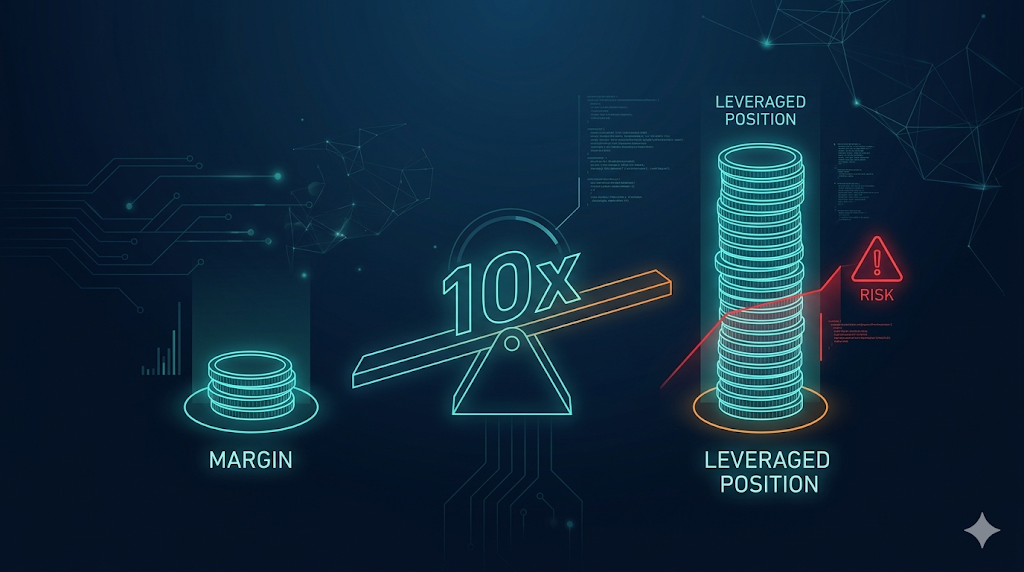
Did you know that global crypto derivatives volume surpassed a staggering $85 trillion entering 2026? Crypto futures trading is a contractual agreement to buy or sell a specific cryptocurrency at a predetermined price on a future date, utilizing borrowed capital to amplify exposure. This system allows traders to speculate on market direction without owning the underlying asset.
While margin requirements drastically increase potential purchasing power, they simultaneously introduce severe liquidation risks. Mastering these foundational mechanics is essential for surviving extreme market volatility.
Understanding Crypto Futures Contracts
Crypto futures contracts are derivative financial instruments obligating parties to transact digital assets at predetermined future prices and dates. They enable market participants to secure pricing or speculate on directional trends without taking direct custody of the underlying token. This financial abstraction fundamentally separates price speculation from asset ownership. By removing custody requirements, futures trading streamlines institutional participation and provides robust hedging capabilities against spot portfolio depreciation.
The Mechanics of Futures Agreements
Futures agreements mechanize trustless trading by establishing strict contractual parameters before execution. Buyers taking a "long" position agree to purchase the asset, anticipating price appreciation. Conversely, sellers taking a "short" position agree to deliver the asset, anticipating price depreciation. The exchange acts as the ultimate clearinghouse, matching these opposing views and mathematically enforcing the contract terms. This structural neutrality guarantees that every profitable trade is directly funded by an opposing counterparty loss.
Perpetual vs. Standard Futures
Perpetual futures lack a defined expiration date, allowing traders to hold leveraged positions indefinitely. This permanent nature makes them the dominant derivative instrument in digital asset markets. Standard futures execute on a strict chronological schedule—usually monthly or quarterly—forcing position closure or rollover upon expiration. Perpetuals mimic spot market pricing continuously, while standard contracts often exhibit price premiums or discounts reflecting future market sentiment before converging at the exact moment of expiration.
The Role of the Funding Rate
Funding rates act as an algorithmic balancing mechanism designed to anchor perpetual contract prices to the actual spot market price. When perpetual prices exceed spot prices, traders holding long positions must pay a fee to traders holding short positions. If perpetual prices fall below spot prices, the dynamic reverses, and short sellers pay long buyers. This continuous capital exchange incentivizes traders to take positions that push the derivative price back toward the underlying asset's true value.
Settlement and Delivery Methods
Cash settlement represents the overwhelming majority of cryptocurrency futures resolutions, where profits and losses are credited directly to user accounts in fiat or stablecoins. This method completely bypasses the complex logistical requirements of transferring actual blockchain tokens. Physical delivery, where the actual underlying cryptocurrency is transferred to the buyer's wallet upon contract expiration, remains rare and is typically restricted to specialized institutional platforms. Cash settlement provides superior liquidity and faster capital deployment for active traders.
The Power and Mechanics of Leverage
Leverage is a financial tool that multiplies a trader's market exposure by allowing them to control large contract sizes utilizing a fraction of their own capital. This mechanism geometrically amplifies both potential profits and catastrophic losses. By pledging a small collateral deposit, traders borrow the remaining required capital directly from the exchange. While leverage enhances capital efficiency during sustained trends, it drastically shrinks the margin of error, making accounts highly susceptible to forced liquidations during routine volatility.
How Leverage Multiplies Exposure
Leverage mathematically transforms minor market movements into significant portfolio impacts. A trader utilizing 10x leverage controlling a $10,000 position only requires $1,000 of personal capital. If the underlying asset appreciates by 5 percent, the position gains $500, representing a 50 percent return on the trader's initial margin. This multiplicative effect acts identically in reverse. A mere 5 percent price drop results in a $500 loss, instantly destroying half of the trader's deployed capital.
Calculating Initial Margin Requirements
Initial margin dictates the absolute minimum capital a trader must deposit to successfully open a leveraged futures position. This requirement scales inversely with the chosen leverage ratio. Higher leverage ratios demand lower initial margin percentages, while conservative leverage requires substantial upfront capital. Exchanges calculate this requirement dynamically based on current market volatility and the total notional value of the desired contract. Failing to meet the initial margin threshold prevents the trade from executing entirely.
Maintenance Margin Metrics
Maintenance margin establishes the critical financial baseline required to keep an active leveraged position open. This threshold is always lower than the initial margin requirement, providing a slight buffer for regular price fluctuations. If floating losses reduce the trader's remaining collateral below this mathematical threshold, the system flags the account as severely undercapitalized. Maintaining a robust buffer above this metric is the only way to survive temporary market drawdowns without losing the entire position.
Liquidation Engine Mechanics
The liquidation engine is an automated protocol designed to forcibly close underfunded positions, preventing trader balances from falling into negative territory. When a position breaches the maintenance margin threshold, the engine seizes control, executing a market order to sell the assets and repay the borrowed capital. This process often incurs additional liquidation penalty fees. The engine operates without human intervention, ensuring the financial solvency of the exchange during extreme, rapid market crashes.
Analyzing the 2026 Futures Market Landscape
The 2026 cryptocurrency futures landscape is characterized by unprecedented trading volumes, driven largely by massive institutional adoption and the rapid expansion of decentralized perpetual exchanges. Total global crypto derivatives volume reached approximately $85.7 trillion annually, solidifying futures as the primary vehicle for price discovery.
Traditional finance entities have seamlessly integrated regulated futures products into their portfolios, altering market liquidity dynamics and reducing historical volatility. This mature infrastructure now handles trillions of dollars in weekly transactional throughput.
Institutional Capital Inflows
Institutional capital flows dictate the macro trends of the 2026 derivatives market, completely overshadowing retail speculative volume. Publicly traded companies and sovereign wealth funds utilize regulated futures contracts to hedge massive spot holdings against cyclical downturns. This influx of sophisticated capital has deepened order book liquidity, drastically reducing the severity of manipulation wicks. Institutional participation provides a stable foundation, anchoring derivative prices more firmly to underlying macroeconomic indicators and traditional financial market movements.
The Rise of Decentralized Derivative Exchanges
Decentralized perpetual exchanges, commonly known as perp DEXs, captured over 10 percent of total market share by early 2026, processing trillions in cumulative volume. These platforms allow users to trade leveraged futures directly from self-custodial wallets via smart contracts, eliminating the need for centralized intermediaries. By utilizing advanced Layer-1 and Layer-2 infrastructure, these protocols offer instant finality and zero gas fees for trading execution. This technological shift provides absolute transparency regarding collateral reserves and system solvency.
Macroeconomic Influences on Trading Volume
Global monetary policy directly dictates the trading volume and open interest within cryptocurrency futures markets. When central banks implement expansionary policies and lower interest rates, borrowed capital becomes cheaper, incentivizing traders to deploy higher leverage in risk-on environments. Conversely, quantitative tightening and high interest rates suppress speculative volume as traders de-risk their portfolios. The 2026 market landscape remains highly sensitive to these macroeconomic shifts, with futures open interest visibly expanding or contracting alongside major fiat inflation data releases.
Regulatory Shifts in Global Markets
Stringent regulatory frameworks implemented across major global jurisdictions have forcefully reshaped how centralized exchanges offer leveraged products. Strict leverage limits have drastically reduced the frequency of systemic, cascading liquidations. Exchanges are now mandated to maintain transparent, cryptographically verifiable proof of reserves, ensuring they hold sufficient collateral to cover all outstanding user positions. This regulatory clarity has legitimized the industry, paving the way for further traditional finance integration.
Primary Risks in Crypto Futures Trading
Futures trading introduces extreme financial risks that simply do not exist in standard spot market purchasing, primarily revolving around rapid capital destruction via forced liquidations. The mathematical reality of leverage means that minor, routine market fluctuations can completely wipe out a trader's margin deposit in seconds. Beyond direct market risk, traders face systemic counterparty threats, severe funding rate degradation, and the intense psychological pressure of managing highly volatile, leveraged exposure during continuous 24/7 trading cycles.
Extreme Volatility Cascades
Volatility cascades occur when a sudden price movement triggers a massive wave of automated liquidations, which in turn violently pushes the price further in the same direction. When long positions are liquidated, the engine forcefully sells the asset, driving the price lower and triggering subsequent liquidations in a vicious cycle. These structural cascades cause violent "flash crashes" or "short squeezes," artificially distorting prices far beyond fundamental values and destroying over-leveraged accounts caught in the crossfire.
Counterparty and Exchange Risks
Traders assume significant counterparty risk when utilizing centralized exchanges, trusting the platform to maintain solvency and honor payouts during extreme market turbulence. If an exchange's liquidation engine fails or its insurance fund is depleted during a massive crash, successful traders may face socialized losses or restricted withdrawals. While proof of reserves mitigates some transparency concerns, the fundamental risk of platform insolvency remains a critical consideration when depositing collateral for leveraged trading.
Funding Rate Capital Erosion
Sustained exposure to negative funding rates acts as a silent tax that steadily erodes a trader's margin collateral over time. If a trader holds a long position during a massively bullish market, they must continuously pay premium funding fees to short sellers every few hours. During prolonged trends, these cumulative fee deductions can easily surpass the actual trading profits, draining the account balance and artificially pushing the position closer to the maintenance margin liquidation threshold.
The Psychological Toll of Leverage
Leverage intensely amplifies the psychological stress associated with financial speculation, frequently inducing irrational decision-making. The continuous, 24/7 nature of cryptocurrency markets means leveraged positions are constantly vulnerable to sudden global news events. Traders often suffer from sleep deprivation and severe anxiety while monitoring tight liquidation thresholds. This emotional exhaustion leads to "revenge trading"—attempting to win back losses using even higher leverage—which almost universally results in total account destruction.
Strategic Risk Management Frameworks
Effective risk management is the absolute mathematical foundation of profitable futures trading, focusing entirely on capital preservation rather than immediate profit generation. Traders must implement strict, non-negotiable rules regarding position sizing, leverage limits, and automated exit strategies. By treating trading capital as inventory, risk management frameworks ensure that a statistical sequence of consecutive losing trades cannot bankrupt the account. Surviving periods of drawdowns is fundamentally more important than capturing every localized market top.
Implementing Strict Stop-Loss Orders
Stop-loss orders are mandatory automated commands that instantly close a position when the asset price breaches a predetermined invalidation level. This mechanical exit prevents small, manageable losses from developing into catastrophic liquidations. Professional traders place stop-losses based on clear technical support or resistance levels, never risking more than 1 to 2 percent of their total account equity on a single trade. Operating a leveraged futures position without a hard stop-loss is mathematically guaranteed to result in ruin.
Dynamic Position Sizing Rules
Position sizing dictates the exact dollar amount allocated to a specific trade, scaling dynamically based on the distance to the stop-loss invalidation point. If market volatility expands, requiring a wider stop-loss to avoid being randomly triggered, the trader must drastically reduce the overall position size to maintain the strict 1 percent risk rule. This dynamic adjustment ensures that total portfolio risk remains absolutely constant, regardless of whether the trader is utilizing 2x or 50x leverage.
Utilizing Directional Hedging Strategies
Hedging involves opening an opposing futures position to temporarily neutralize the market risk of an existing, long-term portfolio without triggering taxable spot market sales. If an investor holds a significant spot Bitcoin portfolio but anticipates a short-term market crash, they can open a leveraged short futures contract. The profits generated by the short position offset the declining value of the spot assets, effectively freezing the total portfolio value during volatile downside macroeconomic events.
Monitoring Market Leverage Ratios
Traders analyze estimated market leverage ratios to accurately gauge systemic risk levels across the broader cryptocurrency ecosystem. When exchange data indicates that aggregate leverage is historically high, the market is severely overextended and primed for a violent liquidation cascade. Risk-conscious traders utilize this specific metric to proactively reduce their own position sizes and tighten their stop-loss parameters, preparing for the inevitable flush of over-leveraged retail participants before the trend resumes.
Advanced Market Data and Analytics
Advanced futures analytics rely heavily on parsing raw order flow and open interest data to determine true market sentiment, moving far beyond basic technical charting. By analyzing the structural composition of the derivatives market, traders can identify whether price movements are driven by genuine capital inflows or fragile, over-leveraged speculation.
This deep quantitative analysis provides a massive statistical advantage, allowing participants to front-run structural liquidations and execute trades based on underlying market mechanics rather than simple price action.
Interpreting Open Interest Divergences
Open interest represents the total number of outstanding futures contracts that have not been settled or closed. When asset prices rise aggressively but open interest declines, it signals that the rally is driven by forced short liquidations rather than organic, new buying pressure. This structural divergence indicates extreme market weakness, as the upward momentum lacks sustainable capital backing. Conversely, rising prices accompanied by rising open interest confirms a robust, fundamentally supported directional trend.
Volume-Profile Breakout Confirmations
Volume-profile analysis examines the distribution of trading volume across specific price levels, identifying massive clusters of historical liquidity. Breakouts past these dense liquidity zones must be accompanied by a significant surge in futures volume to be validated. If a breakout occurs on low relative volume, it is highly probable to be a false movement—a "fake-out"—engineered to trigger retail stop-losses before reversing direction. High-volume confirmation is the only mathematical validation of a true trend change.
Analyzing Long-Short Ratio Data
The long-short ratio measures the relative proportion of accounts holding bullish positions versus bearish positions within a specific exchange. While often viewed as a simple sentiment indicator, professionals use it strictly as a contrarian tool. When the ratio overwhelmingly skews toward long positions, the market is critically unbalanced and vulnerable to a severe downside liquidation cascade. The smart money typically positions itself aggressively against these heavily crowded, emotionally driven retail consensuses.
The Concept of Basis and Contango
Basis refers to the numerical difference between the futures contract price and the underlying spot market price. When a market is in contango, futures prices trade at a premium to the spot price, indicating strong bullish sentiment and a high willingness to pay for future delivery. This structure allows institutional arbitrageurs to execute "cash and carry" trades, buying the spot asset and simultaneously shorting the futures contract, locking in a guaranteed, mathematically risk-free yield upon expiration.
Margin Modes: Cross vs. Isolated
Margin modes determine exactly how an exchange utilizes your deposited collateral to sustain open futures positions, representing a critical choice in risk architecture. Isolated margin strictly confines the potential loss to the specific capital allocated to a single trade, establishing a hard firewall. Cross margin pools the entire account balance, utilizing all available capital to prevent the liquidation of any individual position. Understanding the structural differences between these two modes is essential for accurate portfolio defense.
Advantages of Isolated Margin
Isolated margin provides the ultimate defensive architecture by restricting maximum potential losses directly to the initial margin deployed for that specific contract. If a catastrophic flash crash liquidates the position, the rest of the trader's account balance remains completely untouched. This mode is absolutely mandatory for highly speculative, high-leverage trades on volatile altcoins. It mechanically forces traders to adhere to strict position sizing rules, acting as an involuntary stop-loss during extreme market dysfunction.
Leveraging Cross Margin Flexibility
Cross margin maximizes capital efficiency by allowing multiple floating positions to share a single, unified collateral pool. Unrealized profits from a winning trade can directly offset the floating losses of a separate losing trade, significantly reducing the probability of localized liquidations. This mode is optimal for advanced traders managing complex, multi-asset portfolios or executing delta-neutral hedging strategies. However, a massive systemic crash can instantly vaporize the entire pooled account balance if proper stop-losses fail.
Bankruptcy Price Calculations
The bankruptcy price represents the exact mathematical point where a trader's margin collateral is completely exhausted, leaving zero equity in the position. Exchanges always initiate the liquidation protocol slightly before the price reaches this absolute bankruptcy level to ensure they can safely close the trade and recover borrowed funds.
If the market moves so fast that the closing price is worse than the bankruptcy price, the exchange's centralized insurance fund must cover the resulting deficit.
| Margin Mode | Capital Utilization | Liquidation Risk | Optimal Strategy Use Case |
| Isolated | Confined to specific trade | Limited to allocated margin | High-leverage speculative entries |
| Cross | Shared across all positions | Total account balance exposed | Complex multi-asset portfolio hedging |
Trading on KuCoin Crypto Futures offers direct access to an institutional-grade derivatives platform equipped with advanced execution mechanics.
You can maximize your capital efficiency and manage risk through primary features:
Access the Derivatives Hub: Navigate directly to the KuCoin Futures platform to trade highly liquid contracts with flexible leverage options, allowing you to capture market volatility or hedge your spot portfolios cleanly.
Deploy Advanced Automation: Integrate your derivative strategies with a native KuCoin Trading Bot to systematically buy low and sell high, capitalizing on market swings 24/7.
Conclusion
Crypto futures trading represents the pinnacle of digital asset speculation, offering unparalleled tools for capital efficiency, directional hedging, and sophisticated market positioning. The mathematical mechanics of leverage act as a powerful multiplier, geometrically amplifying both potential returns and the velocity of capital destruction. While institutional integration has stabilized broader liquidity, the fundamental threat of rapid, forced liquidations remains the primary obstacle for market participants. Mastering the complex dynamics of initial margins, maintenance thresholds, and funding rate erosion is absolutely non-negotiable for survival.
By respecting the immense power of leveraged contracts and operating strictly within defined statistical boundaries, participants can successfully navigate the complexities of the modern crypto derivatives landscape.
FAQs
What happens if the exchange insurance fund runs out of money?
If an extreme market crash completely depletes the exchange's insurance fund, the platform implements Auto-Deleveraging. This protocol forcibly closes the highly profitable positions of opposing traders to cover the bankrupt accounts' deficits, ensuring the exchange remains mathematically solvent.
Can I owe the exchange money if my position liquidates terribly?
No, modern cryptocurrency exchanges utilize automated liquidation engines specifically to prevent your account from falling into a negative balance. Your maximum potential loss is strictly limited to the margin collateral you have deposited; you cannot incur debt to the exchange.
How exactly do funding rates affect my long-term holding strategy?
Funding rates act as a continuous fee exchanged between long and short positions to keep the perpetual price anchored to the spot market. If you hold a long position during a bull market, you will consistently pay high funding fees, which severely erodes your margin collateral over extended timeframes.
Why does the liquidation price change when I use cross margin?
In cross margin mode, your entire account balance acts as shared collateral for all open positions. As your other trades fluctuate in value, or as you deposit or withdraw funds from the account, the unified collateral pool changes, dynamically adjusting the liquidation price of every active position.
Is it possible to trade futures without using any leverage?
Yes, trading futures at 1x leverage is entirely possible and simply means you are matching the contract's notional value with your own deposited capital. This effectively mimics spot trading but allows you to utilize futures-specific mechanics, such as short selling or capturing favorable funding rate premiums.
Disclaimer:This content is for informational purposes only and does not constitute investment advice. Cryptocurrency investments carry risk. Please do your own research (DYOR).