

How to Earn ROSE with KuCoin?
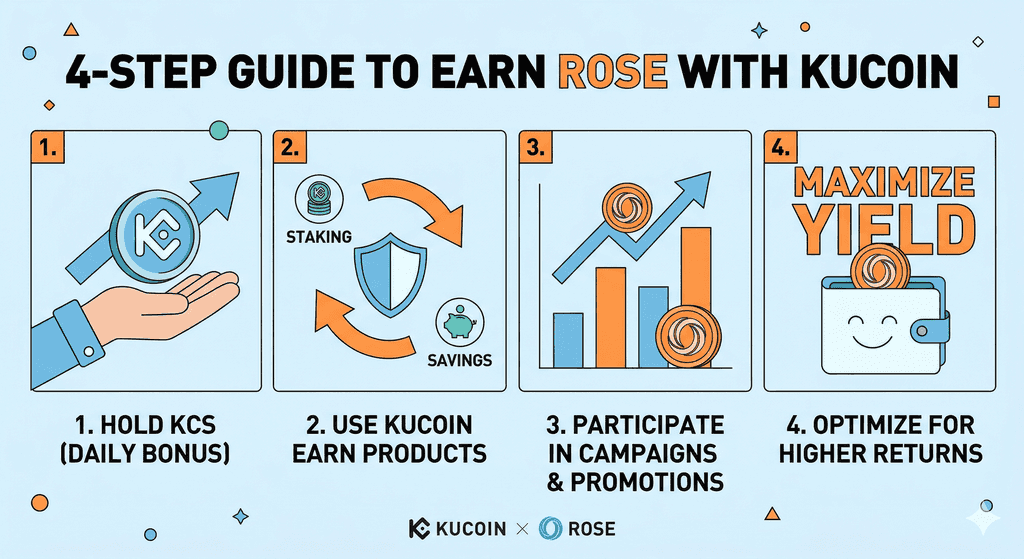
As ROSE, the native token of the Oasis Network, continues to gain traction in privacy‑focused DeFi, KuCoin now offers several earning pathways that go beyond simple holding. From KuCoin Earn products to staking with verified platforms and calculating realistic reward outcomes, this article explains how to make your ROSE work harder while keeping the approach clear and precise.
How ROSE Functions and Why You Can Earn from It
Earning with ROSE starts with understanding what the token represents. ROSE is the native asset of the Oasis Network, a Layer‑1 blockchain designed to enable privacy‑preserving smart contracts and data tokenization. As of 2026, ROSE is widely traded with major liquidity on KuCoin and other exchanges, and can be used in protocol‑level functions like paying transaction fees, staking, and governance participation.
Traditionally, tokens like ROSE generate rewards because blockchain networks built on proof‑of‑stake (PoS) mechanisms require token holders to secure the network. By participating directly (staking) or via platforms like KuCoin Earn, holders contribute to the network’s consensus and are rewarded with additional ROSE. Staking rewards derive from the fact that network inflation typically allocates a portion of new tokens to active stakers, compensating them for locking up tokens that improve network security and decentralization.
KuCoin’s role in this ecosystem is as a major centralized venue where users can both trade and “earn” on crypto holdings. Unlike simply holding an asset that relies on price appreciation alone, earning mechanisms such as staking or KuCoin Earn products provide incremental income, for example, accruing periodic ROSE payouts based on network or platform‑set reward rates. This dual functionality, liquidity and earning potential, is what makes ROSE an attractive token for users focused on yield participation.
KuCoin Earn: A Real Pathway to Earn With ROSE
One of the most accessible first steps to earn with ROSE on KuCoin is through KuCoin Earn, a suite of passive income products that let you “put your crypto to work.” The Earn page on KuCoin offers everything from Flexible and Fixed opportunities to staking‑like products for various cryptocurrencies, including ROSE.
KuCoin Earn categorizes products into two major types: Simple Earn products (Flexible/Fixed) and structured reward products like dual investments or staking. For ROSE specifically, Simple Earn might show mid‑range APRs, for example, recent listings show ROSE flexible and fixed terms with estimated returns in the range of about 0.5% to 3.5% depending on term and product availability.
Let’s break down a real calculation: Suppose you deposit 10,000 ROSE into a Fixed KuCoin Earn product offering a 3.0% annual yield. At the end of one year, your ROSE would generate about 300 ROSE in returns, assuming rates stay constant. This yield is in addition to any price movement of ROSE itself. If ROSE’s price remains unchanged, you’d have 10,300 ROSE after one cycle.
Flexible products usually have lower yields but allow withdrawals anytime. This can be useful if you want liquidity while still earning modest rewards. Fixed terms lock the asset for a set period and tend to offer higher returns, ideal for patient holders. Always visit the actual KuCoin Earn page to check current ROSE products because rates change in response to market conditions.
Staking ROSE Outside KuCoin: How It Works and What Rewards Look Like
While KuCoin Earn gives access to passive returns, the native staking model of the Oasis Network provides arguably the most direct and potentially higher reward structure for ROSE holders who want to earn by securing the network itself. Staking delegates ROSE to validators, who verify transactions and maintain consensus. These validators earn rewards that are then shared with delegators after fees.
Native staking typically involves a lock‑up period (often around 14 days for unbonding) and the delegation process through wallets or validator interfaces. Blockchain documentation suggests annualized returns can range up to around 20% APY depending on validator performance, network conditions, and total staking participation.
For example, imagine you choose to stake 5,000 ROSE at an APY of 10% over one year (a moderately conservative real‑world rate).
The calculation would be:
5,000 ROSE × 0.10 = 500 ROSE earned over 12 months.
This payout is delivered incrementally based on network epochs and adds directly to your staked balance over time.
Practical staking steps include connecting a compatible wallet, selecting a reputable validator, and then approving the delegation. You can further track and calculate staking rewards using community staking tools or the Oasis staking calculator that factor in locked duration and APY changes.
Comparing KuCoin Earn vs. Native Staking Outputs
Understanding the earning potential of ROSE requires comparing the various methods available, the easiest being KuCoin Earn and the more technical being direct blockchain staking. KuCoin Earn offers convenience with automated payout and custodial simplicity, but generally yields lower reward percentages because it must balance risk, liquidity, and platform policy.
By contrast, staking directly on the Oasis Network often offers higher theoretical yields because participants engage directly with protocol economics rather than intermediate custodial products. Real historical data suggests this could be 5–20% depending on period and conditions.
So how does a typical yearly comparison look for the average user? If you deployed the same 10,000 ROSE into (a) KuCoin Earn at 3% and (b) native staking at 10%:
-
KuCoin Earn: ~300 ROSE per year
-
Oasis Staking: ~1,000 ROSE per year
That’s more than 3× the ROSE yield in this simplified calculation, but requires active delegation and understanding of network behavior. This kind of side‑by‑side comparison helps clarify goals: convenience and liquidity versus higher potential yield with more involvement.
Real Calculation Example: Yearly ROSE Earnings
Working from live price data can help estimate real‑world return value. Suppose ROSE is trading around $0.0126 USD based on KuCoin pricing data. Using the earlier staking example where you earn 500 ROSE per year on a 10% staking yield, the USD value of that would be:
500 ROSE × $0.0126 ≈ $6.30 in token rewards.
If the ROSE price rises or falls, that number changes quite rapidly.
Comparatively, KuCoin Earn returning 300 ROSE gives:
300 ROSE × $0.0126 ≈ $3.78.
While $6.30/$3.78 might sound modest, the real income effect grows with larger stakes. For example, staking 50,000 ROSE at 10% yields 5,000 ROSE annually, approximately $63 at a constant price. Because crypto prices are volatile, total earnings will also vary depending on asset appreciation or depreciation.
Using simple annualized projections helps users assess whether holding or earning fits their objectives and risk tolerance. Tools like the CoinLedger profit calculator can help estimate scenario outcomes over time.
Timing Returns: How Often ROSE Rewards Hit Your Wallet
Reward frequency matters when earning with ROSE. Native staking rewards are often issued per block epoch (sometimes multiple times per day), meaning that earnings accumulate incrementally throughout the year.
KuCoin Earn rewards are usually calculated daily but credited upon redemption or end of term depending on product design. Fixed term products often have a defined maturity date when compounded rewards settle back into your account. This means users who compound (re‑stake earned ROSE) can significantly enhance yield over time. Imagine reinvesting 500 earned ROSE back into staking, that additional amount also starts earning, compounding your annual total.
Many community staking dashboards and KuCoin UI tools show projected annual yields based on current metrics, but these estimates change frequently due to active network participation and product demand. Regular tracking allows investors to adjust positions when new opportunities arise or when reward rates shift.
Smart Strategies for ROSE Earning on KuCoin
Maximizing ROSE earnings has a strategic element beyond simply choosing a product. Experienced users often diversify across KuCoin Earn options and direct staking to balance liquidity and yield. For example, allocating 70% of ROSE to a fixed KuCoin Earn product and 30% to a longer‑term staking delegation could balance short‑term return with higher long‑term income.
Another tactic is monitoring KuCoin Earn rates over time. Because yield products fluctuate with supply and demand, entering a flexible term during high rate windows (e.g., when Earn rates jump) locks in better returns while preserving future liquidity.
Advanced users consider market cycles. During periods of expected price appreciation, locking ROSE in longer yield products may be more attractive than trading. But if expecting volatility, shorter flexible terms allow exit when price swings occur.
Using external earning metrics (e.g., community staking calculators) gives additional perspective. These strategies help users combine earning with broader market timing, a practice today’s top crypto participants use to enhance overall performance.
Futures: How Price Movement Affects Your ROSE Earnings
It’s crucial to separate token yield from token value appreciation. Earning 500 ROSE in one year can be job‑like in token terms, but if ROSE price doubles in that same period, your dollar value earnings more than double. Conversely, if ROSE price halves, your earnings shrink correspondingly.
This dynamic is what makes crypto yield different from traditional fixed income. Your yield in token units might be excellent, but value realized depends on market pricing. KuCoin pricing data and live feeds allow you to track ROSE price action in real time, which helps align yield strategies with trading or holding goals.
Understanding Compound Yield: How Reinvesting ROSE Can Maximize Returns
While earning ROSE through KuCoin Earn or staking is valuable, the real power comes from compounding, reinvesting your earned rewards back into the same earning mechanism. Compound yield allows your ROSE to generate returns not only on your initial investment but also on the accumulated rewards, exponentially increasing potential income over time. This strategy is particularly effective for tokens like ROSE, which offer consistent staking or Earn payouts.
To illustrate, imagine you stake 10,000 ROSE at a 10% annual percentage yield (APY). Over one year, you would earn 1,000 ROSE. By immediately reinvesting these 1,000 ROSE back into staking at the same APY, your effective return the following year increases, because your staking base has grown to 11,000 ROSE. Over multiple years, this reinvestment cycle can lead to significant accumulation, particularly if ROSE price appreciates simultaneously.
Compound yield also offers flexibility depending on product choice. KuCoin Earn flexible products allow daily compounding if users manually reinvest their earnings, while fixed-term products often automate the process upon term completion. Staking rewards on-chain usually accrue incrementally, giving delegators the option to manually or automatically reinvest depending on wallet or platform features.
Understanding compounding is critical for any serious ROSE holder. It allows users to strategically plan their earning timeline, calculate projected rewards more accurately, and make informed decisions on whether to prioritize liquidity or maximize long-term gains. Incorporating compounding into your ROSE strategy can elevate passive income from a modest addition to a substantial, high-performing asset growth mechanism.
Tips for Tracking Your ROSE Reward Performance
Some portfolio trackers integrate ROSE and reward tracking, showing both value and yield. These tools help you monitor reward inflows, evaluate compound effects, and determine the best re‑allocation timing.
FAQs
-
Can I earn ROSE on KuCoin without staking?
Yes. KuCoin Earn offers products that pay ROSE for holding it in flexible or fixed terms, even without traditional staking actions.
-
How often are ROSE staking rewards paid?
Native staking distributions typically occur multiple times per day based on epoch transitions.
-
Is there a minimum ROSE amount required to earn on KuCoin Earn?
Minimum amounts vary by product, but KuCoin Earn usually displays the minimum subscription requirements directly in the product details.
-
Do I have access to my ROSE while earning?
Flexible products let you redeem anytime, whereas fixed terms lock your ROSE until maturity. Native staking has unbonding periods.
-
How do I calculate potential ROSE earnings?
Multiply your token amount by the APY of the product to estimate yearly rewards (e.g., 0.10 × your total ROSE for a 10% APR). Then convert it to dollars using the ROSE price.
-
Are KuCoin Earn and native staking better together?
Many users combine both to balance yield and liquidity. KuCoin Earn is more accessible, while native staking can offer higher returns. Balancing both can optimize overall performance.
Disclaimer
This content is for informational purposes only and does not constitute investment advice. Cryptocurrency investments carry risk. Please do your own research (DYOR).