

ZEUS Wallet Goes Offline After Cyberattack: Why No Customer Funds Were Lost
2026/08/07 18:22:00
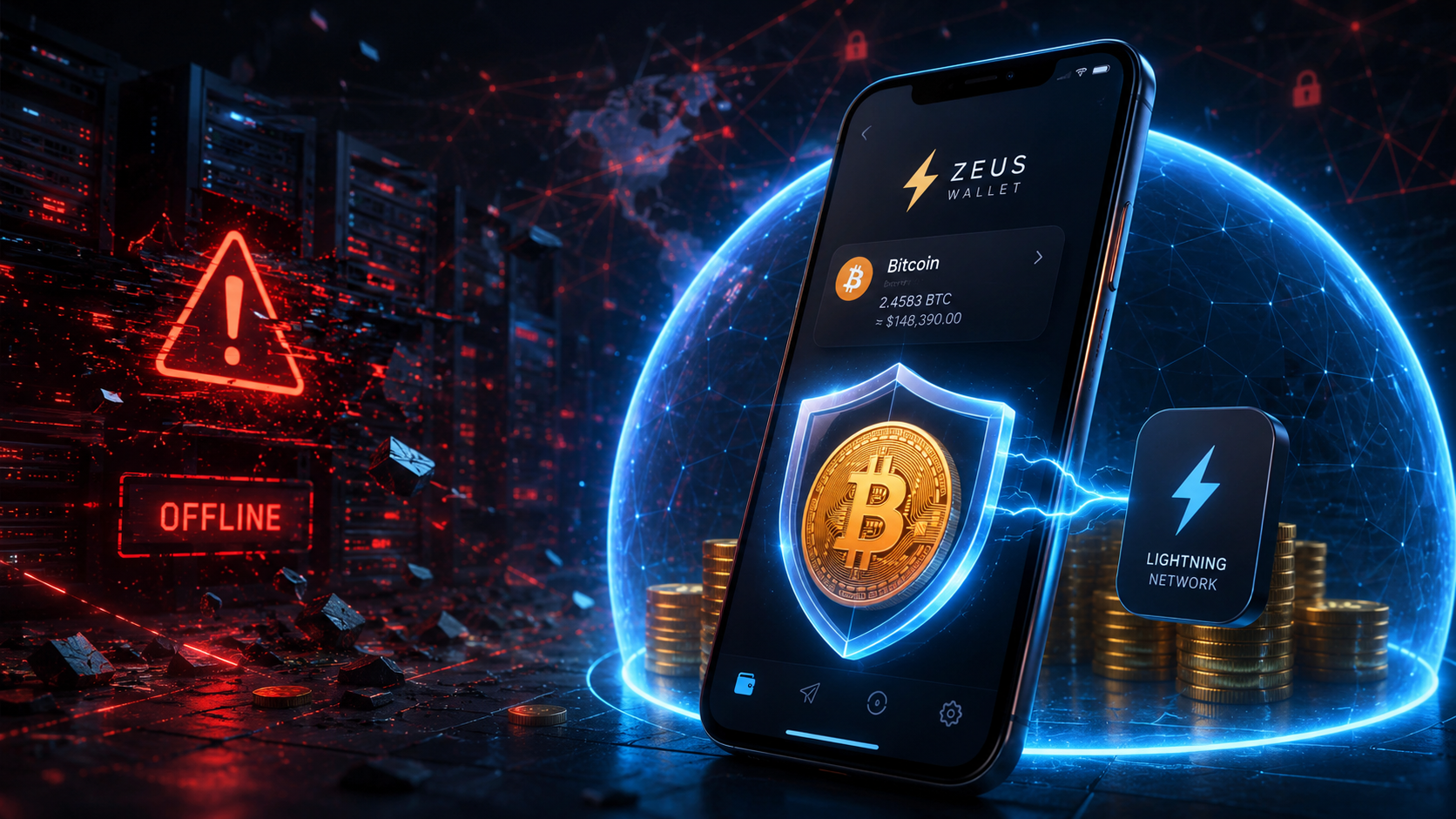
A cyberattack forced ZEUS Wallet to take parts of its infrastructure offline on August 5, 2026, raising immediate concerns among Bitcoin and Lightning users. The security incident was contained within hours, but ZEUS chose to keep affected systems offline while conducting a broader audit. Some Lightning Service Provider channels were closed during the disruption, and several services had to be restored gradually rather than immediately. Yet the most important part of the incident was what did not happen: ZEUS said no customer funds were lost or placed at risk.
That contrast makes the attack more important than a routine wallet outage. ZEUS describes itself as a self-custodial Bitcoin and Lightning wallet, which means users retain direct control of their funds rather than depositing Bitcoin into a centralized company-controlled pool. The incident therefore offers a practical case study in the difference between infrastructure security and custody security. A crypto service can suffer a serious backend compromise without automatically giving attackers control over customer Bitcoin.
So how did ZEUS go offline while user funds stayed safe? And what does the attack reveal about the strengths—and remaining weaknesses—of self-custodial crypto wallets?
What Happened to ZEUS Wallet?
ZEUS detected the security incident on August 5 and moved quickly to contain it. According to reports based on the company's disclosure, the breach was brought under control within several hours. Rather than immediately reconnecting every system after containment, ZEUS took affected infrastructure offline and began a full security review. That decision caused service disruption, but it also reduced the risk of restoring potentially compromised systems before investigators understood the scope of the attack.
Some users experienced a more direct impact. Lightning Service Provider channels were closed during the incident, affecting parts of the Lightning experience even though customer funds were not reported stolen. ZEUS said users affected by those channel closures would receive replacement channels after the relevant infrastructure was restored. The incident therefore created a genuine operational problem, but the available evidence does not support describing it as a mass wallet-draining attack.
The distinction is essential. A company can have servers, APIs, networking infrastructure, or operational systems compromised without an attacker necessarily gaining control of the private keys required to move customer Bitcoin. ZEUS has also said its investigation found no evidence that the attack resulted from an exploitable flaw in Lightning node software itself. At this stage, the confirmed event is a ZEUS infrastructure breach, not a confirmed compromise of Bitcoin, the Lightning protocol, or users' signing keys.
Why No Customer Funds Were Lost
The key to understanding the outcome is self-custody. In a traditional custodial platform, users deposit assets into wallets controlled by the company. The company manages the private keys, security systems, withdrawal logic, and transaction signing. If an attacker compromises those critical systems deeply enough, customer assets can become directly exposed because custody itself is centralized.
A self-custodial wallet uses a different model. The user's wallet retains the authority required to sign transactions, while the company may provide software and surrounding infrastructure. ZEUS supports an embedded Lightning node and other configurations that allow users to maintain direct control over Bitcoin rather than handing custody to ZEUS. Its wider infrastructure can improve connectivity, routing, liquidity, channel management, backups, and usability, but those services are not the same thing as ownership of every user's funds. ZEUS describes its broader stack as including an LSP, Lightning payment tools, block data, swaps, recovery tools, and other infrastructure around the wallet experience.
| Security Question | Custodial Platform | Self-Custodial Wallet |
| Who normally controls private keys? | Platform | User |
| Can a server breach expose pooled customer funds? | Potentially yes | Not automatically |
| Can services still go offline? | Yes | Yes |
| Does downtime mean funds are lost? | Not necessarily | Not necessarily |
| Main lesson from ZEUS incident | Central custody can concentrate risk | Infrastructure compromise and custody compromise can remain separated |
That separation is what appears to have mattered here. An attacker targeting ZEUS infrastructure did not automatically gain the cryptographic authority needed to move customer Bitcoin. Self-custody did not prevent the cyberattack, but it helped limit what an infrastructure compromise could become.
Self-Custody Does Not Mean Zero Downtime
The ZEUS incident also exposes a misconception about self-custody: owning your keys does not mean every wallet feature operates independently of third-party infrastructure. Modern Bitcoin and Lightning wallets often rely on a combination of network data, routing information, payment services, liquidity providers, APIs, exchange-rate feeds, notifications, backups, swap providers, and other components that sit around the core signing process.
ZEUS itself operates a substantial Lightning infrastructure stack. Its Lightning Service Provider opens payment channels to users, helping them receive payments and connect efficiently to the Lightning Network. The company also provides block-related services, routing features, automated backups, recovery tools, and multiple Lightning channel services. If some of that infrastructure becomes unavailable, users may experience degraded functionality even while the underlying Bitcoin remains under their control.
This leads to one of the most useful lessons from the attack: asset ownership and service availability are different security properties. Self-custody primarily answers the question, “Who has authority over the money?” It does not guarantee that every interface, routing service, Lightning channel, price feed, or backend API will remain online at all times. A wallet can therefore become temporarily less useful without becoming financially compromised.
What Happened to Lightning Users?
Lightning users were the group most visibly affected by the incident because some Lightning Service Provider channels were closed. LSPs help wallets connect to the Lightning Network by providing channels and inbound liquidity. ZEUS operates multiple LSP services, including infrastructure designed to create channels when payments arrive and help simplify Lightning onboarding.
A channel closure can disrupt the user's ability to send or receive payments through the same path, but it should not automatically be interpreted as the disappearance of the user's Bitcoin. Lightning channels ultimately settle through Bitcoin's base layer, and their state is governed by protocol rules. Operational disruption can therefore create inconvenience, channel-management requirements, or delays without meaning the underlying BTC has been stolen.
ZEUS said affected users would receive replacement LSP channels once the relevant services returned. That response reinforces the distinction between fund loss and service disruption. Customer money appears to have remained safe, but some users still faced an operational cost from the attack. This is why describing the incident simply as “nothing happened because no funds were stolen” would understate its significance.
Was the Lightning Network Hacked?
No public evidence currently indicates that the Lightning Network itself was compromised. ZEUS has said its investigation found no vulnerability in its Lightning node software that could explain the attack. Reports consistently describe the incident as being confined to ZEUS-controlled infrastructure rather than the underlying Bitcoin or Lightning protocols.
That distinction is similar to the difference between an online bank being hacked and the global banking system itself being cryptographically broken. ZEUS is an application and infrastructure provider operating on top of Bitcoin and Lightning. A breach of its servers does not automatically mean Bitcoin's consensus rules, Lightning payment channels, or Lightning implementations have failed.
The current evidence therefore supports a narrower conclusion: ZEUS suffered a company-level cybersecurity incident that affected services built around Lightning. It does not support claims that attackers “hacked Bitcoin” or “broke the Lightning Network.” Unless the company's continuing audit uncovers something substantially different, those stronger descriptions would exaggerate the available facts.
What We Still Don’t Know About the Attack
The biggest unanswered question is the attack vector. ZEUS has not publicly disclosed a complete technical post-mortem explaining exactly how attackers gained access. There is no confirmed public account yet of whether the incident involved stolen credentials, a cloud configuration problem, a vulnerable service, an exposed administrative interface, compromised third-party software, or another route.
We also do not yet have a full public description of what systems attackers accessed, how long they retained access, whether sensitive operational data was viewed, or what indicators ultimately allowed ZEUS to detect the intrusion. Those details matter because “funds were safe” and “the full impact is known” are not the same claim. Security teams often need days or weeks of forensic analysis to determine whether attackers moved laterally between systems or accessed data that was not immediately visible during containment.
For that reason, the most important future disclosure may be ZEUS's eventual post-mortem rather than the initial incident notice. Until that audit is complete, responsible analysis should avoid confidently naming a vulnerability that the company itself has not confirmed. What is known is already significant; inventing an attack mechanism would only reduce the reliability of the story.
Why ZEUS Is Looking at Stronger Signing Isolation
The attack has also renewed attention around security models that separate an operational Lightning node from the keys that authorize payments. One approach is the Validating Lightning Signer, or VLS. The concept is relatively simple: the software communicating with peers and routing payments does not independently hold unrestricted authority to sign every possible transaction.
Instead, the operational node requests signatures from a separate component that retains the private keys and independently checks whether the requested action follows protocol rules and operator-defined policies. If the internet-facing Lightning node becomes compromised, an attacker may gain access to the node's network environment without automatically gaining the ability to sign malicious state updates. OpenSats describes VLS as an architecture in which the signer can enforce controls such as approved destinations, spending limits, and velocity limits before authorizing actions.
This reflects a broader shift in cybersecurity thinking. Strong systems increasingly assume that some server or endpoint may eventually be breached. Security architecture is therefore designed to limit what happens next. Instead of relying entirely on the assumption that “the node will never be compromised,” signing isolation asks a more realistic question: if the node is compromised, can we stop that compromise from becoming a loss of Bitcoin?
What the Attack Teaches About Wallet Security
Crypto users often discuss wallet security as if there were only two outcomes: “safe” or “hacked.” In reality, security exists across multiple layers. A user can control keys securely while a backend API fails. A company can suffer an infrastructure breach while the blockchain remains intact. A protocol can work exactly as designed while a user falls for phishing. Understanding which layer failed is more useful than reacting to the word “hack” alone.
The ZEUS incident can be understood through three separate risks. Custody risk concerns who controls the private keys and signing authority. Infrastructure risk concerns servers, routing systems, APIs, payment infrastructure, databases, and other operational services. Protocol risk concerns the Bitcoin and Lightning rules themselves. In this case, infrastructure risk appears to have materialized while custody and protocol security remained separated from it.
That separation is a desirable property. Mature financial infrastructure should be designed so a problem in one component does not automatically become a total-system failure. ZEUS's ability to take systems offline, preserve user funds, and rebuild affected Lightning services demonstrates the value of compartmentalization. The incident still matters, but the absence of customer losses suggests the blast radius was substantially smaller than it could have been under a more centralized custody model.
What ZEUS Users Should Do Now
There is currently no public evidence suggesting every ZEUS user needs to urgently move all Bitcoin solely because of this event. However, security incidents create an ideal environment for secondary scams. Attackers frequently impersonate support teams, send fake recovery notices, or claim that users must “verify” wallets immediately. A legitimate infrastructure incident can therefore become the bait for an unrelated phishing campaign.
Users should focus on a small number of practical precautions:
-
Follow ZEUS security updates through official channels rather than links sent by strangers.
-
Never enter a seed phrase or private key into a website claiming it is required to restore ZEUS services.
-
Treat unsolicited support messages, direct messages, and “emergency migration” requests as suspicious.
-
Check the status of Lightning channels once relevant ZEUS services are restored.
-
Keep wallet recovery information backed up offline and verify that it is still accessible.
-
If using large amounts of Bitcoin, consider separating long-term savings from frequently used Lightning balances.
The key principle is not panic; it is verification. Because users retain custody, the greatest new danger after a public security incident may actually come from someone convincing them to voluntarily surrender the credentials the original attacker never obtained.
Why This Matters Beyond ZEUS Wallet
The broader crypto ecosystem is moving toward increasingly complex wallet infrastructure. Wallets are becoming gateways to Lightning payments, DeFi, swaps, payment processors, bridges, AI agents, trading systems, stablecoins, and identity tools. Users may technically retain custody while depending on a growing network of services that make those assets useful.
That means the industry's next security challenge is not simply persuading users to choose “custodial” or “non-custodial.” The harder challenge is designing self-custodial products that remain resilient when surrounding infrastructure inevitably suffers bugs, outages, attacks, or provider failures. A user should ideally be able to preserve control of funds even if the service layer becomes unavailable.
ZEUS's incident illustrates the concept of damage containment. Its infrastructure was attacked and part of the Lightning experience was disrupted, but the incident did not immediately turn into a customer-funds crisis. That is an important property for any crypto system. The strongest security model may not be the one that promises never to be breached—a promise no serious security team can guarantee—but the one that minimizes the amount of authority an attacker gains when a breach does occur.
|
KuCoin is celebrating its 9th anniversary with a special platform campaign filled with exclusive rewards, trading activities, and limited-time offers. Don’t miss the chance to participate and enjoy the benefits as the exchange marks nine years of growth and innovation. Visit the official campaign page now:
|

Conclusion
The ZEUS Wallet cyberattack demonstrates why “wallet hacked” can be an incomplete description of a crypto security event. ZEUS suffered a genuine infrastructure breach, took affected systems offline, and disrupted some Lightning services. Some LSP channels were closed, and the company began a full audit rather than immediately returning every system to production. But ZEUS reported no customer-fund losses, and investigators have not identified a Lightning node software vulnerability behind the attack.
The reason matters. Self-custody separated the operation of ZEUS's infrastructure from the ultimate authority over users' Bitcoin. That did not make ZEUS immune to cyberattacks, nor did it prevent downtime. It did, however, help prevent an infrastructure incident from automatically becoming a custody crisis.
For Bitcoin users, that may be the most important lesson. Security should not be judged only by whether an attack happens. It should also be judged by the system's ability to contain the consequences.
The strongest crypto security model may not be one that never gets attacked, but one that limits what an attacker can do when an attack succeeds.
FAQs
Can I still access my Bitcoin if a self-custodial wallet company shuts down?
In many self-custodial setups, the company does not own the underlying Bitcoin. If users possess the correct recovery information and the wallet follows compatible standards, they may be able to restore access using other software or recovery methods. Lightning configurations can be more complicated because channel state and node backups may matter, so users should understand the recovery process for their specific wallet rather than assuming every seed phrase works identically across applications.
Can hackers steal Bitcoin just by hacking a wallet company’s server?
Not necessarily. To move Bitcoin, an attacker generally needs access to valid signing authority, such as a private key or a system capable of producing authorized signatures. A company server breach could become dangerous if the server controls those keys, but in a self-custodial architecture the user may retain the keys elsewhere. That separation can stop a backend compromise from automatically turning into a wallet drain.
Should I move my Bitcoin after a wallet cyberattack?
The correct response depends on the type of incident. If private keys, signing devices, or wallet-generation systems are suspected of compromise, moving funds to a newly generated secure wallet may be appropriate. If the incident only affects company infrastructure and users still control uncompromised keys, urgent migration may not be necessary. Users should rely on verified technical advisories rather than reacting to social-media speculation.
Are Lightning wallets safer than centralized exchanges?
They have different risk models. A self-custodial Lightning wallet can reduce exposure to centralized custody because users retain control of their Bitcoin. However, Lightning introduces operational concerns involving channels, liquidity, online nodes, backups, and routing. Centralized exchanges may simplify those issues but require users to trust the exchange with custody. Neither architecture eliminates risk; they distribute it differently.
What is the difference between a wallet outage and a wallet hack?
A wallet outage means users temporarily cannot access some services, but it does not necessarily involve unauthorized access. An infrastructure hack means attackers have compromised company systems, yet that still does not automatically mean wallet keys were stolen. A private-key compromise is more serious because the attacker may gain direct authority to move assets. Distinguishing these events is essential when evaluating any crypto security incident.
Disclaimer: This content is for informational purposes only and does not constitute investment advice. Cryptocurrency investments carry risk. Please do your own research (DYOR).