



What is Arc blockchain built by circle?
2026/05/13 09:12:02
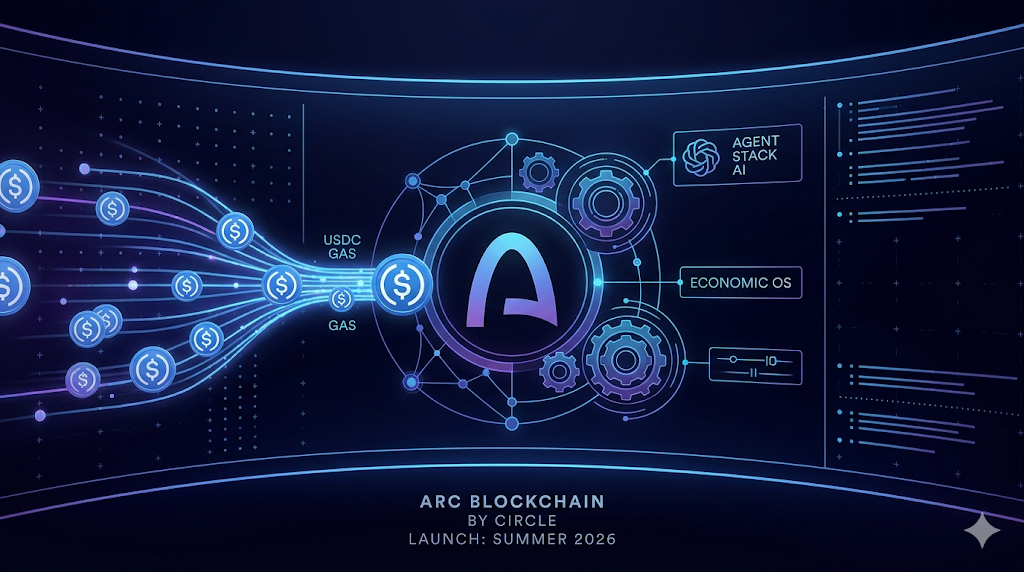
Arc is a newly announced, institutional-grade Layer 1 public blockchain built by Circle to unite programmable money with real-world economic activity. Following a $222 million token presale led by Andreessen Horowitz in May 2026, the network is purpose-built to serve as an "Economic OS" for stablecoin-native finance. Unlike general-purpose blockchains, Arc utilizes USDC for gas fees and features sub-second deterministic finality, offering banks and AI agents a compliant, high-speed settlement layer.
To understand this ecosystem, you should familiarize yourself with these core concepts:
Layer 1 blockchain: A base network infrastructure that validates and records independent transactions without relying on external chains.
Smart contract: Self-executing digital code that automatically enforces agreements without requiring third-party intermediaries.
USDC stablecoin: A heavily regulated, fiat-collateralized digital currency that remains pegged directly to the US dollar.
The Core Architecture of the Arc Blockchain
Arc is an open, EVM-compatible Layer 1 blockchain designed from the ground up to process stablecoin-native financial activity, with its mainnet officially expected to launch in Summer 2026. Circle built this network to act as an "Economic OS", a foundational operating system that provides internet applications with the core tools required for seamless money movement. According to an April 2026 architectural breakdown by Coin Bureau, Arc is not a Layer 2 rollup built on top of another chain; it is a completely standalone infrastructure combining a highly specialized, dedicated consensus layer with an Ethereum-style execution environment.
This execution layer is based on Reth, granting developers a deeply familiar and robust toolkit while simultaneously extending the system with stablecoin-native modules. By controlling the entire technology stack from consensus to execution, Circle ensures that the network is explicitly optimized for institutional payments, high-volume trading, and predictable corporate treasury management rather than speculative retail trading and meme coin launches. The architecture intentionally avoids the heavy fragmentation seen in the broader cryptocurrency ecosystem, providing a singular, highly efficient execution layer for fiat-backed digital assets.
Sub-Second Finality and USDC-Denominated Gas Fees
Arc utilizes USDC as its native gas token and delivers deterministic settlement finality in under 0.5 seconds, eliminating the severe operational uncertainty that plagues legacy blockchains. Traditional networks like Ethereum rely heavily on probabilistic finality, meaning transactions can technically be reorganized, delayed, or entirely reversed under extreme network stress or malicious attacks. On Arc, once a transaction is confirmed by the consensus engine, it is mathematically irreversible and immediately finalized, meeting the strict risk-management requirements of global financial institutions and central clearinghouses.
Based on a May 2026 testnet performance report by PANews, the Arc testnet, which officially launched in October 2025, had already successfully processed over 244.1 million transactions with near-perfect network uptime. By denominating all transaction fees strictly in a US dollar-pegged stablecoin rather than a highly speculative asset, corporate treasury departments can accurately forecast their infrastructure costs months in advance without suffering from the extreme volatility typical of native cryptocurrency gas tokens. This predictable fee structure removes one of the largest remaining barriers to mainstream corporate adoption of blockchain technology.
Why Circle Built an Institutional-Grade Network
Circle engineered Arc specifically because existing internet and blockchain infrastructures were never structurally designed to accommodate the stringent regulatory, compliance, and risk-management demands of large-scale financial institutions. Major commercial banks, global asset managers, and corporate treasury teams absolutely require predictable settlement times, highly configurable privacy settings, and clear legal accountability—critical features that permissionless, completely anonymous networks simply cannot guarantee under current legal frameworks. According to statements made by Circle CEO Jeremy Allaire in a detailed May 2026 CNBC interview, blockchain infrastructure is rapidly becoming as vital to the global economy as mobile operating systems or cloud computing platforms, and Arc is deliberately designed to be governed by major corporate stakeholders rather than anonymous online communities.
By creating a customized network tailored explicitly for cross-border remittance flows, automated conversion rails, and massive stablecoin currency-pair settlements, Circle is effectively providing traditional finance with a "regulator-ready" pathway to adopt blockchain technology securely without violating international compliance mandates or incurring massive operational risks.
Known Validator Sets and Regulatory Alignment
Arc utilizes a permissioned, distributed validator model consisting exclusively of known and heavily vetted counterparties to drastically reduce bank capital costs and easily satisfy stringent supervisory expectations. Unlike fully decentralized networks that rely entirely on anonymous node operators located in unknown jurisdictions, every single validator on the Arc network is a fully identified, legally accountable corporate entity. This structural design choice directly addresses the stringent operational risk management frameworks demanded by international banking standards, including the Basel Committee. According to a comprehensive March 2026 Circle policy paper regarding bank capital efficiency, making validator identity entirely legible gives bank risk committees and compliance officers a crystal-clear narrative for operational oversight and incident accountability.
This permissioned, enterprise-focused approach eliminates the terrifying "unknown third party" risk, allowing conservative financial institutions to generate high-quality, legally sound disclosures regarding who exactly is validating their multi-million dollar transactions and how potential network disruptions will be legally and operationally handled.
The $222 Million ARC Token Presale and Financial Backing
The Arc network officially achieved a massive fully diluted valuation of $3 billion following a highly successful $222 million token presale led by Andreessen Horowitz (a16z) in early May 2026. This monumental funding round represents one of the largest and most significant infrastructure capital raises of the entire year, signaling immense, undeniable institutional confidence in Circle's aggressive pivot from a simple stablecoin issuer to a comprehensive, full-stack internet platform. Based on May 2026 financial disclosures extensively reported by Finovate, a16z committed a staggering $75 million to the round, accompanied by traditional financial heavyweights including BlackRock, Apollo Funds, Standard Chartered Ventures, and the Intercontinental Exchange.
This unprecedented, strategic coalition of traditional finance titans and tier-one crypto venture capitalists essentially guarantees that Arc will launch with immediate, incredibly deep institutional liquidity, entirely bypassing the typical adoption struggles and liquidity bootstrapping phases faced by newly launched Layer 1 alternative networks.
ARC Tokenomics and Long-Term Network Governance
The native ARC token features an initial, strictly capped total supply of 10 billion tokens and is purposefully designed to facilitate robust network security, institutional staking, and decentralized structural governance. Circle has strategically and meticulously engineered the token distribution model to heavily prioritize long-term ecosystem growth while still retaining enough operational influence to safely guide the network's early development phases.
According to the official Arc architectural whitepaper released to the public in May 2026, a massive 60% of the total ARC supply is permanently allocated to developers, active participants, and ecosystem grants to heavily incentivize building high-value applications on the network. Circle itself will retain 25% of the initial supply to fund ongoing corporate operations and operate critical validator infrastructure, which will generate steady, predictable staking revenue for the company. The remaining 15% is securely locked into a long-term treasury reserve to ensure future network stability. This highly transparent distribution model guarantees that the vast majority of the network's value will ultimately accrue directly to the businesses, developers, and users that actively generate on-chain economic activity.
Empowering the AI Economy with the Circle Agent Stack
Arc is uniquely positioned globally as the first comprehensive blockchain infrastructure expressly designed and optimized to support autonomous artificial intelligence agents through the native, seamless integration of the Circle Agent Stack. The modern internet is rapidly and aggressively transitioning toward an agentic economy, where highly sophisticated artificial intelligence programs require the innate ability to hold digital funds, browse external services, and execute complex financial transactions entirely without human intervention or oversight.
Based on May 2026 product rollout announcements detailed extensively by Golden Finance, the Agent Stack includes innovative proxy wallets, a dedicated agent marketplace, and a highly specialized, ultra-fast nanopayment protocol. This groundbreaking infrastructure allows autonomous software agents to seamlessly manage USDC balances and instantly pay for critical machine-to-machine services such as cloud computing power or data scraping. By intentionally building a network where the primary financial clients are AI programs rather than human retail traders, Arc fundamentally redefines the traditional boundaries of programmable commerce and internet money.
High-Frequency Nanopayments and Machine Commerce
The Arc network's revolutionary nanopayment protocol allows for the incredibly high-speed processing of USDC transfers for amounts as low as $0.000001 without ever incurring restrictive or prohibitive gas fees. Traditional legacy banking channels and older, congested blockchains are entirely incapable of supporting this massive volume of micro-transactions due to expensive flat-fee structures, slow clearing times, and network latency.
This specific technological breakthrough natively allows AI agents to stream digital payments continuously for necessary resources like bandwidth, localized data processing, or premium API access on a strict per-second basis. According to Circle's highly anticipated Q1 2026 earnings reports released in early May 2026, this nanopayment capability is considered a foundational pillar of the Arc platform, enabling thousands of developers and merchants to actively monetize agent-driven internet activities across multiple connected blockchains. The unprecedented ability to execute frictionless, microscopic dollar settlements instantly unlocks entirely new, highly lucrative business models for automated global supply chains and digital service marketplaces.
Institutional Interoperability and Post-Quantum Security
Arc is natively and deeply integrated with Circle's highly successful Cross-Chain Transfer Protocol (CCTP) and actively incorporates advanced post-quantum cryptographic signatures from day one to ensure absolute, unbreakable asset security. Because valuable liquidity in the digital asset space is currently heavily fragmented across dozens of isolated, competing networks, Arc deliberately does not attempt to trap institutional capital within a restrictive walled garden. Instead, the CCTP integration allows institutional users to seamlessly and securely burn USDC on external chains like Solana or Ethereum and immediately mint it natively on the Arc blockchain, facilitating instant cross-chain arbitrage and highly efficient corporate treasury management.
Furthermore, Circle has heavily prioritized future-proofing the entire network against rapidly emerging technological threats. According to official corporate security statements released in April 2026, the strict implementation of post-quantum security measures for all transaction messages is deemed an absolutely essential requirement to convince highly conservative sovereign wealth funds and central banks to migrate their massive assets onto a public digital ledger.
Expanding USYC and Tokenized Money Market Funds
Arc is deliberately designed at the protocol level to natively support complex, yield-bearing digital collateral, acting as the primary, highly secure settlement layer for tokenized real-world assets like Circle's wildly popular USYC money market fund. By the beginning of May 2026, USYC had aggressively grown to officially become the world's largest tokenized money market fund, widely and consistently utilized by institutional traders to generate safe, predictable yield on their idle digital capital. Integrating these vital, yield-bearing instruments directly into the core Arc ecosystem allows corporate treasuries to seamlessly utilize USYC as pristine collateral for on-chain lending protocols, advanced margin trading, or automated cross-border FX workflows.
The Arc blockchain provides the necessary auditable, highly secure, and exceptionally high-speed environment for these heavily regulated financial instruments to circulate globally without restriction, drastically reducing the severe friction historically associated with redeeming traditional money market shares during limited, traditional commercial banking hours.
Arc Network vs. General Purpose Layer 1
| Feature | Arc Blockchain | Traditional EVM Networks |
| Primary Focus | Institutional finance, Stablecoins | General decentralized applications |
| Native Gas Token | USDC (Stable, predictable pricing) | Volatile native cryptocurrency (e.g., ETH) |
| Validator Identity | Known, vetted corporate entities | Anonymous, permissionless operators |
| Settlement Speed | Sub-second deterministic finality | Probabilistic finality (minutes) |
| AI Integration | Native Circle Agent Stack support | Requires third-party middleware |
How to Trade USDC and Prepare for Arc on KuCoin?
As Arc utilizes USDC for all transaction fees and native network liquidity, holding this premier stablecoin is the absolute first step toward interacting with the new institutional Layer 1. KuCoin offers highly liquid USDC trading pairs against virtually every major cryptocurrency on the market, providing traders with an optimal, low-slippage environment to secure their dollar-pegged exposure.
To begin your preparation, create and properly verify your KuCoin account to immediately unlock enhanced security features and maximum trading limits. Once your corporate or personal identity is verified, you can easily deposit fiat currency through our diverse global payment gateways or transfer existing digital assets directly into your KuCoin Funding Account. Transfer these funds instantly into your Trading Account to access the professional spot market interface.
Navigate directly to the Spot Trading dashboard to seamlessly execute market or limit orders for USDC. By accumulating USDC now, you position your portfolio to immediately participate in the Arc network's decentralized applications, yield opportunities, and potential AI agent marketplaces the very moment the mainnet goes fully live.
Conclusion
By aggressively transitioning from a simple stablecoin issuer to the master architect of a comprehensive "Economic OS," Circle has directly and forcefully addressed the critical, lingering shortcomings of legacy crypto networks. Arc offers a purpose-built Layer 1 infrastructure featuring sub-second deterministic finality, quantum-resistant security, and a strictly permissioned validator set that finally satisfies the rigorous compliance demands of tier-one global banks and massive corporate treasuries. Furthermore, the massive $222 million institutional presale officially confirms that Wall Street is entirely ready to adopt a network designed specifically for stablecoin-native finance and automated machine-to-machine commerce.
As the Summer 2026 mainnet launch rapidly approaches, Arc stands perfectly poised to seamlessly bridge the gap between traditional, conservative regulatory frameworks and the limitless, high-speed potential of programmable on-chain economies, permanently altering the underlying landscape of global digital settlement.
FAQs
What is the Arc blockchain?
Arc is a public, EVM-compatible Layer 1 blockchain built exclusively by Circle specifically for institutional finance and stablecoin-native activities. It utilizes USDC as its native gas token, features a legally permissioned validator set for strict regulatory compliance, and provides sub-second deterministic finality for incredibly high-speed global payments and corporate settlements.
When is the Arc mainnet expected to launch?
The Arc mainnet is officially scheduled to launch in the Summer of 2026. The network has been aggressively running a highly successful, public testnet since October 2025, processing hundreds of millions of transactions to ensure complete network stability and robust quantum-resistant security prior to the massive public rollout.
What is the native token of the Arc network?
The native token is ARC, which is actively utilized for critical network governance, security mechanisms, and institutional staking incentives. It features an initial total supply of 10 billion tokens, with 60% generously allocated to ecosystem development, 25% retained by Circle for operations, and 15% securely reserved for a long-term treasury holding.
How does the Circle Agent Stack work on Arc?
The Circle Agent Stack provides essential, native infrastructure for artificial intelligence programs to operate completely autonomously on the blockchain. It includes innovative tools like proxy wallets and a high-speed nanopayment protocol that allow AI agents to manage USDC funds, browse digital services, and execute instant micro-transactions as low as $0.000001 entirely without human intervention.
Disclaimer:This content is for informational purposes only and does not constitute investment advice. Cryptocurrency investments carry risk. Please do your own research (DYOR).