



Top Altcoins vs Major Caps: Best Crypto to Buy Now in 2026
2026/05/11 07:36:02
Introduction
Bitcoin dominance stands at approximately 60% as of May 2026, yet five high-cap altcoins have delivered gains exceeding 100% year-to-date despite a 22% broader market pullback.([1]) The cryptocurrency landscape has evolved dramatically from the stimulus-driven mania of 2021 into a mature, institutionally-backed ecosystem where strategic asset selection determines success. With the total crypto market cap hovering between $3.5 trillion and $5 trillion in 2026, investors face a critical question: should capital flow toward established major caps like Bitcoin and Ethereum, or into high-growth altcoins positioned in emerging sectors?
KuCoin, serving over 40 million users across 200+ countries, provides access to 1,000+ digital assets including both blue-chip major caps and early-stage altcoins through its comprehensive trading platform. This analysis examines the performance dynamics, risk profiles, and strategic positioning of major caps versus altcoins to identify the best crypto to buy now.
Quick Answer: Major Caps vs Altcoins in 2026
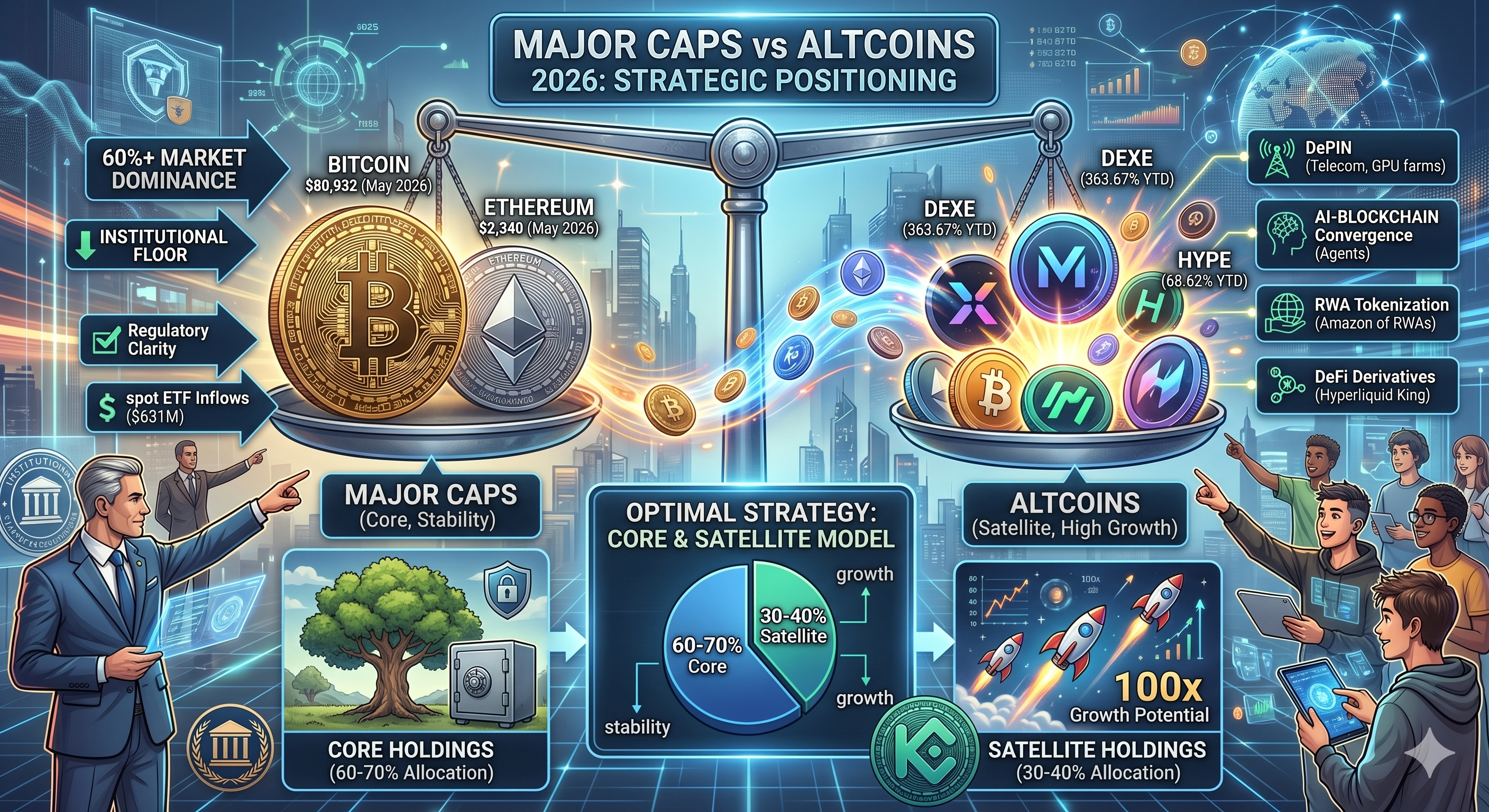
Major caps (Bitcoin, Ethereum) offer stability with Bitcoin up 0.38% and trading at $80,932 as of May 11, 2026, while select altcoins like DeXe (DEXE) have surged 363.67% YTD.([1]) The choice depends on risk tolerance: major caps provide institutional-grade security and lower volatility, while altcoins in DePIN, AI-blockchain convergence, and RWA tokenization sectors offer exponential growth potential at higher risk.
For diversified exposure, KuCoin enables seamless trading across both categories through spot trading, futures contracts with up to 125x leverage, and automated trading bots that help investors capture opportunities in both major cap stability and altcoin volatility.
Major Caps Performance Analysis: Bitcoin and Ethereum in 2026
Bitcoin maintains 60.32% market dominance with a market cap of $1.39 trillion, while Ethereum holds 10.4% dominance at $276.51 billion as of May 2026.([2]) These major caps have demonstrated remarkable resilience through institutional adoption and regulatory clarity.
Bitcoin: The Institutional Safe Haven
Bitcoin's performance in 2026 reflects the "Institutional Floor" phenomenon. Trading at $80,932 on May 11, 2026, BTC has avoided the extreme 80% drawdowns characteristic of previous cycles.([3]) The 2024 halving reduced block rewards to 3.125 BTC, creating supply constraints that continue to support price stability. U.S. Bitcoin spot ETFs recorded net inflows of $631 million in a single week of May 2026, demonstrating sustained institutional demand.([4])
KuCoin offers Bitcoin spot trading with competitive fees and futures contracts allowing traders to hedge positions or leverage exposure up to 125x, making it accessible for both conservative holders and active traders seeking to capitalize on BTC's volatility.
Ethereum: Navigating the Performance Gap
Ethereum trades at $2,340 as of May 11, 2026, with a 0.58% daily gain.([3]) While ETH has shown brief bursts of outperformance—some 60-day windows in late 2025/early 2026 showed ETH +44% versus BTC +10%—the ETH/BTC ratio remains under pressure.([5]) Ethereum's dominance has dropped to 10.4%, a three-year low, as capital rotates toward Layer 2 solutions and alternative smart contract platforms.([6])
Despite this, Ethereum remains the foundation for DeFi, NFTs, and enterprise blockchain applications. U.S. Ethereum spot ETFs recorded $70.3 million in net inflows during the same May 2026 week, indicating institutional interest persists.([4])
Top-Performing Altcoins in 2026: The 100x+ Growth Stories
The altcoin season index currently reads 39/100 as of May 2026, indicating Bitcoin dominance persists, yet specific altcoins have defied this trend with triple-digit gains.([7]) Five high-cap altcoins demonstrate that strategic sector positioning can deliver exponential returns even in a Bitcoin-dominated market.
DeXe (DEXE): The Governance Powerhouse
DeXe leads all major altcoins with a staggering 363.67% YTD gain, trading at $15.03 as of April 2026.([1]) The token's surge is driven by massive capital inflows into DAO governance structures. On-chain data shows DeXe's open interest recovered from near zero in January to over $20 million by mid-April 2026, indicating fresh institutional capital rather than speculative liquidations.([1])
DeXe's focus on professionalizing decentralized autonomous organizations has positioned it as infrastructure for the next generation of on-chain governance, attracting "smart money" from institutional investors seeking exposure to Web3 organizational structures.
MemeCore (M): Culture Meets Infrastructure
MemeCore has secured a 118.53% YTD gain, trading at $3.44 as of April 2026.([1]) Unlike traditional meme coins, MemeCore operates as its own Layer 1 blockchain, transforming viral culture into a governance and economic engine. The project's hard fork in late March 2026 acted as a major catalyst, driving speculative flows toward its growing ecosystem of dApps and social-finance tools.([1])
Hyperliquid (HYPE): The Decentralized Perpetuals King
Hyperliquid trades at $42.88 with a 68.62% YTD increase as of April 2026.([1]) The platform has become the go-to infrastructure for decentralized perpetual futures trading. Sentiment around HYPE is extremely bullish due to spot ETF filings from Bitwise, Grayscale, and 21Shares in the U.S., along with active accumulation by prominent figures like Arthur Hayes.([1]) The upcoming HIP-4 mainnet rollout in 2026 is expected to introduce event-based trading and prediction markets, further expanding utility.
KuCoin users can access HYPE through spot trading and participate in the decentralized derivatives narrative that's reshaping crypto trading infrastructure.
TRON (TRX): The Stablecoin Utility Play
TRON maintains a 17.14% YTD performance, trading at $0.3329 as of April 2026.([1]) In a year where the total crypto market cap retracted by 22%, TRX's positive growth highlights its status as a "safe haven" altcoin. TRON's dominance in USDT (Tether) supply remains its strongest fundamental, with the network facilitating billions in daily stablecoin transactions at minimal cost.([1]) Daily token burns provide deflationary pressure that supports price appreciation.
Tether Gold (XAUt): Digital Gold Hedge
Tether Gold trades at $4,775.53 with a 10.45% YTD gain as of April 2026.([1]) As geopolitical tensions and inflation concerns persist, demand for gold-backed tokens has spiked. XAUt provides a 1:1 peg to London Good Delivery gold bars, offering blockchain-native exposure to physical gold. Its performance reflects the broader "flight to quality" trend during periods of crypto market uncertainty.([1])
2026 Altcoin Performance Comparison Table
td {white-space:nowrap;border:0.5pt solid #dee0e3;font-size:10pt;font-style:normal;font-weight:normal;vertical-align:middle;word-break:normal;word-wrap:normal;}
| Token Name | Current Price | 7-Day Change | YTD Performance | Market Cap Rank | Primary Sector |
| DeXe (DEXE) | $15.03[1] | +55.17%[1] | +363.67%[1] | High-cap | DAO Governance |
| MemeCore (M) | $3.44[1] | +24.55%[1] | +118.53%[1] | #21[1] | Layer 1 / SoFi |
| Hyperliquid (HYPE) | $42.88[1] | +4.79%[1] | +68.62%[1] | High-cap | DeFi Derivatives |
| TRON (TRX) | $0.3329[1] | +3.62%[1] | +17.14%[1] | Top 10 | Payments / Stablecoins |
| Tether Gold (XAUt) | $4,775.53[1] | +1.50%[1] | +10.45%[1] | High-cap | Commodity-backed |
| Bitcoin (BTC) | $80,932[3] | +0.38%[3] | Baseline | #1 | Store of Value |
| Ethereum (ETH) | $2,340[3] | +0.58%[3] | Baseline | #2 | Smart Contracts |
High-Growth Altcoin Sectors: Where 100x Potential Exists in 2026
For altcoins to achieve 100x returns in 2026's mature market, they require extreme volatility and positioning in sectors with "High Displacement Potential" where blockchain replaces expensive traditional services.([8]) Three sectors have decoupled from general market trends and demonstrate exponential growth trajectories.
DePIN (Decentralized Physical Infrastructure Networks)
DePIN has emerged as a cornerstone narrative for 2026 by leveraging blockchain incentives to disrupt multi-trillion dollar legacy sectors like telecommunications, energy, and cloud computing.([8]) Projects building decentralized Wi-Fi networks, solar grids, and GPU farms are transitioning from speculative assets to functional infrastructure. The potential for 100x returns is anchored in massive total addressable markets; capturing even 1% of the global cloud computing market can trigger exponential token appreciation driven by genuine utility demand.([8])
AI-Blockchain Convergence
By 2026, AI is no longer a buzzword but the engine of the global economy, and altcoins providing "Proof of Training" or decentralized model hosting are seeing massive inflows.([8]) The 100x potential lies in "Agents"—autonomous AI entities that hold their own crypto wallets and execute transactions without human intervention. This sector combines two of the most transformative technologies of the decade, creating network effects that compound value accrual.
RWA (Real-World Asset) Tokenization
The tokenization of everything from U.S. Treasuries to fine art has moved on-chain in 2026.([8]) While the assets themselves don't 100x, the platforms that facilitate trillions in RWA transactions can. The "Amazon of RWAs" is likely a sub-$50 million market cap project today that could dominate the space by the end of 2026, offering early investors exponential returns.([8])
KuCoin provides early access to emerging projects across these sectors through its comprehensive listing strategy, which captures over 90% of top trending tokens before they reach mainstream exchanges.
Risk Analysis: Major Caps vs Altcoins in 2026
Bitcoin's 60% market dominance and institutional backing create a "floor" that limits downside risk, while altcoins face liquidity fragmentation across 3 million+ indexed tokens.([8]) Understanding the risk-reward profile of each category is essential for portfolio construction.
Major Caps: Lower Volatility, Regulatory Clarity
Bitcoin and Ethereum benefit from established regulatory frameworks. The approval of spot ETFs in the U.S. has created institutional-grade custody solutions and reduced counterparty risk. Major caps experience lower volatility—Bitcoin's 30-day volatility in 2026 averages 40-50%, compared to 80-120% for mid-cap altcoins. This makes major caps suitable for conservative investors, retirement accounts, and institutional treasuries.
KuCoin offers secure custody for major caps with 100% Proof of Reserves, ensuring 1:1 asset backing and advanced security protocols including PCI DSS compliance and ISO/IEC 27001:2022 certification.
Altcoins: High Reward, High Risk
Thousands of tokens launched in 2024-2025 are now "zombie chains"—projects with high valuations but zero users.([8]) Altcoin investors face three primary risks:
-
Liquidity Fragmentation: Too many Layer 2s and Layer 3s spread capital thin, preventing the "Gains Concentration" needed for explosive pumps.([8])
-
Regulatory Crackdowns: Any project that conducted unregistered securities offerings faces existential risk. A single Wells Notice from regulators can wipe out 90% of a coin's value overnight.([8])
-
VC Dump Risk: Many altcoins are designed as "exit liquidity" for early private investors. The "Low Float, High FDV" trap—where a project has a $100 million market cap but $5 billion fully diluted valuation—creates massive sell pressure from token unlocks.([8])
Strategic Portfolio Allocation: The Core and Satellite Model for 2026
To navigate 2026's bifurcated market, implement the "Core and Satellite" portfolio model that balances major cap stability with altcoin growth potential.([8])
Core Holdings (60-70% of Portfolio)
Allocate the majority to "Value Sovereigns" like Bitcoin and Ethereum, or high-performance Layer 1s like Solana that have reached "escape velocity." These assets provide:
-
Institutional-grade liquidity
-
Lower volatility during market corrections
-
Regulatory clarity and custody solutions
-
Proven network effects and developer ecosystems
KuCoin's spot trading platform offers competitive fees for accumulating core holdings, while its staking and earn products allow major cap holders to generate passive yield on Bitcoin, Ethereum, and other blue-chip assets.
Satellite Holdings (30-40% of Portfolio)
This is the 100x hunting ground. Divide satellite capital into 5-10 high-conviction bets across AI, DePIN, and RWA sectors. Key selection criteria include:
-
FDV/MC Ratio: Look for projects where at least 60% of total supply is already circulating to avoid unlock dilution.([8])
-
Developer Mindshare: Use GitHub metrics to identify blockchains gaining code commits, as developer activity precedes price breakouts by 3-6 months.([8])
-
Community Strength: 100x coins require "cult-like" followings that refuse to sell during 30% dips.([8])
The Exit Rule
If a satellite coin 5x-es, take your initial seed money out. This allows you to ride the remaining "house money" to the 100x mark with zero emotional stress.([8]) KuCoin's advanced order types including trailing stop-loss and take-profit orders automate this risk management strategy.
How to Trade Major Caps and Altcoins on KuCoin
KuCoin provides comprehensive tools for executing both major cap and altcoin strategies through spot trading, futures contracts, margin trading, and automated bots. The platform's infrastructure supports sophisticated portfolio management across market conditions.
Spot Trading for Long-Term Accumulation
KuCoin's spot market offers 1,000+ trading pairs with deep liquidity for both major caps and emerging altcoins. The platform's competitive fee structure—starting at 0.1% for makers and takers—makes it cost-effective for dollar-cost averaging into core holdings or accumulating satellite positions.
Futures Trading for Leverage and Hedging
For traders seeking amplified exposure or downside protection, KuCoin Futures provides up to 125x leverage on major caps like Bitcoin and Ethereum, as well as popular altcoins. Both USDT-margined and coin-margined contracts are available, allowing traders to:
-
Amplify gains during altcoin breakouts
-
Hedge spot holdings during market corrections
-
Execute market-neutral strategies between major caps and altcoins
KuCoin's cross margin and isolated margin modes offer flexibility in risk management, with cross margin allowing profitable positions to buffer losing ones across the futures account.
Trading Bots for Automated Strategies
KuCoin's algorithmic trading bots automate execution across market conditions:
-
Grid Trading Bots: Capture volatility in ranging markets by buying low and selling high automatically
-
DCA Bots: Systematically accumulate major caps or altcoins at regular intervals
-
Smart Rebalance: Maintain target portfolio allocations between major caps and altcoins
These tools are particularly valuable for managing satellite altcoin positions that require rapid response to price movements.
FAQs
What is the difference between major caps and altcoins?
Major caps refer to the largest cryptocurrencies by market capitalization, primarily Bitcoin and Ethereum, which together represent over 70% of total crypto market value as of May 2026. Altcoins are all other cryptocurrencies, ranging from established projects like Solana and Cardano to emerging tokens in DePIN, AI, and RWA sectors. Major caps offer institutional-grade stability and regulatory clarity, while altcoins provide higher growth potential at increased risk.
Should I invest in Bitcoin or altcoins in 2026?
The optimal strategy combines both through the Core and Satellite model. Allocate 60-70% to major caps like Bitcoin and Ethereum for stability and institutional backing, while dedicating 30-40% to high-conviction altcoins in growth sectors like DePIN, AI-blockchain convergence, and RWA tokenization. Bitcoin's 60% market dominance and ETF inflows provide a floor, while select altcoins like DeXe have delivered 363% YTD gains as of April 2026.([1])
Which altcoins have the best growth potential in 2026?
Altcoins in three sectors demonstrate the highest growth potential: DePIN projects disrupting physical infrastructure, AI-blockchain convergence tokens enabling autonomous agents, and RWA tokenization platforms facilitating trillions in on-chain asset transfers. Specific high-performers include DeXe (DEXE) with 363.67% YTD gains, MemeCore (M) up 118.53%, and Hyperliquid (HYPE) gaining 68.62% as of April 2026.([1]) KuCoin provides early access to emerging projects across these sectors through its comprehensive listing strategy.
Is it too late to buy Bitcoin in 2026?
Bitcoin remains a strategic core holding in 2026 despite trading at $80,932 as of May 11, 2026. Institutional inflows continue with U.S. Bitcoin spot ETFs recording $631 million in net inflows during a single week in May 2026.([4]) The 2024 halving's supply constraints and corporate treasury adoption create long-term upward pressure. While 100x returns are unlikely for Bitcoin from current levels, it provides portfolio stability and serves as the foundation for a diversified crypto allocation.
How can I reduce risk when investing in altcoins?
Implement five risk management strategies: (1) Limit altcoin allocation to 30-40% of total crypto portfolio, (2) Diversify across 5-10 projects rather than concentrating in one or two, (3) Verify FDV/MC ratios to avoid token unlock dilution—look for projects with 60%+ supply already circulating, (4) Use stop-loss orders to cap downside at 20-30% per position, and (5) Take profits systematically by removing initial capital after a 5x gain.([8]) KuCoin's advanced order types and margin trading tools enable precise risk management across altcoin positions.
Conclusion
The 2026 cryptocurrency market presents a bifurcated opportunity set where major caps provide institutional-grade stability and altcoins offer exponential growth potential in specialized sectors. Bitcoin's 60% market dominance and sustained ETF inflows establish a floor for the broader market, while select altcoins like DeXe, MemeCore, and Hyperliquid have delivered triple-digit gains by positioning in high-growth narratives like DAO governance, Layer 1 infrastructure, and decentralized derivatives.
The optimal strategy combines both asset classes through the Core and Satellite model: 60-70% allocated to major caps for stability, and 30-40% to high-conviction altcoins in DePIN, AI-blockchain convergence, and RWA tokenization sectors. This approach captures the security of established assets while maintaining exposure to the exponential returns that define crypto's value proposition.
KuCoin empowers this strategy through comprehensive trading infrastructure including spot markets for 1,000+ assets, futures contracts with up to 125x leverage, automated trading bots, and advanced risk management tools. With 100% Proof of Reserves, institutional-grade security certifications, and access to both blue-chip major caps and emerging altcoins, KuCoin provides the platform for executing sophisticated portfolio strategies in 2026's evolved crypto landscape.
The window for 100x returns has not closed—it has migrated to specialized sectors where blockchain solves real-world problems at scale. Success requires moving beyond the "shotgun approach" to data-driven selection, rigorous risk management, and strategic positioning across both major caps and high-potential altcoins.
References
[1] KuCoin, "Top 5 High-Cap Altcoins Outperforming the Market in 2026," April 19, 2026. "The top altcoins in 2026 have defied a 22% market pullback early in the year. DeXe (DEXE) leads with a 363.67% YTD gain, followed by MemeCore (M) and Hyperliquid (HYPE)." https://www.kucoin.com/news/flash/top-5-high-cap-altcoins-outperforming-the-market-in-2026
[2] Forbes Advisor, "Top 10 Cryptocurrencies Of May 8, 2026," May 8, 2026. "Market Dominance: 60.32%. 2. Ethereum (ETH). Market Cap: $276.51 billion." https://www.forbes.com/advisor/investing/cryptocurrency/top-10-cryptocurrencies/
[3] KuCoin, "Crypto Exchange | Bitcoin Exchange | Bitcoin Trading," May 11, 2026. "BTC /USDT $80,932.71 0.38%" and "ETH /USDT $2,340.71 0.58%". https://www.kucoin.com
[4] KuCoin News, "U.S. Bitcoin and Ethereum Spot ETFs Record Net Inflows of $631M and $70.3M, Respectively," May 2026. "Last week, U.S. spot Bitcoin ETFs saw three days of net inflows, totaling $631 million." https://www.kucoin.com/news/flash/us-bitcoin-and-ethereum-spot-etfs-see-net-inflows-of-631m-and-70-3m-respectively
[5] Binance Square, "ETH vs. BTC Dominance in 2026: Is the Rotation Finally Here?," 2026. "Ethereum has had brief bursts of outperformance, some 60-day windows in late 2025/early 2026 showed ETH +44% vs. BTC +10%, but the ratio remains under pressure." https://www.binance.com/en/square/post/290519009651234
[6] Phemex, "Ethereum Dominance Hits 10.4%, a Three-Year Low," 2026. "ETH's share of the crypto market dropped to 10.4% in Q1 2026, the lowest since mid-2021, while BTC dominance climbed past 56%." https://phemex.com/blogs/ethereum-market-share-three-year-low
[7] CoinDCX, "Crypto Bull Run Outlook 2026: Key Signals from the 2025 Market," 2026. "Bitcoin dominance is now at 60% as of May, 2026, gain from yesterday (58.15%), while the CMC Altcoin Season Index sits at 39/100." https://coindcx.com/blog/crypto-deep-dives/crypto-bull-run/
[8] KuCoin Blog, "2026 Altcoin Outlook: Is the 100x Window Closing?," 2026. "For an altcoin to 100x, it needs extreme volatility. The 2026 market is more 'efficient,' meaning mispriced assets are discovered and corrected faster." https://www.kucoin.com/blog/will-altcoin-hit-100x-in-2026