

CertiK Report: How Agentic AI Is Reshaping Cybersecurity, AML and Web3 Compliance
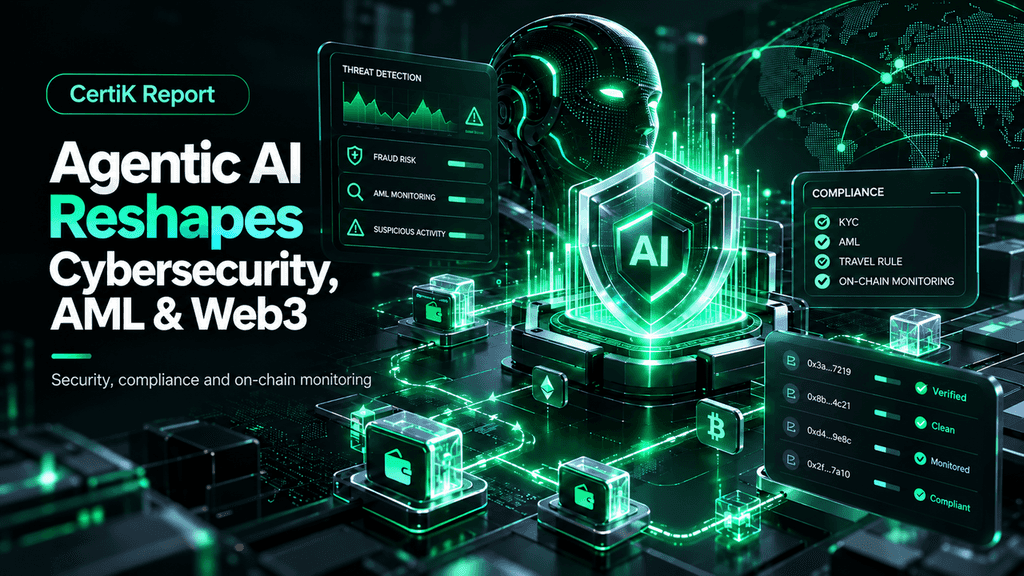
CertiK’s October 5, 2026 Intel3D report says agentic AI is moving cybersecurity, AML and Web3 compliance beyond basic alert systems toward AI agents that can investigate incidents, trace blockchain transactions and support smart-contract and compliance work. The shift comes as Web3 security losses remain high and crypto regulation expands, with FATF reporting that 83% of surveyed jurisdictions had passed Travel Rule legislation by July 2026. As Chainalysis and MetaMask bring AI agents into real blockchain workflows, the focus is increasingly on how much authority these systems should receive while keeping human oversight and accountability in place.
Key Takeaways
-
Agentic AI is moving cybersecurity beyond basic alerts by allowing AI security agents to investigate incidents, use external tools and complete multi-step tasks within defined permissions.
-
Web3 security is a major use case, with AI agents able to support on-chain monitoring, transaction tracing and smart-contract analysis.
-
AML and crypto compliance could become more automated, especially for alert enrichment, KYA/KYT screening, cross-chain tracing and evidence preparation.
-
Human oversight remains essential for high-impact actions, regulatory decisions and final validation.
-
Greater AI autonomy introduces new risks, including prompt injection, hallucinations, excessive permissions and weak audit controls.
How Agentic AI Is Reshaping Cybersecurity and Web3 Security
Agentic AI is moving cybersecurity beyond systems that only detect threats and generate alerts. In its October 5, 2026 Intel3D report, CertiK describes AI security agents that can investigate incidents, gather evidence, use security tools and carry out predefined actions within strict permission limits. That shift is particularly relevant to Web3, where stolen assets can move across wallets, bridges and protocols within minutes. CertiK recorded more than $1.31 billion in Web3 security losses across 344 incidents during the first half of 2026, showing why faster investigation and response have become a priority.
How AI Security Agents Go Beyond Traditional Cybersecurity Tools
Traditional AI security tools usually analyze data, detect unusual activity and send alerts to human analysts. Agentic AI can take the process further. An AI security agent may break an incident into several tasks, check multiple data sources, use security tools and continue investigating without waiting for a new instruction at every step. The main difference is not that humans disappear, but that the AI can complete more of the investigative workflow before a person needs to intervene.
In Web3 security, this can be especially useful because blockchain data is available continuously. If suspicious activity appears around a smart contract or wallet, an agent could examine related addresses, review transaction history, compare the behavior with known attack patterns and follow subsequent transfers. That can help security teams understand an incident faster than manually checking each transaction separately, especially when funds are being split or moved across chains.
Smart-contract auditing could also become more continuous. Traditional smart contract audit fundamentals center on reviewing blockchain code for vulnerabilities, while CertiK describes AI agents helping analyze code paths, investigate unusual contract behavior and prepare possible vulnerability findings for human auditors. These systems should not be treated as substitutes for professional audits because false positives, incomplete reasoning and context-specific vulnerabilities still require expert review. Their value is in accelerating analysis and keeping security monitoring active after a protocol goes live.
Real-Time Monitoring Could Speed Up Web3 Incident Response
The strongest advantage of agentic AI in Web3 security is speed. Instead of stopping after detecting suspicious activity, an AI security agent can begin gathering evidence and tracing related transactions while an incident is still unfolding. More advanced systems could also be connected to predefined defensive controls, although actions that affect user funds or protocol availability require much tighter safeguards. The faster an investigation starts, the greater the chance that analysts can understand how assets are moving before the trail becomes more complex.
Potential uses include:
-
On-chain transaction monitoring: tracking unusual wallet, contract and token movements as they happen.
-
Cross-chain tracing: following suspicious funds across addresses, bridges and multiple blockchain networks.
-
Smart-contract analysis: checking abnormal calls, code behavior and potential exploit patterns.
-
Incident triage: ranking alerts and assembling evidence before escalation to a human security team.
-
Controlled response: triggering predefined actions such as circuit breakers or contract pauses where the protocol supports them and the agent has explicit authorization.
The key distinction is that these capabilities do not make AI agents fully independent security operators. CertiK’s framework still places human professionals in charge of validating findings, approving consequential actions and maintaining accountability. The practical change is that agentic AI can shorten the gap between threat detection and investigation, giving Web3 security teams more time to respond before an attack spreads. That division of labor also makes it possible to automate repetitive analysis without handing unrestricted control of critical infrastructure to an AI system.
How AI Agents Could Transform AML and Crypto Compliance
AI agents could change crypto compliance by handling more of the investigative work that sits between an automated transaction alert and a human compliance decision. In AML workflows, agentic AI can help examine wallet histories, connect related addresses, follow funds across chains and organize evidence for further review. The opportunity is becoming more relevant as virtual-asset regulation expands: the Financial Action Task Force reported in July 2026 that 83% of surveyed jurisdictions had passed Travel Rule legislation, up from 73% a year earlier. Greater regulatory coverage increases the amount of transaction data and case material that compliance teams may need to examine.
AI-Powered Transaction Monitoring Could Make AML Investigations Faster
Traditional crypto transaction-monitoring systems are good at flagging activity that meets predefined risk rules, but alerts still need to be investigated. An AI agent can potentially take on more of that process by reviewing the transaction path, checking counterparties, examining address relationships and collecting information from blockchain intelligence tools before a compliance analyst opens the case. These processes sit within the broader framework of AML in crypto, where identity checks and on-chain transaction monitoring are used to identify potentially illicit financial activity. Agentic AI can reduce time spent on routine alert enrichment without handing the final decision to the AI.
The same approach can support Know Your Address (KYA) and Know Your Transaction (KYT) screening. Instead of judging a wallet only from one transaction, an agent can build a broader picture from historical transfers, connections to previously identified services and movements through different blockchain networks. That is particularly useful in crypto because funds can be divided among many addresses or routed through bridges, making the full transaction trail difficult to assess manually.
Chainalysis has already moved in this direction. In March 2026, the company introduced blockchain intelligence agents designed to automate parts of alert enrichment, multi-chain investigations and continuous monitoring. Chainalysis says humans determine how much authority those agents receive, which is an important distinction for AML compliance. AI can accelerate evidence gathering, but decisions such as escalating a customer, restricting an account or making a regulatory filing still require accountable human oversight.
AI Agents Could Support Travel Rule Checks and Regulatory Reporting
As more jurisdictions implement FATF’s Travel Rule, crypto businesses face growing pressure to collect, verify and transmit information about qualifying virtual-asset transfers. Agentic AI could help compliance teams organize that information, identify missing data and prepare case material, while also assisting with suspicious activity investigations. CertiK’s report similarly describes AI agents helping prepare Suspicious Activity Report material, with human compliance officers expected to review the evidence and certify the final filing. This distinction matters because automation can support the investigative process without transferring legal or regulatory responsibility to the software.
Potential AML and crypto compliance uses include:
-
Transaction alert enrichment: gathering relevant wallet history and counterparty information before human review.
-
Cross-chain fund tracing: following suspicious assets as they move through different blockchains, bridges or connected addresses.
-
KYA and KYT screening: assessing address and transaction risk using a broader set of on-chain relationships.
-
Travel Rule support: identifying incomplete transfer information and organizing compliance data for review.
-
SAR preparation: assembling transaction histories, evidence and draft narratives while leaving final filing decisions to qualified compliance staff.
These functions could make high-volume investigations easier to manage, particularly when analysts must combine on-chain evidence with customer and transaction records. However, the quality of any automated conclusion still depends on the accuracy of the underlying data and the controls governing how an agent uses it.
AI Security Agents Bring New Risks as Automation Expands
As AI security agents gain more access to cybersecurity tools, blockchain infrastructure and compliance systems, the risk profile changes with them. A system that only recommends an action is easier to contain than one that can query privileged data, call APIs, trigger defensive controls or interact with digital assets. CertiK’s October 2026 report therefore treats permissions, human approval, auditability and accountability as core requirements for agentic AI rather than optional safeguards. The more authority an agent receives, the more important it becomes to control exactly what it can access and execute.
Prompt Injection and Hallucinations Can Create New Security Failures
Prompt injection is one of the most important risks facing agentic AI because attackers may try to manipulate the information an AI agent reads and influence what it does next. The danger becomes more serious when the agent has access to external tools, credentials or automated response systems. Similar concerns already appear in discussions of AI assistants and crypto account security, particularly when software can access wallets, API keys, browsers or trading tools. NIST has also been examining how autonomous agents should be authenticated, restricted and monitored inside security environments.
Hallucinations create a different type of failure. An AI security agent may interpret an alert incorrectly, misclassify suspicious activity or produce a confident but inaccurate explanation of a vulnerability. If the system is only assisting an analyst, that error can be reviewed before action is taken. If the agent has greater autonomy, however, an incorrect conclusion could contribute to unnecessary account restrictions, false escalations or other operational mistakes. This is why human validation remains especially important for decisions that can affect users, funds or critical infrastructure.
Excessive AI Agent Permissions Can Increase the Blast Radius
The amount of access granted to an AI agent often determines how damaging a mistake or compromise could become. A read-only monitoring agent has a very different risk profile from one that can revoke credentials, freeze access, initiate transactions or change system configurations. Security teams therefore need to apply the same least-privilege principles used for human administrators and service accounts, while also considering how an autonomous system may combine several tools during a single task.
For Web3 and crypto platforms, that distinction matters even more because some actions can be difficult or impossible to reverse once executed on-chain, a core consideration in Web3 wallet security. Permission design should separate investigation from execution wherever possible, so an AI agent can gather evidence and recommend a response without automatically receiving authority to move assets or alter a protocol. High-impact actions may require additional approval, multi-signature controls or predefined transaction limits before the system can proceed. This approach limits the potential damage if an agent is manipulated, compromised or simply reaches the wrong conclusion.
AI Governance Is Lagging Behind Security Adoption
Cybersecurity teams are adopting AI faster than many organizations are developing specific controls for failures involving autonomous systems. ISACA’s 2026 State of Cybersecurity research, based on more than 1,800 professionals, found that only 8% of organizations regularly conducted AI-specific incident-response exercises. Another 48% either said their organization did not have an AI incident playbook or did not know whether one existed. That gap becomes more important as AI systems move from analysis into operational security workflows.
Organizations deploying AI security agents may need controls that go beyond conventional monitoring, including:
-
Independent action logging: every tool call, permission request and system change should be recorded so investigators can reconstruct what the agent did and why.
-
Credential separation: AI agents should use dedicated identities rather than sharing broad administrator credentials with human teams or other automated systems.
-
Behavioral limits: organizations can define which systems, transaction sizes, contract functions or account types an agent is allowed to touch without additional approval.
-
Emergency shutdown mechanisms: security teams should be able to revoke an agent’s access quickly if its behavior becomes abnormal or its instructions appear compromised.
-
Regular adversarial testing: red-team exercises can test whether manipulated inputs, deceptive content or malicious prompts can push the agent outside its intended role.
As AI security agents become more capable, the central challenge is no longer only whether they can detect threats quickly. Organizations also need to know exactly what each agent is allowed to do, how its decisions can be reviewed and who remains responsible when automated actions produce real-world consequences. Governance therefore becomes part of the security architecture itself, rather than a policy issue that can be addressed after deployment. Clear ownership can also make incident response faster when an autonomous system behaves unexpectedly.
Conclusion
CertiK’s latest report points to a broader change in how AI may be used across cybersecurity, AML and Web3 security. Agentic AI can already take on more complex work than traditional alert systems, including multi-step investigations, transaction tracing, smart-contract analysis and compliance support. Products from Chainalysis and MetaMask also show that some of these capabilities are moving into operational environments rather than remaining purely experimental. The evidence so far points toward controlled automation, not the wholesale replacement of security or compliance professionals.
The more important development, however, is the shift from AI that recommends actions toward systems that may eventually carry out some actions themselves. That creates clear potential for faster investigations and more scalable compliance, but it also raises harder questions around permissions, prompt injection, auditability and responsibility. For crypto companies and security teams, the long-term value of an AI security workforce will depend less on how autonomous agents can become and more on whether that autonomy can be governed safely. The organizations that deploy these systems will still need clear boundaries between analysis, recommendation and execution, especially when user assets or regulatory obligations are involved.
🔥 Beyond the Headlines: What KuCoin 5.0 Means for You
Market news moves fast — but where you act on it matters just as much. This October, KuCoin launches KuCoin 5.0, transforming KuCoin into a rebuilt platform. Here's what actually changes for you:
-
One account for everything. Older platforms split your money across separate "spot," "margin," and "futures" accounts and expected you to understand why. KuCoin 5.0's unified account removes that entirely — deposit once, and everything is simply there (only available to VIPs for now).
-
Stocks, indices, and commodities. KuCoin 5.0 expands beyond crypto into global markets. When crypto chops sideways and equities rally (or the reverse), you rotate in minutes instead of opening a brokerage account and waiting days for fiat rails.
-
Real-world assets (RWA). Tokenized exposure to traditional assets like commodities, right inside your crypto account. One of the fastest-growing segments in global finance is no longer reserved for institutions — you access it from the same balance you trade with.
-
Earn while you learn. Not ready to trade? KCUSD lets your stablecoins earn daily, auto-compounding interest. The lowest-stress way to put your idle deposit to work for 4% yield.
-
An AI assistant in plain language. Ask questions, get market context, understand what you're looking at — built into the platform, no jargon required.
-
An app that doesn't overwhelm. Faster, cleaner, and consistent — intuitive from the first tap, not after a tutorial.
-
Safety you can check, not just trust. A MiCAR-licensed EU entity, Proof of Reserves you can verify yourself, and internationally certified security (SOC 2 Type II, ISO 27001:2022).
Create your account in minutes — and start on the platform built for where crypto is going, not where it's been.
FAQs
What is agentic AI in cybersecurity?
Agentic AI refers to AI systems that can pursue a security task through multiple steps, use external tools and make limited operational decisions within defined permissions. Unlike a standard AI assistant that mainly answers questions or summarizes data, an agentic system can continue working toward a goal such as investigating an alert or tracing suspicious activity. The level of autonomy can vary significantly depending on the tools and permissions an organization gives the system.
Is an AI security agent the same as a traditional security bot?
No. Traditional security bots usually follow fixed rules or predefined workflows. AI security agents can interpret context, choose between tools and adjust their next step based on new information. That flexibility makes them more capable, but it also creates additional governance and security requirements. An agent may therefore need stronger identity, permission and audit controls than a conventional automated script.
Could AI security agents replace cybersecurity analysts?
Current evidence does not support broad replacement of human cybersecurity analysts. AI agents are better suited to automating repetitive investigation, data gathering and alert enrichment, while human professionals remain important for judgment, escalation, accountability and high-impact decisions. The more likely near-term change is a redistribution of work, with analysts spending less time on routine investigation and more time reviewing complex or consequential cases.
How can AI agents help crypto exchanges with AML compliance?
AI agents can assist exchanges by reviewing transaction histories, identifying wallet relationships, enriching alerts and organizing evidence for compliance teams. They may also help analysts investigate suspicious transfers more quickly, but final customer-risk decisions and regulatory filings should remain subject to human review. Their usefulness depends on the quality of blockchain intelligence, customer information and other data available to the system.
Disclaimer
The information provided on this page may originate from third-party sources and does not necessarily represent the views or opinions of KuCoin. This content is intended solely for general informational purposes and should not be considered financial, investment, or professional advice. KuCoin does not guarantee the accuracy, completeness, or reliability of the information, and is not responsible for any errors, omissions, or outcomes resulting from its use. Investing in digital assets carries inherent risks. Please carefully evaluate your risk tolerance and financial situation before making any investment decisions. For further details, please consult KuCoin’s Terms of Use and Risk Disclosure.