

AI Storage Demand Hits Crypto: Why Filecoin and Storj Are Surging as US Equities Rally
2026/05/08 16:27:02
Introduction
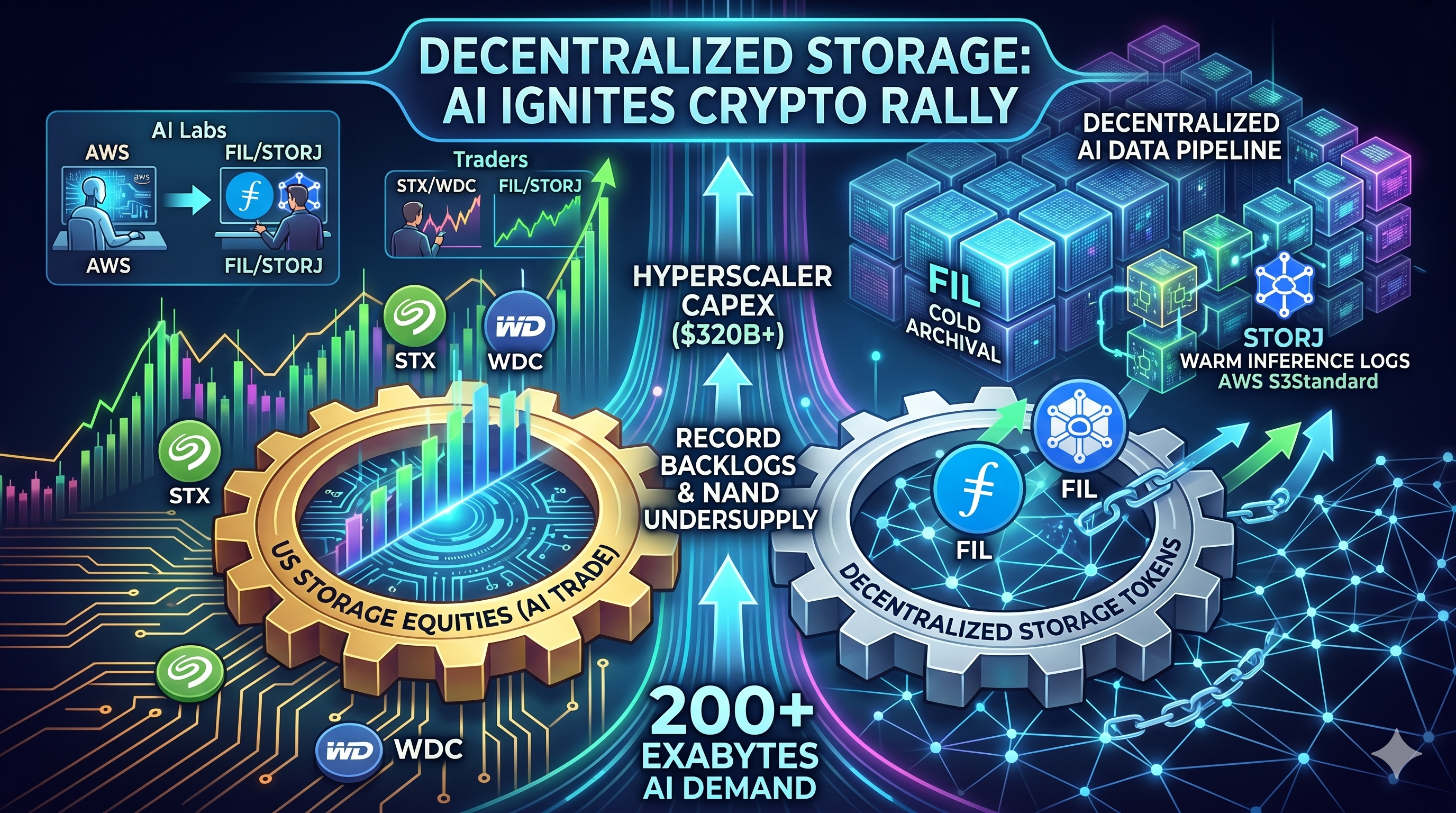
The decentralized storage narrative is back — and this time, artificial intelligence is the catalyst. According to TrendForce data published in April 2026, enterprise SSD contract prices climbed more than 25% quarter-over-quarter in Q1 2026, while Seagate and Western Digital posted record backlogs tied to AI data center buildouts. That same demand wave is now spilling into crypto: Filecoin (FIL) and Storj (STORJ) have outperformed the broader altcoin market over the past 30 days, mirroring the rally in US-listed storage equities like STX, WDC, and NTAP.
The reason is simple — AI workloads consume storage at an unprecedented rate, and decentralized networks are positioning themselves as cost-efficient cold and warm storage layers for AI training datasets, model checkpoints, and inference logs. As hyperscaler capex breaks records, capital is rotating into any asset levered to the "storage shortage" thesis, including crypto storage tokens.
Why Is AI Driving a Storage Supply Crunch in 2026?
AI training and inference are creating a structural storage deficit because every large model generates terabytes of intermediate data that must be retained, versioned, and re-accessed. According to a Morgan Stanley research note from April 2026, global AI-related storage demand is projected to exceed 200 exabytes by year-end 2026 — a figure that outpaces current NAND and HDD production capacity.
Three forces are tightening supply simultaneously:
-
Hyperscaler capex — Microsoft, Meta, Google, and Amazon collectively guided to over $320 billion in 2026 capex, with a meaningful share allocated to storage infrastructure, based on their Q1 2026 earnings calls.
-
NAND undersupply — Samsung and SK Hynix have prioritized HBM (high-bandwidth memory) production for GPUs, squeezing NAND wafer allocation.
-
HDD lead times — Seagate's CEO confirmed in April 2026 that nearline HDD lead times have stretched to 52 weeks, the longest in company history.
This shortage is the macro backdrop. Storage prices rise, storage equities rally, and traders begin searching for adjacent exposure — which is where decentralized storage tokens enter the picture.
How Are US Storage Equities Performing in 2026?
US-listed storage names are leading the S&P 500 information technology subsector year-to-date. Based on Bloomberg market data through early May 2026, Seagate Technology (STX), Western Digital (WDC), Pure Storage (PSTG), and NetApp (NTAP) have posted double-digit gains, with STX up roughly 40% YTD and WDC up over 35%.
What's behind the equity rally?
The rally reflects revenue acceleration, margin expansion, and AI revenue mix. Seagate's Q1 2026 earnings showed nearline HDD revenue growing more than 60% year-over-year, while Pure Storage's AI-specific product line "FlashBlade//EXA" booked over $200 million in AI-tagged contracts in a single quarter, according to its April 2026 investor presentation.
The market is pricing storage as the next leg of the AI trade — after GPUs (Nvidia), networking (Arista, Broadcom), and power (Vistra, Constellation), storage is the fourth pillar getting re-rated.
Why Are Filecoin (FIL) and Storj (STORJ) Rallying?
Filecoin and Storj are rallying because traders view them as the crypto-native expression of the AI storage thesis. Both protocols offer decentralized object storage at price points significantly below AWS S3 — a value proposition that resonates as enterprise storage costs spike.
Over the trailing 30 days through early May 2026, FIL has outperformed Bitcoin by a wide margin, while STORJ has posted one of the strongest moves among small-cap infrastructure tokens, according to CoinGecko price data.
What is Filecoin's role in AI storage?
Filecoin is the largest decentralized storage network by storage capacity, and it has aggressively pivoted toward AI dataset hosting in 2025-2026. The Filecoin Foundation announced in March 2026 that the network now stores over 25 exbibytes of active data, with a growing share dedicated to public AI training datasets — including academic LLM corpora, scientific imagery, and genomics data.
Key catalysts for FIL include:
-
FVM (Filecoin Virtual Machine) enabling smart contracts and DeFi-style storage marketplaces.
-
Filecoin Web Services (FWS) — an S3-compatible API layer launched to lower onboarding friction for AI labs.
-
Direct integrations with retrieval markets like Saturn and compute layers like Bacalhau, creating an end-to-end AI data pipeline.
What makes Storj attractive for AI workloads?
Storj differentiates itself with sub-second retrieval times and S3-compatibility out of the box — characteristics that matter for AI inference and active datasets. The network distributes file shards across more than 24,000 nodes globally, delivering performance closer to centralized object storage while pricing roughly 80% below AWS S3, based on Storj's published pricing as of Q2 2026.
Storj's commercial momentum has been the recent catalyst. The team disclosed in its April 2026 community update that enterprise ARR (annual recurring revenue) crossed key milestones, with several AI startups citing Storj as their primary cold storage provider.
How Does Decentralized Storage Compare to Centralized Cloud for AI?
Decentralized storage is meaningfully cheaper than centralized cloud for cold and archival AI data, but trade-offs exist around latency, SLAs, and enterprise compliance. The cost gap is the headline driver of adoption interest.
|
Provider
|
Storage Cost (per TB/month)
|
Egress Cost (per TB)
|
Best Use Case
|
|
AWS S3 Standard
|
~$23
|
~$90
|
Hot data, production inference
|
|
Google Cloud Storage
|
~$20
|
~$80
|
Hot data, analytics
|
|
Filecoin
|
~$0.20 to $2
|
Minimal
|
Cold archival, training datasets
|
|
Storj
|
~$4
|
~$7
|
Warm data, S3 drop-in
|
Pricing approximations based on each provider's public pricing pages as of April-May 2026.
For AI labs running petabyte-scale training corpora, even a 50% cost reduction on storage and egress translates to seven-figure annual savings — a number that justifies the engineering work to integrate decentralized providers.
What Are the Risks for FIL and STORJ Investors?
The risks for FIL and STORJ are narrative-dependent demand, token emission pressure, and competition from low-cost centralized providers. Anyone trading these names on the AI storage thesis needs to understand that token price action can decouple from network fundamentals.
Token emissions and supply
Filecoin still has meaningful inflation from block rewards, though the schedule is decelerating. Storj distributes tokens to storage node operators monthly, creating persistent sell pressure that can cap rallies absent strong demand-side flows.
Competition
Cloudflare R2, Backblaze B2, and Wasabi are aggressive low-cost centralized alternatives that offer zero egress fees — a value proposition that competes directly with decentralized networks on the cost axis without the complexity of crypto rails.
Narrative correlation
FIL and STORJ trade as high-beta proxies for the AI storage trade. If US storage equities roll over, or if hyperscaler capex guidance disappoints, decentralized storage tokens will likely sell off harder than the underlying equities they shadow.
Which Other Decentralized Storage Tokens Benefit From AI Demand?
Beyond FIL and STORJ, the decentralized physical infrastructure (DePIN) storage subsector includes Arweave (AR), Sia (SC), and BitTorrent-related tokens. Arweave specifically targets permanent storage — a fit for AI model weights and immutable training data provenance.
Arweave (AR)
Arweave's "pay once, store forever" economic model has attracted projects that need permanent dataset hosting. Recent integrations with AI provenance tools position AR as the go-to for verifiable model weights and training data lineage.
Sia (SC)
Sia operates a decentralized storage marketplace with a focus on encryption and privacy. It has a smaller market footprint than FIL but appeals to users with strict data sovereignty requirements.
These adjacent tokens often move in sympathy with FIL and STORJ during sector rotations, offering diversified exposure to the same thesis.
How to Trade FIL and STORJ on KuCoin
KuCoin offers deep liquidity for both FIL and STORJ across spot and derivatives markets, making it one of the most efficient venues to express the AI storage thesis. Users can trade FIL/USDT and STORJ/USDT spot pairs, as well as FIL perpetual futures with leverage for traders looking to amplify directional conviction.
Getting started takes three steps:
-
Create and verify your KuCoin account — complete identity verification to unlock full trading and withdrawal limits.
-
Fund your account — deposit USDT, BTC, or fiat via supported on-ramp partners.
-
Place your trade — search "FIL" or "STORJ" in the spot market, choose a market or limit order, and execute.
For traders who want passive exposure, KuCoin Earn offers flexible and fixed-term products on FIL, allowing holders to generate yield while waiting for the AI storage narrative to play out. Risk-conscious investors can also use dollar-cost averaging through KuCoin's recurring buy feature to build positions gradually rather than chasing momentum.
New users can now register at KuCoin and Get Up to 11,000 USDT in New User Rewards.

Conclusion
The convergence of AI infrastructure demand and decentralized storage tokens is one of the more coherent macro-to-crypto narratives of 2026. Enterprise storage prices are rising on AI-driven demand, US storage equities are leading the IT subsector, and crypto-native storage networks like Filecoin and Storj are capturing capital flows from traders who want levered exposure to the same theme.
Filecoin's pivot toward AI dataset hosting, combined with FVM and S3-compatible service layers, gives it the strongest fundamental claim within the sector. Storj's enterprise traction and S3-compatibility make it a credible commercial alternative for warm AI data. Both face risks from token emissions, centralized competitors, and narrative correlation — but the underlying demand driver, AI's insatiable appetite for storage, looks structural rather than cyclical.
For traders, the setup is clear: storage shortages are real, equity markets are pricing it, and decentralized storage tokens offer high-beta exposure to the same trade. Position sizing, risk management, and patience around emission-driven volatility are essential to capturing the opportunity.
FAQs
1. Is Filecoin actually used by major AI companies?
Yes, but adoption is concentrated in open-source AI projects, academic research labs, and Web3-native AI startups rather than top-tier hyperscalers. The Filecoin network hosts public datasets used by language model researchers, and integrations with compute layers like Bacalhau allow AI workloads to run directly on stored data.
2. What's the difference between Filecoin and Storj technically?
Filecoin uses cryptographic proofs (Proof-of-Replication and Proof-of-Spacetime) to verify storage providers are honestly storing data, with retrieval handled separately. Storj uses erasure coding to split files into encrypted shards distributed across many nodes, prioritizing low-latency S3-compatible retrieval. Filecoin suits archival and large datasets; Storj suits active warm data.
3. How do storage tokens generate value accrual for holders?
Storage tokens accrue value primarily through network usage demand — clients pay in tokens (or stablecoins converted into tokens) to store data, and providers must lock or stake tokens as collateral. Higher network utilization tightens circulating supply and increases token demand, though emission schedules can dilute holders if usage growth lags issuance.
4. Are decentralized storage networks secure enough for sensitive AI data?
For non-sensitive training data, public datasets, and model checkpoints — yes. Files are encrypted client-side and sharded across many providers, making unauthorized access extremely difficult. For regulated data (HIPAA, GDPR-protected information), enterprises typically still require centralized providers with formal SLAs and compliance certifications, though hybrid architectures are increasingly common.
5. What's the correlation between FIL/STORJ and US storage equities?
The correlation has tightened significantly in 2026 as the AI storage narrative has become a unifying theme. Based on observed price action over the past quarter, FIL and STORJ have shown directional alignment with STX and WDC, though crypto tokens exhibit higher volatility and beta — meaning bigger moves in both directions on the same catalysts.