

Why TON Price Is Exploding: Pavel Durov Makes TON Telegram's Official Blockchain
Introduction
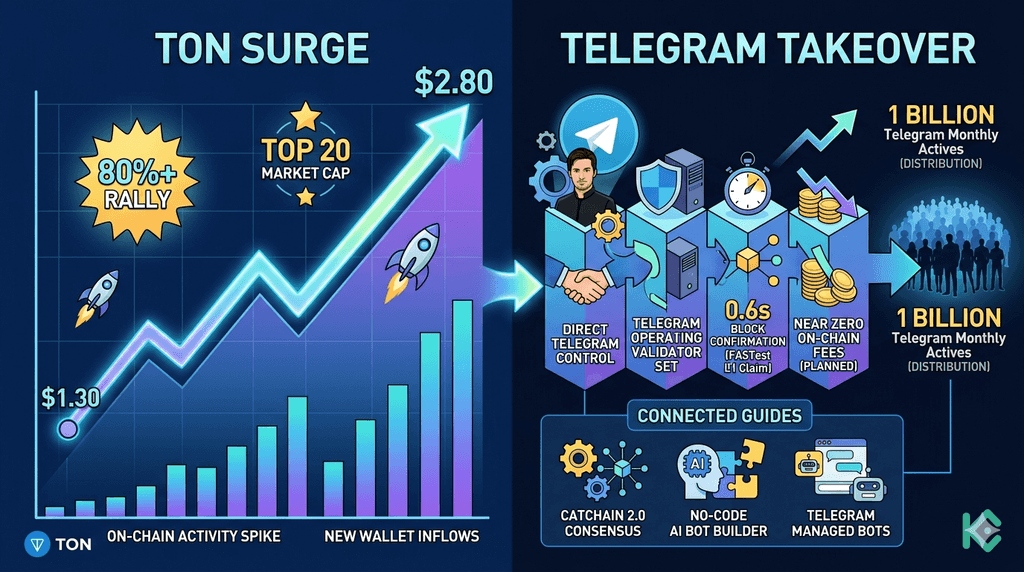
TON surged from roughly $1.30 to $2.80 in just a few days — an 80%+ rally that pushed The Open Network back into the top 20 cryptocurrencies by market cap. The catalyst is unambiguous: Telegram founder Pavel Durov announced that Telegram is taking direct control of TON, sidelining the TON Foundation and committing to operate the largest validator set itself. Durov also highlighted TON's 0.6-second block confirmation — claiming it as the fastest among major Layer 1s — and confirmed plans to slash on-chain fees to near zero. TON is no longer "the blockchain Telegram uses." It is now Telegram's blockchain, with a built-in distribution channel of roughly 1 billion monthly active users.
To understand the full context, this guide covers three connected areas:
-
Catchain 2.0 Upgrade explains the consensus changes powering TON's speed leap.
-
No-code AI Bot Builder explores Telegram's no-code automation layer for developers.
-
Telegram Managed Bots shows how crypto communities deploy bots for token launches and trading alerts.
What Triggered TON's Price Explosion in May 2026?
Telegram's formal takeover of TON governance triggered the rally. According to Pavel Durov's public statements in early May 2026, Telegram will replace the TON Foundation as the primary steward of The Open Network, operate as the largest validator on the chain, and reduce transaction fees to near-zero levels. The market interpreted this as removing the biggest overhang on TON: the perception that Telegram only "supported" TON casually rather than committing to it as core infrastructure.
The price action reflects this re-rating. TON climbed from approximately $1.30 to $2.80 within days, an 80%+ move that returned it to a top-20 market cap ranking. Ecosystem tokens followed even more aggressively — the meme token $MTONGA spiked 420% intraday based on community-tracked data, and other TON-native assets posted double-digit gains.
How Does Telegram's Takeover Change TON's Status?
TON has shifted from "a blockchain Telegram uses" to "Telegram's blockchain." This is a categorical change in identity, not a marketing tweak. Previously, the TON Foundation coordinated development, validators, and ecosystem grants while Telegram remained an arms-length integration partner — a structure originally designed to satisfy the SEC settlement that ended Telegram's first blockchain attempt in 2020.
Durov's announcement reverses that arrangement. Telegram now drives the technical roadmap directly, runs validator infrastructure, and ties TON's product surface to the messenger's built-in features such as Wallet, Stars, and Mini Apps. The TON Foundation is being progressively de-emphasized, with Telegram engineering teams assuming ownership of core protocol decisions.
Why Did On-Chain Activity Spike Alongside Price?
New wallet inflows and ecosystem token rotation accelerated immediately after the announcement. On-chain trackers reported a surge in fresh wallets making large initial buys of TON, as well as elevated turnover in TON-based DeFi pools and meme tokens. This is consistent with a narrative-driven entry wave rather than purely speculative churn — capital is moving into the ecosystem, not just rotating among existing holders.
What Is The Open Network (TON) and Why Does It Matter?
TON is a high-throughput Layer 1 blockchain originally designed by Telegram and now formally run by it again. The network uses a sharded proof-of-stake architecture optimized for messenger-scale workloads — meaning it must handle the kind of micro-transactions, payments, and bot interactions that 1 billion Telegram users could plausibly generate.
Three properties make TON structurally different from most Layer 1s:
-
Native messenger distribution. TON is the only major chain with a built-in user funnel of roughly a billion monthly actives. Onboarding happens through Telegram's Wallet, not a third-party app.
-
Sub-second finality. Durov has publicly stated TON achieves 0.6-second block confirmation, which he described as the fastest among major public chains.
-
Mini Apps as the application layer. TON does not compete primarily on web-based dApps. Its application surface is Telegram Mini Apps — embedded experiences inside chats.
How Fast Is TON Compared to Other Layer 1s?
TON's 0.6-second block time outperforms most leading Layer 1 networks in confirmation speed, according to Durov's public claims published via Telegram channels in early May 2026. For comparison, Solana operates around 400ms slot times but with longer practical finality, Ethereum settles in roughly 12-13 seconds per block, and chains like BNB Chain sit at around 3 seconds. TON's combination of sub-second finality plus near-zero fees positions it specifically for high-frequency, low-value flows — payments, tipping, in-app purchases, and bot interactions.
This speed advantage is enabled by the Catchain 2.0 consensus upgrade rolled into the network. The upgrade reduces validator coordination overhead and tightens block production cycles without sacrificing security guarantees.
How Will Telegram's 1 Billion Users Impact TON Adoption?
Telegram's user base provides TON with the largest distribution funnel of any blockchain. Telegram reports approximately 1 billion monthly active users globally as of recent disclosures, and TON's Wallet, Stars, and Mini App ecosystem sit natively inside the messenger. There is no separate app to download, no seed phrase setup friction by default, and no need to acquire crypto from an external onramp before using TON-based products.
This translates into a structurally lower customer acquisition cost than competing Layer 1s. Where Solana, Avalanche, or Sui must spend on growth marketing to onboard each new wallet, TON converts existing Telegram users.
What Role Do Mini Apps Play in TON's Growth?
Mini Apps are TON's primary consumer surface and the main reason Telegram's takeover is bullish for TON's economic activity. Mini Apps are full applications — games, exchanges, social tools, AI assistants — that run inside Telegram chats and can transact in TON natively. Hamster Kombat, Notcoin, and dozens of other Mini Apps each onboarded tens of millions of users in 2024-2025, demonstrating that the format works at scale.
With Telegram now treating TON as its own infrastructure, Mini App developers can expect deeper platform integration: lower fees, prioritized API access, and likely revenue-share or promotional support tied to TON usage.
How Does the Fee Reduction Strengthen TON's Value Proposition?
Near-zero transaction fees make TON viable for use cases that would be uneconomic on other Layer 1s. Durov confirmed plans to drive on-chain fees to a fraction of a cent, which unlocks micro-payments, in-chat tipping, bot subscriptions priced at a few cents, and game-economy transfers that occur dozens of times per session. These workloads dominate consumer crypto activity but are the first to break when fees rise.
Lower fees also strengthen TON's positioning against stablecoin payment rails on Tron and Solana, both of which compete for retail remittance and tipping flows.
Is the TON Rally Sustainable or a Short-Term Pump?
The TON rally has both structural and speculative components, and separating them is essential for risk management. The structural case rests on Telegram's formal commitment to the chain, the fee reduction, and the validator takeover — all of which materially reduce execution risk for the next 12-24 months. The speculative component is the FOMO wave amplified by KOLs.
According to social sentiment trackers, mentions of $TON across crypto Twitter and Telegram channels spiked sharply in the days following Durov's announcement. Notable commentary includes:
-
@DegenerateNews described "TON glory days inevitable," citing post-takeover FOMO sentiment.
-
@JuliusElum observed "Telegram cooking $TON," highlighting the social heat that turned TON into a focal narrative.
-
@Giooton noted that the TON ecosystem predates most current Layer 1s but cautioned new participants about meme token and scam proliferation.
What Are the Risks of Telegram's Centralized Control?
Centralization risk is the most cited concern post-announcement. With Telegram operating as the largest validator and controlling protocol direction, TON's decentralization narrative weakens. Critics argue this exposes the network to regulatory pressure on Telegram itself — the company's leadership has faced legal scrutiny in multiple jurisdictions, and concentrating chain governance under a single corporate entity creates a single point of failure that pure decentralization-focused investors will discount.
Token holders should weigh this against the pragmatic benefit: a clearly accountable, well-resourced operator versus a foundation model that struggled to coordinate growth.
What Does On-Chain Data Say About New Capital?
On-chain activity confirms genuine capital inflow rather than purely existing-holder rotation. New wallet creation accelerated, large first-time TON buys appeared in the days following the announcement, and ecosystem tokens recorded sharp turnover increases. This pattern — fresh wallets plus elevated ecosystem activity — is more consistent with narrative-driven entry than a leveraged squeeze.
That said, derivatives data shows funding rates climbed meaningfully, which means a significant portion of the rally is leveraged. Long-side liquidations in the event of a pullback could amplify any reversal.
TON Price Performance and Market Context
|
Metric
|
Pre-Announcement
|
Post-Announcement
|
|
TON Price (approx.)
|
$1.30
|
$2.80
|
|
Market Cap Rank
|
Outside Top 20
|
Top 20
|
|
Block Confirmation
|
0.6s (Catchain 2.0)
|
0.6s
|
|
On-Chain Fees
|
Standard
|
Near-zero (planned)
|
|
Largest Validator
|
Distributed
|
Telegram
|
The table reflects publicly stated data and price observations from early May 2026.
How Does TON Compare to Other Messenger-Linked Crypto Plays?
TON is uniquely positioned because no comparable messenger-blockchain integration exists at scale. WhatsApp does not have a native chain, Signal does not transact, WeChat operates a closed payment system unconnected to public crypto, and Line's blockchain efforts have not achieved comparable scale. TON's only true peer would be a hypothetical X (formerly Twitter) chain integration, which has been discussed but not delivered.
This structural moat is why analysts argue TON deserves a different valuation framework than pure-play L1s.
Should You Trade TON on KuCoin?
KuCoin offers deep TON liquidity across spot and derivatives markets, making it a practical venue for both long-term accumulators and active traders responding to the Telegram takeover narrative. Spot TON/USDT pairs allow direct accumulation, while futures contracts let traders express directional views with leverage during high-volatility periods like the current rally.
Getting started takes minutes:
-
Create a KuCoin account and complete verification.
-
Fund your account with USDT, BTC, or fiat via supported channels.
-
Search for TON in the spot or futures markets.
-
Place your order — market for immediate execution, limit for price control.
-
Manage risk with stop-loss orders, particularly given elevated funding rates and FOMO-driven volatility.
New users can now register at KuCoin and Get Up to 11,000 USDT in New User Rewards.
Conclusion
TON's price explosion from $1.30 to $2.80 reflects a fundamental re-rating, not just speculative froth. Pavel Durov's decision to make TON officially Telegram's blockchain — with Telegram as largest validator, near-zero fees, and direct stewardship of the protocol — removes the biggest structural concern that suppressed TON's valuation: the perception of casual rather than committed integration. Combined with 0.6-second block confirmation, the Catchain 2.0 upgrade, and access to roughly 1 billion Telegram users, TON now has a credible path to becoming consumer crypto infrastructure at unprecedented scale.
The risks are real. Centralization concerns, regulatory exposure tied to Telegram itself, and frothy derivatives positioning all warrant caution. Meme tokens within the ecosystem are particularly prone to manipulation, and new entrants should distinguish core TON exposure from speculative offshoots. For traders who believe in the messenger-as-blockchain thesis, the current rally may be an early stage of a longer adoption cycle. For those wary of leverage and centralization, sizing discipline matters more than ever.
FAQs
1. What is the maximum supply of TON, and is it inflationary?
TON has no fixed maximum supply and operates on a mildly inflationary model tied to validator rewards. Annual issuance is offset partly by transaction fee burning, though the planned move toward near-zero fees will reduce the burn component going forward.
2. Can US users access TON-based Mini Apps and Wallet?
Access varies by jurisdiction and specific app. Telegram Wallet has historically restricted some features for US users due to regulatory considerations, though Mini Apps that do not directly facilitate token trading remain broadly accessible. Always verify current availability in your region.
3. How does TON staking work for token holders?
TON holders can stake their tokens with validators to earn yield, typically through pooled staking services accessible via Telegram Wallet or third-party platforms. Returns vary based on network participation and validator commission. With Telegram now operating as the largest validator, staking dynamics may shift over coming months.
4. Are TON Mini App tokens safe to invest in?
Mini App tokens vary widely in quality. Some, like Notcoin and Hamster Kombat, achieved major exchange listings and meaningful liquidity. Others are short-lived meme launches with high rug-pull risk. Always verify contract addresses, team disclosures, and liquidity depth before allocating capital, and treat ecosystem tokens as higher-risk than core TON exposure.