

What makes MegaETH a high-performance L2, and how is it different from other Ethereum L2 networks?
Introduction
What if an Ethereum Layer 2 could process transactions faster than a centralized exchange?
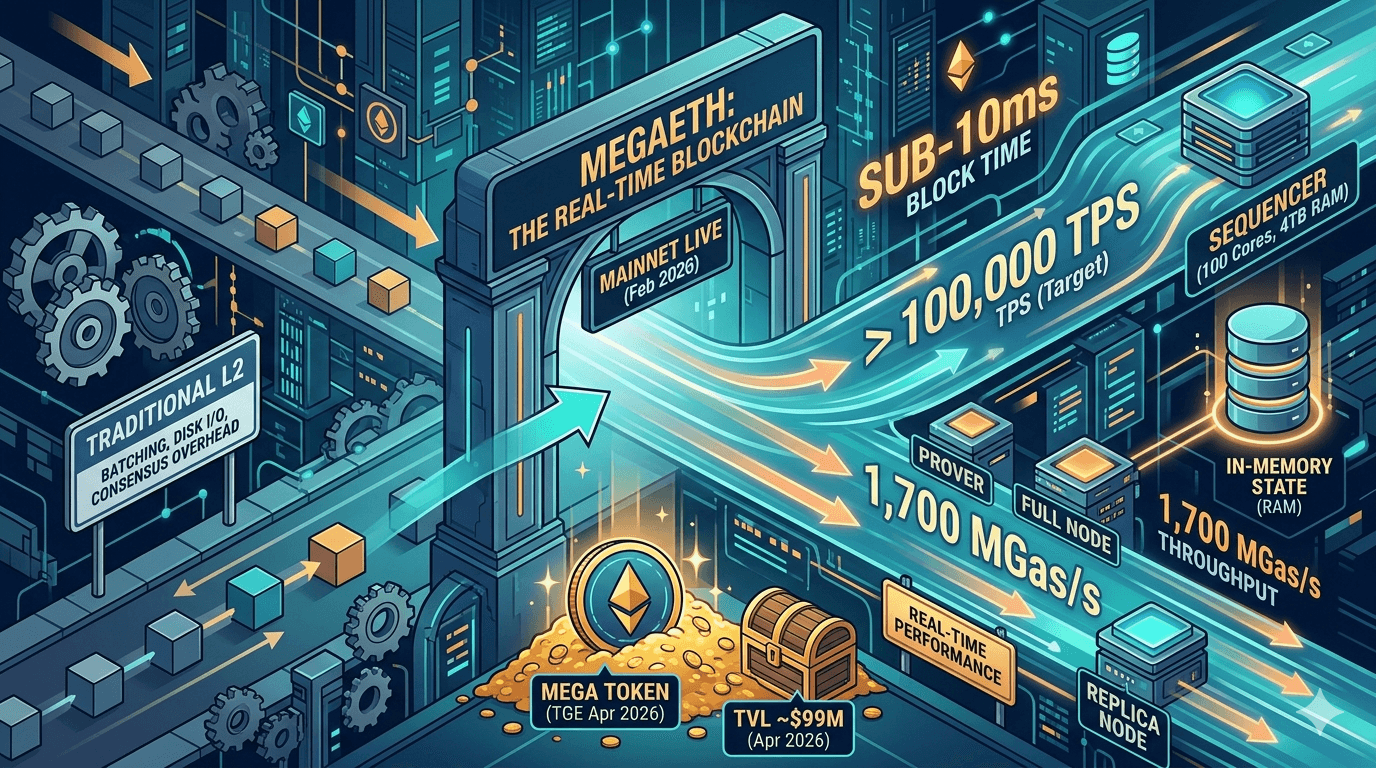
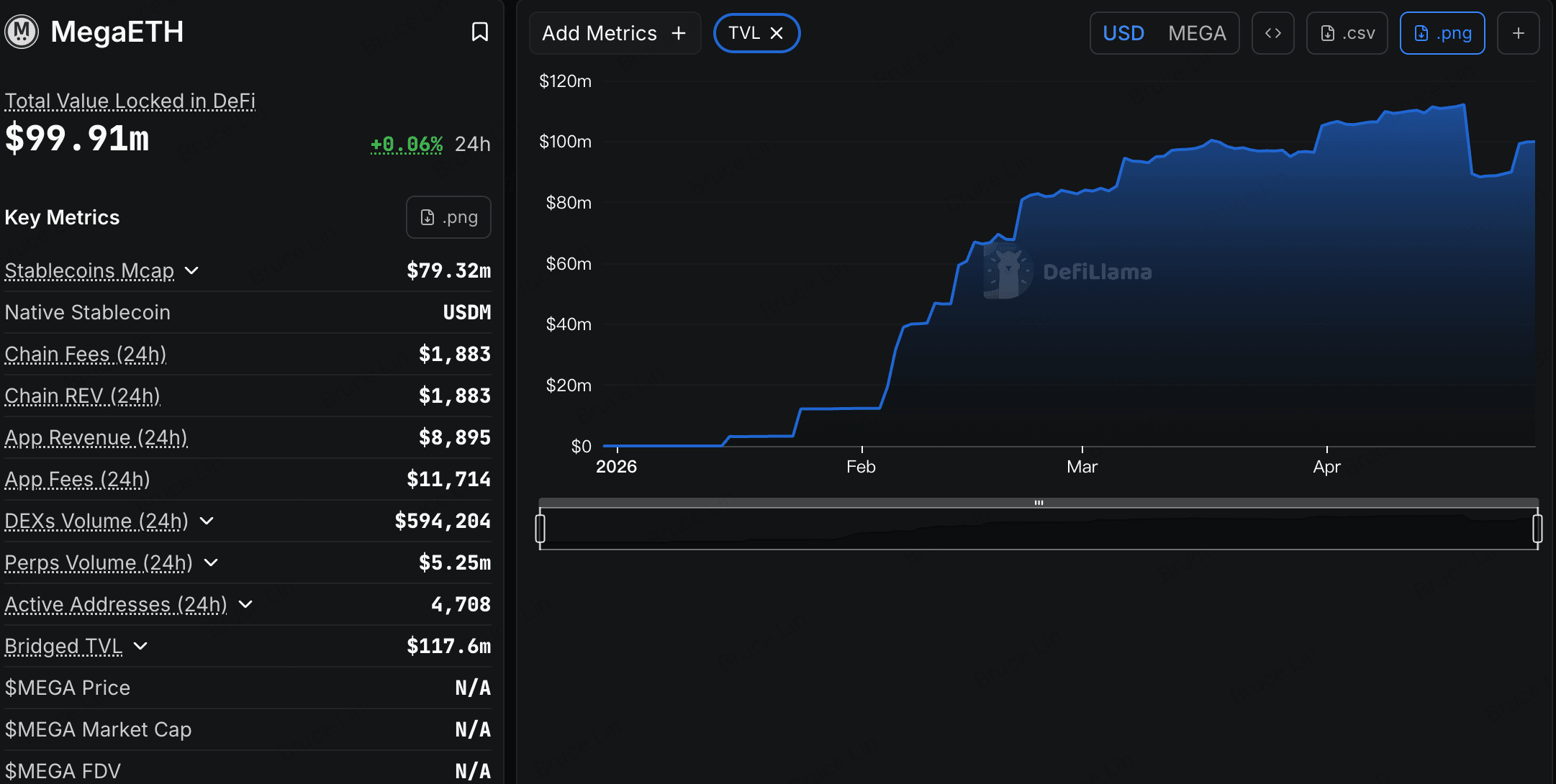
MegaETH answers that question with a resounding yes. This high-performance L2 delivers sub-10-millisecond block times and targets over 100,000 transactions per second (TPS), fundamentally redefining what developers and traders can expect from blockchain infrastructure. Unlike general-purpose rollups that prioritize broad compatibility, MegaETH optimizes every layer of the execution stack for real-time performance. Since its public mainnet launch on February 9, 2026, the network has already accumulated approximately $99 million in Total Value Locked (TVL) according to DeFiLlama data from April 2026, and processed billions of transactions in controlled stress tests. For traders seeking CEX-level speed with DeFi-level sovereignty, MegaETH represents a genuine paradigm shift in Ethereum scaling.
What Is MegaETH?
MegaETH is an Ethereum Layer 2 scaling solution engineered specifically for real-time blockchain performance. While most L2s focus primarily on reducing gas fees, MegaETH targets millisecond-level latency and massive throughput without sacrificing EVM compatibility. The network went live on mainnet in February 2026 and has since attracted significant developer attention through its Mega Mafia incubator program.
The project distinguishes itself through a performance-first architecture that treats execution speed as the primary design constraint. MegaETH is fully EVM-compatible, meaning Solidity developers can deploy existing smart contracts without rewriting code. However, beneath the surface, the network replaces traditional blockchain execution bottlenecks with specialized hardware configurations, in-memory state management, and advanced compilation techniques. This approach allows MegaETH to stream transactions continuously rather than batching them into discrete blocks, creating a user experience that feels closer to traditional cloud computing than conventional blockchain interaction.
MegaETH's native token, MEGA, launched its Token Generation Event (TGE) on April 30, 2026, following the achievement of strict on-chain performance milestones. The tokenomics are uniquely structured: 53.3% of the total 10 billion token supply is allocated to staking rewards tied to four measurable Key Performance Indicators (KPIs), ensuring that token emissions correlate directly with network growth and adoption. According to data from CryptoBriefing in April 2026, MegaLabs has raised $470 million in total funding, including a $450 million oversubscribed public token sale backed by Vitalik Buterin, Joe Lubin, and Dragonfly Capital.
Architectural Innovations Driving Performance
MegaETH achieves its extreme performance through three core architectural innovations that depart significantly from traditional rollup designs. These changes target the fundamental bottlenecks that limit existing L2s: state access latency, execution overhead, and consensus inefficiency.
Node Specialization
MegaETH replaces the one-size-fits-all node model with a heterogeneous architecture featuring four distinct node types, each optimized for a specific function. Based on MegaETH's official research documentation, sequencer nodes handle transaction ordering and execution using enterprise-grade hardware: 100 CPU cores, 1-4 terabytes of RAM, and 10 Gbps network bandwidth. Prover nodes generate cryptographic validity proofs using specialized hardware like GPUs and FPGAs. Full nodes re-execute transactions for independent verification, while lightweight replica nodes update state by applying diffs without re-execution, lowering participation barriers for everyday users.
This specialization allows the sequencer to focus entirely on raw throughput while decentralization and security are maintained through the broader node network. The design aligns with Vitalik Buterin's "Endgame" vision for Ethereum, where block production may centralize on powerful hardware but block validation remains accessible and trustless. By decoupling execution from verification, MegaETH eliminates consensus overhead during normal operation since only one active sequencer processes transactions at any given time. According to Messari's April 2026 comparative analysis, this single-sequencer model does not introduce additional trust assumptions beyond those already present in Arbitrum, Base, and Optimism, all of which currently utilize centralized sequencers.
In-Memory State Execution
Perhaps the most radical technical choice MegaETH makes is storing the entire blockchain state in RAM rather than on disk. Traditional blockchains are I/O-bound: reading and writing state to SSDs creates milliseconds of latency that compound across thousands of transactions. By maintaining full state in memory, MegaETH removes this bottleneck entirely and enables the sub-10-millisecond block times that define its real-time character.
The trade-off is substantial hardware investment for sequencers, but the performance gains are dramatic. Modern server CPUs support up to 4 TB of RAM, with emerging Compute Express Link (CXL) technology promising even greater capacity. For context, Ethereum's current state is approximately 100 GB, well within the capabilities of high-end server configurations. Based on pre-mainnet testing data from early 2026, MegaETH's measurements showed that existing Ethereum execution clients like Reth could only achieve approximately 1,000 TPS on powerful servers with 512 GB memory in real-time sync setups, primarily due to disk I/O constraints. Moving state to RAM eliminates this ceiling.
JIT Compilation and Custom EVM Implementation
MegaETH replaces the standard EVM interpreter with evmone, a C++ implementation optimized for raw execution speed, and layers Just-in-Time (JIT) compilation on top to push smart contract execution closer to native machine code performance. According to DWF Labs research from March 2026, these changes are combined with a reimagined state trie that minimizes write amplification and a write-optimized storage backend, addressing the compute overhead that keeps conventional EVM chains orders of magnitude slower than Web2 infrastructure.
The network also implements a two-pronged parallel execution model. While MegaETH's own measurements show that current Ethereum workloads have limited natural parallelism (median parallelization under 2 transactions per block), the architecture is designed to extract maximum throughput from batch processing while maintaining deterministic ordering guarantees. Based on Gate Academy's April 2026 whitepaper analysis, even faster EVM interpreters like revm remain 1-2 orders of magnitude slower than native execution, a gap that JIT compilation closes meaningfully.
Performance Metrics: How MegaETH Compares
The performance gap between MegaETH and existing L2s is not incremental -- it is transformational. Based on data from April 2026, the network delivers computational and latency metrics that redefine EVM chain capabilities.
|
Metric
|
MegaETH
|
Ethereum L1
|
Arbitrum
|
Base
|
|
Real-Time TPS
|
100,000+ (target)
|
~23
|
~57
|
~74-84
|
|
Block Time
|
10 milliseconds
|
12 seconds
|
250 milliseconds
|
2 seconds
|
|
Finality
|
~1 second
|
12-18 minutes
|
5-15 minutes
|
1-2 minutes
|
|
Computational Throughput
|
1,700 MGas/s
|
1 MGas/s
|
~50 MGas/s
|
~26-60 MGas/s
|
|
Contract Size Limit
|
512 KB
|
~24 KB
|
~24 KB
|
~24 KB
|
|
Transaction Gas Limit
|
~1 billion gas
|
~30 million gas
|
~30 million gas
|
~30 million gas
|
According to Messari's April 2026 comparative data, in January 2026 stress tests MegaETH processed approximately 10.3 billion transactions with sustained throughput between 10,000 and 22,000 TPS, peaking at 47,000 TPS. Post-mainnet, the network has demonstrated capacity exceeding 100,000 TPS in optimized conditions. For developers, the 1,700 MGas/s computational throughput matters more than raw TPS: it means complex smart contracts -- such as on-chain order books or derivatives engines -- execute at speeds previously impossible on EVM infrastructure.
The expanded contract size and gas limits are equally significant. Based on Messari's analysis from April 2026, MegaETH's 512 KB contract size cap allows deployment of sophisticated protocols that would be impossible on standard EVM chains, while the 1 billion gas transaction limit enables atomic operations across complex DeFi compositions without hitting block gas ceilings. These limits support resource-intensive applications like fully on-chain games and AI-powered protocols that require substantial computational resources per transaction.
Key Differences From Other Ethereum L2s
MegaETH occupies a distinct position in the L2 landscape. While Arbitrum, Base, and Optimism compete primarily on cost and ecosystem breadth, MegaETH competes on raw performance for latency-sensitive applications.
MegaETH vs. Arbitrum
Arbitrum remains the DeFi sovereign of the L2 ecosystem. According to Messari's April 2026 comparative report, Arbitrum secures approximately $16.8 billion in TVL and hosts over $8.6 billion in stablecoins. Based on Eco's April 2026 data, it processes roughly 57 TPS in real-world conditions with 250-millisecond block times -- respectable metrics that serve broad DeFi use cases well.
However, Arbitrum's optimistic rollup architecture batches transactions and exposes state updates only after blocks are produced. MegaETH, by contrast, streams execution continuously. Arbitrum's recent ArbOS Dia upgrade introduced dynamic gas pricing and improved throughput, yet its design fundamentally optimizes for general-purpose scalability rather than real-time responsiveness. For high-frequency trading or on-chain gaming, Arbitrum's 250-millisecond blocks represent a hard latency floor that MegaETH's 10-millisecond blocks shatter. According to Eco's April 2026 analysis, Arbitrum's theoretical maximum of 40,000 TPS under optimal conditions also remains untested in production, while MegaETH has already demonstrated sustained five-figure TPS in live stress tests.
MegaETH vs. Base
Base has emerged as the transaction volume leader among L2s. Based on market data from April 2026, Base processes the majority of all L2 transactions. According to Eco's April 2026 analysis, Base achieves real-world throughput of approximately 159 TPS in peak conditions. Backed by Coinbase's distribution muscle and over 100 million verified users, Base excels at consumer applications and retail DeFi.
Yet Base operates with 2-second block times and approximately 26-60 MGas/s in computational throughput. MegaETH's 1,700 MGas/s represents a 28x to 65x improvement in raw execution capacity. Base announced its "Azul" upgrade targeting May 2026 to enhance performance and decentralization, but even post-upgrade, its architecture remains oriented toward broad accessibility rather than extreme performance. MegaETH's hardware requirements -- 100-core sequencers with terabytes of RAM -- explicitly trade accessibility for speed, a choice Base does not make. According to Messari's April 2026 analysis, Base has focused on distribution and profitability rather than raw execution performance, positioning it in a fundamentally different market segment.
MegaETH vs. Optimism
Optimism powers the Superchain ecosystem and maintains strong developer activity. According to Chainspect data from April 2026, Optimism has over 3,300 contributors and nearly 180,000 code commits. Its optimistic rollup design achieves approximately 27 TPS with 2-second block times and 16-minute finality.
Optimism's strategic focus in 2026 centers on rebalancing Superchain revenue and strengthening OP Mainnet's position. While Optimism provides reliable, low-cost transactions for standard DeFi operations, its throughput and latency specifications place it in a different category from MegaETH. Optimism's architecture assumes that most applications do not require millisecond responsiveness -- an assumption MegaETH explicitly rejects. The Superchain model, which powers multiple chains including Base, prioritizes shared standards and interoperability over single-chain performance extremes.
Ecosystem and Real-World Adoption
MegaETH's mainnet launched with immediate DeFi integrations including Aave V3, GMX, World Markets, and Chainlink SCALE. According to Messari's April 2026 report, this gives the network access to approximately $14 billion in flagship DeFi assets. The ecosystem has also introduced FastBridge, powered by Avail Nexus, enabling asset transfers from over 14 EVM ecosystems in seconds.
The network's KPI-based tokenomics have already demonstrated traction. According to MEXC News from April 2026, 10 Mega Mafia applications went live to trigger the April 30, 2026 TGE, including on-chain game Showdown, decentralized telecom protocol Ubitel, and stablecoin payments protocol Cap. Each qualifying app recorded over 100,000 transactions in 30 days, proving genuine user activity rather than artificial inflation. Three additional KPI milestones remain, including requirements for three apps to generate $50,000 in daily fees for 30 consecutive days and for USDM stablecoin circulation to reach $500 million.
However, concentration risk exists. According to DeFiLlama data from April 2026, approximately $51 million of MegaETH's $99.6 million TVL resides in a single protocol, and USDM stablecoin captures roughly 83% of the network's stablecoin market cap. The daily fee generation remains modest at approximately $1,834 in chain revenue, indicating that while the infrastructure performs, monetization at scale remains a developing story. The DEX volume of $648,000 in 24 hours and perpetuals volume of $3.29 million show early trading activity but pale in comparison to Arbitrum's billions in daily volume.
Conclusion
MegaETH represents a fundamental architectural departure from conventional Ethereum Layer 2 design. By combining node specialization, in-memory state execution, and JIT compilation, the network achieves sub-10-millisecond block times and computational throughput exceeding 1,700 MGas/s -- metrics that place it in a performance category entirely separate from Arbitrum, Base, and Optimism. The February 2026 mainnet launch and April 2026 TGE have validated the core thesis that EVM chains can deliver real-time performance without sacrificing security inheritances from Ethereum.
The trade-offs are clear: MegaETH requires enterprise-grade hardware for sequencers and accepts a more centralized block production model in exchange for transformative speed. For applications like high-frequency DeFi, fully on-chain gaming, and AI-powered protocols, this trade-off is not merely acceptable -- it is necessary. As the L2 market consolidates around a handful of winners, MegaETH has carved out a defensible niche as the real-time blockchain. Whether its ecosystem can translate technical superiority into sustained economic activity remains the critical question for 2026 and beyond.
FAQs
What is MegaETH's transaction throughput?
MegaETH targets over 100,000 TPS with sustained stress test results showing 10,000-22,000 TPS and peaks reaching 47,000 TPS in January 2026 according to Messari's April 2026 analysis. Its computational throughput of 1,700 MGas/s significantly exceeds other EVM chains.
How does MegaETH differ from Arbitrum and Base?
MegaETH focuses on real-time execution with 10-millisecond block times, while Arbitrum operates at 250 milliseconds and Base at 2 seconds. Based on Messari's April 2026 data, MegaETH also delivers 1,700 MGas/s in computational throughput compared to approximately 50 MGas/s for Arbitrum and 26-60 MGas/s for Base.
What hardware does MegaETH require?
According to MegaETH's official research documentation, sequencers require enterprise servers with 100 CPU cores, 1-4 TB of RAM, and 10 Gbps network bandwidth. Full nodes need 16-core consumer PCs with 64 GB RAM, while lightweight replica nodes can run on 8-core machines with 8 GB RAM.
When did MegaETH launch its mainnet and token?
MegaETH launched its public mainnet on February 9, 2026. According to CryptoBriefing's April 2026 reporting, the MEGA token TGE occurred on April 30, 2026, triggered by the deployment of 10 live applications meeting transaction volume KPIs.
What are proximity markets in MegaETH?
Proximity markets allow applications and market makers to bid MEGA tokens for execution priority near the sequencer. Based on OurCryptoTalk's April 2026 analysis, this mechanism creates direct demand for MEGA while giving latency-sensitive traders deterministic performance advantages.