

OP Mainnet’s 70% TVL Crash: Can the L2 Giant Mount a Comeback?
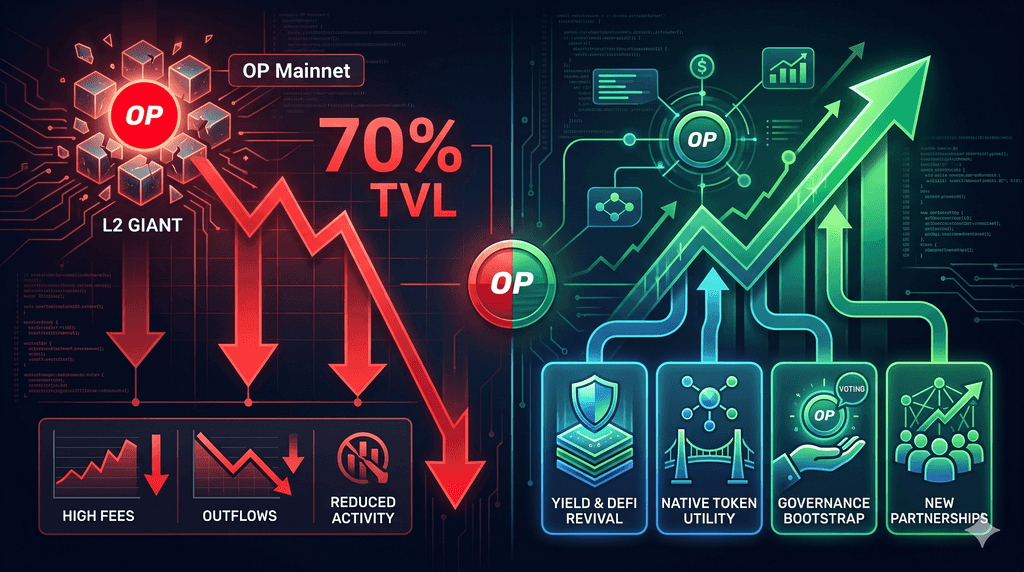
The Ethereum Layer 2 (L2) landscape has always been a battlefield of rapid innovation and ruthless competition, but April 2026 has brought a seismic shift that few predicted with such intensity. OP Mainnet, once the undisputed titan of the "Superchain" vision, has witnessed a staggering 70% collapse in its Total Value Locked (TVL). This decline isn't just a number on a chart; it represents a fundamental migration of liquidity and a potential identity crisis for one of the industry's most respected scaling solutions.
As of mid-April 2026, the decentralized finance (DeFi) community is grappling with a difficult question: Is this the beginning of the end for Optimism, or is it a necessary purge before a more sustainable evolution? The departure of major ecosystem partners and the rise of specialized competitors have left OP Mainnet at a crossroads. To understand whether a comeback is possible, we must first dissect the mechanics of this crash and the shifting loyalties of the "Superchain" members.
Key Takeaways
-
The Catalyst: The primary driver of the 70% TVL drop was the official exit of Base from the Superchain revenue-sharing model in February 2026, which took a massive chunk of transaction volume and liquidity with it.
-
Revenue Strain: Base previously contributed over 96% of the gas fees flowing into the Optimism Collective; its departure has left a massive hole in the protocol’s treasury.
-
Infrastructure Pivot: Optimism is shifting its focus from being a "consumer destination" to a "backend infrastructure provider" (the OP Stack), which may stabilize its long-term value despite lower frontend TVL.
-
New Lifeblood: Strategic partnerships with entities like ether.fi are bringing tens of thousands of new users and real-world payment use cases to the chain.
-
Technical Hurdles: The delay in delivering "Native Interoperability" between OP Stack chains has been a significant point of friction, leading to "Superchain fatigue" among developers.
The Genesis of the Collapse: Why the Liquidity Fled
The 70% crash in OP Mainnet’s TVL did not happen in a vacuum. It was the culmination of months of "theoretical" promises failing to meet the "practical" needs of high-growth applications. For much of 2025, the Superchain was marketed as a seamless web of interconnected blockchains. However, as 2026 began, the lack of native, trustless interoperability became an unbearable tax on developers.
When Base, the powerhouse L2 backed by Coinbase, announced its strategic pivot to a more independent codebase in February 2026, the dominoes fell. Base wasn't just another chain; it was the engine room of the Optimism Collective. At its peak, Base accounted for nearly 96.5% of the gas fees that funded the Optimism treasury. When that revenue stream was severed, investor confidence plummeted, leading to a massive exit of liquidity providers who had been farming OP rewards.
Furthermore, the "Superchain Tax"—a revenue-sharing agreement where chains paid a percentage of their fees to the Optimism Collective—became a point of contention. Smaller chains realized they were paying for a "brand" rather than functional technology that increased their bottom line. This led to a "vampire attack" from rival ecosystems like Arbitrum’s Orbit and Polygon’s AggLayer, which offered more flexible economic models for new rollups.
Dissecting the Data: The Current State of OP Mainnet
While Arbitrum has maintained its lead through "DeFi stickiness" and Base has exploded via mainstream Coinbase integration, OP Mainnet has seen its TVL retract to levels not seen since the early days of the 2023 bear market. The token price has followed suit, hovering near all-time lows as the market re-evaluates the "Fully Diluted Valuation" (FDV) of a chain that has lost its primary revenue contributor.
The Superchain Fatigue: Theoretical Gains vs. Reality
A major reason for the migration of capital is what analysts call "Superchain Fatigue." The Optimism Foundation spent years promoting a vision where any chain built with the OP Stack would be part of a unified collective. The reality in 2026 has been more fragmented.
-
Delayed Interoperability: Native cross-chain messaging was promised for early 2025. By mid-2026, it is still largely in a "testing phase" for most mainnet users. This forced users to use third-party bridges, negating the primary selling point of the Superchain.
-
The Governance Tax: Chains like Base and Zora were essentially paying "rent" to the Optimism Collective. When the value of the "Shared Security" and "Shared Brand" didn't result in a measurable increase in users compared to going solo, the incentive to stay diminished.
-
Token Inflation: Massive amounts of OP tokens have been unlocked for ecosystem grants and retroactive public goods funding. While noble in intent, this constant supply pressure has made OP a difficult asset to hold for investors, contributing to the TVL flight as users move to assets with better "value capture" mechanisms.
Can the Infrastructure Pivot Save the Ecosystem?
Despite the grim TVL numbers, it would be a mistake to count Optimism out entirely. The Foundation has subtly shifted its strategy. Rather than trying to compete with Base or Arbitrum for the "most retail users," Optimism is doubling down on being the Linux of Blockchains.
The OP Stack remains the most widely adopted framework for building custom L2s. Even if these chains (like the now-independent Base) stop sharing revenue, they often continue to use the underlying technology. This creates a massive "developer moat." If Optimism can successfully implement its shared sequencing layer in late 2026, it could regain its status as the connective tissue of the Ethereum ecosystem.
In this scenario, OP Mainnet becomes less of a "shopping mall" (where TVL matters) and more of a "utility provider" or "central bank" for other chains. The focus is moving toward Retroactive Public Goods Funding (RPGF), which ensures that the developers who build the most useful tools are rewarded. If the best developers stay in the OP ecosystem, the users—and the TVL—will eventually follow.
The Silver Lining: New Partnerships and Consumer Use Cases
While the 70% drop is historic, new life is beginning to stir in the wreckage. In February and March of 2026, a series of "Consumer-First" partnerships began to stabilize the floor.
The most notable is the integration with ether.fi. Unlike previous DeFi protocols that were purely speculative, ether.fi has brought its on-chain credit card product to OP Mainnet. This has introduced over 70,000 active cards and 300,000 new accounts to the chain. These aren't whales looking for 1,000% APY; they are real-world users spending crypto on coffee and groceries.
Furthermore, the OP Buyback Program has recently launched. By allocating 50% of the remaining sequencer revenue toward monthly OP repurchases, the Foundation is attempting to create a floor for the token price. This move toward "sustainable tokenomics" is a direct response to the criticisms of 2025 and is a crucial component of any potential comeback.
The Road to Recovery: What Needs to Happen Next
For OP Mainnet to mount a successful comeback and reclaim its $5B+ TVL status, three things must happen before the end of 2026:
-
Delivery of the "Interop" Layer
Optimism must move past the "theoretical" stage of interoperability. A user on an OP Stack chain should be able to buy an NFT on another OP Stack chain without ever knowing they are switching networks. If this is achieved, the "Superchain" becomes a single, massive liquidity pool that can rival the convenience of Solana.
-
High-Yield Real World Assets (RWA)
As speculative DeFi yields dry up, OP Mainnet is well-positioned to become the home for tokenized treasuries and private credit. Because of its institutional-friendly governance and modular stack, it could attract billions in RWA TVL, which is far more stable than "meme coin" liquidity.
-
A New Economic Contract
The "Superchain Tax" needs to be redesigned. Instead of a flat fee that feels like a burden, the Optimism Collective needs to offer tangible, revenue-generating services—such as shared fraud proofs or decentralized sequencing—that make it cheaper for a chain to be in the Collective than to be out of it.
Conclusion
The 70% TVL crash of OP Mainnet is a sobering reminder that in the world of Layer 2s, past performance does not guarantee future dominance. The "Base-exit" was a "black swan" event that exposed the fragility of the early Superchain model. However, the underlying technology of the OP Stack remains a cornerstone of the Ethereum roadmap.
Optimism is currently in a "rebuilding year." By pivoting away from pure TVL metrics and focusing on sustainable consumer use cases and robust infrastructure, it is laying the groundwork for a different kind of success. The "Giant" may have fallen, but it is far from dead. For the patient investor and the dedicated developer, the current "low" may eventually be seen as the moment the Superchain finally grew up.
FAQs
Q1: Is OP Mainnet still safe to use after the 70% TVL drop?
Yes. The TVL drop is an economic and liquidity event, not a security one. The technical integrity of the network remains intact, and it continues to inherit the full security of the Ethereum L1.
Q2: Why did Base leave the Optimism Superchain?
Base didn't "leave" the technology (it still uses the OP Stack), but it moved away from the formal revenue-sharing and governance obligations of the "Optimism Collective" to pursue a more independent roadmap and retain more of its own sequencer fees.
Q3: What is the "OP Stack" and why does it matter?
The OP Stack is an open-source development blueprint for building blockchains. Even if TVL on OP Mainnet is low, the widespread use of the OP Stack by other chains (like Zora, Mode, and World Chain) gives the Optimism ecosystem significant influence and long-term potential.
Q4: How does the ether.fi partnership help Optimism?
It shifts the focus from "DeFi farming" to "Consumer Payments." By bringing hundreds of thousands of credit card users onto the chain, Optimism gains a stable base of daily active users who generate consistent transaction fees regardless of market volatility.
Q5: Will the OP token price recover?
Price recovery depends on the success of the new buyback program and the delivery of native interoperability. While the token is currently near all-time lows, many analysts believe the "infrastructure pivot" will eventually lead to more sustainable value capture for token holders.