

Measuring Bitcoin's Quantum-Exposed Supply After Glassnode's 2026 Wake-Up Call
2026/05/25 15:48:02
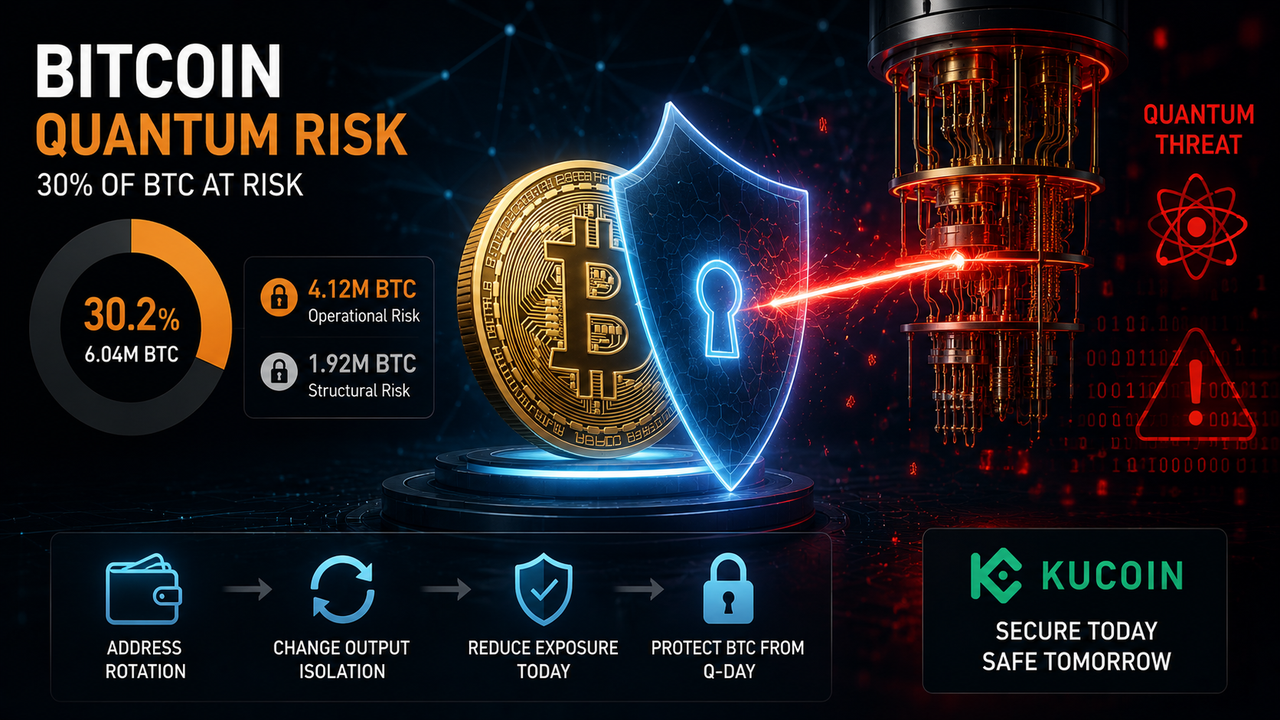
The rapid rise of quantum computing has triggered intense scrutiny over blockchain security, specifically targeting how market participants manage digital assets. A groundbreaking May 2026 report from Glassnode warns that over 30% of the circulating Bitcoin supply is currently vulnerable to future quantum decryption due to exposed public keys.
Understanding the deep operational realities behind Bitcoin's Quantum risk profile allows global investors to evaluate the structural integrity of premier trading venues like KuCoin. This deep dive maps out visible blockchain vulnerabilities, entity-level exposure data, and tactical key rotation defenses.
Key Takeaways
-
Massive On-Chain Exposure: Over 6.04 million BTC (30.2% of the issued supply) sits in a state of at-rest public-key exposure, leaving it theoretically targetable by a future quantum computer.
-
Behavior Over Code: More than two-thirds of this risk (4.12 million BTC) stems from operational exposure—specifically poor address hygiene and address reuse—rather than unfixable legacy protocol design.
-
The Exchange Vulnerability Pool: Centralized trading platforms represent the single largest operational hotspot, holding roughly 1.66 million BTC of the network's exposed quantum supply.
-
The Architecture Divide: On-chain data reveals a massive polarization in security practices, where fixed-address custodial structures suffer 100% exposure, while advanced platforms utilizing aggressive UTXO rotation keep public-key visibility below 5%.
-
Immediate Defense Available: Mitigating the majority of Bitcoin's Quantum vulnerabilities does not require waiting for slow protocol-level hard forks; it can be achieved today through rigorous institutional address rotation and automated change routing.
Quantifying the Post-Quantum Risk: What This 2026 Data Means for CEX Users
The technical discourse around Bitcoin's Quantum resilience shifted dramatically following the publication of Glassnode’s mid-2026 network intelligence data. Analysts confirmed that 6.04 million BTC—amounting to 30.2% of all issued coins—sits in a state of "at-rest public-key exposure." For everyday users of Centralized Exchanges (CEXs), this metrics-driven alert means that nearly a third of the network's liquidity rests on infrastructure that provides zero cryptographic buffering against a Cryptographically Relevant Quantum Computer (CRQC).
This risk is not abstract. While the remaining 13.99 million BTC (69.8%) remains securely shielded behind advanced mathematical hash walls, the exposed cohort is instantly targetable the moment a sufficiently scalable quantum machine goes online. CEX users must recognize that their choice of trading venue dictates whether their underlying custodial deposits reside within the protected majority or the vulnerable minority.
Critical Insights: The Trillion-Dollar Vulnerability Sitting in Plain Sight
The true revelation of the 2026 data lies in the dual-layered taxonomy of this multibillion-dollar vulnerability. Security engineers categorize the exposed supply into two distinct silos: Structural Exposure and Operational Exposure.
-
Structural Exposure (1.92 Million BTC / 9.6%): Coins locked in script configurations that, by structural design, must display the public key to the ledger even when the asset is completely static.
-
Operational Exposure (4.12 Million BTC / 20.6%): A massive pool of capital that was initially protected by blockchain hashing layers but became exposed due to human error, poor wallet configuration, and structural address reuse.
For digital asset platforms, this split proves that quantum vulnerability is heavily accelerated by institutional address management workflows, rather than being an unfixable limitation of the core Bitcoin protocol.
The Core Metric: Understanding Public-Key Visibility
Decoupling Asymmetric Cryptography from Theoretical Quantum Threats
To properly assess Bitcoin's Quantum attack surface, we must demystify how asymmetric cryptography functions across the distributed ledger. Bitcoin relies on pairs of keys: the private key, which generates cryptographic signatures to authorize outbound fund transfers, and the public key, which the decentralized network uses to verify those signatures. Under classical computing constraints, the mathematical relationship between these keys is governed by the Elliptic Curve Digital Signature Algorithm (ECDSA), specifically the secp256k1 curve.
Deriving a 256-bit private key from its corresponding public key using a classical supercomputer would require billions of years of continuous computation, rendering the system effectively unbreachable. The core vulnerability emerges only when a different paradigm of computing is introduced—one capable of bypassing these computational walls entirely.
At-Rest vs On-Spend: Clarifying the True Vectors in Measuring Bitcoin's Quantum-Exposed Supply
When mapping out vectors of exploitation, cryptography experts draw a hard boundary between two distinct threat states.
Under the At-Rest Exposure model, coins are currently sitting in Unspent Transaction Outputs (UTXOs) where the raw public key is already completely visible to anyone running a full node. An attacker possessing a CRQC can independently parse the historic ledger, extract these public keys, derive the matching private keys offline, and draft a transaction to drain the funds. The victim has no warning because their wallet was completely passive when the cryptographic breach occurred.
Under the On-Spend Exposure model, a dynamic race condition occurs. When a user transmits a spend command from a previously unexposed address, the raw public key is broadcast to the network's mempool to facilitate validation. A quantum adversary would have to detect this unconfirmed transaction, instantly calculate the private key, forge a competing transaction with a much higher priority fee, and front-run the original payment before it gets permanently minted into a block. By prioritizing the measurement of at-rest exposure, the industry can accurately track the exact stock of stagnant, defenseless inventory across global custody networks.
Q-Day Timelines: Decoding Shor’s Algorithm and the 2,330 Logical Qubits Milestone
The mathematical engine driving this systemic anxiety is Shor’s Algorithm. When executed on a quantum computer utilizing quantum superposition and entanglement, Shor’s Algorithm factors massive integers and solves discrete logarithms in polynomial time. For the secp256k1 elliptic curve utilized by Bitcoin, breaking the system requires a quantum processor stable enough to sustain roughly 2,330 logical qubits.
It is vital to distinguish between raw physical qubits and error-corrected logical qubits. Current hardware announcements often showcase processors with hundreds or thousands of noisy physical qubits. However, due to environmental decoherence, thousands of physical qubits must be bundled together via complex quantum error correction (QEC) protocols to create a single, stable logical qubit. Academic and intelligence agencies estimate that a machine running 2,330 stable logical qubits could appear sometime between the late 2020s and the mid-2030s—a timeline commonly referred to as "Q-Day."
Dissecting the 6.04M BTC Structural Risk
Satoshi-Era Legacy: The Peril of Unhashed P2PK and Bare Multisig Outputs
The first line of structural vulnerability traces directly back to the earliest iterations of Bitcoin’s codebase. In the network’s infancy, the default transaction script was Pay-to-Public-Key (P2PK). Under a P2PK regime, when a block reward or transaction was sent to an entity, the recipient's raw, unhashed public key was written directly into the scriptPubKey of the UTXO.
This cohort includes an estimated 1.1 million BTC attributed directly to Satoshi Nakamoto's early mining operations, alongside approximately 620,000 BTC claimed by other early network participants. Because these early outputs do not benefit from a secondary layer of cryptographic hashing, they are structurally exposed by default. A parallel vulnerability exists within legacy Bare Multisig (P2MS) scripts, which explicitly list the public keys of all potential signers within the public state ledger. If these historical keys belong to lost, destroyed, or abandoned wallets, their owners cannot voluntarily move them to modern, safer architectures, leaving them permanently exposed to future quantum extraction.
The Taproot Paradox: How Modern Scripting Accidental Boosts Quantum Visibility
While legacy scripts represent an expected historical vulnerability, the introduction of the Taproot upgrade (BIP-341) brought an unexpected twist to Bitcoin's Quantum risk mapping. Taproot was widely celebrated for dramatically boosting transaction privacy, optimizing data efficiency, and enabling advanced smart contract configurations via Schnorr signatures.
However, under the hood, Taproot alters how the master output key is handled. First, the key-path channel consolidates spending paths into a single master output key that is written directly into the blockchain state. Second, this design provides immediate visibility, because unlike older Pay-to-Script-Hash (P2SH) workflows that hide complex scripts behind a hash until the point of spending, a Taproot UTXO leaves its output public key fully visible while sitting idle. This design choice places roughly 200,000 BTC of modern, highly active institutional and programmatic capital squarely into the structurally exposed at-rest category. This paradox proves that upgrading to modern standards does not automatically equate to achieving comprehensive post-quantum immunity.
BIP-360 and P2MR: The 2026 Protocol Proposals Aiming to Save Future UTXOs
Recognizing the structural exposure embedded within Taproot, core developers introduced BIP-360, which outlines the technical blueprint for a new output standard known as Pay-to-Merkle-Root (P2MR). The explicit goal of P2MR is to preserve the multi-path scripting efficiencies and advanced privacy benefits introduced by Taproot, while systematically eliminating its structural public-key exposure at rest.
Standard Taproot (P2TR) exposes the master output key on-chain at rest. In contrast, the BIP-360 (P2MR) proposal replaces the public key with a cryptographic Merkle Root hash while idle. P2MR achieves this by stripping the naked key-path option from the default base layer of the output script. Instead of displaying a spendable public key on-chain while the funds are idle, the script commits strictly to a cryptographic Merkle Root hash. The true public keys are only revealed when a spending event occurs, effectively restoring the dual-layer defensive hashing mechanism that protects native SegWit addresses. Crucially, BIP-360 is not a magic bullet; it cannot retroactively secure existing Taproot outputs or recover legacy P2PK funds. It functions strictly as a forward-looking architectural upgrade designed to halt the ongoing growth of structurally exposed supply.
Operational Exposure: The Trillion-Dollar Address Hygiene Problem
Instead of stemming from early protocol choices or unhashed legacy scripts, the vast majority of at-rest quantum exposure is driven entirely by human behavior, system architecture errors, and poor transaction hygiene. Modern address standards like P2PKH (Pay-to-Public-Key-Hash) and P2WPKH (Native SegWit) offer robust quantum buffering by wrapping the public key inside a one-way cryptographic hash function. A quantum computer cannot crack what it cannot see; as long as the raw public key remains hidden inside the hash envelope, the underlying assets are completely secure at rest. However, this defensive layer is instantly compromised when users fail to maintain proper wallet management policies.
Breaking Down the 4.12M BTC At-Risk Supply Driven by User Behavior
Data reveals that operational exposure accounts for a massive 4.12 million BTC, representing a staggering 20.6% of the total issued Bitcoin supply. This means the behavioral vulnerability pool is more than double the size of the unchangeable structural risk pool. This massive concentration of at-risk capital is directly tied to how individuals, automated platforms, and institutional custodians manage day-to-day transactions. When scaled across millions of global users and automated payment rails, minor omissions in wallet rotation logic compound into a massive systemic vulnerability.
The Anatomy of Address Reuse: How One Transaction Unlocks the Vault
The core mechanics behind address reuse illuminate exactly how a single transaction can unintentionally compromise a wallet's long-term security. When an address receives a Bitcoin deposit, the public ledger records the hash of the public key, keeping the raw key safe from quantum eyes. The moment the wallet owner initiates an outbound transfer, the underlying protocol mechanics require them to broadcast the raw public key alongside the digital signature to prove ownership to the network.
When a wallet receives its first deposit, only the public key hash is recorded on the ledger, keeping the quantum shield active. During an outbound spend, the raw public key must be broadcast to validate the transfer, briefly opening the shield. If address reuse occurs because remaining or new funds are left in that same address, the quantum shield is broken permanently. If the wallet software or the user continues to reuse that identical address for subsequent incoming transactions—or fails to sweep the unspent "change" balance to a freshly generated address—the remaining funds sit on the ledger with their raw public key completely exposed. The historical protective hash layer is rendered useless, leaving the wallet vulnerable to direct offline private key derivation by a quantum adversary.
Slipping Standards: Why CEX Quantum Safety Dropped from 55% to 45%
An alarming insight from Glassnode's analysis is the measurable degradation of data hygiene across the exchange landscape over time. Historically, trading platforms were diligent about rotating deposit addresses to enhance user privacy and keep internal ledgers organized. In 2018, approximately 55% of all Bitcoin held on exchange-labeled wallets was classified as operationally safe.
By mid-2026, that safety ratio had slid down to roughly 45%. This downward trend points to a systemic slip in custody standards across major trading venues. As platforms scale their internal liquidity networks, deploy high-frequency clearing systems, and adopt complex multi-sig architectures, many have sacrificed address rotation for operational speed. Rather than constantly sweeping balances to fresh, unexposed UTXOs, many platforms routinely cycle billions of dollars through fixed, highly exposed deposit addresses, steadily expanding the network's overall quantum attack surface.
The Institutional Divide: Who Wins the Cryptographic Hygiene Race?
The On-Chain Footprint of Global Liquidity
When examining entity-level architecture, the scale of public-key exposure correlates heavily with the operational design of the platform. On-chain mapping reveals that across the global digital asset ecosystem, a massive divergence exists between entities. While some institutional custodians choose fixed-address systems that prioritize settlement simplicity over advanced on-chain key concealment, premier exchanges implement highly advanced, automated clearing and address rotation matrices to guard customer capital against future vectors of exploitation.
Deep Diving into Institutional Exchange Customization and Wallet Security
The divergence in security standards across the digital asset industry highlights a stark divide in custodial philosophy. Trading venues that rely on fixed address models see 100% of their labeled balances classified as operationally exposed. This complete exposure indicates that these platforms rely on stagnant address systems, where user deposit wallets double as long-term storage hubs without any automated clearing to unexposed addresses.
In stark contrast, modern security-focused platforms like KuCoin actively implement advanced wallet security measures. KuCoin mitigates these structural risks by utilizing a sophisticated Hierarchical Deterministic (HD) wallet matrix and strict change output rotation. By ensuring that internal clearing mechanisms systematically sweep user deposits away from front-facing, high-velocity entry points into completely fresh, unexposed addresses, KuCoin keeps its operational exposure profile tightly optimized and insulated against future quantum decryption.
TradFi vs Crypto-Natives: Tracking Institutional Asset Exposure
The entry of traditional Wall Street firms into the digital asset space via spot Bitcoin ETFs has set up a fascinating head-to-head matchup in cryptographic safety standards. Traditional institutions that built their custody systems from scratch often apply rigorous enterprise-grade financial controls to their digital asset divisions, keeping their public-key exposure exceptionally low. Conversely, legacy crypto trusts that launched long before automated address rotation systems became an industry-wide standard carry significant technical debt, often resulting in exposure rates exceeding 50% to 100% due to reliance on stagnant infrastructure.
Sovereign Perfection: Why Governments Stand at 0% Risk
While commercial entities display mixed results due to profit motives and high transaction volumes, national governments exhibit near-flawless cryptographic execution. Wallets controlled by the sovereign treasuries of the United States, the United Kingdom, and El Salvador consistently maintain an impressive 0% quantum exposure rate, with overall safety metrics holding above 99.8%.
Sovereign entities are not operating commercial trading desks, so they do not face the pressure of managing high-velocity retail deposits and withdrawals. When government law enforcement agencies seize assets or execute state-level purchases, the incoming funds are routed into fresh institutional cold-storage arrays. Because these state-level entities strictly avoid address reuse, keep internal rebalancing transactions to an absolute minimum, and never recycle legacy infrastructure, their multi-billion-dollar reserves remain completely shielded from post-quantum vectors.
Active Defense: How Exchanges Can Mitigate Risks Today
Eliminating Address Reuse: Implementing Automated Change Output Rotation
The most effective defense against operational quantum risk does not require a complex, contentious overhaul of the core Bitcoin protocol. Because over 20% of the network's overall vulnerability is driven entirely by bad address hygiene, platforms can drastically improve their security profile by upgrading their internal wallet management software. The first step in this defense is the total elimination of address reuse via automated change output rotation.
When an exchange initiates a transaction to process a user withdrawal, the total balance from the originating UTXO is pulled. A portion is sent directly to the recipient's new address, while the remaining balance is instantly routed as a change output to a brand-new, completely unexposed address. By ensuring that change outputs are never routed back to the original address, the platform guarantees that lingering funds are always protected by a fresh, unhashed layer of security, keeping public keys hidden from the public ledger.
Institutional Custody Upgrades: The Operational Levers Leading to Quantum Safety
For high-volume trading platforms, achieving elite quantum safety requires a fundamental redesign of how internal liquidity is managed. Instead of pooling assets into massive, highly exposed omnibus addresses, exchanges must deploy automated clearing systems that continuously move idle funds out of front-facing retail deposit wallets.
First, platforms must isolate retail gateways, treating front-end user deposit addresses as temporary, high-risk entry zones rather than long-term storage hubs. Second, the exchange’s backend must automate internal clears, monitoring incoming user deposits and immediately triggering an automated sweep to move those funds deeper into internal cold-storage structures. Third, platforms should deploy HD wallet matrices to automatically generate an endless stream of fresh, unexposed addresses for every inbound transfer. By executing these continuous, automated sweeps behind the scenes, a platform can systematically shrink its visible on-chain footprint, shifting the vast majority of its custodial reserves from the exposed 30% minority into the secure 70% majority.
Educating the Retail Trader: Best Practices for Self-Custody and Address Rotation
While institutional custodians manage the largest pools of capital, individual traders running self-custody setups must also be educated on proper address hygiene. Many hardware and software wallets generate a fresh receive address by default for every new transaction, but users often bypass these protections by saving a single deposit address to their personal address books or whitelisting a single fixed location across multiple platforms.
Exchanges can play a vital role in protecting the broader ecosystem by building clear, proactive safety alerts directly into their user interfaces. When a user requests a withdrawal, the platform's system should analyze the destination address on-chain. If the system detects that the target address has already broadcast its public key in a past transaction, it can display a helpful warning message advising the user that the address has been used before and its public key is visible on-chain, recommending they generate a fresh, unused address to protect their long-term privacy and quantum safety. By actively encouraging these simple, proactive habits, platforms can help users protect their own self-custody assets while driving down the global volume of exposed Bitcoin.
Conclusion
Evaluating Bitcoin's Quantum risk profile reveals that post-quantum readiness is an immediate operational priority for asset custodians, rather than a distant protocol-level concern. Glassnode's 2026 data proves that over two-thirds of all at-rest public key exposure is driven entirely by bad address hygiene and poor wallet management, rather than unchangeable historical code. Advanced platforms like KuCoin prove that by implementing rigorous address safety standards—such as utilizing automated Hierarchical Deterministic (HD) wallet matrices and enforcing strict change output isolation—platforms can keep operational public-key exposure down to an absolute minimum. By adopting automated change address rotation and eliminating address reuse today, the global exchange layer can systematically secure customer assets long before Q-Day arrives.
FAQ
Does high public-key exposure mean an exchange is currently insolvent or unsafe?
No. High public-key exposure does not mean a platform is insolvent or at immediate risk of theft under classical computing standards. It simply means the platform's wallet architecture leaves public keys visible on-chain, which will make those specific funds vulnerable once a powerful, error-corrected quantum computer becomes operational in the future.
Why do sovereign government wallets have a better quantum safety rating than CEXs?
Sovereign government wallets achieve perfect safety ratings because they manage fixed, static asset reserves rather than high-velocity commercial trading desks. Because state-level entities do not have to process millions of retail deposits and withdrawals, they can easily enforce strict security policies, avoid address reuse entirely, and keep public keys completely hidden behind protective hash layers.
What is the difference between structural and operational quantum exposure?
Structural exposure occurs when an output script type (like early P2PK or modern Taproot) inherently publishes the public key to the blockchain by design, regardless of user behavior. Operational exposure is caused entirely by human behavior and bad wallet management, occurring when a user reuses a hashed address after its public key has already been revealed during an outbound transaction.
Can an exchange fix its quantum exposure without waiting for a Bitcoin hard fork?
Yes, absolutely. Since the majority of at-rest quantum exposure is operational rather than structural, an exchange can drastically lower its risk profile today without any changes to the core Bitcoin protocol. By upgrading internal wallet software to enforce strict address rotation and automatically sweeping customer funds to fresh, unexposed UTXOs, a platform can quickly secure its reserves.
How does the proposed BIP-360 upgrade help mitigate long-term quantum risk?
BIP-360 introduces a new output type called Pay-to-Merkle-Root (P2MR), which is designed to fix the structural public-key exposure inherent to Taproot scripts. P2MR replaces the visible master output key with a secure Merkle Root hash while assets are idle, ensuring that the raw public keys are only revealed during an active spend event.