

BlackRock's New BITA ETF: Earn Passive Income from Bitcoin — How It Works?
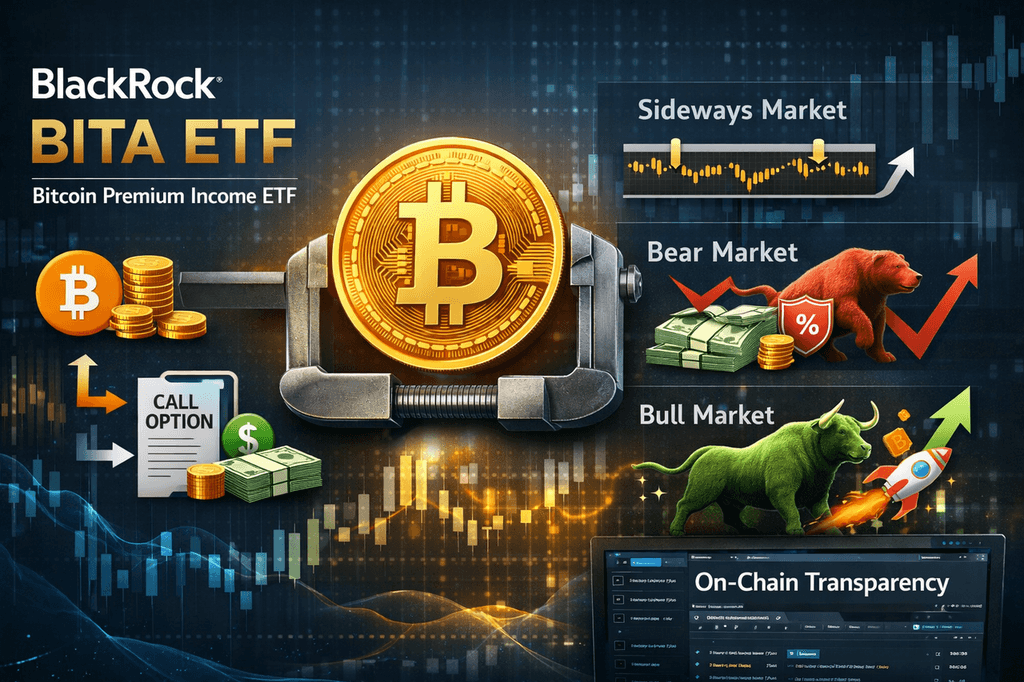
This comprehensive guide explores the mechanics behind BlackRock's New BITA ETF, detailing the covered call strategy and key market performance indicators to help you decide if this yield-focused product fits your portfolio.
Key Takeaways
-
What is BITA? The iShares Bitcoin Premium Income ETF is a specialized fund designed to provide investors with regular monthly cash flow sourced directly from Bitcoin-related assets.
-
The Core Strategy: It utilizes a "Covered Call" strategy, which involves holding Bitcoin (or Bitcoin-linked assets) and selling potential upside to other traders in exchange for immediate cash.
-
Income Source: Unlike traditional "buy and hold" strategies, BITA’s earnings are derived from selling call option premiums, creating a yield that doesn't solely rely on Bitcoin’s price going up.
-
Ideal Investor: This fund is best suited for income-seekers and conservative crypto investors who prefer steady distributions over volatile "moonshot" gains, particularly during sideways market phases.
What is BlackRock's New BITA ETF?
BlackRock has dominated the 2024-2025 crypto narrative with its spot Bitcoin trust, but BlackRock's New BITA ETF represents the "Phase 2" of institutional adoption. While the first wave of ETFs was about access, this second wave is about optimization—specifically, how to turn a non-yielding asset like Bitcoin into a productive one.
Bridging Bitcoin Exposure with Monthly Income
BlackRock's New BITA ETF is the strategic successor to the massive iShares Bitcoin Trust (IBIT). While IBIT was built for "HODLers" and long-term accumulators who want pure, 1:1 price tracking, BITA is built for the "Cash Flow King." It transforms Bitcoin from a speculative digital gold into an income-generating asset. By providing a steady "paycheck," BITA allows crypto investors to cover living expenses or reinvest dividends without having to manually sell their core holdings.
The Dominance of IBIT Liquidity
One of the most significant advantages of BlackRock's New BITA ETF is its internal synergy. Because BlackRock’s spot ETF (IBIT) manages over $50 billion in assets, BITA can tap into the deepest liquidity pool in the entire crypto ETF ecosystem. This allows the fund managers to execute option trades with much lower slippage and higher precision than smaller competitors. For the end investor, this translates to a more stable Net Asset Value (NAV) and potentially more reliable distribution rates.
How the BITA Covered Call Strategy Works
To understand the value proposition of BlackRock's New BITA ETF, one must understand the "Covered Call" strategy. This is a time-tested technique in the stock market—often used with the S&P 500 or Nasdaq—now being applied to the world’s most famous digital currency.
Generating Premiums Through Call Options
The fund doesn't just sit on a pile of Bitcoin; it actively manages it. BITA holds a mix of physical Bitcoin and IBIT shares while simultaneously "writing" (selling) call options to other market participants.
Think of this process like "renting out" your Bitcoin. The buyers of these options pay a cash fee, known as a premium, to the fund. In exchange, they get the right to buy BlackRock’s Bitcoin at a specific "strike price" at a future date. Whether Bitcoin goes up, down, or stays flat, BITA keeps that premium. These accumulated premiums are what fund the monthly distributions to BITA shareholders.
Performance in Different Market Conditions
The beauty of BlackRock's New BITA ETF is its versatility, but it behaves very differently than a standard spot ETF depending on the market cycle:
-
Sideways/Range-bound Markets: BITA is at its absolute best here. When Bitcoin’s price is flat, IBIT investors earn 0%. However, BITA investors continue to collect option premiums, significantly outperforming the spot price.
-
Bear Markets: While BITA will still lose value if Bitcoin crashes, the income from premiums acts as a "buffer." If Bitcoin drops 10% but the fund collects 3% in premiums, the net loss is only 7%, providing a crucial safety net for conservative portfolios.
-
Bull Markets: This is the trade-off. During rapid "moon" rallies, BITA’s upside is "capped." If Bitcoin jumps 20% in a month but the strike price of the sold options was only 10% higher than the starting price, BITA must sell its upside. In this scenario, BITA will lag behind IBIT.
BITA vs. IBIT: Which Investment is Right for You?
Choosing between BlackRock's New BITA ETF and the original IBIT depends entirely on your risk tolerance and financial objectives. It is not a matter of which is "better," but which tool fits the specific job you need it to do.
Capital Appreciation vs. Regular Cash Flow
If your goal is maximum wealth generation over a 10-year period and you believe Bitcoin is going to $500,000, IBIT remains the superior choice. You want 100% of that upside. However, if you are an older investor, someone living off their investments, or using a retirement account like an IRA or 401(k), the regular cash flow from BlackRock's New BITA ETF is far more valuable. It provides liquidity without forced selling in a down market.
Management Fees and Distribution Rates
Efficiency matters. With an expected management fee of 0.38%, BlackRock's New BITA ETF is positioned as a highly competitive institutional product. In comparison, some "yield-max" crypto funds charge over 1%. While official yields will fluctuate based on Bitcoin’s volatility, similar products in the market have historically offered annualized distribution rates ranging from 27% to over 40% during high-volatility periods. BlackRock's scale likely means more sustainable, albeit perhaps more conservative, yield targets.
How to Track BITA Holdings and Real-Time Data
In the world of crypto, "Don't Trust, Verify" is the golden rule. Even with a titan like BlackRock, investors value the ability to see the underlying assets moving on the blockchain.
Utilizing Arkham Intel for On-Chain Transparency
Investors can maintain total peace of mind by tracking BlackRock’s on-chain movements via the Arkham Intel Platform. By monitoring the specific wallets associated with Coinbase Prime and BlackRock, you can watch the flow of BTC in real-time. This level of transparency ensures that the "Covered" part of the covered call strategy is physically backed by the world's most secure digital asset. Seeing these massive capital movements as they settle on the blockchain provides a layer of security that traditional equity ETFs simply cannot match.
Conclusion
BlackRock's New BITA ETF represents a landmark evolution in the cryptocurrency market, successfully merging the explosive potential of Bitcoin with the disciplined income generation of a covered call strategy. By leveraging the immense liquidity of its predecessor, IBIT, BlackRock has created a vehicle that effectively "harvests" volatility, turning price swings into tangible monthly dividends. Whether you are looking to hedge against a sideways market or seeking a way to include Bitcoin in a retirement strategy without the stress of daily price crashes, BITA offers a sophisticated, institutional-grade solution. As Bitcoin matures into a staple of global finance, products like BlackRock's New BITA ETF will be essential for investors who prioritize consistent cash flow and long-term portfolio stability over speculative mania.
FAQs
-
What is the ticker for BlackRock's New Bitcoin Income ETF?
The fund officially trades under the ticker BITA on major national securities exchanges.
-
When is the BITA ETF launch date?
Following the amended S-1 filing in April 2026, industry experts and Bloomberg analysts expect the fund to go live within "weeks, not months," pending final SEC comments.
-
Does BITA earn income through Staking?
No. It is important to note that Bitcoin uses a Proof-of-Work consensus and does not support staking. All income for BlackRock's New BITA ETF is generated through the sale of call option premiums.
-
What are the risks of investing in BITA?
The primary risks include "capped upside" during parabolic bull runs and the fact that the fund's NAV will still decline if the underlying price of Bitcoin enters a severe bear market.
-
Is BITA more expensive than IBIT?
Yes, the management fee for BlackRock's New BITA ETF is expected to be approximately 0.38%, compared to IBIT’s 0.25%, reflecting the active management required for the options strategy.